
Sudan’s military has told Washington it will only fully embrace a U.S. peace proposal if the paramilitary Rapid Support Forces agree to pull out of every city they have seized since the war began, according to documents reviewed by Reuters and confirmed by senior Sudanese officials. The condition marks the latest sticking point in years of failed attempts to end a civil war that has killed hundreds of thousands of people and displaced millions more.
The documents show the U.S. proposal, put forward last month, called for both sides to accept an immediate 90-day humanitarian truce. That pause would create room to negotiate a permanent ceasefire and begin a transition toward a civilian-led government and elections.
The plan also outlined a United Nations-led mechanism to oversee limited RSF withdrawals, starting with North Darfur, where RSF fighters recently seized the city of al-Fashir in an assault marked by widespread violence, and North Kordofan, which the RSF has targeted with an ongoing drone campaign.
Sudan’s army-backed government accepted most of the U.S. plan but rejected the idea of a partial pullback. The documents show Sudanese officials insisted the agreement must require the RSF to withdraw “from all the cities it has occupied since May 11, 2023,” the date fighting broke out between the two forces. That demand for a complete withdrawal has derailed previous rounds of negotiation, and its return here signals the same obstacle remains unresolved.
Neither the U.S. State Department nor Sudan’s Foreign Ministry responded to requests for comment.
A broader plan for disarmament and civilian rule
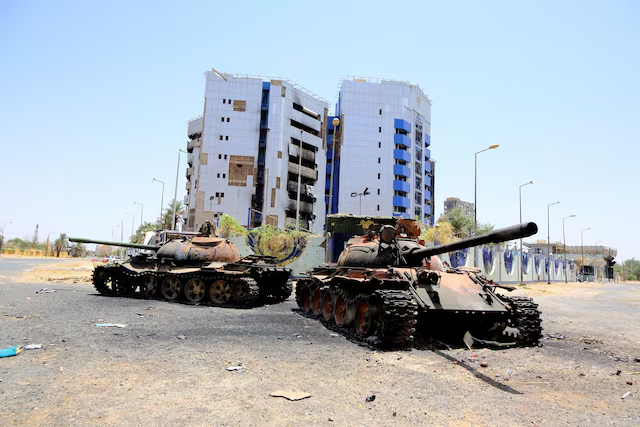
Beyond the truce and withdrawal terms, the U.S. proposal calls for merging Sudan’s fighting forces into a single national army, paired with a formal disarmament, demobilization and reintegration process for former combatants. It also lays out a civilian-led political transition that would exclude both the Muslim Brotherhood and militia groups accused of committing atrocities during the war.
The diplomatic picture around the proposal has been muddled. U.S. Senior Adviser for Arab and African Affairs Massad Boulos initially told the UN Security Council that Sudan had rejected the plan. Days later, Boulos posted on social media that he was pleased to learn Sudanese army chief General Abdel Fattah al-Burhan had, in his words, “apparently accepted — rather than rejected” the proposal. The shift left the actual state of negotiations unclear even as both sides continued discussing terms.
A senior RSF official told Reuters the paramilitary group had received the proposal, welcomed it and submitted a written response, though the official did not disclose what that response contained. The RSF has a history of publicly welcoming peace offers while continuing military operations on the ground, a pattern that has fed skepticism about how seriously either side is committed to a full stop in fighting.
Fighting continues in Kordofan
Even as the diplomatic exchanges play out, the RSF is running a drone-driven offensive in the Kordofan region, the area separating Darfur from the eastern half of Sudan that remains under army control. The continued military pressure there complicates any near-term truce, since the region sits at the boundary between territory each side is fighting to hold or retake.
The RSF’s position in Darfur has grown more entrenched since it captured al-Fashir. UN experts have accused the group of committing genocide in the region, an area roughly the size of France where the RSF now exercises control and has begun setting up its own parallel governing structures separate from the internationally recognized government in Port Sudan. The RSF denies deliberately targeting civilians.
A war rooted in a failed integration plan
The conflict began in April 2023 after negotiations broke down between the army and the RSF over how to merge the paramilitary force into the national military as part of a planned transition to civilian democratic rule. What started as a power struggle between Burhan and RSF commander Mohamed Hamdan Dagalo, known widely as Hemedti, escalated into a nationwide war that has since drawn in various militias and regional actors.
The war has produced one of the world’s largest displacement crises, pushing millions of Sudanese from their homes, both within the country and across borders into neighboring states such as Chad, Egypt and South Sudan. Estimates of the death toll vary widely depending on the source, with figures reaching into the hundreds of thousands when accounting for deaths from violence, disease and starvation tied to the collapse of health and food systems in affected regions.
Washington has led multiple prior mediation efforts aimed at ending the fighting, including earlier rounds of talks that produced short-lived truces before collapsing amid renewed offensives from one side or the other. The repeated failure of these efforts has left both Sudanese civilians and international observers wary of how durable any new agreement might prove, particularly given that the core disagreement over troop withdrawals from occupied territory remains as unresolved now as it was earlier in the conflict.
Whether the latest proposal fares differently may hinge on details neither side has made public: how the UN would enforce phased or full RSF withdrawals from cities like al-Fashir, and what guarantees either side would accept that the other will not use a truce period to regroup and resume fighting once the 90 days expire. For now, both the army and the RSF have signaled openness to negotiation while continuing to jockey for position on the ground, a dynamic that has defined much of the war’s diplomatic history since it began three years ago.