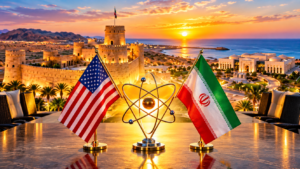
Few bilateral relationships have shifted as dramatically as the one between Iran and the United States. Iran US relations history helps explain why the two countries have spent more than four decades as adversaries after once being close allies. From early diplomatic ties in the 19th century to a CIA-backed coup, a revolution, a hostage crisis, and a fractured nuclear agreement, this timeline traces the key events that continue to shape Iran-US relations today. For a broader overview of the topic, see this guide to Iran-US relations. Iran US Relations History: The Early Years Formal diplomatic contact between the United States and Iran, then known internationally as Persia, dates back to the late 19th century. The two countries signed a Treaty of Amity in 1856, and the United States opened a legation in Tehran in 1883. For decades, the relationship was distant but generally cordial, since the US had no colonial history in the region, unlike Britain and Russia, which competed for influence over Persian oil, trade routes, and territory. In the early 20th century, American advisers occasionally assisted Iran with financial and administrative reforms. Iran’s official name changed from Persia to Iran in 1935. Relations remained modest until the mid-20th century, when oil, Cold War politics, and rising nationalism transformed the relationship into one of far greater strategic importance. The 1953 Iranian Coup and Its Impact One of the most consequential episodes in the history of US-Iran relations occurred in 1953. Prime Minister Mohammad Mossadegh, who had nationalized Iran’s British-controlled oil industry in 1951, became a target of British and American intelligence services. Britain, which had lost access to Iranian oil revenue, lobbied Washington to help remove him, framing the dispute partly in Cold War terms as a way to prevent Soviet influence in Iran. Declassified cables and reports on the operation are now available through the U.S. State Department’s Office of the Historian. In August 1953, a covert operation coordinated by the American CIA and British intelligence contributed to Mossadegh’s overthrow. Shah Mohammad Reza Pahlavi, who had briefly fled the country, returned and consolidated power with US and British support. The 1953 coup became a defining grievance for many Iranians. It is frequently cited as a key reason for the deep distrust of the United States that later fueled the 1979 revolution, and it remains a central reference point in Iran US relations history. US-Iran Relations Under the Shah Following the coup, the United States and Iran developed a close strategic partnership that lasted more than two decades. The Shah positioned Iran as a reliable Western ally in the Middle East during the Cold War, and Washington in turn supported his government politically, economically, and militarily. Key features of this period included: Military cooperation: Iran purchased large quantities of American weapons and received US military training and advisers. Economic ties: American companies invested in Iran’s oil sector and broader economy, and Iran used oil revenue to fund rapid modernization programs. Political support: US administrations largely overlooked human rights concerns tied to the Shah’s secret police, SAVAK, in exchange for Iran’s role as a regional counterweight to Soviet influence. This close alignment made Iran one of the closest US allies in the Middle East by the 1970s, but it also deepened resentment among Iranians who viewed the Shah’s government as beholden to Washington. The 1979 Iranian Revolution By the late 1970s, opposition to the Shah’s rule had grown across multiple segments of Iranian society, including religious leaders, students, and secular nationalists, who objected to political repression, economic inequality, and perceived foreign interference. Mass protests intensified through 1978, and the Shah left Iran in January 1979. Ayatollah Ruhollah Khomeini, a Shia religious leader who had spent years in exile, returned to Iran in February 1979 and became the leading figure of the revolution. An Islamic Republic was declared soon after, replacing the monarchy with a system based on religious governance. The revolution fundamentally altered Iran-US relations. The new Iranian leadership viewed the United States as having propped up the Shah and interfered in Iran’s internal affairs, particularly by referencing the events of 1953. Anti-American sentiment became a defining feature of the new government’s rhetoric and policy. The Iran Hostage Crisis Tensions escalated sharply in November 1979, when Iranian students supportive of the revolution seized the US Embassy in Tehran, taking American diplomats and staff hostage. The immediate trigger was the Carter administration’s decision to allow the exiled Shah into the United States for medical treatment. The Iran hostage crisis lasted 444 days, from November 4, 1979, until January 20, 1981. During this period: The United States imposed economic sanctions and froze Iranian assets. Diplomatic efforts to negotiate a release repeatedly stalled. In April 1980, a US military rescue mission, Operation Eagle Claw, failed after equipment malfunctions and a fatal collision in the Iranian desert, resulting in the deaths of eight American service members. The hostages were finally released on January 20, 1981, minutes after Ronald Reagan was inaugurated as president, following negotiations mediated by Algeria. The crisis had a lasting effect on American public opinion toward Iran and cemented a period of open hostility between the two governments. Iran-US Relations After 1980 The United States formally severed diplomatic relations with Iran in April 1980, and no formal diplomatic ties have been restored since. Switzerland has represented US interests in Iran, while Pakistan has represented Iranian interests in Washington. During the 1980s, tensions were compounded by the Iran-Iraq War (1980–1988), in which the United States provided intelligence and other support to Iraq for parts of the conflict, while separately becoming entangled in the Iran-Contra affair, a covert and controversial arms-for-hostages arrangement involving Iran. Throughout the 1990s, Washington maintained sanctions on Iran and classified it as a state sponsor of terrorism, a designation that remains in place. Iran’s Nuclear Program and US-Iran Negotiations Concerns over Iran’s nuclear program became a central issue in US-Iran relations starting in the early 2000s, after previously undisclosed nuclear facilities were revealed. The United States and other countries, including the UK, France, Germany, Russia, and China, grew concerned that Iran might be pursuing nuclear weapons capability, despite Iran’s insistence that its program was for peaceful energy purposes. Throughout the 2000s and early 2010s, the United Nations Security Council and Western governments imposed escalating sanctions targeting Iran’s oil exports, banking sector, and nuclear-related activities. Multiple rounds of negotiations, often called the P5+1 talks, sought a diplomatic resolution. The 2015 Iran Nuclear Deal These negotiations culminated in July 2015 with the Joint Comprehensive Plan of Action (JCPOA), commonly known as the Iran nuclear deal. Under the agreement, Iran agreed to significant limits on its nuclear activities, including uranium enrichment levels and stockpiles, in exchange for relief from many international sanctions. The JCPOA was negotiated between Iran and the P5+1 group: the United States, United Kingdom, France, Germany, Russia, and China, along with the European Union. It was widely regarded as a major milestone in Iran nuclear deal history and a rare example of sustained diplomatic engagement between Tehran and Washington since 1979. US Withdrawal From the JCPOA The agreement’s stability did not last. In May 2018, President Donald Trump announced that the United States would withdraw from the JCPOA, arguing that it failed to adequately address Iran’s missile program and regional activities. Washington reimposed sweeping sanctions under a policy known as “maximum pressure.” Iran initially continued complying with parts of the agreement but gradually reduced its commitments in response, including increasing uranium enrichment beyond the deal’s limits. The withdrawal deepened mistrust and set off years of renewed economic and diplomatic strain. Iran-US Relations in Recent Years Since 2021, diplomatic efforts to revive some version of the nuclear agreement have continued intermittently without a lasting breakthrough. Indirect US-Iran talks, often mediated by Oman, resumed in 2025 under the Trump administration, focused on limiting Iran’s nuclear program and missile capabilities. These negotiations were disrupted in mid-2025 after Israeli strikes on Iranian nuclear and military sites led to a broader Iran-Israel conflict, which halted talks entirely. Diplomatic pressure continued through the year: in August 2025, European powers warned Iran that they would trigger the JCPOA’s “snapback” mechanism, and by late September 2025, United Nations sanctions on Iran were formally reimposed after Security Council efforts to delay the move failed. Tensions escalated further in early 2026, when the United States and Israel launched military strikes against targets inside Iran in late February 2026, following the collapse of extended negotiations. Despite the strikes, the two countries did not enter a formal state of war. Diplomacy resumed afterward, with Iranian and American negotiators meeting for renewed nuclear talks in Geneva. By June 2026, the US and Iran had reached a memorandum of understanding committing both sides to negotiate a broader agreement covering the nuclear program and sanctions within a set timeframe. As of mid-2026, a comprehensive, lasting settlement between Washington and Tehran had not yet been finalized, and the relationship remains defined by cycles of negotiation, sanctions, and periodic military confrontation. Key Timeline: Iran US Relations History at a Glance Date Event 1856 Treaty of Amity establishes early US-Persia relations 1953 CIA- and British-backed coup removes Prime Minister Mossadegh 1953–1979 Close US-Iran alliance under Shah Mohammad Reza Pahlavi 1979 Iranian Revolution establishes the Islamic Republic under Ayatollah Khomeini 1979–1981 US Embassy hostage crisis (444 days) 1980 United States and Iran formally break diplomatic relations 1980–1988 Iran-Iraq War strains relations further 2000s–2010s International concern grows over Iran’s nuclear program; sanctions escalate 2015 JCPOA nuclear deal signed between Iran and world powers 2018 United States withdraws from the JCPOA; sanctions reinstated 2025 Renewed US-Iran talks collapse amid Iran-Israel conflict; UN sanctions reimposed 2026 US-Israel strikes on Iran, followed by renewed talks and a June 2026 US-Iran memorandum of understanding