

A dramatic explosion involving a Blue Origin New Glenn rocket at a Florida launch facility has delivered a major setback to the space company founded by Jeff Bezos, intensifying pressure on the firm as it races to compete with SpaceX in the increasingly crowded commercial space industry.
The uncrewed rocket erupted into flames late Thursday during a hot-fire test at Cape Canaveral, sending a massive fireball and thick smoke into the night sky. The incident occurred while Blue Origin was preparing the heavy-lift vehicle for its fourth mission, which was expected to deploy dozens of satellites into low-Earth orbit.
The explosion represents another challenge for a program that has already faced years of delays, technical hurdles, and mounting competition from Elon Musk’s rapidly advancing space enterprise.
Massive Fireball Erupts During Engine Test
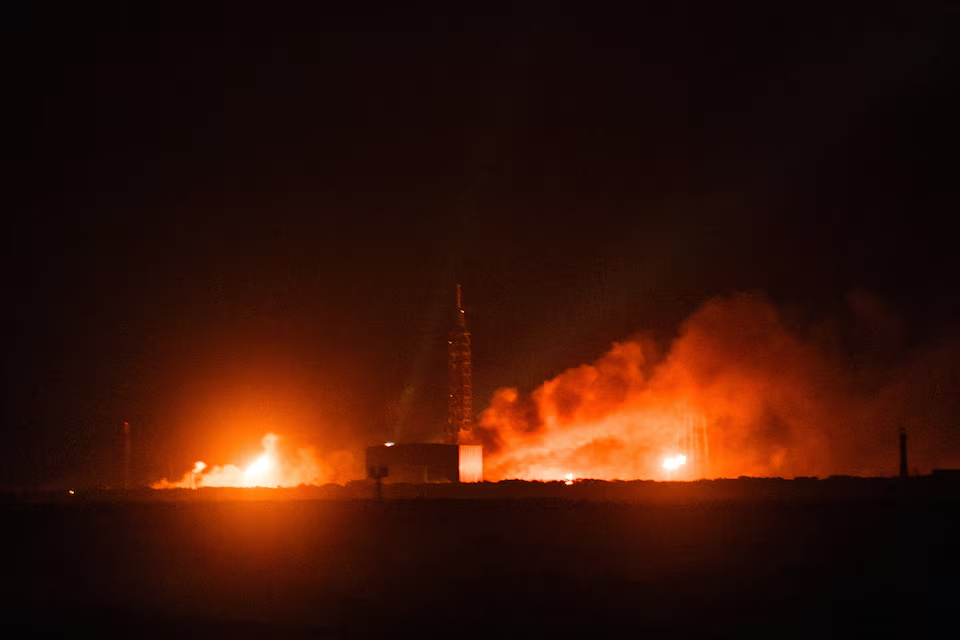
Footage captured by spaceflight observers showed the towering New Glenn rocket igniting on the launchpad shortly after 9 p.m. local time before a sudden explosion engulfed the vehicle.
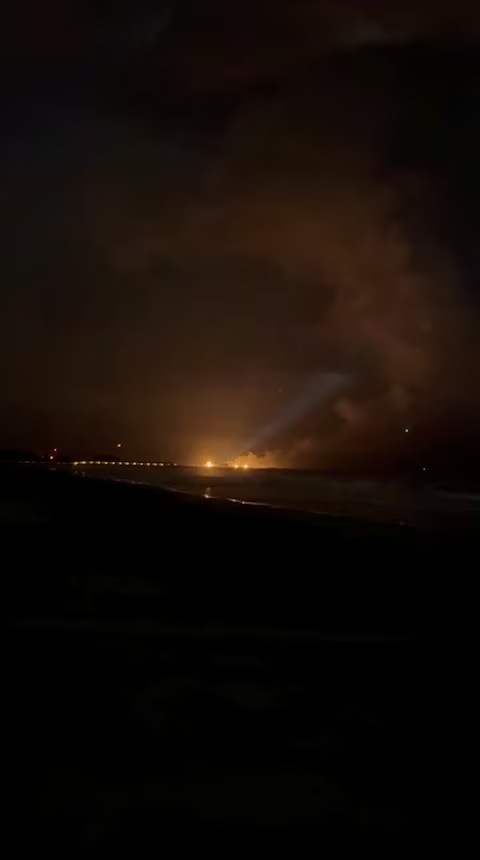
Flames shot hundreds of feet into the air as emergency crews rushed to contain the blaze at the launch complex in Florida. Thick plumes of smoke lingered above the site for hours following the incident.
Blue Origin later confirmed that the rocket experienced what it described as an “anomaly” during a hot-fire test — a critical procedure in which engines are fired while the rocket remains secured to the ground.
Such tests are designed to verify propulsion systems and identify technical problems before launch, but they also carry significant risks because of the enormous quantities of fuel and pressure involved.
Fortunately, no injuries were immediately reported, and officials said no payload had been attached to the rocket at the time of the explosion.
Satellite Mission Delayed
The New Glenn mission had been scheduled to carry 48 satellites for Amazon’s Project Kuiper broadband network, a major initiative intended to compete directly with SpaceX’s Starlink satellite internet constellation.
According to sources familiar with the launch preparations, the satellites had not yet been integrated onto the rocket when the accident occurred, likely preventing an even more costly setback.
Project Kuiper is considered one of Amazon’s most ambitious technology ventures. The company aims to build a global satellite-based internet service capable of providing high-speed connectivity to underserved regions around the world.
Delays to New Glenn could therefore have wider implications not only for Blue Origin’s launch business but also for Amazon’s long-term space communications strategy.
A Critical Program Under Pressure
New Glenn has become central to Blue Origin’s future ambitions. Standing roughly 29 stories tall, the reusable rocket was designed to compete with SpaceX’s Falcon Heavy and eventually support lunar and deep-space missions.
The rocket has been in development for nearly a decade and has reportedly cost billions of dollars. Repeated schedule changes and technical setbacks, however, have slowed progress considerably.
The latest explosion comes at a particularly sensitive moment for the company.
Just days earlier, NASA awarded Blue Origin a contract worth $188 million tied to future lunar rover missions as part of the Artemis moon exploration program.
The company is also deeply involved in efforts to develop lunar landers that could eventually transport astronauts back to the moon later this decade.
Bezos Responds as Investigation Begins
Following the incident, Bezos acknowledged the seriousness of the setback but sought to reassure supporters that the company would continue moving forward.
In a statement posted on social media, the billionaire entrepreneur said Blue Origin would rebuild and investigate the failure thoroughly before returning to flight operations.
Industry analysts noted that rocket development has historically involved repeated failures, particularly during testing phases for next-generation launch systems.
Still, the incident is expected to intensify scrutiny over Blue Origin’s pace of progress compared with SpaceX, which has established itself as the dominant force in commercial launches.
NASA Monitoring Potential Impact
NASA Administrator Jared Isaacman said the agency would work closely with Blue Origin during the investigation into the cause of the explosion.
He emphasized that developing heavy-lift launch systems remains one of the most technically demanding tasks in aerospace engineering.
NASA is also expected to assess whether the incident could affect schedules tied to its Artemis lunar exploration initiative and future Moon Base concepts.
The U.S. space agency has increasingly relied on partnerships with private companies to advance its lunar and deep-space ambitions, making the health of commercial launch providers strategically important.
Intensifying Competition With SpaceX
The explosion further highlights the widening gap between Blue Origin and SpaceX, led by Elon Musk.
While Blue Origin continues to work toward operational heavy-lift capability, SpaceX has already conducted multiple integrated tests of its next-generation Starship system.
Although SpaceX has also experienced high-profile failures — including dramatic test explosions in Texas — the company has moved at a much faster development pace and now dominates the global launch market.
Last week, SpaceX completed another Starship test mission that successfully deployed mock satellites and achieved a controlled ocean splashdown, even though some landing objectives were not fully met.
Musk reacted briefly to the Blue Origin explosion online, commenting that rocket development is inherently difficult.
Why Rocket Testing Frequently Ends in Failure
Aerospace experts say explosions during rocket testing, while spectacular, are not uncommon in the development of advanced launch systems.
Modern rockets contain highly volatile propellants and operate under extreme thermal and mechanical stress. Even minor faults in fuel lines, valves, software systems, or engine timing can trigger catastrophic failures.
Hot-fire tests are especially dangerous because they place engines under near-launch conditions while the vehicle remains fixed in place, concentrating immense force onto the launch structure.
Companies often use these tests specifically to uncover hidden weaknesses before actual missions take place.
What Comes Next for Blue Origin?
The immediate priority for Blue Origin will be determining the exact cause of the explosion.
Investigators are expected to examine engine systems, fuel handling operations, telemetry data, and structural components to establish what went wrong.
The company will likely face delays to upcoming launches while repairs and safety reviews are completed.
Despite the setback, analysts believe Blue Origin remains a major long-term player in the global space industry because of its financial backing, government partnerships, and growing role in national space infrastructure.
However, the incident underscores how difficult it remains to challenge SpaceX’s lead in an industry where speed, reliability, and innovation often determine survival.
For now, the fiery destruction of New Glenn serves as a reminder that the modern space race — even among the world’s wealthiest companies — remains unforgiving.