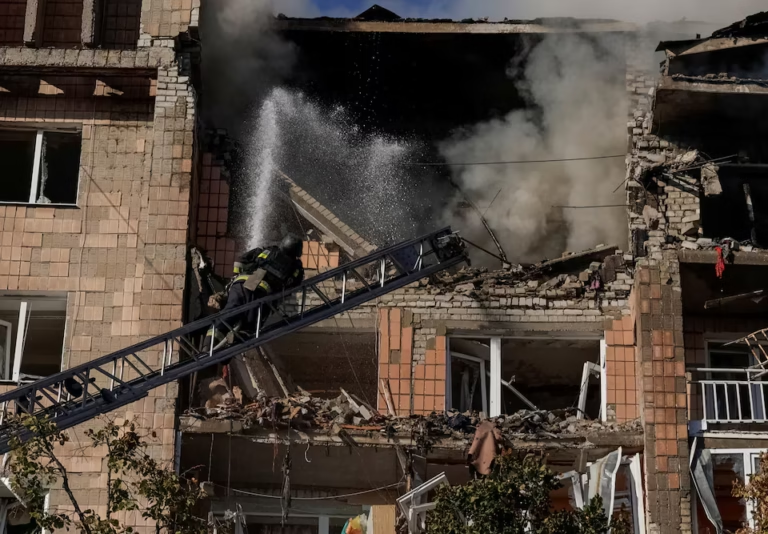

Fighting flared again across the Gulf this week, marking the sharpest exchange between the United States and Iran since the two countries signed an interim agreement in June.
US Central Command said Tuesday it launched strikes in response to attacks on three oil tankers in the Strait of Hormuz, hitting more than 80 targets that included air defense systems, coastal radar installations and fast boats. Iran said Wednesday it had struck back at US military sites in Bahrain and Kuwait.
Oil markets reacted immediately. Brent crude rose more than 3% to $76 a barrel ($56.88) following the strikes.
NATO Secretary General Mark Rutte defended the American response while speaking at the alliance’s summit in Ankara, Turkey. “I think it was absolutely necessary,” Rutte said, arguing Iran was “basically violating the ceasefire” given what “happened yesterday with ships being attacked.” He added, “I think it is totally crucial that the US forcefully [reacts].”
Washington also revoked its temporary suspension of sanctions on Iranian oil sales. Iran’s parliamentary speaker, Mohammad Bagher Ghalibaf, accused the US of breaching their memorandum of understanding through this move and others, including strikes in southern Iran and what he called violations of “Iranian adjustments in the Strait.” He said, “The era of bullying and extortion is over. It leads nowhere. We don’t fold.”
Iranian state media reported the US strikes hit Qeshm island, Bandar Abbas and Sirik, with residents injured by shrapnel. The Islamic Revolutionary Guard Corps said missiles and drones targeted 85 US military facilities across Bahrain and Kuwait, including a Navy headquarters and an air base. Iran’s state news agency IRNA reported the first confirmed casualty: “Guardsman Mohammadreza Khazini was killed while confronting enemy drones after being struck by shrapnel from a projectile.”
Kuwait condemned the Iranian strikes on its territory, calling them “repeated attacks.”
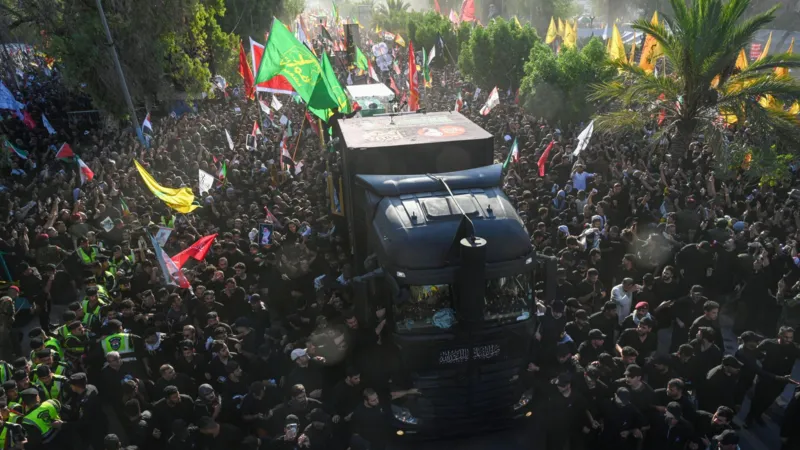
The renewed violence has interrupted funeral proceedings for the late Ayatollah Ali Khamenei, who was killed on the first day of joint US-Israeli strikes on Iran. Ceremonies continued in Iraq on Wednesday, with final rites and burial scheduled for Mashhad in northeastern Iran on Thursday. Talks toward a permanent deal remain paused, and officials have not said when negotiations might resume.
Earlier Tuesday, Iran’s deputy foreign minister called the US strikes a violation of the memorandum signed last month and warned Tehran would “take decisive measures” in response. The US had already signaled consequences for what it described as “wholly unacceptable” attacks on the three tankers.
Centcom said its strikes also hit 60 small boats along with Iranian missile launch sites and command centers, though it did not disclose target locations. The command said the operation aimed “to impose heavy costs for targeting and attacking commercial shipping crewed by innocent individuals in an international waterway.”
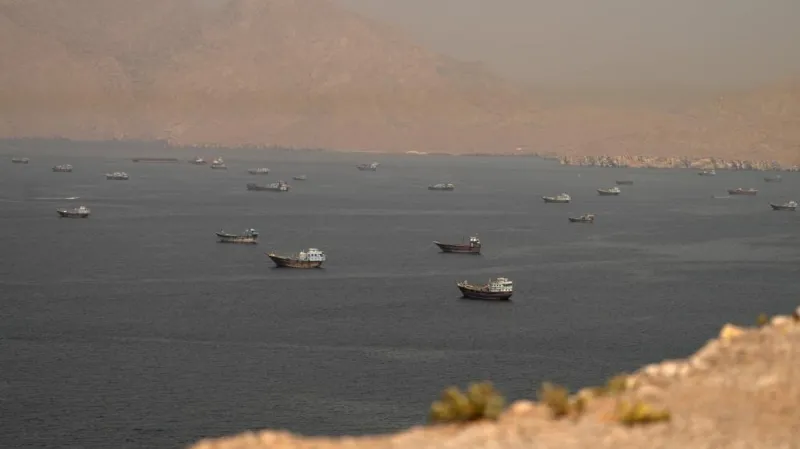
Before the strikes began, the US Treasury revoked a waiver that had temporarily lifted oil sanctions on Iran, a waiver that had formed part of the memorandum Washington and Tehran signed last month. Iran’s foreign ministry called the move a breach of that agreement and said it demonstrated the “bad faith, inconsistency, and unreliability” of the US government. The ministry said Tehran “will take whatever measures it considers necessary to safeguard its national interests and national security.”
Qatar and Saudi Arabia both condemned the tanker attacks, each reporting that a vessel flagged to its country had been struck while transiting in or near the strait. Both governments blamed Iran directly.
Qatar’s foreign ministry spokesperson, Majed Al Ansari, said his government held Iran “fully responsible” for what he described as a targeted attack on a vessel called Al-Rekayyat. Saudi Arabia’s foreign ministry said in a social media post that Iran had targeted the Saudi tanker Wadyan as it crossed the strait.
Iran’s foreign ministry spokesman, Esmail Baghaei, rejected Qatar’s accusation, calling it “contrary to the principle of good neighbourliness.” He said commercial vessels traveling routes not coordinated with Iran, or tampering with their tracking systems, risk collision and interfere with Iran’s efforts to “facilitate safe transit” through the strait.
The UK Maritime Trade Operations agency reported that a tanker passing through the strait caught fire Monday after an unidentified projectile struck its engine room. Two more incidents followed Tuesday: one tanker reported being hit as it exited the strait but was able to continue to its next port, while another sustained minor structural damage after being struck, the agency said.
Speaking on condition of anonymity before Centcom announced the new strikes, a US official said negotiators would continue working in “good faith” toward a final agreement with Iran.
That effort had gained ground last month, when the US and Iran agreed to a 14-point memorandum aimed at extending the ceasefire and ending conflict “on all fronts.” Under the agreement, Iran and Oman, both of which border the strait, are required to hold talks to determine “the future administration and maritime services” in the waterway alongside other Gulf states.
During the earlier conflict, Iran moved to assert control over the strait by creating the “Persian Gulf Strait Authority,” which it said would issue “safe passage permits” to vessels transiting the waterway. Iran’s Fars news agency has reported that under the new arrangement with the US, the strait would ultimately fall under Iranian management in coordination with Oman, potentially including “service fees” charged to ships passing through.