
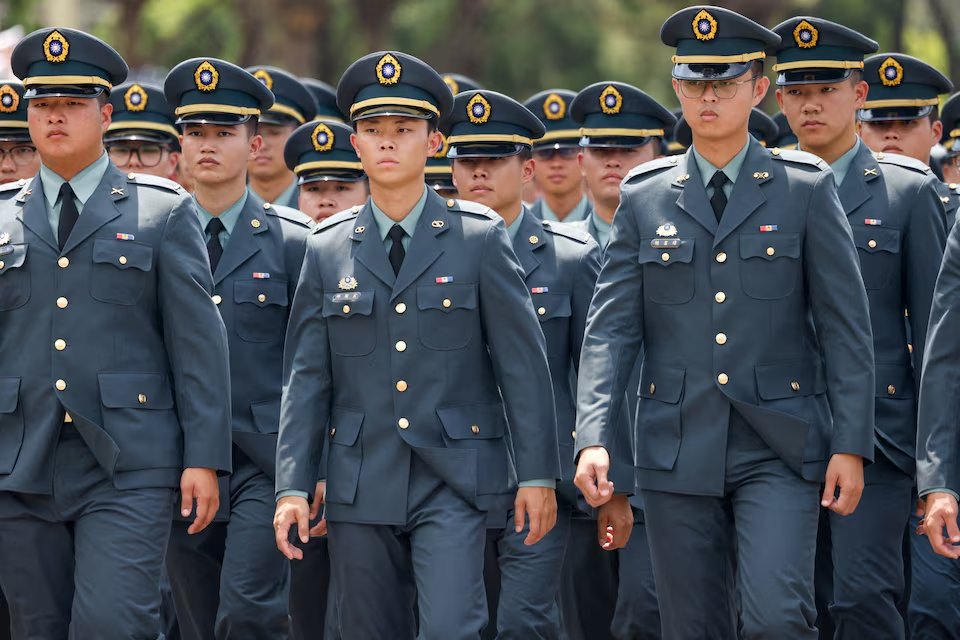
Taiwan’s military has restarted “anti-communist” patriotic classes for its graduates after a 25-year break, the defense ministry said Sunday, pointing to a growing threat from China as a senior official reported another jump in Chinese naval activity near the island.
a return to cold war language
During the Cold War, Taiwan ran widespread campaigns warning against the dangers of “communist bandits” in China, whose government claims the island as its own territory. Those campaigns shaped decades of military and civilian education on the island, framing the Chinese Communist Party as an existential threat to Taiwan’s survival as a self-governing democracy. The formal “anti-communist patriotic education” program for military graduates ended in 2002 and was replaced with a version simply called “patriotic education,” a shift that came as cross-strait relations briefly warmed and direct confrontation seemed less likely.
Taiwan’s defense ministry said in a statement that it had restored the classes because of rising military and infiltration threats from China. The decision marks a return to more explicit ideological language after two decades in which official rhetoric had generally avoided direct references to communism, even as tensions between Taipei and Beijing worsened.
“It is necessary for them to clearly understand national security threats and recognize the military mission of ‘why we fight, and for whom we fight,'” the statement said.
China’s defense ministry did not respond to a request for comment outside office hours. China has never ruled out using force to bring Taiwan under its control, a position it has held since the Chinese civil war ended in 1949, when the defeated Republic of China government retreated to the island. Beijing considers Taiwan a breakaway province and has repeatedly said unification, by force if necessary, remains a long-term goal.
Officials from several government bodies will lecture the graduates, including the Mainland Affairs Council, which sets China policy, the National Security Council, the Ministry of Justice and the government think tank Academia Sinica, according to the defense ministry. Bringing in officials from across these agencies suggests the program is meant to cover legal, intelligence and policy dimensions of the China threat, not just military strategy.
“The aim is to establish among graduates a clear awareness of friend and foe,” the ministry said.
a record number of chinese ships near taiwan
China’s military operates near Taiwan almost every day, a pattern that has become routine enough that Taiwan’s defense ministry now issues near-daily tallies of Chinese aircraft and ships detected around the island. As of Friday, Taiwan was tracking more than 110 Chinese military and coast guard ships along the first island chain, a record number, according to a post late Saturday by Joseph Wu, secretary-general of Taiwan’s National Security Council.
“China’s massive maritime mobilization along the 1st Island Chain is a clear sign of its expansionism,” Wu wrote, referring to the chain of territory running from Japan through Taiwan, the Philippines and Borneo. The first island chain has long been treated by military planners in the region as a strategic boundary, one that Chinese naval expansion has increasingly tested in recent years through larger and more frequent deployments.
On Saturday, China’s coast guard launched a new patrol off Taiwan’s east coast, drawing a sharp response from Taipei. Taiwan’s government says Beijing has no jurisdiction in those waters and rejects China’s broader sovereignty claims over the island. Coast guard patrols close to Taiwan’s coastline have become a recurring flashpoint in recent years, with Beijing using them to assert administrative claims over waters Taipei considers part of its own territorial jurisdiction.
decades of tension shape taiwan’s military training
The revival of the anti-communist curriculum comes against a backdrop of steadily increasing military pressure on Taiwan, including large-scale exercises, near-daily incursions into Taiwan’s air defense identification zone and a buildup of Chinese naval capacity in the region. Taiwanese officials have repeatedly warned that the risk of conflict has grown as Beijing continues to expand its military reach, even as both sides avoid direct armed confrontation.
Taiwan holds presidential and legislative elections independently of Beijing, maintains its own military, currency and government, and has never been governed by the Chinese Communist Party. The self-governing island’s political status remains one of the most sensitive issues in the region, with the United States maintaining informal ties with Taipei while officially recognizing Beijing, a policy of strategic ambiguity that has underpinned cross-strait stability for decades.
For Taiwan’s military academy graduates now returning to a curriculum shelved a quarter-century ago, the shift reflects how far cross-strait relations have moved from the brief thaw that led to the program’s suspension in 2002, and how central the China threat has again become to the island’s approach to training its next generation of officers.