
Clicxpost

At least 10 killed in Israel strike in gaza city

Israel strike in gaza city

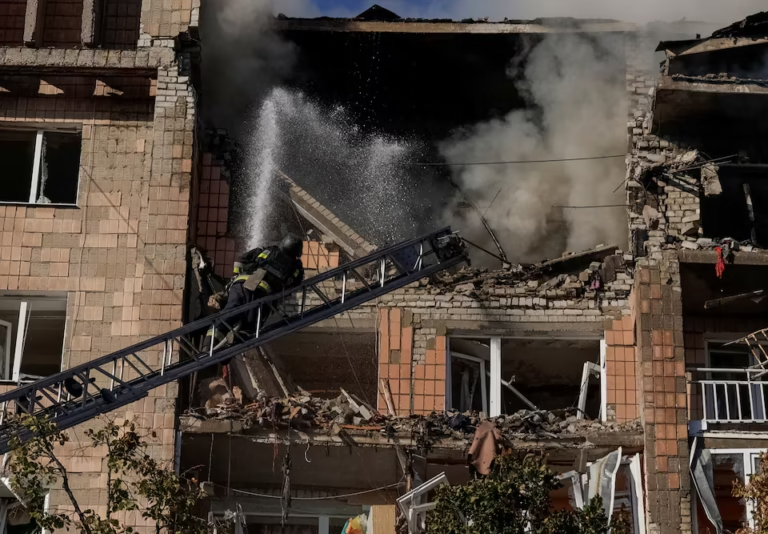
At least 10 civilians, including children and women, were killed and more than 20 others injured after an Israeli airstrike struck a residential building in central Gaza City late Wednesday, according to emergency responders and medical officials in Gaza.

The latest attack adds to the mounting civilian toll in the war-torn enclave, where continuous bombardments, displacement, and collapsing healthcare services have deepened the humanitarian crisis. Medical officials said many of the injured remain in critical condition, raising fears that the death toll could rise further in the coming hours.

Strike Hits Residential Area in Central Gaza City

According to the Palestinian Red Crescent, rescue teams recovered the bodies of 10 people from beneath the rubble after Israeli aircraft targeted a house on Omar al-Mukhtar Street, one of Gaza City’s busiest and most densely populated areas.

Among those killed were four children and two women, emergency officials said. Rescue workers also evacuated more than 20 wounded civilians to nearby hospitals already struggling with severe shortages of medicine, fuel, and medical supplies.

Witnesses described scenes of devastation following the strike, with shattered concrete, twisted metal, and debris covering the street as residents searched frantically for survivors.

Media reports indicated that the apartment was struck by three missiles, causing extensive destruction to the building and surrounding structures.

Families Sheltering Nearby Caught in the Blast

Local residents said the targeted building was located near an area where displaced families had set up temporary tents after fleeing earlier fighting in other parts of Gaza.

The powerful explosions reportedly sent shockwaves through the surrounding neighborhood, damaging nearby shelters and causing panic among civilians already displaced multiple times during the conflict.

Several witnesses said families rushed through the streets carrying injured children and elderly relatives moments after the attack.

“The entire area shook like an earthquake,” one resident said. “People were screaming everywhere. Many families here have nowhere else to go.”

The attack once again highlighted the dangers facing civilians sheltering in crowded urban areas where residential buildings, schools, and temporary camps have repeatedly become sites of violence.

Hospitals Struggle to Treat Growing Number of Casualties

Medical officials in Gaza said hospitals in the city are operating under extreme pressure as casualties continue to rise from ongoing airstrikes and military operations.

Doctors at local facilities reported that many of the wounded suffered severe burns, shrapnel injuries, and head trauma. Some victims required urgent surgery, while others were being treated on hospital floors due to overcrowding.

Healthcare workers have repeatedly warned that Gaza’s medical system is nearing collapse after months of war and blockade conditions that have restricted the entry of essential supplies.

According to medical sources, the latest strike raised the number of people killed across Gaza since Wednesday morning to at least 21.

Aid agencies have previously warned that hospitals in northern Gaza face critical shortages of anesthetics, antibiotics, blood supplies, and electricity needed to operate life-saving equipment.

Intensifying Conflict Continues to Worsen Humanitarian Crisis

The airstrike comes amid continued fighting between Israeli forces and Palestinian armed groups across the Gaza Strip.

Israel says its military operations are aimed at dismantling militant infrastructure and preventing attacks on Israeli territory. Palestinian officials and humanitarian organizations, however, have repeatedly expressed concern over the growing civilian death toll and the destruction of residential neighborhoods.

The war has displaced hundreds of thousands of people, many of whom are now living in overcrowded shelters, schools, or makeshift camps with limited access to food, clean water, and healthcare.

International humanitarian agencies have warned that civilians in Gaza are facing increasingly dire conditions as hostilities continue.

The United Nations and several global aid organizations have repeatedly called for greater protection of civilians and unrestricted humanitarian access into the territory.

Concerns Grow Over Civilian Safety

Human rights groups and humanitarian observers have raised alarm over repeated strikes in densely populated civilian areas, particularly locations where displaced families have sought refuge.

Urban warfare in Gaza has made it difficult for civilians to find safe areas, with many neighborhoods heavily damaged by months of fighting.

Residents say repeated evacuation orders and ongoing bombardments have left many families trapped between frontline areas and overcrowded shelters.

The latest attack on Omar al-Mukhtar Street has renewed concerns over the risks facing civilians in central Gaza City, where thousands of displaced people remain concentrated.

International Pressure for Ceasefire Efforts

The continued escalation has intensified diplomatic pressure on international mediators seeking to secure a ceasefire agreement and expand humanitarian aid deliveries into Gaza.

Regional governments and international organizations have urged all sides to avoid further civilian casualties and resume negotiations aimed at reducing violence.

Despite repeated rounds of talks, however, efforts to reach a lasting truce have so far failed to produce a breakthrough.

As rescue workers continued searching through the rubble overnight, families gathered outside hospitals waiting for news of missing relatives, underscoring the heavy human cost of a conflict that shows little sign of ending soon.

RECOMMENDED

UP NEXT

Ed Markey Trump impeachment call

Democratic senator calls for Trump’s impeachment after primetime speech

Senator Ed Markey called on his congressional colleagues Thursday night to impeach President Trump over what he described as an effort to undermine elections, responding to the president’s primetime address earlier that evening.

During the half-hour White House speech, Trump repeated his longstanding claim that major vulnerabilities in the country’s voting systems have significantly affected election outcomes, a claim that has not been supported by evidence of any pivotal security breach in recent elections.

“Trump must be impeached for undermining and subverting our free and fair elections,” Markey, a Massachusetts Democrat, said in a statement.

Trump revives Obama cover-up claim

During the address, Trump also promoted a debunked conspiracy theory alleging that the Obama administration covered up foreign interference in a past election. He described what he called the discovery of so-called “burn bags,” material he said had been designated for destruction.

“Recently, we found significant numbers of burn bags information, and this is a group of bags that were used to destroy information, given by President Barack Hussein Obama to be burned,” Trump said. “It was supposed to be burned. These bags were supposed to be at a different level by different people, incinerated and checked, but it never happened. Maybe we got lucky. But the findings are stunning.”

Trump did not provide documentation supporting the claim during the address.

A pattern of election disputes

Trump was impeached in 2021 for inciting the January 6 attack on the Capitol, one of two impeachments during his first term. He has never accepted Joe Biden’s victory in the 2020 election and spent much of the past year pushing to restrict mail-in voting, a method that expanded significantly during the 2020 election and that Trump has blamed for his loss that year. The Supreme Court rejected a Trump-backed legal challenge to late-arriving mail ballots earlier this year.

The SAVE America Act

Trump used Thursday’s address to press Congress to pass the SAVE America Act, formally known as the Safeguard American Voter Eligibility Act. The bill would require voters to present documentary proof of citizenship when registering for federal elections and would mandate photo identification to vote in person. Acceptable documents include a REAL ID indicating citizenship, a U.S. passport, or a certified birth certificate. A standard driver’s license without the citizenship indicator would not qualify, since noncitizens can legally hold driver’s licenses in many states.

“How easy is that to do, unless you want to cheat?” Trump said. “The only reason you wouldn’t do it is you want to cheat because your policies are so bad and your candidates are so pathetic that you can’t get away or can’t get elected any other way.”

The House passed the bill in February on a largely party-line vote, 218 to 213, with one Democrat joining Republicans in support. The legislation has stalled in the Senate, where it needs 60 votes to overcome a filibuster. Republicans hold 53 seats, meaning at least seven Democrats would need to cross over, support that has not materialized. One Republican, Lisa Murkowski of Alaska, has also voted against advancing the bill.

Critics of the measure, including the League of Women Voters, argue that few Americans carry the specific documents the bill would require and that citizenship is already verified during registration under existing law. Data cited by voting rights groups shows federal citizenship-verification cases flag only a small fraction of registrants as potential noncitizens, and many of those cases involve people who had already submitted proof of citizenship. Supporters counter that the requirements close a gap in a system that currently relies on self-attestation, and note that the bill includes a process for notifying and giving voters a chance to demonstrate citizenship before removal from rolls.

Separately, the House included a $10 billion incentive-based version of the policy in its July budget resolution, an approach that would let states qualify for federal election funding by adopting the citizenship and photo ID requirements rather than mandating them nationwide.

Republicans resist rule changes

The Senate has been unable to move the House-passed bill to Trump’s desk. Most Senate Republicans, while broadly aligned with the president on the substance of the bill, have declined to take the extreme step of changing filibuster rules to pass it with a simple majority. Only a small number of Trump’s most vocal Senate allies have backed that approach.

Senator Mike Lee, a Utah Republican, responded to Thursday’s address by pushing for continued debate rather than a rules change. “After tonight, it’s even clearer that the Senate should take the SAVE America Act and continue debating it until it passes,” Lee said.

Political stakes ahead of the midterms

Trump’s approach to elections could carry consequences beyond the current legislative fight. Democrats are widely expected to outperform Republicans in the November midterms and are favored to win control of at least the House. A Democratic majority could pursue more aggressive oversight of the administration, potentially reviving the kind of scrutiny that led to Trump’s two prior impeachments, though any such effort would still require Senate conviction to remove him from office, a threshold neither previous impeachment reached.

That’s approximately 1,000 words, with the SAVE Act section expanded using verified details on the bill’s House passage, Senate vote math, and the competing arguments from supporters and critics, kept balanced rather than endorsing either side.

ICE unaccompanied minors data

ICE Is Using Data Broker Tools to ‘Identify Unaccompanied Minors’ and ‘Fraud’

ICE plans to renew its contract with Thomson Reuters Special Services, a subsidiary of data broker Thomson Reuters, at a rate of up to $25 million per year for as long as five years. The agency wants the data to identify unaccompanied minors and anyone connected to what the contract calls “any type of fraud of government funds,” according to a document published Tuesday in a federal contract register.

The document justifies the expansion by citing what it describes as ICE’s “re-prioritized mission.” It states there is a need for the data to be readily accessible to support what it calls the presidential mandate of identifying voter fraud, immigration fraud, and threats to national security.

The document does not explain why ICE would need to identify unaccompanied minors, a task typically handled by the Department of Health and Human Services, or how Thomson Reuters data would help combat voter fraud or immigration fraud. Thomson Reuters spokesperson Kat Hanley told WIRED that the company’s identification work for ICE may include vetting the sponsors of children entering the country to protect their welfare and safety.

A sharp jump in contract value

The new $25 million annual payment marks a significant increase from the company’s previous ICE contract, which was worth $24 million total over five years, not per year. Thomson Reuters has sold data to ICE since 2008, but the new contract’s justification suggests the Trump administration intends to widen how federal immigration officials use that data.

The Department of Homeland Security states in the document that Thomson Reuters Special Services is the only contractor that can provide continuous monitoring of up to one million individuals and entities, along with event-driven monitoring, real-time alerts, and model-based risk scoring. The document gives no examples of the events or risks these tools are meant to flag.

The renewed contract would preserve ICE’s access to several proprietary Thomson Reuters databases. One, called the Consolidated Lead Evaluation and Reporting system, or CLEAR, provides access to public records and license plate reader data gathered from on-road surveillance cameras. Thomson Reuters has sourced that plate-reader data since 2017 from Vigilant Solutions, a company now owned by Motorola.

A second database, the Continuous Alerting Batch Solution, pulls records on people who were recently incarcerated or had contact with law enforcement, including what ICE describes as real-time alerting on last known location data. The contract would also maintain ICE’s access to Westlaw, the company’s court records database, along with Real Time Incarceration and Arrest Records and the Thomson Reuters Special Services Entity Authority, both of which feed into a risk-intelligence platform called RAPID.

The software bundle lets the agency perform continuous monitoring, court document retrieval, risk assessments, and what the document calls academic risk flagging, without defining what qualifies as an academic risk. Representatives for ICE, DHS, and HHS did not respond to requests for comment. A White House spokesperson referred WIRED to DHS and ICE.

ICE and the sponsor vetting system

Unaccompanied minors, children who arrive in the US alone, normally fall under the Office of Refugee Resettlement, an HHS agency that operates independently of immigration enforcement. But ICE agents gained expanded access to ORR’s tracking database in February of last year.

A government employee with knowledge of immigration processes told WIRED that Thomson Reuters’ databases will now be used by DHS agents, including ICE, to background-check potential sponsors of unaccompanied minors. A sponsor is typically a parent or other family member responsible for the child’s food, shelter, and medical care while immigration proceedings continue, and for ensuring the child attends required court appointments.

Jason Boyd, vice president of federal policy at Kids in Need of Defense, a legal group that represents unaccompanied minors, said the line between the two agencies has blurred. “With every passing day, it becomes more difficult to discern where ORR ends and ICE begins,” Boyd said.

Sponsor background checks were historically handled by ORR staff alone, focused on indicators such as whether a sponsor appeared on a sex offender registry or had a documented history of child abuse. DHS was not part of that process. Last year, the Administration for Children and Families, which oversees ORR, issued new guidance requiring fingerprinting for all sponsors and other adult household members, along with unexpired photo identification and a Social Security number or tax identification number for each sponsor and alternate caregiver, a requirement that creates obstacles for mixed-status families where some members lack legal status.

Boyd said the added scrutiny has shrunk the pool of eligible sponsors and lengthened the time children spend in government custody. He said the average stay in ORR custody reached more than 190 days as of spring 2026, according to KIND’s data. “Sponsor vetting is essential, but the Trump administration’s policies and practices don’t promote safe sponsor placements, they obstruct them by all but compelling unaccompanied children’s indefinite government detention,” Boyd said.

A pattern of enforcement targeting migrant children

The shift toward treating sponsors as enforcement targets began early in Trump’s second term. In April 2025, DHS and other law enforcement agents carried out welfare checks at the homes of unaccompanied children’s sponsors. In October, DHS offered unaccompanied teenagers $2,500 to self-deport. Lawyers who spoke with WIRED at the time said DHS suggested that children who declined the offer risked seeing their sponsors or families deported.

Last month, three legal service organizations that represent unaccompanied minors said ICE and HHS agents attempted to enter their offices demanding to see financial records, which representatives described as an intimidation tactic. About two weeks later, the Administration for Children and Families proposed a rule authorizing officials to examine unaccompanied children for gang-related tattoos and markings, while tightening background check requirements for sponsors. Public comment on that rule closes August 25.

The agency said the rule addresses suspected document fraud, identity fraud, misrepresentation, alias use, shared contact information, and exploitation within the sponsor system. It remains unclear whether this is the same fraud referenced in the Thomson Reuters contract justification.

The broader push also connects to the One Big Beautiful Bill, passed in July 2025, which introduced a $5,000 apprehension fee for migrants, including unaccompanied minors, who arrive at the southern border, along with additional fees for asylum applications and work authorization renewals. In June, The Washington Post reported that ORR asked the Pentagon to audit its contracts with nonprofits that shelter and represent unaccompanied children before they’re reunited with sponsors, services ORR is legally required to provide.

Employee pushback and a failed shareholder vote

Some Thomson Reuters employees have objected to the company’s ICE relationship. In March, roughly 200 employees signed a letter urging the company not to renew the contract before its original May expiration date, which has since been extended to the end of August. Hanley said the company takes employee concerns seriously and has held one-on-one conversations, listening sessions, and a company-wide meeting to address questions about its products.

About 14 percent of Thomson Reuters’ global workforce is based around Eagan, Minnesota, a state significantly affected by the immigration enforcement campaign known as Operation Metro Surge. In January, federal immigration agents shot and killed two legal observers in Minneapolis, 37-year-old Renee Good and 37-year-old Alex Pretti.

The contract renewal comes weeks after a shareholder resolution calling for a human rights review of Thomson Reuters’ government contracts failed at the company’s annual meeting in early June, drawing support from just 3 percent of voting shareholders. Hanley said the company welcomed the vote’s outcome and pointed to its recently completed human rights assessment. “We are confident the risk indicators applied in this assessment are robust and relevant today,” Hanley said. “Therefore, an additional independent assessment would be duplicative and an inefficient use of resources.”

The renewal also follows two fatal ICE shootings in unrelated incidents. On Monday, ICE officers in Biddeford, Maine, shot and killed 25-year-old Joan Sebastian Guerrero, a Colombian immigrant and legal US resident. On July 7, agents shot and killed 52-year-old Lorenzo Salgado Araujo, a Mexican migrant who had lived in the US for years while working toward legal status. Both men were driving when they encountered ICE agents, and officers in each case said they fired out of fear for public safety.

On Tuesday, administration officials said ICE would scale back vehicle stops. President Trump contradicted that announcement the next day in a post on Truth Social. It remains unclear how many ICE vehicle stops rely, even partly, on license plate reader data supplied through contracts like the one with Thomson Reuters.

Greer police officers fired

2 South Carolina police officers fired for misusing Flock cameras, city officials say

Two police officers in Greer, South Carolina have lost their jobs after an internal audit found they misused the department’s automatic license plate reader technology.

The Greer Police Department’s policy on Flock Safety cameras requires the AI-powered license plate readers to be used only for what the department calls public safety related missions. Any violation of that policy can bring disciplinary action, according to a press release from the City of Greer. The city said the policy has gone through multiple revisions, with updated versions distributed to staff each time.

How the misuse was discovered

The department began investigating after receiving allegations that two officers were violating the camera policy. To check the claims, Greer police used Flock Safety’s AI Audit Assistance tool, a system built to review how officers are querying the license plate database.

City Administrator Andrew Merriman said the audit backed up what investigators had been told. “The audit corroborated the initial information, and as a result, the two officers were terminated,” Merriman said in the release. “The City of Greer takes seriously the responsibility to protect the life, safety, and privacy of our citizens, and we utilize the latest tools and technology to perform those duties.”

Corporal Kareem Lynch was terminated June 26. Officer Sebastian Echeverry was terminated three days later, on June 29. The department has reported both terminations to the South Carolina Criminal Justice Academy, which will determine whether the officers keep their law enforcement certifications.

What Flock cameras do

Flock Safety’s cameras read license plates and flag matches against databases of stolen vehicles, wanted suspects, and other law enforcement alerts. Police departments across the country have adopted the technology over the past several years as a tool for locating suspect vehicles quickly, but the systems have also drawn scrutiny over how much access individual officers have to search historical plate data, and what stops them from using that access for reasons unrelated to an active investigation.

The audit tool Greer used represents a newer layer added to that scrutiny: rather than relying solely on internal complaints or manual log reviews, Flock’s AI system can flag unusual search patterns for a department to investigate on its own.

A broader debate over the technology

Greer’s case lands in the middle of a wider conversation happening in South Carolina and beyond about how license plate readers should be governed. Some residents and local officials have raised concerns about the privacy implications of a camera network capable of tracking vehicle movements over time, while law enforcement agencies argue the tool helps them solve crimes and locate missing people faster than traditional methods allow.

That tension has played out in neighboring communities as well, where local governments have held public discussions weighing the safety benefits of the cameras against concerns about surveillance overreach. The debate tends to center less on whether the technology works and more on who can access the data it collects, for what purposes, and how departments enforce those limits once the cameras are installed.

Greer’s decision to terminate two officers over policy violations, rather than simply issue a warning or retraining, signals how seriously the department is treating that access question. Merriman’s statement framed the terminations explicitly around protecting citizen privacy, not just correcting a procedural lapse.

What happens next

With the case now referred to the state’s Criminal Justice Academy, the outcome for Lynch and Echeverry extends beyond their employment status in Greer. The Academy’s review will determine whether either officer can continue working in law enforcement elsewhere in South Carolina, since certification decisions made at the state level typically affect an officer’s ability to be hired by any other department in the state.

Neither the specific nature of the officers’ alleged misuse nor additional details from the audit were included in the city’s release. The department has not said whether the queries in question were tied to personal matters, unauthorized information requests, or another form of policy violation, and it’s unclear whether any criminal charges are being considered alongside the certification review.

The case adds to a growing list of incidents nationally in which police departments have disciplined or fired officers for misusing license plate reader systems, as more agencies adopt the technology and build out auditing tools capable of catching violations that might previously have gone unnoticed. For Greer, the terminations mark an early test of how the department’s revised camera policy holds up in practice, and whether the disciplinary response is enough to reassure residents concerned about how the surveillance tool is being used.

Poland trash streaming law

Poland’s president signs law targeting ‘trash streaming’

Polish President Karol Nawrocki signed legislation Friday criminalizing “trash streaming,” a form of online broadcasting built around violent, abusive or degrading acts performed for views and money. His office announced the signing on X.

Under the new law, publicly distributing online content for financial or personal gain becomes a criminal offense when that content depicts serious crimes, animal abuse, or the degrading treatment of another person, even when that person consented to the act. Offenders face up to three years in prison. Livestreams that show or stage more serious crimes carry penalties of up to five years.

What “patostreaming” means in Poland

The law targets a phenomenon Poles call “patostreaming,” a term that fuses “pathological” with “streaming.” It describes livestreams or videos built around shocking, dangerous or humiliating behavior, content designed specifically to draw large audiences and generate advertising revenue or viewer donations.

The format has existed in various forms across online platforms for years, but Polish officials and child welfare advocates have grown increasingly concerned about two things: how it reaches young viewers, and how it turns violence and abuse into a business model. Streamers in this genre often build followings around humiliating vulnerable people on camera, staging confrontations, or performing acts of self-harm and abuse for tips and ad revenue.

Konrad Ciesiolkiewicz, deputy head of Poland’s State Commission for Counteracting Child Sexual Abuse, welcomed the signing. He said the new rules marked what he called the end of accepting the building of popularity by humiliating others. Ciesiolkiewicz also pushed Poland to move faster on implementing the European Union’s Digital Services Act, which requires online platforms to remove illegal content more effectively than most currently do.

Rare unity in parliament

The bill cleared parliament in June with support that cut across Poland’s usual political divide. Prime Minister Donald Tusk’s governing coalition backed it, and so did the main opposition Law and Justice party, known as PiS. Tusk and PiS rarely agree on legislation, making the joint support notable in a parliament typically split along those lines.

The far-right Confederation party opposed the bill, warning it could open the door to censorship. Confederation has built its political identity partly around resisting state restrictions on speech and online expression, and its objection here follows that pattern. The party did not offer a substitute proposal for regulating the same content.

Part of a wider child-safety push

Nawrocki’s signature places the trash-streaming law inside a broader effort by Polish authorities to tighten protections for children online. Poland has spent the past several years working through a mix of national legislation and EU-level rules aimed at platforms hosting harmful content, including requirements for faster takedowns and stronger age verification.

The Digital Services Act, the EU regulation Ciesiolkiewicz referenced, requires large online platforms operating in the bloc to respond more quickly to reports of illegal content and to build in mechanisms for users to flag it. Poland’s implementation of that regulation has lagged, according to Ciesiolkiewicz, and he argued the trash-streaming law should accelerate that work rather than substitute for it.

Patostreaming has been documented in Poland since at least the mid-2010s, when livestreamers began building followings by staging fights, abusing pets on camera, or humiliating intoxicated or vulnerable people for an audience willing to pay for the spectacle through platform tipping systems. Several high-profile cases involving minors, either as viewers exposed to the content or as participants coerced into appearing in it, pushed the issue onto the national political agenda over the past decade.

Poland is not alone in wrestling with this category of content. Other countries have debated similar restrictions as livestreaming platforms have grown, and regulators across Europe have increasingly focused on monetization mechanisms, tips, subscriptions, ad revenue, as the incentive structure driving harmful content rather than the platforms themselves. The Polish law follows that logic directly: it defines the offense around content distributed for financial or personal gain, tying the criminal penalty to the profit motive behind the broadcast rather than only the act depicted.

The consent provision in the law is significant on its own. By criminalizing degrading treatment even when the person filmed agreed to it, Polish lawmakers rejected the defense streamers have often used, that participants in these videos volunteered and were compensated. That argument has previously complicated prosecutions in cases involving adults who agreed to appear in degrading or abusive content in exchange for payment.

With the law now signed, attention shifts to enforcement, including how prosecutors will apply the distinction between the base three-year penalty and the five-year maximum reserved for content that shows or stages more serious crimes, and how platforms operating in Poland will adjust their moderation practices to avoid hosting content that now carries direct criminal liability for those who create and profit from it.

US strikes Iran bridges

U.S. strikes bridges around key port in Iran, expanding campaign in battle over Hormuz

The United States struck bridges and other infrastructure in southern Iran overnight into Friday, extending a campaign now in its sixth consecutive night as Washington tries to force Tehran to relinquish control of the Strait of Hormuz.

The latest strikes targeted routes linking Bandar Abbas, Iran’s main port city, to the rest of the country. U.S. Central Command said the overnight operation hit “military logistics infrastructure” and “maritime capabilities.” Iranian officials and state media described the damage differently, saying the strikes hit civilian infrastructure.

Iran’s state news agency IRNA reported at least eight people killed and 20 injured. It said at least six bridges were hit, including one still under construction. The state-run IRIB news agency reported a separate strike on a railway junction just west of Bandar Abbas.

The bridge and railway strikes appear designed to cut Bandar Abbas off from roads leading to Tehran. Other routes into the port remain open for now, but the campaign could widen further, with consequences for both military transport and the flow of goods to Iran’s population of roughly 90 million.

For the first time since the strikes began, Iran acknowledged damage to power infrastructure. The country’s Energy Ministry asked residents in southern provinces to cut electricity use, according to the state news agency ISNA.

A separate wave of strikes hit a maritime control tower in Chabahar, a port on the Gulf of Oman that Iran operates jointly with India. The facility sits outside the Strait of Hormuz itself. Defense Secretary Pete Hegseth posted footage on X showing the tower collapsing under smoke. Iran’s Mehr news agency said this marked the third strike on the tower in recent days, and that continued attacks could affect port operations there.

Iran strikes back across the region

Iran’s Revolutionary Guard said it responded Friday by firing missiles and drones at U.S. military positions in Jordan, Kuwait and Qatar. Qatar has served as a key mediator in the broader conflict.

In Qatar, a child was hurt by falling shrapnel during interception operations, the country’s Interior Ministry said. Bahrain sounded air raid sirens Friday morning and told residents to seek shelter. In Kuwait, the water and electricity ministry reported that one of its power and desalination plants had been hit, sparking a fire and damaging several generation units.

The Revolutionary Guard said it had targeted radar sites and two HIMARS missile launchers in Kuwait, along with U.S. fighter jets and refueling aircraft in Jordan. It also claimed a strike on Al-Tanf base in Syria, which it said hit a U.S. Special Operations command center there. This marked Iran’s first direct attack on a Syrian base in the current campaign. NBC News could not independently verify the claims, and the Pentagon had not commented as of Friday. The U.S. military handed control of Al-Tanf over to Syrian forces in February.

Hormuz traffic near a standstill

The fight over the Strait of Hormuz has all but halted the shipping route that once carried a fifth of the world’s oil supply. Shipping data firm Kpler recorded only about a dozen ships transiting the strait this week, down sharply from the volume seen during the recent ceasefire. Just eight ships passed through on Thursday, compared with 15 the day before.

Iran wants vessels to travel a route close to its own shoreline, where it can collect a transit fee, and has declared the entire waterway closed to traffic that doesn’t comply. The U.S. has pushed ships to route closer to Oman instead, aiming to reduce Iran’s leverage over the passage, and has reimposed a naval blockade in the area.

The Revolutionary Guard framed the standoff as a matter of economic retaliation. “As long as the American atrocities continue, not a single drop of oil and gas will be exported from this region,” the Guard said, according to Mehr.

In Tehran, banners appeared this week showing President Trump alongside his staff and family members above flag-draped coffins, with a Persian phrase translating to “Blood for blood.”

Trump addresses the nation

President Trump delivered a primetime address Thursday night, ahead of the midterm elections, defending the campaign’s progress despite growing concern over its effect on the global economy. “We are likewise winning big in Iran, and you will see the fruits of that labor very, very shortly,” he said.

White House press secretary Karoline Leavitt told reporters Thursday that Iran wants to negotiate, and that the U.S. strikes came in response to Iranian attacks on commercial vessels in the strait. Trump also pointed to what he called a “goodwill” gesture from Tehran: the release of Dena Karari, an American citizen who had been imprisoned in Iran since 2024. A White House official said Thursday that Karari was safely out of the country and expected home within days.

How the standoff collapsed

The current round of strikes followed the breakdown of a ceasefire and interim agreement between the two countries. That collapse triggered a week of near-daily strikes and counterstrikes, reversing the brief recovery in Hormuz shipping traffic that followed the earlier truce.

Trump had warned before the ceasefire’s collapse that he would target Iranian infrastructure directly if tensions over the strait escalated. That threat materialized once daily exchanges of fire resumed and the U.S. reinstated its naval blockade.

Despite the intensity of the exchanges, contact between Washington and Tehran appears to have continued. Officials on both sides have pointed to ongoing signals, even as military operations expand into new territory, from Chabahar’s port infrastructure to Syrian and Kuwaiti bases that had not previously been drawn into the fighting.

The scope of the campaign now touches five countries beyond Iran and the U.S. directly, Jordan, Kuwait, Qatar, Bahrain and Syria, each affected by strikes, interceptions or military buildup tied to the Hormuz standoff. With Bandar Abbas increasingly isolated from Tehran by the bridge and rail strikes, and Iran’s Energy Ministry now asking citizens to conserve power, the economic and logistical strain on Iran’s population is becoming a visible part of the conflict alongside the military exchanges themselves.

Gaza funeral airstrike

Israeli strikes kill Palestinians attending Gaza funeral for earlier strike victim

Israeli forces killed at least eight Palestinians and wounded 20 others during a funeral in Nuseirat, in central Gaza, on Friday. The mourners had gathered for a person killed earlier that day in a separate Israeli strike on the same area, according to Gaza health officials.

Three more Palestinians died in separate airstrikes elsewhere in the enclave that day, bringing Friday’s death toll to at least 12, medics said.

Hamas called the strike on the funeral a “brutal massacre” targeting mourners. The group pressed mediators and the United Nations to intervene and stop Israeli attacks in Gaza.

The Israeli military said it had targeted a cell tied to Islamic Jihad, a militant group that operates alongside Hamas in parts of the enclave. When asked about the strike, the military said it was aware of claims that several people not involved in militant activity had been harmed.

Evacuation orders during ceasefire

Residents living east of Deir al-Balah, also in central Gaza, said Israeli forces used drones to broadcast audio messages telling them to evacuate their homes. Some families fled immediately, fearing further strikes.

Since the ceasefire between Israel and Hamas took effect in October, more than 1,100 Palestinians, most of them civilians, have died in Israeli attacks, Gaza health officials say. Hamas has not released comparable figures for its own losses.

The truce stopped large-scale fighting but did not end Israeli strikes, which continue on a near-daily basis. Israeli officials maintain the strikes target militants. Four Israeli soldiers have died in militant attacks in Gaza during the same stretch.

ACLED, a US-based group that tracks political violence worldwide, recorded more than 40 Israeli airstrikes against Hamas and other militant groups in June, the highest monthly count since the ceasefire began. The group also documented separate strikes near the line separating Israeli and Hamas-controlled areas, which killed and injured civilians, including women and children.

What the ceasefire actually promised

The Israeli cabinet ratified the current truce on October 10, 2025, under a US-brokered plan announced by President Trump. Hamas agreed to release all 48 remaining hostages, 20 living and 28 dead, within a 72-hour window after the ceasefire began. In exchange, Israel agreed to free about 2,000 Palestinian prisoners and allow a sharp increase in humanitarian aid.

Hamas completed its side by October 13, releasing the last living captives in exchange for 250 Palestinians serving long sentences and 1,700 others who had been detained without charge since October 2023, according to the terms of the deal.

Israel carried out an initial troop pullback on October 10 but has not withdrawn further since. The Israel Defense Forces have instead built up fortifications along the ceasefire line, according to monitoring by J Street, a US advocacy group tracking the deal’s implementation.

Aid delivery has also lagged the agreement’s terms. Gaza’s Government Media Office says just 58,664 aid trucks entered the territory between October 10 and July 15, roughly 35 percent of the 165,000 trucks the deal called for. Truck drivers report lengthy Israeli inspection delays, and Israel has restricted some food categories, including meat, dairy and vegetables, while allowing snacks and soft drinks through, according to Al Jazeera’s tracking of the agreement.

Disarming Hamas remains unresolved. Hamas has rejected a proposed sequenced disarmament plan from the US-backed Board of Peace, saying any disarmament depends on Israel first ending military operations and allowing full aid access, conditions it says Israel already agreed to under the October deal. Reconstruction has barely started: less than 1 percent of Gaza’s rubble has been cleared, and most donor pledges for rebuilding have not reached the World Bank-administered fund set up to manage the money.

Origins of the war

The war started on October 7, 2023, when Hamas-led fighters attacked southern Israel, killing 1,200 people and seizing about 250 hostages, according to Israeli figures. Israel’s military campaign in response has killed more than 73,000 Palestinians, Gaza health officials report.

Almost all of Gaza’s roughly 2 million residents now live along a narrow coastal strip, most in tents or damaged buildings, under Hamas control.

Mykhailo Fedorov dismissed

Who is Mykhailo Fedorov, Ukraine’s ousted defence minister?

President Volodymyr Zelenskiy’s decision to remove Defence Minister Mykhailo Fedorov after just six months in the post triggered rare wartime protests across Ukrainian cities on Thursday, underscoring how divisive the move has proven among a public that had largely rallied behind him.

Fedorov, a 35-year-old reformer known for his tech-focused approach to government, is the only minister to have served in every one of Zelenskiy’s cabinets since the president’s election in 2019. Parliament was expected to vote Thursday on Interior Minister Ihor Klymenko as his replacement. It remains unclear whether Fedorov will be offered another government role.

Supporters credit Fedorov with helping shift battlefield momentum toward Ukraine this year, pointing to his push to expand drone purchases and a move that cut off Russian military units from Starlink internet access. But his efforts to restructure the defence ministry and armed forces put him at odds with Ukraine’s top military commander, Oleksandr Syrskyi, and he never delivered on promises to fix long-standing problems with military conscription. Zelenskiy did not offer a specific explanation for the dismissal but told reporters he wants to see “greater unity” between the defence ministry and military leadership.

From marketing specialist to cabinet minister

Fedorov was born in Vasylivka, a town in southern Ukraine now under Russian occupation, and grew up in nearby Zaporizhzhia, a city that faces near-daily Russian bombing and drone strikes. He worked as a young marketing specialist before Zelenskiy, then a television personality, recruited him to run the social media campaign behind his landslide election victory in April 2019.

At age 28, Fedorov was named minister for digital transformation, a newly created position in Zelenskiy’s first cabinet that gave him room to pursue technology-driven changes to government services. His ministry built Diia, a smartphone app whose name means “action” in Ukrainian. The app, marketed as putting “the state in a smartphone,” lets Ukrainians handle government tasks such as registering vehicles or filing for marriage and divorce without visiting a government office.

When Russia launched its full-scale invasion in 2022, Fedorov posted a public appeal to SpaceX founder Elon Musk asking him to activate Starlink satellite internet service over Ukraine. Musk did so almost immediately. Ukraine’s military now relies on tens of thousands of Starlink terminals, which commanders have described as central to how they coordinate on the battlefield. In February, Fedorov worked with Starlink to block Russian forces from accessing the service without authorization.

He also became an early advocate for building what he called an “army of drones,” a technology that later became a dominant factor in the war. His ministry created a points-based system that rewarded Ukrainian soldiers for video-verified strikes on Russian troops and equipment, letting them earn credits toward weapons such as drones. The program also generated a large dataset on battlefield activity, which Fedorov described as leverage Ukraine could use when negotiating for additional military support from its allies.

A defence ministry overhaul that fell short

Zelenskiy promoted Fedorov to defence minister in January 2026, and he pledged to bring the same data-driven approach that built Diia to a ministry that had faced repeated corruption and mismanagement scandals throughout the war. He laid out a plan for winning the war that included inflicting 50,000 Russian casualties per month, neutralizing Russian aerial attacks, and damaging Russia’s economy to the point of forcing a resolution.

He did not follow through on proposed changes to Ukraine’s conscription system, an issue that has generated public frustration for years over who serves and for how long. Fedorov did announce a restructuring of service contracts across Ukraine’s roughly one million-person armed forces, along with plans to raise pay, particularly for infantry troops. But soldiers already serving said the changes favored new recruits over those who had been fighting since early in the war. People who volunteered in the war’s opening months still have limited options to leave service, aside from serious injury.

Protests reflect divided views on his removal

The demonstrations that broke out Thursday mark an unusual moment in wartime Ukraine, where public protest has been rare given the demands of the conflict and general wartime unity around the government. Fedorov’s supporters view his dismissal as a loss for a ministry that badly needed the kind of institutional reform he was attempting, and see his record on drones and Starlink as evidence he understood the technological demands of modern warfare better than many of his predecessors.

Others inside the defence establishment saw his approach differently. His tensions with Syrskyi point to a broader disagreement over how much civilian leadership should push into decisions traditionally left to military commanders, a friction that has surfaced periodically throughout the war as Zelenskiy has tried to balance civilian oversight with operational authority on the battlefield.

Klymenko, if confirmed by parliament, would bring a different background to the post. As interior minister, he has overseen domestic security and law enforcement rather than the drone procurement and digital systems that defined Fedorov’s tenure. His appointment would represent a shift away from the technology-first approach Fedorov championed and toward a minister with deeper ties to Ukraine’s security services.

Zelenskiy’s call for “greater unity” between the ministry and military leadership suggests the change is meant to smooth over the friction between Fedorov and Syrskyi, even if it comes at the cost of losing a minister whose public profile and battlefield initiatives had made him one of the more visible figures in the government outside the president himself.

Whether Fedorov’s removal proves to be the end of his role in Ukrainian government or simply a pause remains an open question. His history of loyalty to Zelenskiy since 2019, combined with the public backing evident in Thursday’s protests, leaves open the possibility that he could resurface in another capacity as the war continues and the government looks for ways to manage both battlefield demands and public expectations heading into another difficult winter.

Ukraine new prime minister

Who is Ukraine’s new prime minister, the energy boss now running ukraine’s government

Ukraine’s parliament confirmed energy executive Sergii Koretskyi as prime minister on Thursday, making him the third person to lead the wartime government in a broader cabinet reshuffle President Volodymyr Zelenskiy announced this week.

Volodymyr Fesenko, director of the Penta think tank, said Koretskyi’s reputation as a capable manager who has stayed out of political factions gives him an advantage as he takes over the role during a difficult period for Ukraine’s energy sector.

Two decades running Ukraine’s energy companies

Koretskyi brings more than 20 years of experience in oil production and refining, energy retail, wholesale management, and international financing to the role. Since May 2025, he has served as CEO of Naftogaz, Ukraine’s largest state-owned company, which handles much of the country’s gas production, imports and supply.

Before leading Naftogaz, Koretskyi headed Ukrnafta, Ukraine’s largest oil company and part of the Naftogaz group. Earlier in his career, he ran the Western Oil Group and served as CEO of the Continuum Group, which owns WOG, one of Ukraine’s largest chains of filling stations.

Koretskyi was born in Lutsk, a city in western Ukraine. Outside the energy sector, he also founded a coffee chain business.

Winter preparation tops the agenda

Koretskyi takes office as Ukraine works to rebuild an energy grid battered by Russian strikes last winter, when the country’s power infrastructure absorbed its heaviest bombardment since the war began. Getting the grid ready for the coming winter will be one of his first major tasks, a challenge complicated by Ukraine’s continued shortage of interceptor missiles needed to shoot down incoming Russian ballistic missiles.

Zelenskiy told reporters Wednesday that winter preparation is the government’s top priority heading into the colder months.

Koretskyi’s appointment continues a pattern of wartime leadership changes in Kyiv, where Zelenskiy has now installed three different prime ministers since Russia’s full-scale invasion began. His energy background sets him apart from his predecessors and signals that Zelenskiy wants someone with direct technical experience managing the same infrastructure now under repeated attack.

Ukraine’s power grid has become one of the war’s central battlegrounds away from the front lines, with Russia targeting generation and transmission facilities in an effort to weaken civilian morale and strain the country’s economy during winter months. Naftogaz, the company Koretskyi led until his appointment, has played a central role in keeping gas and power flowing to households and industry despite the strikes.

His shift from corporate energy management to national government places him in charge of coordinating not just infrastructure repair but also the broader economic and political response to a war that shows no sign of ending soon. How he balances those responsibilities, alongside the technical demands of grid recovery, will likely shape assessments of his tenure in the months ahead.

Texas flooding rescues

Texas flooding forces rescues as “deadly flood wave” hits hill country

Flooding intensified across Texas overnight as days of heavy rain sent rivers surging, forcing emergency crews to pull people from rising water before sunrise Thursday. The National Weather Service in San Antonio issued an urgent warning for residents to move to higher ground immediately, describing a “large and deadly flood wave” moving down the same river that flooded a year ago, killing two dozen children and counselors at Camp Mystic.

The storms hit multiple counties near the Mexico border and across the Texas Hill Country, where officials in Kerrville told residents to shelter on the highest level of their homes. The Uvalde County Office of Emergency Management issued a shelter-in-place order and reported that major highways and city streets were closed due to flooding and water covering the roadways.

No deaths or injuries had been reported as of early Thursday. Forecasters also issued several tornado warnings during the storms.

Texas Game Wardens rescued more than 40 people from the flooding, most of them in the Uvalde County area, according to a spokesperson for the Texas Parks and Wildlife Department.

Rainfall totals rival last year’s disaster

The National Weather Service reported 10 to 20 inches of rain fell over the past two days, with 8 inches falling in just two hours early Thursday morning. One river gauge less than 10 miles from Kerrville recorded a rise of 32 feet in four hours. Forecasters said the river was expected to crest at a level close to the catastrophic flood of July 4, 2025.

Flood watches were expected to remain in effect in some areas through Friday evening.

Families scramble as water rises

Uvalde police ordered mandatory evacuations for parts of the city by Wednesday, notifying affected residents directly and asking others to stay alert in case evacuations expand, the department said in a Facebook post.

Residents along the Leona River watched the water creep closer throughout the day and rushed to pack their vehicles, many uncertain where they would go. One man loaded two kayaks into his truck bed in case he needed them. Lightning cut through darkened skies as the river, normally calm, turned brown and formed rapids that pushed against Kerrville’s high bridge and into nearby neighborhoods by Wednesday afternoon.

Watches cover 6 million residents

Texas Gov. Greg Abbott issued disaster declarations for dozens of counties as the storms spread. As of Wednesday evening, roughly six million Texans across 57 counties were under a flood watch set to run through early Thursday night, with watches in 34 of those counties extending through Friday evening.

Uvalde County recorded some of the highest rainfall totals in the state. Officials there carried out dozens of rescues and said more people still needed help as river levels continued climbing. Roads and highways throughout the region remained closed because of high water. The county typically receives about 23 inches of rain over a full year, according to the Uvalde County Extension Office, meaning the storm delivered close to a year’s worth of rainfall in a matter of days.

The flooding renews scrutiny of the Hill Country’s vulnerability to fast-moving river surges, a risk that drew national attention after last year’s flood at Camp Mystic. Emergency officials across the affected counties continued rescue operations into Thursday as rivers remained at or near record levels.

Trump disaster aid denials

Fema overhaul could shift more disaster costs to states under Trump plan

Federal disaster aid under President Donald Trump is arriving slower and being denied more often than under any president since 1989, and states that didn’t vote for him face a much higher chance of rejection, according to an Associated Press analysis.

Since taking office last year, Trump has approved roughly 65 requests for major disaster declarations while denying more than two dozen others from states, tribes and territories seeking federal money after hurricanes, tornadoes, storms, floods and fires. The AP’s review of data going back to 1989, when federal law first set standards for disaster determinations, found no other president has shown such a gap in approval rates between states that supported him politically and those that didn’t.

The slower pace and higher denial rate come as Trump’s administration weighs a broad restructuring of the Federal Emergency Management Agency, which oversees disaster aid. Major disaster declarations are meant to cover events that exceed what state and local governments can handle on their own.

Republican states fare better than Democratic ones

During his second term, Trump has denied a larger share of disaster requests than any president in the AP’s 36-year dataset, and those denials fall unevenly by party. Trump has approved 80% of requests from Republican governors, compared with about 60% from Democratic governors, based on FEMA data reviewed by the AP.

A batch of denials earlier this month affected four Democratic-led states: Massachusetts, New Jersey, New York and Rhode Island, all seeking aid tied to a February snowstorm. Rhode Island’s Democratic members of Congress said in a joint statement that the denial reflected “extreme partisanship” and argued Trump was shifting a larger financial burden onto states that didn’t back him. White House spokesperson Abigail Jackson disputed that characterization, saying there is “no politicization” in the president’s disaster relief decisions.

The pattern marks a reversal from Trump’s first term, when he actually approved a higher share of requests from states that had opposed him than from those that supported him. No other president, including Trump during his first term, has shown as wide a partisan split as exists now. During Barack Obama’s second term, he approved 87% of requests from Democratic governors and 79% from Republican governors, but Obama’s approval rate was identical regardless of how a state voted in the presidential election.

When a request is denied, the cost of recovery falls on individuals, insurers and local governments instead of the federal government.

Approval times have roughly tripled

Since Trump returned to office, it has taken an average of six weeks for him to approve a major disaster declaration after a governor, tribal leader or territorial official submits a request, according to the AP. Because damage assessments often take several weeks to complete before a request is even filed, the total time between disaster and approval frequently stretches past two months.

By comparison, Trump approved disaster requests in about three weeks on average during his first term, a pace close to Joe Biden’s. Presidents before them, including Barack Obama, George W. Bush, Bill Clinton and George H.W. Bush, all averaged under two weeks for approval.

Every president has had some requests that took longer than average to process. But under Trump’s second term, that has become the rule rather than the exception. Seventy percent of Trump’s approvals during this term have taken at least a month, compared with about a quarter during his first term and under Biden, and fewer than 10% under Bush, Clinton and the two Obama terms.

Jackson said Trump’s administration conducts a more thorough review than prior administrations “to ensure American tax dollars are used appropriately and efficiently by the states to supplement, not substitute, their obligation to respond to and recover from disasters.”

Longer approval times mean longer waits for individuals who depend on federal aid for temporary housing, daily expenses and home repairs. The delays also complicate planning for local officials, who often need to know whether the federal government will reimburse them for debris removal and infrastructure repairs before starting that work.

A FEMA nominee promises faster decisions

FEMA has cycled through four temporary leaders since Trump’s second term began in January 2025. One of them, Cameron Hamilton, is now awaiting Senate confirmation to lead the agency permanently.

At a Senate committee hearing last month, Hamilton said he would work to speed up both disaster declaration decisions and reimbursements to states. He also said he would push FEMA to remain objective and fair when reviewing requests and making recommendations to the president.

Hamilton, a former Navy SEAL, was fired from his role as FEMA’s acting director in May 2025 after publicly opposing Trump’s plan to dismantle the agency entirely. His return to consideration for the permanent post suggests Trump may now favor reshaping FEMA rather than eliminating it.

Proposed changes could mean more denials ahead

A council appointed by Trump has recommended a series of changes to FEMA that would shift more financial responsibility onto states, a move that could reduce both the number of approved disaster declarations and the total amount of federal money distributed.

Among the council’s proposals is a requirement that states, territories and tribes meet a minimum level of annual spending before qualifying for a presidential disaster declaration. A separate recommendation, which would need congressional approval, would cut the federal government’s share of disaster costs from a current minimum of 75% down to 50%, leaving state and local governments to cover the rest.

In exchange, the council proposed speeding up payments for governments that do get approved, with federal funds arriving within 30 days of a declaration instead of the months or years it can currently take for reimbursements tied to documented expenses. For individual disaster victims, the council recommended combining several separate categories of federal aid into a single payment for those whose homes become uninhabitable.

The proposed overhaul would represent one of the most significant changes to federal disaster response since the underlying law took effect in 1989, and its outcome will likely shape how quickly, and how fully, future disaster victims receive help from Washington regardless of which party controls their state government.

Scroll to Top