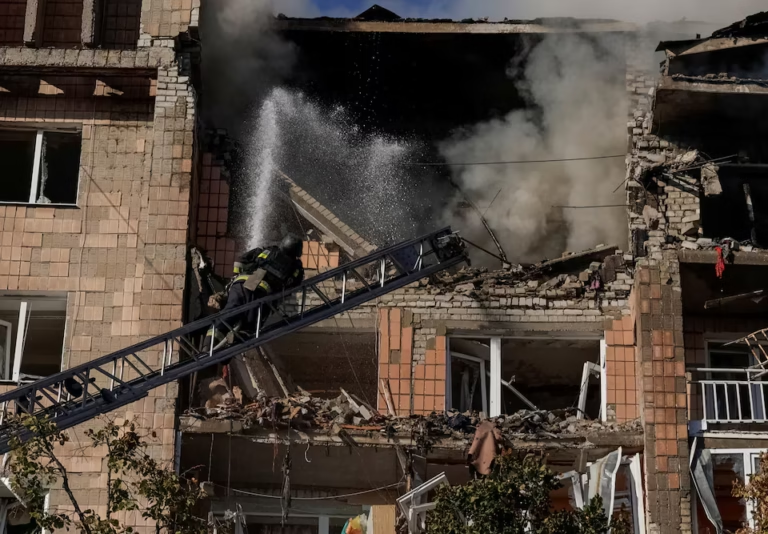

Russia’s Oreshnik hypersonic ballistic missile has re-emerged in global security discussions after Moscow reportedly used the weapon again during one of its largest missile assaults on Ukraine since the start of the war. The strike renewed attention on a weapon that Russia presents as a major technological breakthrough, while Western analysts continue to debate its actual battlefield value.
Named after the Russian word for “Hazel Tree,” Oreshnik is an intermediate-range ballistic missile designed to carry both conventional and nuclear payloads. It first gained international attention after its initial combat use against Ukraine in late 2024.
A Missile With Multi-Warhead Capability
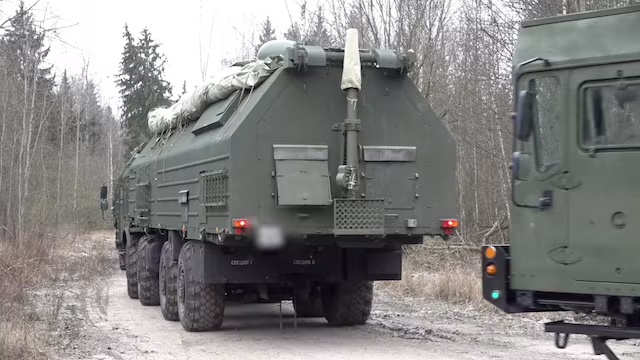
One of Oreshnik’s most notable features is its ability to carry multiple independently targetable warheads (MIRVs) — technology more commonly linked to long-range intercontinental ballistic missiles (ICBMs).
Defense experts say this allows a single missile to release several warheads capable of striking different targets almost simultaneously, increasing the complexity of interception efforts.
The missile is reportedly derived from Russia’s RS-26 Rubezh program, originally developed as an intercontinental ballistic system before being adapted into the Oreshnik platform. Analysts estimate its range at several thousand kilometres, enabling strikes far beyond Ukraine.
Ukraine previously reported that one Oreshnik launch reached speeds of around 13,000 km/h (about 8,000 mph) — placing it firmly in the hypersonic category. Russian President Vladimir Putin has repeatedly claimed the missile travels at more than 10 times the speed of sound and is extremely difficult to intercept.
Nuclear-Capable But Used Conventionally
Although Oreshnik is capable of carrying nuclear warheads, there has been no indication of nuclear payloads in its known battlefield deployments.
Military analysts note that the missile has so far been used with conventional configurations. Reports from previous strikes suggested some launches may even have carried dummy or inert warheads, causing limited physical destruction while serving more as strategic messaging tools.
Russia has nevertheless portrayed the system as having destructive power comparable to strategic weapons even without nuclear material.
Western officials, however, have pushed back against those claims. U.S. officials previously described Oreshnik as an experimental system rather than a battlefield game-changer, suggesting Russia possesses only limited quantities.
Limited Battlefield Damage but Strong Symbolism
The practical impact of Oreshnik’s earlier use appeared relatively modest.
According to Ukrainian assessments cited in previous reports, an earlier strike caused only minor structural damage, including small penetrations in concrete surfaces and nearby craters, because explosive warheads were reportedly absent.
This led analysts to conclude that the missile’s deployment may have been intended more as a political signal than a purely military operation.
Security experts argue that Russia used Oreshnik partly to demonstrate that it possesses an advanced, nuclear-capable hypersonic system capable of reaching targets across Ukraine and potentially parts of Europe.
The timing of previous launches also coincided with heightened tensions between Moscow and Western allies over military support for Kyiv.
Why Russia Uses Dummy Warheads
The apparent use of inert payloads has raised questions about Moscow’s strategy.
Experts believe Russia’s objective may not always be immediate destruction but psychological deterrence.
Launching a sophisticated hypersonic missile sends a message to adversaries about technological capability while avoiding escalation associated with nuclear use.
The demonstrations also reinforce Moscow’s narrative that it retains strategic advantages despite battlefield challenges and sanctions pressure.
For Ukraine and its allies, each launch carries symbolic weight because it signals Russia’s willingness to showcase advanced weapons systems during critical phases of the conflict.
Will More Oreshnik Launches Follow?
Analysts believe future Oreshnik deployments will likely remain limited.
Production appears constrained, and experts estimate Russia has relatively small stockpiles of the missile. As a result, Moscow is expected to reserve the system for high-profile operations or moments intended to send strategic messages.
Recent reports indicate Russia has moved toward serial production and expanded deployment planning, including cooperation with Belarus.
Still, defense analysts argue that Oreshnik’s value may remain more psychological and political than operational unless Russia significantly expands production.
For now, the missile remains one of the most closely watched weapons in the war — not only because of its speed and nuclear capability, but because of what each launch signals about the broader trajectory of the conflict.