

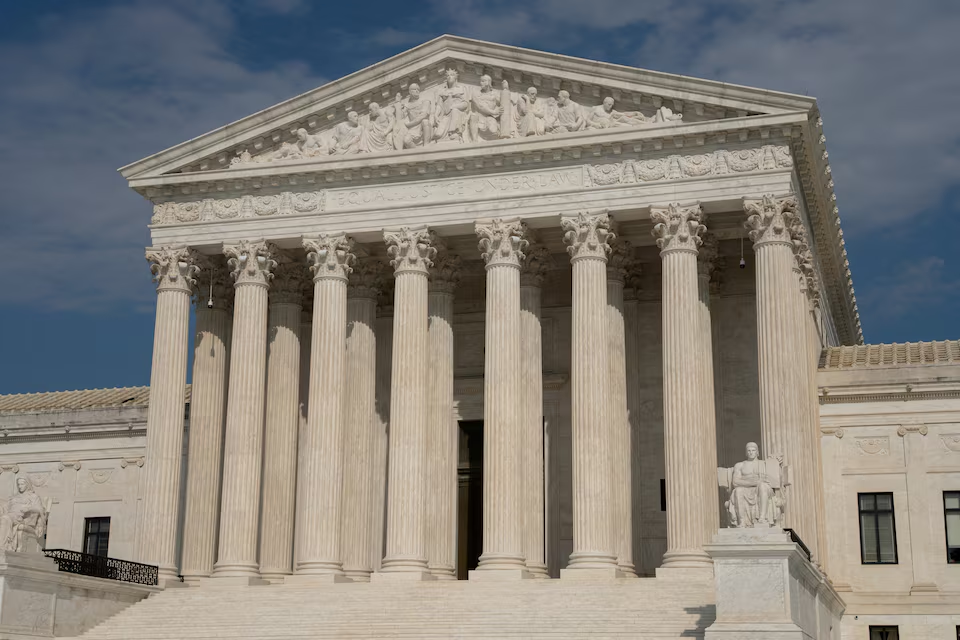
President Donald Trump attacked his own Supreme Court appointees on Tuesday, a day after the nation’s highest court blocked a U.S. Postal Service rule that would have restricted mail-in ballots ahead of the November midterm elections. The outburst marked the latest in a string of public criticisms Trump has leveled at the court following rulings that have gone against him.
“This Supreme Court is bullied and cajoled by the Radical Left into making decisions that have set America back at least a hundred years,” Trump wrote on social media.
Writing on Truth Social, Trump did not name any specific justices but made clear his frustration extended to the court as a whole, including the three justices he appointed during his first term. “These are not the people I interviewed to serve on the United States Supreme Court, they are merely a shell of their original selves,” he wrote. “It is a Court that will go down as having rendered some of the most destructive, hurtful, and damaging decisions in our Country’s history.”
A Court Reshaped by Trump Himself
The criticism is notable given that Trump built the court’s current conservative majority. During his first term, he appointed Neil Gorsuch, Brett Kavanaugh and Amy Coney Barrett, cementing a 6-3 conservative bloc that has steered the court rightward since 2020. That the president now regularly criticizes justices he selected underscores how personally he has taken a series of rulings that have not gone his way, even as the court has largely maintained a conservative tilt on most issues.
The Ruling at the Center of the Dispute
On Monday, the Supreme Court issued a brief, unsigned order preventing the Postal Service from implementing a rule restricting mail-in ballots, a format typical of how the court handles emergency requests. The regulation had been adopted at Trump’s direction and would have required states to submit voter-specific data and use agency-approved mail-ballot envelopes tracked by barcodes. Under the rule, the Postal Service could have refused to deliver ballots that failed to meet the new standards or that were linked to voters not appearing on approved lists.
Critics of the measure warned it risked disrupting the delivery of large numbers of legitimate ballots as the November 3 election approaches, particularly with many states preparing to send mail ballots to eligible voters in the coming weeks. The Trump administration defended the rule as a safeguard against voter fraud, though evidence of such fraud in U.S. elections remains rare.
Trump called the court’s decision a “horrible, highly political, ruling.” Only two conservative justices, Samuel Alito and Clarence Thomas, publicly dissented from the majority. Trump singled them out for praise, calling them “legends, both.”
Attorney General Todd Blanche told reporters afterward that the administration would comply with the court’s decision, signaling that despite Trump’s public frustration, the ruling would stand and the disputed rule would not move forward as originally planned.
Not the First Clash With His Own Appointees
Tuesday’s outburst continues a pattern. In February, the Supreme Court struck down Trump’s sweeping global tariffs, ruling that he had imposed them illegally by invoking a law intended for national emergencies. In that 6-3 decision, both Gorsuch and Barrett sided with the majority against the administration, drawing some of Trump’s sharpest criticism yet.
“I think it’s an embarrassment to their families, you wanna know the truth, the two of them,” Trump said at the time, speaking from a White House lectern.
In his post on Tuesday, Trump revisited those grievances, referencing both the tariffs ruling and a separate decision in June that blocked his effort to restrict birthright citizenship. Taken together, the remarks suggest a president increasingly willing to publicly criticize the court’s conservative majority even when it includes justices he handpicked, particularly on cases touching immigration, trade and now election administration.
Political Stakes of the Mail-In Ballot Fight
The mail-in ballot rule sits at the center of a broader political battle as Republicans work to retain control of Congress in the midterms. Restricting mail-in voting would likely benefit Republicans, according to various surveys showing that Democratic voters disproportionately rely on mail ballots. That dynamic has made the issue a flashpoint well beyond the specifics of postal regulation.
Trump signed the executive order targeting mail-in ballots in March, following years in which he repeatedly cast doubt on their security, despite having voted by mail himself on multiple occasions. He has also made false claims of widespread fraud in past U.S. elections, including his 2020 loss to former President Joe Biden, claims that have been repeatedly disproven by courts, state election officials and independent audits.
“It is a big loss for Republicans, and America itself,” Trump wrote of Monday’s ruling.
A Mixed Record on Election Cases

The Supreme Court’s relationship with Trump’s political interests has not been one-directional. The court has issued several election-related rulings in recent months that have benefited Republicans, reinforcing the party’s view of the court as broadly sympathetic to its priorities. But last Thursday, the court blocked Missouri from using a redrawn congressional map that favored Republicans, a decision that dealt a setback to the party’s efforts to protect its narrow majority in the U.S. House of Representatives ahead of November’s elections.
That mixed record complicates the narrative Trump has pushed in his social media posts. While he has portrayed the court as uniformly hostile to his agenda, its recent rulings show a more complicated picture, one in which the conservative majority has sided with Republican interests in some cases while rejecting administration positions in others, including the tariffs case, the birthright citizenship ruling and now the mail-in ballot rule.
What Comes Next
With the Postal Service rule blocked, states are expected to proceed with plans to distribute mail-in ballots without the tracking and eligibility requirements the administration had sought to impose. The Justice Department’s confirmation that it will comply with the ruling suggests no immediate legal escalation, though Trump’s public attacks on the court suggest the dispute is far from resolved politically.
As the midterms approach, both parties are likely to keep close watch on further legal battles over redistricting, mail-in voting procedures and other election administration questions, with the Supreme Court positioned to remain a central and unpredictable player in shaping how the November elections unfold. Trump’s willingness to publicly criticize even his own appointees signals that further friction between the White House and the court is likely as more election-related cases reach the justices in the weeks ahead.