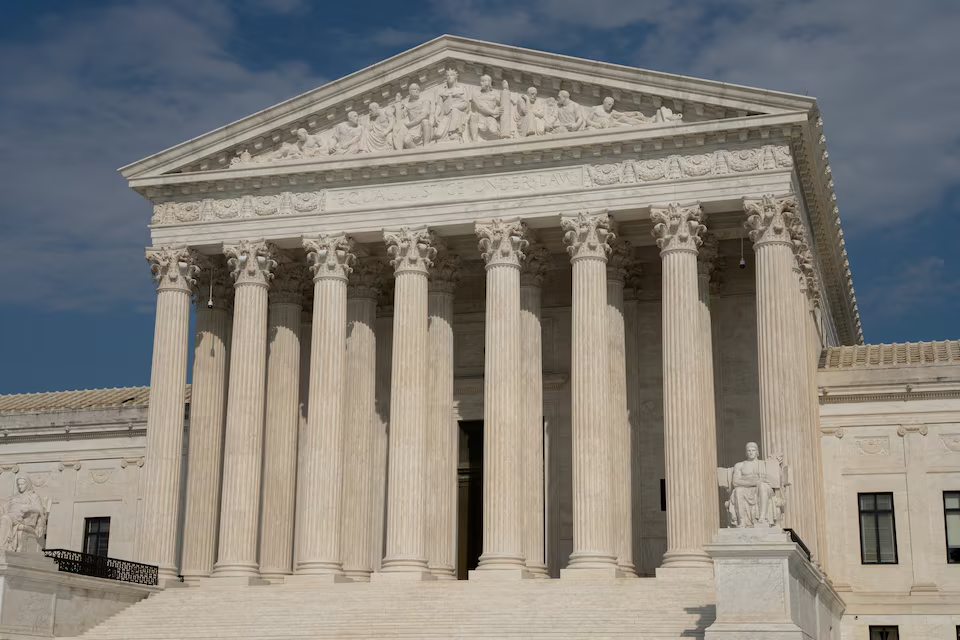

The Supreme Court of Virginia delivered a major political blow to Democrats on Friday by invalidating a newly approved congressional map that had been designed to shift four Republican-held U.S. House seats into Democratic territory ahead of the 2026 midterm elections.
In a sharply divided 4-3 ruling, the court sided with Republican challengers who argued that Democratic lawmakers failed to follow constitutional procedures when advancing the redistricting measure last year. The decision effectively restores the previous congressional boundaries and significantly improves Republican prospects of maintaining control of the narrowly divided U.S. House of Representatives.
The ruling comes at a critical moment in the national battle over congressional redistricting, where both major parties are aggressively attempting to redraw district lines to maximize political advantage before November’s elections.
Court Rules Democrats Violated Constitutional Process
At the center of the dispute was a Democratic-backed ballot initiative approved by Virginia voters during a special election in April. The proposal sought to redraw the state’s congressional districts in a way that political analysts believed would likely benefit Democrats in several competitive areas.
However, Republican groups challenged the measure in court, arguing that Virginia lawmakers bypassed constitutional requirements governing how amendments can be placed before voters.
Under Virginia law, proposed constitutional amendments must be approved by two separate legislative sessions with a statewide election occurring between those approvals. Republicans argued that Democrats rushed the process and violated the requirement because early voting for the state election had already begun before lawmakers passed the amendment for the first time.
The Virginia Supreme Court agreed.
Writing for the majority, the court said the General Assembly’s first approval of the amendment came too late in the election cycle to satisfy constitutional standards.
“The General Assembly voted for the first time to propose the constitutional amendment to the electorate on October 31, 2025,” the majority opinion stated. “By that date, over 1.3 million votes had already been cast in the general election.”
The ruling concluded that because voting was already underway, the required “intervening election” between legislative approvals had not legally occurred.
Democratic Leaders Condemn the Decision
Democrats reacted angrily to the court’s decision, accusing the justices of undermining voter intent and ignoring the results of the April referendum.
Hakeem Jeffries, the top Democrat in the House of Representatives, criticized the ruling as politically motivated and anti-democratic.
Jeffries argued that millions of Virginians had already expressed support for the new electoral boundaries through the ballot box and said the court’s intervention disregarded the will of voters.
Democratic leaders had viewed Virginia as one of their best opportunities to regain ground in the battle for control of Congress. With Republicans holding only a razor-thin House majority, flipping several districts in Virginia could have significantly altered the national electoral map.
The setback now complicates Democratic efforts to reclaim the chamber during the midterm elections.
Trump Celebrates Republican Victory
President Donald Trump quickly praised the ruling, calling it a major victory for Republicans nationwide.
In a post on his social media platform Truth Social, Trump described the decision as a “huge win for the Republican Party.”
Republicans see the outcome as validation of their argument that Democrats attempted to manipulate the redistricting process through procedural shortcuts.
Republican National Committee officials also framed the ruling as a broader rejection of partisan redistricting efforts by Democrats.
“Democrats just learned that when you try to rig elections, you lose,” said Republican National Committee Chairman Joe Gruters.
High Stakes in the National Redistricting Battle

The Virginia case is part of a much larger nationwide fight over congressional maps that could shape control of the U.S. House for years to come.
Traditionally, congressional districts are redrawn once every decade following the national census. However, recent political and legal developments have triggered an unusual wave of mid-cycle redistricting efforts across several states.
Republicans currently appear to hold the upper hand in that battle.
The latest momentum shifted further toward the GOP after the Supreme Court of the United States recently weakened a major provision of the Voting Rights Act of 1965. That decision opened the door for Republican-controlled states to redraw majority-Black and majority-Latino districts that have historically favored Democrats.
Several Southern states — including Louisiana, Alabama, Tennessee and South Carolina — have already begun exploring new congressional maps ahead of the midterms.
Political analysts say the combined impact of those changes could hand Republicans a substantial structural advantage nationwide.
Republicans Gain Momentum in House Race
Election experts believe Friday’s ruling strengthens Republican chances of retaining control of the House in November.
Kyle Kondik, an elections analyst at the University of Virginia Center for Politics, said the decision immediately improved the GOP’s electoral outlook.
“Whatever odds you would have given to Republicans winning the House yesterday, I think you would raise them today,” Kondik said.
Republicans can afford to lose only two net seats in November while still maintaining their majority in the House of Representatives.
If redistricting efforts in other Republican-led states succeed, analysts estimate the GOP could secure advantages in 10 or more congressional seats nationwide.
That possibility has alarmed Democrats, who argue that the growing use of partisan map-drawing threatens fair representation and weakens voter confidence in the electoral system.
How Democrats Tried to Change the Map
Virginia’s invalidated congressional map emerged from a complicated legislative strategy designed to bypass restrictions created by an earlier constitutional amendment.
In 2020, Virginia voters approved reforms transferring congressional redistricting authority to a bipartisan commission in an effort to reduce partisan gerrymandering.
Democrats later sought to alter that arrangement through a new constitutional amendment that would allow revised district boundaries more favorable to their party.
The amendment passed the legislature for the first time in October 2025, shortly before the state election. After Democrats expanded their legislative majority in that election, lawmakers approved the proposal again in January 2026 and scheduled a statewide referendum for April.
Virginia voters narrowly approved the measure by a margin of 51.7% to 48.3%.
Republicans immediately challenged the process in court, arguing that early voting had already started before the first legislative approval, meaning the constitutional requirement for an intervening election had not been met.
The court ultimately accepted that interpretation.
Sharp Dissent Highlights Legal Divide
The decision exposed deep disagreement within Virginia’s highest court.
Chief Justice Cleo Powell wrote a strong dissent joined by two other justices, arguing that the majority improperly expanded the legal definition of an election.
Powell contended that the constitution refers to Election Day itself rather than the early voting period leading up to it.
“This is in direct conflict with how both Virginia and federal law define an election,” she wrote.
Legal scholars say the close split reflects the broader political sensitivity surrounding redistricting disputes across the country.
Millions Spent on Referendum Fight
The political significance of the Virginia map battle was evident in the enormous amount of money poured into the campaign.
Democratic and Republican-affiliated organizations collectively spent nearly $100 million fighting over the referendum, according to campaign finance records.
The massive spending underscored how critical control of congressional boundaries has become in modern American politics, where even a handful of districts can determine which party controls Congress.
With the Virginia map now struck down and similar legal battles unfolding nationwide, the fight over redistricting is expected to remain one of the defining political issues of the 2026 election cycle.
For Democrats, Friday’s ruling represents not only a legal defeat but also a major setback in their attempt to regain momentum ahead of one of the most consequential midterm elections in recent history.