
America’s rapidly expanding solar manufacturing sector is facing growing disruption as major installers, banks and insurance providers pull back from doing business with several U.S.-based solar factories linked to Chinese companies.
The shift, triggered by uncertainty surrounding new Trump administration rules on foreign ownership and clean-energy subsidies, is threatening billions of dollars in investment and putting thousands of manufacturing jobs at risk across the United States.
Industry executives, financial analysts and legal experts say the policy confusion has already begun slowing solar development projects nationwide, raising concerns that efforts to reduce dependence on Chinese manufacturing could unintentionally weaken the American renewable energy industry at a time of soaring electricity demand.
At the center of the issue is a new set of restrictions introduced under President Donald Trump’s 2025 legislative package known as the “One Big Beautiful Bill,” which sharply reduced clean-energy incentives established during former President Joe Biden’s administration while tightening rules aimed at limiting Chinese involvement in U.S. energy infrastructure.
The Treasury Department has yet to release detailed guidance explaining exactly how the law will be enforced — leaving businesses uncertain about whether projects involving Chinese-linked factories will qualify for critical federal tax credits.
That uncertainty has already reshaped the solar market.
Solar Installers Begin Distancing Themselves From Chinese-Linked Factories
Several of the country’s largest solar companies are now taking a cautious approach by avoiding suppliers with direct or indirect ties to China.
Among them is Sunrun, the nation’s largest residential solar installer, which has reportedly removed several China-linked manufacturers from its approved supplier list.
According to documents reviewed by Reuters, Sunrun previously sourced panels from companies such as JinkoSolar, LONGi, Trina Solar, Canadian Solar and JA Solar — all firms with Chinese ownership or operational ties.
However, a revised supplier list circulated earlier this year included only manufacturers perceived as independent from Chinese control, including Qcells, REC, Silfab and Elin.
Sunrun executives confirmed the company is taking what they described as a conservative compliance approach.
“We have taken a cautious position and are avoiding procurement from manufacturers that may raise compliance concerns,” Sunrun Deputy Chief Financial Officer Patrick Jobin said.
Other companies are making similar decisions.
North Carolina-based rooftop solar provider Palmetto has also reportedly moved away from sourcing equipment tied to Chinese companies, despite efforts by some manufacturers to restructure ownership arrangements in order to comply with the new rules.
Industry insiders say many developers fear that if federal regulators later determine projects violated subsidy requirements, companies could lose valuable tax credits retroactively.
Banks and Insurers Pull Back Amid Regulatory Uncertainty
The uncertainty is also affecting financing and insurance markets critical to solar expansion.
Major financial institutions including Morgan Stanley, JPMorgan Chase and Goldman Sachs have reportedly reduced tax-equity financing for certain solar developments because of concerns surrounding future Treasury interpretations.
Tax-equity financing is one of the key mechanisms allowing renewable energy projects to move forward by helping companies monetize federal tax incentives.
Without financing certainty, many planned projects may be delayed or canceled altogether.
Insurance providers have become even more cautious.
According to tax insurance specialists, several insurers are refusing to offer protection against the possibility that solar developers could later lose eligibility for federal tax credits due to Chinese ownership concerns.
“The companies best positioned right now are the ones without obvious ties to countries of concern,” said Peter Henderson, a principal at accounting firm Baker Tilly.
Industry observers say the absence of clear regulatory guidance has effectively created a freeze across parts of the solar market.
Trump Administration Pushes Harder Line Against China
The developments reflect the Trump administration’s broader strategy of reducing Chinese influence across strategic American industries.
The legislation passed in 2025 limits Chinese ownership in facilities receiving clean-energy subsidies to below 25%, while also restricting what officials call “effective control” by foreign entities.
The law further imposes sourcing rules intended to reduce dependence on Chinese technology and supply chains.
Trump has repeatedly criticized renewable energy policies introduced under Biden, arguing that subsidies created unfair advantages for foreign companies while failing to strengthen American energy independence.
At the same time, the administration is attempting to expand domestic electricity production to support rapidly growing demand from artificial intelligence data centers and advanced manufacturing.
That has created a complicated contradiction.
While the White House seeks to weaken China’s grip on clean-energy technology, the United States remains heavily dependent on Chinese equipment, expertise and supply chains within the solar sector.
China currently controls roughly 80% of global solar manufacturing capacity, according to energy research firm Wood Mackenzie.
U.S. Solar Boom Now Faces Major Threat
Under Biden-era climate legislation passed in 2022, Chinese solar companies were among the fastest to invest in American manufacturing facilities.
Since then, nearly $43 billion in solar manufacturing investments have been announced across the United States, according to the Solar Energy Industries Association.
Those projects were expected to support approximately 48,000 jobs while helping the country build enough domestic production capacity to meet rising demand for solar panels without relying heavily on imports.
Now, however, many of those factories are facing uncertain futures.
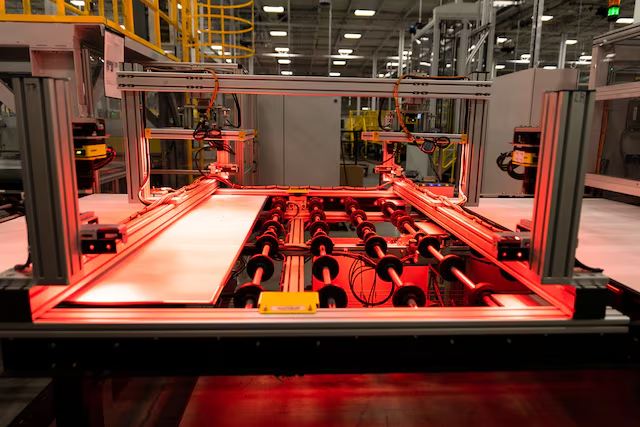
Factories originally built or operated by Chinese-linked firms account for roughly 25 gigawatts of America’s 66-gigawatt solar manufacturing capacity.
That means more than one-third of the nation’s operating solar module production could be affected by the regulatory uncertainty.
Industry experts warn that if these facilities lose access to subsidies or financing, electricity prices could rise as solar development slows.
Aaron Halimi, chief executive of Renewable Properties, said developers are already shifting purchases toward manufacturers perceived as politically safer, including Arizona-based First Solar.
“This is likely going to continue increasing electricity costs in the United States,” Halimi warned.
Chinese Companies Attempt to Comply — But Questions Remain
Several Chinese manufacturers have tried restructuring ownership arrangements to comply with the new law.
Some have reduced equity stakes in U.S. facilities below the 25% threshold, while others have sought outside investors or modified intellectual property agreements.
But concerns remain over whether ongoing profit-sharing arrangements, licensing deals or supply agreements could still violate federal rules.
Reuters reported that many Chinese firms continue maintaining financial or operational ties to U.S. factories even after ownership restructuring.
That ambiguity has become the central concern for banks, insurers and installers.
“Very few Chinese manufacturers are completely severing ties from their American factories,” said Elissa Pierce, an analyst at Wood Mackenzie.
One example is Illuminate USA, a solar manufacturing joint venture between Chinese solar giant LONGi and Chicago-based Invenergy.
The company reportedly reduced LONGi’s ownership stake in its Ohio facility to below 25% and renegotiated intellectual property arrangements in an attempt to comply with the law.
Still, uncertainty remains over whether the plant qualifies for federal support.
The Ohio factory employs approximately 1,700 workers, highlighting the broader economic stakes involved.
In comments submitted earlier this year to the Internal Revenue Service, the company warned that unclear rules could jeopardize the facility’s survival.
Renewable Energy Industry Warns of Economic Consequences
Many energy experts argue that slowing solar development could undermine broader American economic goals.
Solar combined with battery storage is widely viewed as one of the fastest ways to increase electricity generation capacity because projects can be deployed more quickly than gas, coal or nuclear plants.
That rapid deployment is increasingly important as electricity demand rises sharply due to artificial intelligence infrastructure and expanding data center operations.
Despite Trump’s support for fossil fuels, some industry leaders warn the U.S. cannot realistically meet future energy demand without large-scale renewable expansion.
Legal experts say the Treasury Department’s forthcoming guidance will likely determine whether the current uncertainty deepens into a full-scale industry crisis.
Until then, developers, investors and manufacturers remain stuck in limbo — unsure whether billions of dollars in projects will ultimately survive America’s escalating economic confrontation with China.