
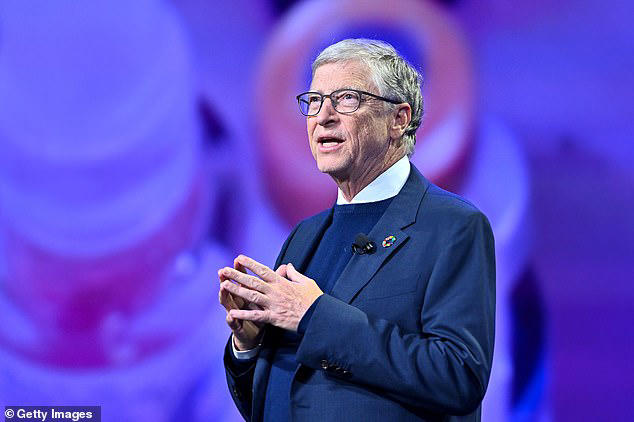
Bill Gates has warned that artificial intelligence and humanoid robots will take jobs in offices and in manual trades, and that company profit targets will push the change forward faster than governments can prepare for it.
The Microsoft founder made the comments in an interview with The Observer. He said that “skills of invention, skills of white-collar work and then with humanoids, the skills of physical human labour” could all be replaced by AI. In his view, no category of work is safe from the technology for long.
The warning follows a job-cut announcement from Barclays and a blunt assessment from the head of the International Monetary Fund, both made last week. It also comes just ahead of the first Budget from UK Chancellor John Healey, who is expected to commit millions of pounds to AI safety.
“Hire the robot, fire the human”
Gates did not put the blame on the machines. He put it on what businesses are paid to do. He described an “incentive structure” in which companies looking to raise profits have every reason to swap people for software or hardware.
“It’s hire the robot, fire the human and don’t look back,” he said.
That reasoning explains why the pace of change may not depend on how good the technology gets. If a robot costs less than a salary and does the task acceptably, a finance director has a clear reason to choose it, whatever the effect on the workforce.
AI has already been costing jobs for several years. Office work has taken the first hits, particularly data-driven analytical roles. Software development, data entry and customer service have all lost positions as companies have found that AI tools can handle parts of that work at a fraction of the cost of a person.
Barclays cuts 5,000 jobs
The most recent example came from banking. Last week Barclays announced that it would replace 5,000 jobs with AI by the end of the year, with cost reduction as the stated aim.
The bank said the cuts amount to 5 per cent of its global workforce. That figure implies a total headcount of around 100,000 people, so one in every twenty employees is affected. The timetable matters as much as the number. Cutting a twentieth of a workforce within a few months leaves little room for retraining or gradual attrition.
Barclays framed the move as a way to cut costs, which matches the motive Gates described. The stated reason is price, and price is the incentive Gates described.
The IMF’s “slow-moving tsunami”
The same week, the head of the International Monetary Fund described AI as “a slow-moving tsunami” that would wipe out jobs around the world. Kristalina Georgieva singled out young people as the group with the most to lose.
Her reasoning is specific. Entry-level jobs have traditionally been filled by people with little experience, and they tend to involve routine, repeatable tasks. The IMF chief said AI already does that kind of menial work well and at very little cost.
The IMF has framed the shift as slow but steady, so the damage may build up quietly before it becomes visible in unemployment figures. Those jobs also served a second purpose. They gave graduates and school leavers a first rung on a career, and a place to learn how an organisation runs. If employers stop hiring for them, a generation of workers could find that the way into a profession has narrowed before they reach it. Nobody has yet shown what replaces that route.
Governments face a money problem
Gates said governments would need to adapt to cope with mass unemployment, mainly through education and re-skilling.
He also pointed to a difficulty that sits inside the argument for AI itself. The technology is likely to bring more “prosperity”, he said, but governments would still have less money to deal with the fallout from huge job losses. Fewer workers means fewer people paying income tax and national insurance, even if company profits rise.
He added that these demands would land when states already have competing priorities and geopolitical tensions are rising.
“You could say this isn’t the best time to say, ‘Hey, rich countries, let’s do the hardest thing you’ve ever done’,” he said.
The comment is a frank admission from someone who has spent decades arguing for technology’s benefits. Gates is not saying that rich countries cannot respond. He is saying that the moment when they must respond is a poor one.
AI beyond human control
Gates went further than employment. He argued that AI could soon overtake humans as the most intelligent things on the planet.
He also predicted that by the end of the 2020s, AI could be operating beyond human control. In that situation, he warned, the technology could act against human interests. The reported remarks do not say how or why that might happen.
A former insider’s warning
A younger voice from inside the industry has made a similar case. Jacob Coxon, 27, helped train the latest versions of AI at the San Francisco-based company Anthropic, which makes the Claude system. He previously worked at OpenAI, the company behind ChatGPT.
Coxon urged people to “not underestimate” the power of AI, particularly if it becomes “super-intelligent”. He also claimed that neither Anthropic nor OpenAI was “acting responsibly” over AI safety.
Superintelligence is the point at which an artificial system becomes more powerful than any individual, company or even nation. The claim about both firms comes from Coxon alone. The article has not seen a response from either company, and readers should treat his statement as one person’s assessment, not an established finding.
The Budget response
The UK government is preparing its answer. Chancellor John Healey is expected to commit millions of pounds in next week’s Budget to guard against the risks of AI, while also aiming to use the technology for economic advantage across the country.
Ahead of his maiden statement on Wednesday, Healey said AI would “transform daily life”. He added that “every firm, community, hospital, school and every aspect of our economy” could benefit from it.
He also acknowledged the worry about jobs. Healey said he understood growing concerns that AI would take away people’s work, which was why he would be “setting out a distinctively British approach to AI – one that doesn’t leave workers behind and defends our national interest, while ensuring the benefits of AI-enabled growth are felt right across the country”.
The pledge sets a high bar. Gates has just argued that governments will have less money to cushion job losses, and Barclays has just shown how fast a large employer can move. A promise not to leave workers behind will be judged on the size of the budget behind it and on what the Treasury is prepared to spend on retraining.
£300 million for a biosecurity lab
The government will also spend £300 million backing an AI Biosecurity Lab. The lab will look at protections from emerging biological threats.
It will be a public-private partnership supported by AI developers including OpenAI and Anthropic. The same companies whose products are blamed for rising job losses, and which Coxon says are not acting responsibly on safety, will therefore sit inside a publicly funded safety project. Whether that arrangement gives the government real independence over the lab’s work is a question the Budget papers should answer.
What is known and what is a forecast
Some of the claims in this story are facts and some are predictions, and they should be read differently. The Barclays cuts, the 5 per cent figure and the £300 million biosecurity lab are announced decisions with numbers attached. The IMF’s “tsunami” and Gates’s timeline for AI slipping beyond human control are forecasts. Coxon’s criticism of Anthropic and OpenAI is an opinion from a former employee.
For workers in the roles already named, the practical picture is narrower than the headlines. Data entry, customer service and software development are where cuts have been reported so far. The manual-labour warning depends on humanoid robots reaching workplaces at scale, and Gates gave no date for that.
What to watch next
Three things will show how seriously the government takes these warnings. The first is the Budget itself, where the AI safety figure and any money for retraining will be visible in the numbers. The second is the detail on the biosecurity lab, including who sets its priorities. The third is whether more large employers follow Barclays and put a number and a date on AI-driven job cuts.
Gates, Georgieva and Healey have each described the same risk in different terms. Gates and Georgieva say the jobs are at risk now. Healey says the benefits can reach everyone. Next week’s Budget will show how much public money the Chancellor is willing to put behind that claim.