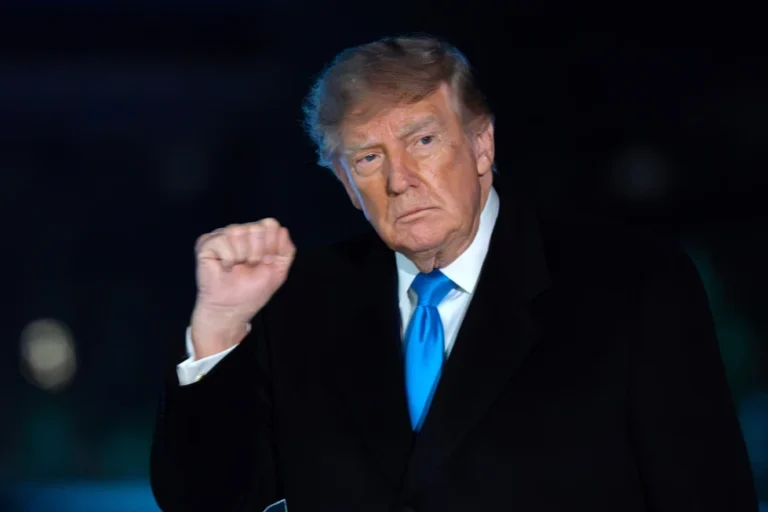

President Donald Trump’s approval rating is at the lowest point of his current presidency, and a vast majority of Americans fear the U.S. battle with Iran might go for months, a Reuters/Ipsos survey found.
The survey indicates growing public concern over the war, increased gasoline costs and the greater economic impact of a disruption in the Strait of Hormuz. # The findings also offer a political dilemma for Trump and House Republicans ahead of the November midterm elections.# Trump’s Approval Falls to 33%
Only 33 percent of Americans polled said they approved of Trump’s job performance; 64 percent said they disagreed.
The approval percentage was down from 35 percent in a Reuters/Ipsos poll earlier this month and was the lowest rating in Trump’s current term. It also matched his lowest approval rating during his first presidency, achieved in December 2017.
The decrease comes after Trump’s return to the White House in 2025 with the backing of just under half of Americans. Since then, his electoral fortunes have waned as voters express concern about the administration’s handling of the conflict with Iran and its impact on household budgets.
The newest data indicate that Trump’s political power is facing challenges not only from resistance by Democrats but also from economic concerns among the supporters who supported him.## Americans Expect Long Iran Conflict
Perhaps the most evident conclusion from the poll was the broad anticipation that the war is not going to end soon.
About 80% of those surveyed believe the United States will be involved in Iran for a long time to come. The sentiment cut across party lines, with 87 percent of Democrats and 71 percent of Republicans voicing the same concern.
Only 16% of Americans felt the conflict was likely to conclude in a few weeks.
The numbers are a tough development for Trump, who campaigned on cutting inflation and avoiding long overseas wars.
When the battle started, Trump had said the combat wouldn’t endure for a long time. But Iran’s resilience and the ongoing disruption of shipping via the Strait of Hormuz has made those expectations more difficult to fulfill.
The fighting has disrupted one of the world’s most critical energy corridors, generating uncertainty in oil markets and driving up fuel costs.Gas Prices Turn Into Political Issue
One of the clearest ways the conflict is affecting American families is through higher gasoline prices.
Trump has tried to justify the higher prices, saying Americans might have to live with higher fuel prices in exchange for keeping Iran from getting a nuclear weapon.
Speaking Friday at a political rally in Garden City, New York, Trump said paying a little extra at the gas pump was a good price to pay to take on what he called a dangerous Iranian dictatorship.
But most Americans haven’t been sold on the argument.
Just under one in five of those who answered the Reuters/Ipsos poll said they thought the war had been worth the cost. Even among Republicans, only nearly half said the war was worth it.
That finding could take on added significance in the wake of voters’ assessment of the administration’s economic record.
Gasoline prices are a very obvious and immediate indicator of the health of the economy for many families. Higher gasoline prices can also be transmitted to transportation, food distribution and other costs, making it harder to tame inflation.# Midterm Elections Put G.O.P. Under Pressure
The poll comes at a politically sensitive time for Trump and his Republican allies.
The Nov. 3 elections could see Republicans trying to hold onto their slim majority in the House of Representatives while Democrats see an opportunity to battle for control of the Senate.
The war in Iran could be a big factor in those races, especially if energy prices stay high or the conflict stretches into election season.
Trump’s playbook politically has always been to lean heavily on his ability to persuade supporters that his policies are making the country’s economic standing better and America’s place abroad more secure.
The message could be harder to sustain in the face of a long war and rising costs of living.# Democrats Make Strides on the Economy
The latest Reuters/Ipsos poll also shows a major shift in how voters view the economic credentials of the two parties.
For the first time in almost 10 years, voters prefer Democrats to Republicans on which party would do a better job handling the economy.
In the latest poll, 38 percent of respondents said Democrats were better able to handle the economy, versus 35 percent who said they trusted Republicans more.
Democrats also gained an advantage when voters were asked which party would be better at managing the cost of living.
The development could be consequential for the midterm elections, which have historically been driven by economic issues as a major factor in voter behavior.
Republicans have stressed tax cuts, deregulation and energy policy, while Democrats have emphasized household costs and the affordability of necessities.
The poll indicates that the Republican edge on economic management could be fraying.# Immigration a Republican Strong Point
Immigration remains a Republican advantage, but a much slimmer one.
About 40 percent of registered voters said Republicans had the better approach to immigration, while 38 percent said Democrats did.
The two-point Republican advantage was the smallest recorded during Trump’s current term.
The change is notable because Republicans enjoyed a much larger advantage immediately after Trump returned to office. In January 2025, Republicans held a 26-point lead over Democrats on the issue.
Trump has made immigration enforcement a central part of his presidency. His administration has pursued a nationwide crackdown, while officials have highlighted a significant decline in illegal border crossings.
However, the administration’s immigration policies have also generated controversy over detention conditions, confrontations involving law enforcement and the detention of children.
Those disputes appear to have affected Republican support on an issue that has traditionally been one of the party’s strongest political assets. ## War, Inflation and Political Risk
The combination of foreign policy and economic concerns creates a difficult environment for the president.
Trump has repeatedly shifted between threatening further escalation against Iran and suggesting that a negotiated settlement could be close.
That uncertainty has made it difficult for businesses, investors and households to determine how long the economic disruption might last.
The Strait of Hormuz is particularly important because of its role in global energy transportation. Any prolonged restriction on shipping through the waterway can affect oil prices far beyond the Middle East.
For the administration, the political challenge is to convince voters that the costs associated with the conflict are temporary and justified by broader national security objectives.
The latest poll suggests that message has not yet gained widespread public support. ## Public Opinion Could Shape the Midterms
The Reuters/Ipsos findings do not necessarily predict the outcome of November’s elections, but they identify several vulnerabilities for the Republican Party.
Trump’s approval rating is weak, voters are increasingly pessimistic about the duration of the Iran war, and Democrats have begun gaining ground on the economy.
At the same time, Republicans retain a narrow advantage on immigration and continue to benefit from Trump’s strong base of support.
The coming months could therefore prove decisive.
If the Iran conflict moves toward a durable settlement and fuel prices decline, Trump could regain some of the political ground lost during the crisis. But if fighting continues, shipping remains disrupted and gasoline prices stay high, economic frustration could become a central issue in the midterm campaign.
The Reuters/Ipsos poll was conducted online among 1,166 U.S. adults nationwide. It carried a margin of error of approximately three percentage points in either direction.
For Trump, the results offer a clear warning: voters are increasingly judging his presidency not only by his promises of strength abroad, but also by the cost of that approach at home.