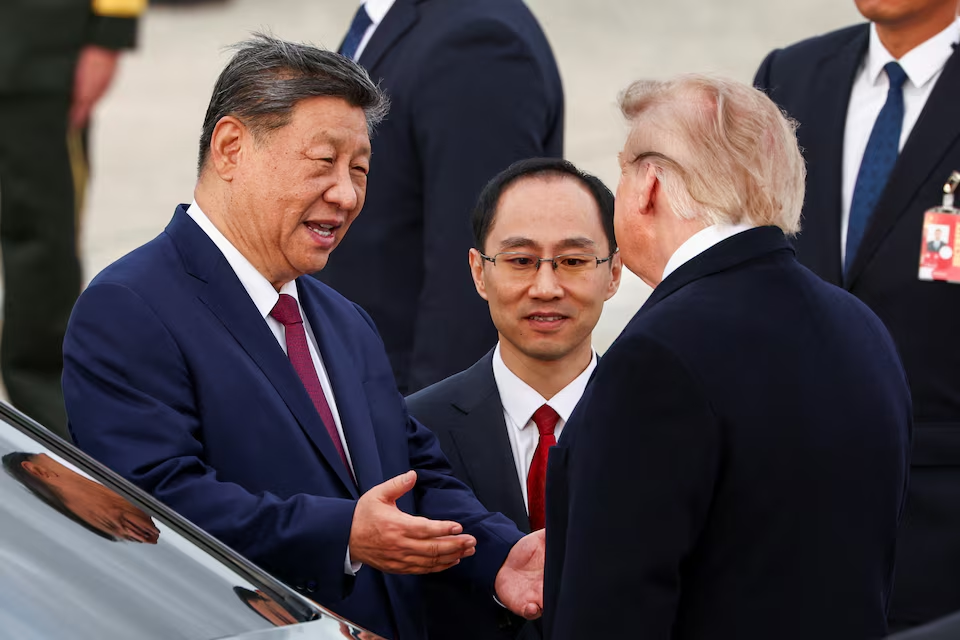

U.S. President Donald Trump has renewed threats against a fortified Iranian nuclear site called Pickaxe Mountain, telling Iranian officials to prepare for a possible strike on the facility buried beneath a mountain south of Tehran.
“We’re going to take out Pickaxe Mountain. Tell the Iranians to be ready,” Trump said during a July 13 interview on the Hugh Hewitt Show. The comment marks the latest escalation in a standoff over Iran’s nuclear program that has already drawn U.S. and Israeli strikes on the country’s enrichment infrastructure twice in roughly a year.
Location and scale
Pickaxe Mountain sits 220 kilometers south of Tehran, just 2 kilometers from the Natanz nuclear complex, one of Iran’s two main uranium enrichment sites. The peak reaches about 1,600 meters above sea level, and the facility carved into it remains under construction, according to the Institute for Science and International Security (ISIS), a Washington-based think tank that tracks nuclear proliferation.
Natanz itself has been hit twice in the current conflict, first during the war the United States and Israel launched on February 28, then again during last year’s 12-day war. Both strikes damaged the above-ground enrichment hall; the U.N.’s nuclear watchdog has confirmed that structure was destroyed, and the underground plant was likely damaged as well. The tunnel complex at Pickaxe Mountain, by contrast, has not been targeted in either round of strikes.
Origins tied to a 2020 sabotage attack
Construction at Pickaxe Mountain began in 2020, shortly after an explosion Iranian officials attributed to sabotage struck the Natanz facility. Tehran said the damage from that incident could set back its development of advanced centrifuges, the machines used to enrich uranium.
Months later, in September 2020, Iran’s nuclear chief at the time, Ali Akbar Salehi, said the country had begun building what he described as a larger, more modern hall inside the mountain for producing advanced centrifuges. Rafael Grossi, director general of the International Atomic Energy Agency, referenced the project in a March interview with PBS Frontline, saying Iran had already signaled its intent to move sensitive nuclear work underground. He called it part of a deliberate pattern by Tehran to bury its most important facilities.
That pattern is not unique to Pickaxe Mountain. Iran built its Fordow enrichment plant into a mountainside near Qom for similar reasons, placing it far enough underground to complicate any airstrike. Pickaxe Mountain appears to extend that same logic, this time next to Natanz rather than Fordow.
What satellite imagery shows
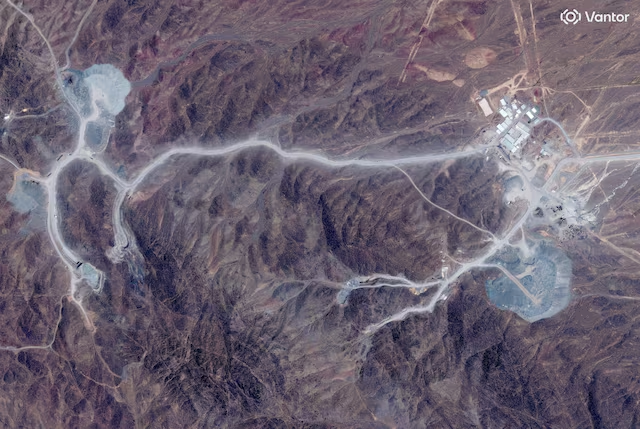
ISIS analysts have tracked the site through satellite imagery for years. Their most recent assessment, published July 14, describes two pairs of tunnel entrances believed to connect to a single underground facility, estimated to run at least 100 meters beneath the mountain. The defenses at the site rely mainly on a wide security perimeter and reinforced tunnel entrances rather than any above-ground structure that could be hit directly.
The eastern pair of tunnel entrances has been partially filled in since the two wars, a move that blocks vehicle access without sealing the tunnels completely. Sam Lair, a fellow at the Foreign Policy Research Institute who has also reviewed recent satellite images of the site, told Reuters that strengthening the tunnel entrances would make it harder to hit the facility with penetrating munitions such as bunker-buster bombs.
Current status remains unclear
Trump said the U.S. has been monitoring the site closely and has not observed activity there. “They’re not doing well with their nuclear situation. Every time we hear about it, we blow it up. So they don’t like talking about it. But we’ll probably give Pickaxe a shot relatively soon,” he said in the July 13 interview.
ISIS reached a similar conclusion in its report, stating that the facility does not appear operational yet, though construction continues. The group said satellite imagery alone cannot establish a timeline for when the site might become functional.
There’s also uncertainty about the facility’s ultimate purpose. ISIS noted it remains unclear whether Iran still intends to install a large-scale centrifuge assembly line inside the mountain, given the damage its centrifuge manufacturing capacity has already suffered in prior strikes. If Iran does rebuild that capability, the group said, it could instead opt for a smaller assembly facility at Pickaxe Mountain, one still capable of supporting a weapons program.
The military calculus
Analysts generally agree the facility sits too deep for even the most powerful bunker-buster bombs in the current U.S. arsenal to reach, including the GBU-57 Massive Ordnance Penetrator that the U.S. used against Fordow last year. ISIS argued the site is better suited to a ground assault or sabotage operation than an aerial one, though the report also noted that deep-penetrating weapons delivered by air could still exploit certain vulnerabilities.
Lair offered a similar read on Iran’s posture. He said Iran appears to be conducting activity at the site it wants to protect, and its steps to reinforce the tunnel entrances suggest real concern about a future attack.
Why this matters now
Trump’s comments come as the U.S. and Iran remain locked in an uneasy standoff following two rounds of direct military conflict in the span of about a year. Unlike Fordow and Natanz, which were both built with known enrichment infrastructure that inspectors had monitored for years under past nuclear agreements, Pickaxe Mountain was never part of any inspection regime. That leaves outside analysts dependent on satellite imagery and second-hand accounts to judge what Iran is actually building, and how close it might be to using it.
Whether Washington moves from threats to action will likely depend on what surveillance shows in the weeks ahead, particularly any sign that Iran is resuming centrifuge production elsewhere and shifting components toward the mountain.