
Clicxpost

US News

Inflation Hits 3.7% as Gas Prices Push US Families Into Side Jobs and Cancelled Trips

US inflation September 2026

US consumer prices rose 3.7% in the 12 months to September, up from 3.4% in August, the Bureau of Labor Statistics reported on Wednesday, October 14. A 9.1% monthly jump in gasoline prices drove most of the increase, and the annual figure came in above forecasts. Across the country, families are changing how they work, eat, travel and save to absorb it.

What the September report shows

Prices rose 0.6% from August to September, after a 0.4% rise the month before. Core inflation, which strips out food and energy, climbed to 2.6% a year from 2.4%, so the pressure is not confined to the pump. Shelter costs rose 0.4% in the month, and airline fares are up 22% over the past year, according to Axios’s breakdown of the data. Food prices were flat in September, which means grocery bills have stopped climbing for now, even though many households say they are still paying far more than they did a year ago.

Gasoline did the damage this month. It rose 3.9% in August and then 9.1% in September. AAA put the September average for a gallon of regular at $4.33, which is 50 cents above the previous September record of $3.83, set in 2023. A year ago the national average was $3.16. In California, the most expensive state, a gallon cost $6.40 at the start of October. Diesel has also hit record highs, and that cost passes through to anything trucked to a store shelf.

The Trump administration has responded by temporarily easing restrictions on tax-exempt diesel and lifting some sanctions on Russian fuel to bring more diesel onto the market, Axios reported.

Three jobs, and still short

Kathryn Vaughn, 46, started the school year in rural West Tennessee with a longer list of worries than she had last autumn. She teaches art at a primary school. When the final bell rings, she drives to her second job, facilitating an after-school programme for at-risk youth. Her five-year-old son comes along, which saves the family the cost of childcare.

The third job is a patchwork. “I have done some incredibly unhinged things to survive,” she said. “I hand-modeled for a local jewelry store, I sell everything that sits longer than ten minutes at my house on Facebook swap sites, I resell clothes on ThredUp and Poshmark.” She also writes obituaries for money. Together, the work still does not cover the bills for a family of four.

The cuts keep coming. Back-to-school shopping for her son’s supplies came to $130, a bill that stopped her in the aisle. She decided to buy his school lunches each day instead of packing them, after working out that the school meal cost less than the groceries for a homemade one. The family dropped a planned autumn trip to Florida to see her parents because the gas money was out of reach.

“It’s rough out here,” Vaughn said. “The cost of everything is insane. Gas to get to work, my insurance costs have gone up, feeding two children and a husband. It’s a lot.”

Her situation is common among people with steady jobs. A full-time teaching salary and two more positions are not producing a cushion, and the extra work is going to costs that have already risen, not to savings.

A home purchase that keeps slipping

Punal Bhavsar, 39, lives in California and had a plan. He expected to save enough in 2026 to buy a house. He assumed interest rates would fall during the year, which would bring monthly mortgage payments down to a level he could manage.

That plan no longer looks workable. “I was thinking the interest rates would decrease and then I’d be able to purchase a house, but I don’t think that’s likely now,” he said. The reason is in the policy outlook. With inflation rising, the Federal Reserve is discussing another rate increase, not a cut, and Treasury yields moved up on Wednesday’s data. The 2-year yield rose 12 basis points and the 10-year rose 7, which tends to push mortgage rates the same direction.

Saving has become harder for him at the same time. Gasoline is his largest new expense. He drives a car that needs premium fuel, and where he lives it sells for close to $6 a gallon (£4.50). “For me, it’s just like gas prices have got to be under control,” he said, explaining why he may vote on that single issue in the midterm elections in November. He described the economic outlook as bleak.

Ground beef at $8 a pound

Caitlin Green moved to Utah seven years ago. Her mother helped her unpack and gave her one rule for feeding a household cheaply: buy ground beef.

The rule has stopped working. Green remembers paying about $2 a pound. She now pays $8, she said. Her grocery spending with her husband has gone from roughly $200 a month to $400. They sometimes switch to ground turkey or ground chicken, and she reworks recipes around what costs less that week.

“[Ground beef] is almost … not a luxury like steak … but it’s just to the point where it’s become a luxury; we have to think about it if we’re going to purchase it,” she said. “I understand inflation is a thing, but I just feel like in my lifetime, I’ve never seen inflation hit so quickly and so drastically.”

Her account matches the flat September food reading only partly. Monthly grocery prices paused, but a household that doubled its grocery budget over a longer stretch does not feel a pause. Government data measures the change from one month to the next and from one year to the next; families measure what they pay today against what they paid when they last felt comfortable.

Confidence at a low

Americans’ own assessments are poor. The Gallup Economic Confidence Index, which runs from -100 to +100 and combines views of current conditions with the outlook, stood at -40 in September. A summer survey by the Guardian found that 95% of respondents believe the US is in an affordability crisis.

Those numbers arrive three weeks before the midterm elections on November 3. Bhavsar’s comment about voting on gas prices alone is one example. Candidates in both parties are likely to face the same question from voters: what happens to the price of fuel, food and housing before the next paycheck.

What the Federal Reserve is weighing

Wednesday’s report changed the odds on interest rates. CME FedWatch data showed the probability of a rate increase at the Fed’s late-October meeting rising to 44% from 22% a day earlier, according to Axios.

Federal Reserve officials have been giving different readings of the situation in the past three days. Cleveland Fed President Beth Hammack said in a speech on Monday, October 12, that inflation pressure extends well beyond energy and comes from tariffs, AI investment and rising prices for services. Fed Governor Christopher Waller told Bloomberg on Tuesday, October 13, that higher Treasury yields are already slowing activity, which could lower the need for a hike this month. New York Fed President John Williams has said one more increase may come this year, and that the Fed may not need to raise rates again in 2027.

The split matters for people like Bhavsar. If Waller’s reading holds, borrowing costs may stop rising before they cause more damage. If Hammack’s holds, the Fed has more work to do, and mortgage rates stay where they are or move higher.

How households are coping

The three households in this report share a pattern. Each has changed where the money goes in specific, small steps:

  • Work: Vaughn took on a second job and a series of side gigs, and she brings her son to her after-school shift to avoid paying for care.
  • Food: Green swapped ground beef for turkey or chicken. Vaughn compared the cost of homemade and school lunches and chose the school option.
  • Travel: Vaughn’s family cancelled a trip to see her parents. Bhavsar says fuel is his largest new expense.
  • Big purchases: Bhavsar has postponed his plan to buy a home, because he no longer expects mortgage rates to fall.

None of these steps is dramatic on its own. Together, they add up to a household budget that has been rebuilt around a price level that arrived faster than wages did.

What to watch next

The next dates are close together. The Federal Reserve meets in late October and will decide whether to raise rates. Voters go to the polls in the midterm elections on November 3. The Social Security Administration will announce the 2027 cost-of-living adjustment, which takes effect in January and will tell millions of retirees how much of this year’s price increase their benefits will cover. The October inflation report, due in November, will show whether gasoline prices, which eased slightly from their peak in early October, have started to pull the annual figure back down.

For Vaughn, Bhavsar and Green, the practical question is smaller. It is whether the price at the pump and the checkout counter will stop rising before the next round of bills arrives.

Sources

RECOMMENDED
US News

Public executions in the US stopped nearly a century ago – why are they resuming now?

By George Mensah 7 min read

The US military plans to carry out a public execution by firing squad and broadcast it live, the first announcement of its kind in the United States in almost 90 years. US Secretary of Defense Pete Hegseth said the military would publicly execute Nidal Hasan, who killed 13 unarmed fellow soldiers at the Fort Hood base in Texas in 2009. The Pentagon later said the execution would be live-streamed.

“People need to understand that there’s serious consequences for these types of things,” Hegseth said.

The announcement has drawn alarm from a death penalty scholar, an author who researched the last major public hanging in America, a violence researcher and the chair of the US Conference of Catholic Bishops. President Donald Trump has said he approved the decision to livestream Hasan’s death. Vice-President JD Vance says he will not watch.

What was announced

The sources available so far describe the plan in broad terms. Hasan, who killed 13 people in the 2009 shooting at Fort Hood, would be executed by firing squad. The military would conduct the execution in public, and the Pentagon says it will be livestreamed.

Trump was asked whether he would tune in himself and avoided the question. He confirmed that he had approved the livestream. “I really don’t care how he goes as long as he goes,” Trump said. “And I think that the death penalty is a very worthy way of going for him.”

Vance, who is Catholic, has said he would not be watching the execution.

The reports do not say when the execution will take place, where it will be held or who will be able to view the stream. Those details have not been made public in the material reviewed for this article.

The last time America did this

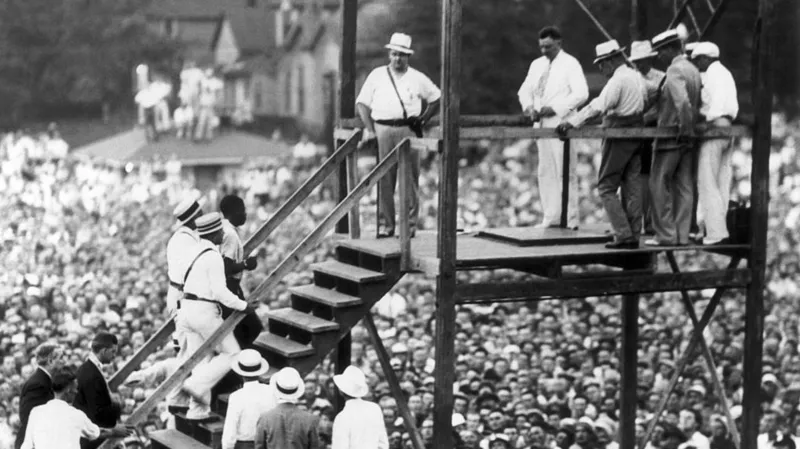
The previous public executions in the US belong to a different era. The most prominent took place on 14 August 1936 in Owensboro, Kentucky, during a heat wave. It was a Friday.

Rainey Bethea, an orphan in his 20s, was hanged on a riverfront gallows. He had been sentenced to death after allegedly confessing to robbing, raping and killing Lischia Edwards, 70, an elderly white widow. Bethea was black.

The scene around the gallows turned into a public event. Spectators arrived from near and far. Some slept overnight close to the gallows to keep their places. Others held “necktie” parties the evening before and arrived hungover. Teenagers sold popcorn and soda to the crowd.

By the time of the execution at 5am, the crowd was estimated at 20,000 people, including men, women and children. Reporters had come from as far away as Chicago and New York. Many spectators were there to see a rumoured “Lady Executioner”. The local sheriff had died four months earlier and his widow had taken over the post. She declined to pull the lever herself, and hired hangmen carried out the hanging.

Bethea had eaten his last meal the previous afternoon: fried chicken, pork chops, mashed potatoes, pickled cucumbers, cornbread, lemon pie and ice cream.

The spectacle embarrassed many in Kentucky. Eighteen months later, the governor outlawed public executions. By then most states had already stopped holding executions in view of the public, as attitudes turned toward more humane and private methods. A hanging in Missouri in 1937 drew a few hundred people. It was less well known, and it is recorded as the final public execution in America.

Hegseth’s announcement comes a little more than 90 years after Bethea’s death.

A scholar who did not expect it

Michael Radelet, a professor emeritus at the University of Colorado and a long-time scholar of capital punishment, said the announcement shocked him. “I never imagined [another] public execution,” he told the BBC.

He pointed to falling public support for the death penalty. Backing for capital punishment was 80% in 1994 and stands at 52% now. That is a drop of 28 percentage points, or a fall of 35% from the 1994 level, by our calculation. “It’s gone down precipitously, especially when you give the alternative of life without parole,” Radelet said.

It is too soon to know what Americans think of livestreaming an execution. The BBC’s reporting assumes a large audience, saying it is nearly certain that millions of people or more would tune in.

That prospect troubles Radelet. With Hegseth’s announcement, he said, “the justification for the death penalty becomes entertainment … bring your popcorn, invite your friends”.

An author with a family link to 1936

Sonya Lea published a book last year about Bethea’s execution. When she heard of the planned livestream, she “felt absolute horror for our descendants”.

“What they called it in 1936 was a carnival of sadism,” she said. “That we now have the technology that can make it go wider than the 20,000 people who showed up … to witness in Owensboro, Kentucky, it just makes it even more horrific.”

Her connection is personal. Lea’s grandparents were teenage newlyweds in the 1936 crowd. She learned that only after her grandmother died in 2002, when she read an account her grandmother had left. It said they stood close enough to hear Bethea’s neck snap.

Years of research afterward taught Lea that many Kentuckians were “haunted” by the execution. She had believed that kind of event belonged to the past.

“I really thought, with all my heart, that we had put this in the rearview mirror, this level of grotesquery that only a few countries in the world engage in – Iran, North Korea, Afghanistan,” she said. “Are we now, as the United States of America, considering ourselves to be part of that kind of government? It’s just horrific.”

Polarisation and desensitisation

Kurt Gray, a social psychology professor at Ohio State University, said the polarised tone of American politics may have made the announcement possible. He does not think most Americans want to see it.

“Some Americans might thirst for blood, but I think a lot of Americans don’t, and, if anything, I think a lot of other Americans are just kind of maybe desensitised,” he said. “So it’s not like they’re cheering a public execution; they’re just like, ‘Oh, yeah, I guess that’s where we’re at now.’”

Gray’s point separates two groups. Some Americans may welcome the broadcast. Many others, in his view, may simply accept it as normal.

A reading of the country that may be wrong

Other research suggests Hegseth and the administration may be misjudging the public. Garen Wintemute, director of the Violence Prevention Research Program at the University of California, Berkeley, said survey data point to a declining appetite for violence in the US.

He also cited the response from religious leaders. “This morning, the chair of the US Conference of Catholic Bishops labeled this [livestream execution announcement] as barbaric,” Wintemute said. “And I think he speaks for a lot of people.”

“I think it’s this: A public execution is not who we are,” he added. “It’s not who we aspire to be as a country.”

Vance is a Catholic. The chair of the bishops’ conference has called the plan barbaric, and Vance has said he will not watch.

The case and the reaction

The criticism in the BBC’s reporting is aimed at the method and the broadcast, not at the verdict. Radelet objects to turning a punishment into entertainment. Lea objects to the technology. Gray and Wintemute talk about what the plan says about the country. None of them is quoted disputing that Hasan killed 13 people.

Hegseth framed it as a response to that crime. His stated reason was that people need to understand there are serious consequences for such acts. Trump’s reason was blunter: he said he did not care how Hasan dies as long as he does.

What to watch

The material reviewed so far leaves several questions open. The date of the execution is not given. Neither is the format of the stream, or whether the public will be allowed to attend in person. The sources also do not say whether any legal challenge is planned.

Opinion surveys will be worth watching. Public support for the death penalty is at 52%, the current figure Radelet cited, and no poll yet measures how Americans feel about a livestreamed execution. The first such numbers will show whether Gray’s reading of a desensitised public or Wintemute’s reading of a country that rejects the idea is closer to the truth.

The 1936 hanging in Owensboro shows how long the memory of such a spectacle can last. Many Kentuckians were haunted by it, and the governor acted within 18 months. Whether the Hasan execution produces a similar reaction depends on how many people watch and what they make of it.

Sources: BBC News reporting on the planned execution of Nidal Hasan; statements from Pete Hegseth, Donald Trump and JD Vance; comments from Michael Radelet (University of Colorado), Sonya Lea, Kurt Gray (Ohio State University) and Garen Wintemute (University of California, Berkeley).

US News

Trump wants to reduce the cost of fuel as the midterms loom

By George Mensah 7 min read

With a few weeks left before the US midterm elections, President Donald Trump on Friday announced a deal with Russian President Vladimir Putin to release Russian diesel to American and global markets. It is his latest attempt to bring down fuel costs that have more than doubled since the US-Israel conflict with Iran began in February. Analysts quoted by the BBC say high prices will outlast this announcement.

The price rise has hit transport businesses, farmers and anyone who drives a vehicle in America. Calls for action have grown as voters move toward the polls, and Trump has made several announcements aimed at getting costs down.

What Trump announced

Trump said the arrangement covers an immediate supply of over 300,000 tonnes of Russian diesel, 500,000 tonnes in November and a further million tonnes “immediately thereafter”. By his own account, diesel prices in the US and across the world “will be COMING DOWN, IN RECORD NUMBERS, AND FAST!”

“Lower prices for Americans, especially our Great Farmers, Ranchers, and Truckers, is my Greatest Priority,” he said.

He added that another 3m tonnes would be delivered “within a short period” after that, depending on the condition of Russia’s refineries. The three batches he named without conditions add up to at least 1.8 million tonnes. That total is our own arithmetic, not a figure either government has published.

Fuel prices and the midterm vote

Earlier in the week, at a campaign stop, Trump announced a waiver on red dye diesel. The move shows how much weight gas prices carry in an election dominated by affordability.

Public worry over the cost of fuel, food and other goods is widespread. Voters have tied the issue to Trump and his party, and it is weighing on Republicans running in November. Polls show a majority of Americans disapprove of how Trump is handling the economy and the war in Iran, which has contributed to high diesel and gasoline prices.

What is pushing prices up

Charles-McClintock Wilson/NurPhoto via Getty Images A customer wearing a backwards cap and a blue tshirt refuels a red vehicle at a gas station in Salt Lake City, Utah, United States on a clear, sunny day.

Global oil supplies have been restricted since the conflict in the Middle East effectively halted the usual flow of oil and refined products through the Strait of Hormuz for months. Crude is flowing again at nearly pre-war levels, but the price remains above $100 a barrel. Those sustained crude prices have carried through to diesel and gasoline.

Russia’s war with Ukraine also plays a part. David Ruisard, pricing manager at the commodities intelligence firm Argus, put numbers on the split.

“Our estimates are that your price increase from about $3 a gallon up to $6 a gallon [for diesel] is 60% connected to the Strait of Hormuz, 40% connected to the Russia-Ukraine conflict,” he said.

Apply his percentages to the $3 increase and about $1.80 of it traces to Hormuz and about $1.20 to the Russia-Ukraine conflict. Those dollar amounts are our calculation from his estimate. They suggest the larger share of the increase comes from a disruption that Russian cargoes cannot reach.

Michael Pearce, chief US economist at Oxford Economics, said higher energy prices account for most of this year’s rise in inflation, which is pushing up interest rates. “The combined impact of higher rates and higher energy prices is squeezing household budgets and adding to firms’ costs,” he said.

Prices are still high, but Patrick De Haan, head of petroleum analysis at the fuel price tracking site GasBuddy, said gasoline and diesel have both seen modest declines recently. “A lot of that is likely due to some of the manoeuvres that we’ve seen the Trump administration employ over the last couple of weeks,” he said.

What Trump has already tried

Friday’s diesel deal follows a series of other policies and ideas.

Red dye diesel. This week Trump said he would let so-called red dye diesel, which is used off-road and carries no federal tax, be used on US highways without federal levies. Ruisard said the only difference between that fuel and the diesel used by truck drivers and everyday consumers is the dye.

The dye is the problem. “It’s extremely hard to clean it out of your tank,” Ruisard said. Trucking companies that fill up with dyed diesel face a question once the temporary tax relief ends. “The fines are pretty high for having that in your fuel tank because it’s considered tax evasion,” he said.

He raised a second issue. People and businesses, rail operators among them, usually set aside a fixed amount of red dye diesel. “If suddenly people go out and they start consuming that diesel, that depletes their available supply as well,” he said.

Stockpile releases. Last week the G7 countries announced they would release 100 million barrels of oil and diesel from stockpiles, after pressure from Trump. Analysts rate this one as more effective. De Haan said the announcement alone, whatever has physically been released so far, “has worked to push prices down to some degree”.

Pearce agreed but called the release temporary. “As long as energy exports from the Gulf remain disrupted, stocks will need to be drained further to supply the market,” he said. “And the need to refill those stocks will mean energy prices remain elevated for a period, even when disruption in the Middle East clears.”

State gasoline taxes. Trump has urged states to cut their own gasoline taxes, and several have, including Ohio and Georgia. De Haan said state taxes make up a “moderate portion” of what consumers pay at the pump, and the cuts have helped lower prices and national averages. They cost money. By De Haan’s estimate, Indiana’s May cut has cost the state government $1bn (£760m) in lost revenue.

The federal gasoline tax. Trump said earlier this week he was “thinking about” suspending it. That would need Congress to cooperate. “That may be difficult to obtain ahead of the midterm elections,” De Haan said.

A diesel export ban. Trump has previously supported calls to ban diesel exports from the US. Pearce said this would give partial relief in the Gulf and the Midwest, but “little benefit” to the Northeast and the West Coast. He also warned of a side effect. “The policy risks backfiring because it would result in stockpiling of diesel, and as that storage runs out, refineries would need to cut back on production,” he said. “That would raise prices of other energy products, including gasoline.”

The options that remain

De Haan thinks the president has “basically pulled all of the small levers that a president can pull, and we’re still seeing prices very elevated”.

In his view the remaining answer lies outside fuel policy. “The only way out of this to reduce gas prices in a meaningful way is solve one or both of the geopolitical tensions that are causing high prices,” he said. That means reaching a deal with Iran and helping to broker an agreement between Ukraine and Russia. Pearce noted that the White House cannot directly control either.

Even a settlement would not bring quick relief. Ruisard said damage to Middle East facilities from military strikes means production would still need four to six months to return to normal. Counted from today, that points to a window between February and April 2027, and only if a deal came immediately.

“The message to consumers and industry is that regardless of what happens and whether the president is able to successfully negotiate that kind of a deal,” Ruisard said. “High prices are here to stay for a little while at least.”

What to watch next

The first test of the Russian arrangement is the November shipment of 500,000 tonnes. The three million tonne batch after it depends on the condition of Russian refineries, so its timing is open.

Three other items will decide how drivers and businesses feel by election day. The first is whether Congress takes up a federal gasoline tax suspension, which De Haan expects to be hard to win. The second is whether more states follow Ohio and Georgia and cut their own taxes, with Indiana’s $1bn cost as a warning to state budgets. The third is whether talks on Iran or on Ukraine and Russia produce anything before November.

Each of those depends on governments the White House does not control, or on a legislature that has to agree. The analysts quoted here treat the Russian diesel deal as a modest, temporary help at best. Their shared view is that fuel prices will fall in a meaningful way only after the conflicts behind them are settled, and that even then relief would take months to reach the pump.

Sources: BBC News reporting on Trump’s Russian diesel announcement and US fuel prices; statements from Donald Trump; comments from David Ruisard (Argus), Michael Pearce (Oxford Economics) and Patrick De Haan (GasBuddy).

ADVERTISEMENT
Scroll to Top