Clicxpost

World News

Russia Strikes Six Energy Targets in Ukraine Days After Trump Announces Energy Ceasefire

Russia Ukraine energy strikes

Russia hit at least six energy targets during a night and morning of deadly airstrikes across Ukraine, President Volodymyr Zelenskiy said on Monday, October 12. He said the attacks showed Moscow has no interest in the energy ceasefire that US President Donald Trump announced over the weekend. Kharkiv, Ukraine’s second-largest city, was among the places hit.

Trump said on the weekend that Ukraine and Russia had agreed not to hit each other’s energy systems. The announcement caught Kyiv and its European allies off guard. Neither warring side had confirmed it, and Russian strikes continued on Monday.

Zelenskiy: “Terrorist air attacks” will continue

Zelenskiy posted his assessment on X. “It is increasingly evident that Russia is unwilling to accept an energy ceasefire proposed by the United States and intends to continue its terrorist air attacks against our people and communities,” he wrote.

He tied the timing to Russian revenue. “This is what happens when Russia sees the prospect of higher revenues for its war machine,” he said.

Speaking by video link to a conference in Poland earlier in the day, Zelenskiy named two of the targets: a gas facility and a petrol station. Russian drones hit both.

Kharkiv: a body under the debris

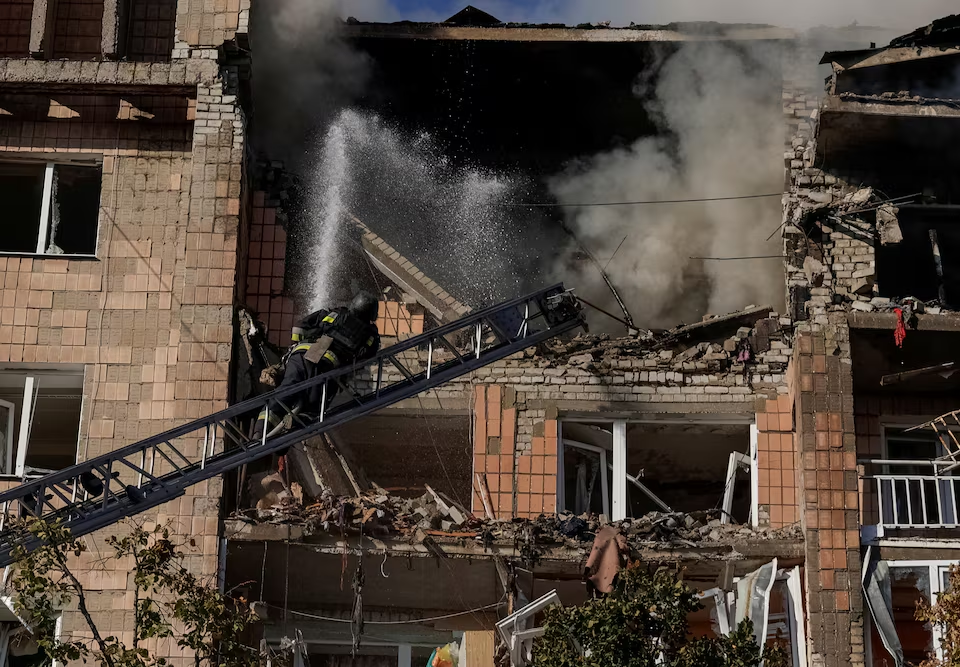
Overnight attacks killed at least three people in Kharkiv. Further strikes in the morning hit residential buildings and wounded at least 22 more people, municipal officials said. Reuters photographed a firefighter at an apartment building damaged by a Russian drone. In the dark, rescue workers searched through wreckage under floodlights. The body of a civilian in jeans and white sneakers lay beneath the debris.

Resident Nataliia Minka had just reached a shelter when a missile hit close by. She and her child watched what they believed was a missile strike on a nearby power station. “Ten minutes had passed since they promised they wouldn’t target energy facilities,” she said.

She described what she saw afterward. “It’s so hard to describe how a child was lying there, already covered up, and the father was running around her, crying and screaming,” Minka said. “It’s so terrifying. It’s impossible to get through something like this.”

In the western city of Ivano-Frankivsk, at least three people were reported killed on Sunday.

A grid campaign two weeks old

Russia began its latest campaign against Ukraine’s power grid two weeks ago. Kyiv has had hours-long power cuts every day since. The outages have reached the capital’s water and sewage systems, and twice stopped its underground trains without warning.

The campaign continues a pattern. Russia has attacked Ukrainian cities for more than four and a half years, including repeated efforts to knock out power and heat in successive winters. Kyiv has answered in recent months with long-range strikes on Russian oil refineries and logistics.

Moscow’s mixed message

Zelenskiy said Ukraine carried out no attacks on Russian refineries overnight. He said Kyiv is willing to agree to an energy ceasefire, but only if Russia keeps to it.

He also raised elections, which are suspended during wartime. Ukraine could hold them, he said, if Moscow agreed to a full ceasefire for 60 days.

Russia gave two answers. Kremlin spokesman Dmitry Peskov said talks on a possible energy ceasefire are continuing and that more information would come in due course. He rejected the 60-day truce. “In the Kremlin, both President (Vladimir) Putin and officials at other levels have repeatedly stated that we do not want a ceasefire,” Peskov said. “We want long-term peace and are prepared to do everything possible to achieve it.”

The two statements sit awkwardly together. Peskov confirmed talks on an energy ceasefire in one breath and said Russia does not want a ceasefire in the next. The strikes on six energy sites came in between.

Oil prices and US politics

Trump is under pressure over high energy prices with US midterm elections next month. Diesel has reached record prices in the United States since he launched his military campaign against Iran. He has increasingly blamed Kyiv’s attacks on Russian refineries for the rise in fuel costs. On Saturday he said Zelenskiy had “better damn well stop” attacking them.

A person familiar with the situation said Washington has threatened to cut off intelligence sharing with Ukraine and supplies of weapons. The United States no longer provides weapons to Kyiv directly but allows European countries to buy them on its behalf, so a cutoff would hit the purchases Europeans make for Ukraine.

Trump announced the ceasefire days after unveiling a deal to buy diesel from Russia. Zelenskiy has criticised that deal as a reversal of years of Western policy aimed at isolating Russia’s economy. Trump has also called on Ukrainians to unseat Zelenskiy in an election. Reuters described the exchange as unusually severe in a relationship that has been strained since Trump returned to power in 2025.

This was the second time within a few weeks that Trump declared an energy ceasefire without confirmation from both sides.

Europe adds 1,569 names to its sanctions list

Ukraine’s European allies voiced scepticism on Monday about any such agreement and spoke strongly in support of Kyiv. EU foreign ministers added 1,569 individuals and businesses to the sanctions list, described as the largest single package since Russia’s full-scale invasion in 2022.

German Chancellor Friedrich Merz said Moscow “will only negotiate seriously under pressure, which is why we are sticking to our sanctions against Russia.” He added: “Following Moscow’s ruthless attacks on Ukraine’s civilian energy infrastructure, we must actually tighten them further.”

What to watch

Three things will show where the energy talks stand. The first is whether Moscow gives the “further information” Peskov promised. The second is whether Washington follows through on the reported threat to cut intelligence and weapons purchases. The third is whether Russia’s grid attacks continue in Kyiv, where the power cuts have run daily for two weeks.

Zelenskiy has set his condition: Ukraine will stop hitting Russian refineries when Russia stops hitting Ukrainian power. Russia’s strikes on Monday were the answer so far.

Sources

  • Volodymyr Zelenskiy, post on X and remarks by video link to a conference in Poland, October 12, 2026
  • Dmitry Peskov, Kremlin spokesman, October 12, 2026
  • Friedrich Merz, German Chancellor, October 12, 2026
  • Kharkiv municipal officials; Nataliia Minka, Kharkiv resident
  • Reuters reporting from Kharkiv, Brussels and Washington
RECOMMENDED
World News

Flavio Bolsonaro Refuses to Concede as Lula Wins Fourth Term in Brazil

By George Mensah 9 min read

Brazilian Senator Flavio Bolsonaro has refused to accept defeat in Sunday’s presidential runoff, following the example of his father, the jailed former president Jair Bolsonaro. Leftist President Luiz Inacio Lula da Silva won a fourth term on October 25, 2026, and the senator says he will ask for the result to be annulled.

Bolsonaro, a right-wing senator and the son of the former president, questioned a decision made late on Sunday by a Supreme Court justice appointed by Lula. The justice extended voting by two hours over alleged irregularities in public transport. Bolsonaro told journalists the ruling made it impossible for him to accept the outcome.

“It is impossible to recognize the election results, given the circumstances under which things unfolded,” he said.

His refusal came as most of the world moved the other way. Leaders in Europe, Latin America, Asia and Russia congratulated Lula quickly. Financial markets reacted just as fast, with sharp falls in Brazil’s currency, stock index and public debt after a result that private polling had not predicted.

The numbers work against the annulment request

Lula beat Bolsonaro by more than 4 million votes. Analysts quoted by Reuters said a margin that wide makes it unlikely the annulment effort will succeed.

The disputed two-hour extension adds to the weakness of the case. Pedro Burgos, a professor at the Insper school, analysed electoral records and found that fewer than 35,000 votes were cast in the extra time. That is about 0.03 per cent of all ballots. Set against a lead of more than 4 million, the extension involved fewer than one late vote for every 114 votes in the winning margin. Even if every one of those late ballots went to Lula, removing them would not change the winner.

Bolsonaro’s own campaign has also weakened the argument. It asked for a voting extension too, citing heavy rains in the conservative-leaning south of the country. A campaign that wanted more voting hours for its own supporters has a harder time arguing that extra hours invalidate the result.

The petition may fail in court and still carry a political cost. Observers cited by Reuters said that a refusal to concede could lead to protests in a country where trust in the electoral system and in the independence of its judges has been under strain in recent years.

What the petition has to prove

An annulment request carries a heavy burden. Bolsonaro would need to show that the extra voting hours changed the outcome or corrupted the process, and the figures in the public record point the other way. The late ballots were a tiny share of the total, the margin is large, and his own campaign sought a similar extension.

His argument also rests on who made the decision. He is objecting to a ruling by a justice appointed by Lula, which lets him frame the extension as favouring the winner. That framing is political as much as legal. Its target is the voters who already distrust the courts, and the audience that matters most may not be the judges who read the petition.

A family precedent

Brazil's presidential runoff election

Flavio Bolsonaro is repeating a pattern set by his father. After the 2022 election, Jair Bolsonaro refused to accept the result, and his supporters stormed government buildings in protest. He was later sentenced to 27 years in prison for plotting a coup.

That history gives the son’s statement more weight with both sides. Supporters who stormed buildings in 2022 may read a refusal to concede as a signal. Opponents will read it as an attempt to repeat a strategy that has already led to a prison term for the person who used it. The senator’s words so far focus on one court decision and not on fraud in general, which suggests a narrower argument than his father made. Whether the courts or his supporters see the difference is not yet known.

Foreign leaders move quickly

While Bolsonaro disputed the result at home, foreign leaders accepted it. Congratulations came from the European Union, Mexico, France, Canada, India and Russia.

French President Emmanuel Macron said France and Brazil had “much to build together”. European Commission President Ursula von der Leyen said “democracy and multilateralism have won in Brazil.”

The Kremlin welcomed Lula’s re-election and praised his contribution to bilateral ties and to BRICS. Ukrainian President Volodymyr Zelenskiy also congratulated Lula on “remarkable election results” and said he looked forward to expanding cooperation.

Right-wing governments also recognised the result. Recently elected presidents in Colombia, Peru and Chile joined the leaders who accepted the outcome. These are governments that share Bolsonaro’s politics and could have chosen to back his challenge. They did not, which removes an argument he might have used: that the political right abroad shares his doubts.

Two names were missing. The White House and the US State Department did not immediately comment, and President Javier Milei of neighbouring Argentina had not said anything either. The silence from Washington stands out because the State Department under President Donald Trump led a campaign to return the Bolsonaros to power. The result is likely to disappoint the Trump administration, and its response will show whether it backs Bolsonaro’s challenge or accepts the count.

Lula wins against the polls

Brazil's presidential runoff election

Lula’s win went against the polls, against precedent and against a wave of anti-incumbent feeling in elections around the world. It also interrupted a run of right-wing election victories across Latin America.

He trailed Bolsonaro in the first round of voting. In the runoff he convinced enough people to turn out for him to overturn that gap and win by more than 4 million votes.

Private polling had pointed the other way. Investors had built their positions on the expectation that Bolsonaro would win, and many of those bets lost money overnight.

The first round put Bolsonaro ahead, and a surge of conservative voters pushed Congress to the right. Those results made a Bolsonaro win look like the continuation of a trend. The runoff turned on turnout, and Lula won it.

Markets sell off

The reaction in financial markets was severe. Brazil’s currency fell by more than 11 per cent against the US dollar in early spot trading, one of its biggest one-day declines on record. The Bovespa, Brazil’s benchmark stock index, dropped by more than 15 per cent. That was its largest daily percentage fall since 1998. Brazilian public debt also fell in value.

Investors were reassessing the country’s fiscal outlook under Lula. Falling prices for Brazilian debt mean higher borrowing costs for the government, and a weaker currency raises the cost of imports and of debts held in dollars.

Andres Abadia, chief Latin America economist at Pantheon Macroeconomics, said the first wave of selling might ease. “The initial selloff could moderate as election-related positions are unwound, but investors will demand convincing fiscal commitments before rebuilding exposure,” he said.

His comment separates two causes. One is mechanical, as traders close out positions that assumed a different winner. The other is a judgment about Lula’s spending plans, which only the new government’s budget decisions can settle.

What the sell-off means for ordinary Brazilians

A currency that loses more than 11 per cent in a day raises the price of anything bought in dollars, from imported goods to foreign travel, and makes dollar-denominated debts harder to repay. A stock index that falls more than 15 per cent cuts the value of savings invested in Brazilian shares. These effects reach households and companies within weeks, long before any government policy changes.

The new government also starts with less room to manoeuvre. When investors demand more to hold Brazilian debt, the state pays more to borrow, and that leaves less money for any spending plans. Abadia’s reference to “convincing fiscal commitments” points to the first test of the term: the budget Lula submits and how he explains it to markets.

Lula’s speech

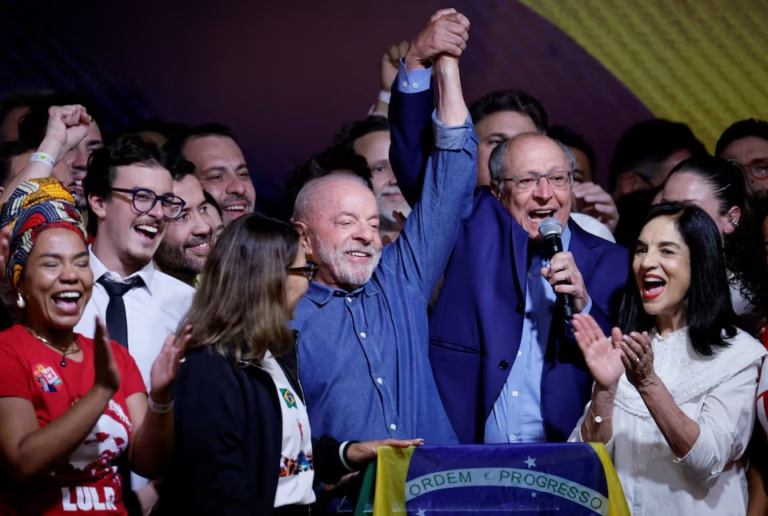
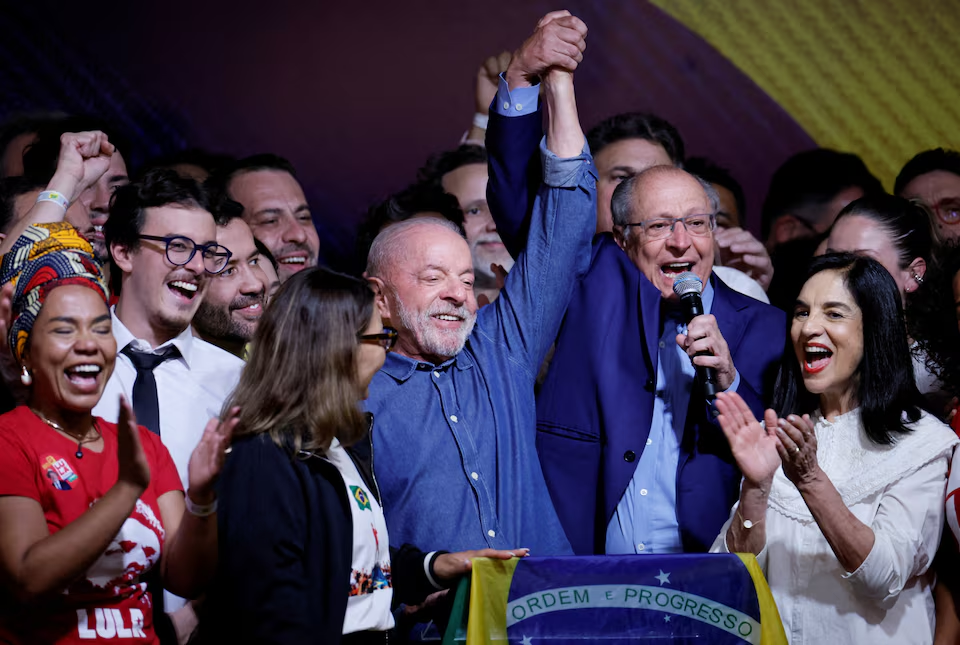
Speaking at a hotel in Sao Paulo late on Sunday, Lula took a conciliatory tone. He did not call for national unity, and he explained why.

“I won’t speak of national unity, because that doesn’t always fit the reality of this country. No one is obliged to like the elected president, but he was put in place to govern for everyone,” Lula said.

The remark accepts that Brazil is divided and that many voters chose his opponent. It sets a smaller goal than reconciliation. He said he would govern for everyone, including those who did not vote for him, and did not ask them to like him.

A Congress that leans right

During the campaign, Lula pointed to his record of cutting poverty and inequality. He also cited record low unemployment, illiteracy and deforestation.

His fourth term may be difficult. He will face a hard fight to pass his agenda in a Congress full of Bolsonaro allies. A surge of conservative voters in the first round of the general election pushed the legislature further to the right.

That arithmetic limits what a president can do, whatever the size of his winning margin. Spending plans, tax changes and any attempt to reassure investors on the budget will need votes from lawmakers who campaigned against him.

“The challenges are countless,” said Carlos Melo, a political science professor at Insper in Sao Paulo.

The risk of street protests

Reuters reports that observers see protests as a possibility, and Brazil has a recent example of how they can turn. The storming of government buildings after the 2022 election shows that anger over a result can lead to physical action against state institutions. The size of Lula’s margin and the broad acceptance abroad give the authorities a stronger position than they had in earlier disputes. They do not remove the risk, because a refusal to concede from a leading opposition figure can keep supporters who already doubt the system from accepting the count.

What to watch next

Several things will show how this election ends. The first is whether Flavio Bolsonaro files his annulment petition and how the courts respond. The second is whether his supporters take to the streets, as they did after the 2022 election. The third is whether the United States recognises Lula’s victory, since the White House and the State Department have so far said nothing. The fourth is how markets behave once the initial selling slows, and whether Lula’s government offers the fiscal commitments that Abadia says investors want.

The answers will arrive at different speeds. Court filings and market prices move within days. A decision from Washington depends on a White House that has not yet spoken. Congress will show its hand only when the new government sends its first bills.

For Lula, the immediate task is to take office with a result that most of the world has accepted and a minority at home that has not. His opponents hold a large share of Congress, and his opponent has said he will not recognise the vote. The next few weeks will show whether that refusal stays a statement or becomes a mass movement.

World News

Israel Votes as Be’eri Survivors Demand Netanyahu Answer for October 7

By George Mensah 7 min read

Israelis vote on Tuesday, October 27, in an election that many survivors and relatives of the October 7, 2023 victims see as a chance to remove the prime minister who led the country on the day of the Hamas attack and has led it ever since. Polls point to a sharp fall in support for Benjamin Netanyahu’s Likud party, yet none of the likely outcomes guarantees the formal reckoning his critics want.

At Be’eri, a kibbutz near the Gaza border, the vote carries a personal weight. Gal Cohen, 61, walks along a memorial wall engraved with the names of the men, women and children killed there on the day of the attack. He says the thought that Netanyahu could win again hurts.

“If this government will stay, many hearts and minds will be broken. It will be really hard to continue,” Cohen said.

A community that lost one in ten

Hamas killed 1,200 people in its surprise attack of October 7, 2023, the deadliest single day in Israel’s history. One in ten residents of Be’eri was among them. With around 1,000 residents today, that ratio points to roughly 100 people lost from one small community. Dozens more were among the 251 people taken hostage to Gaza.

In the days after the attack, the kibbutz was full of Israeli soldiers moving through burnt and shattered homes. Floors were stained with blood and doors were pierced with bullet holes. In some spots the smell of dead bodies still hung in the air. Shelling and the noise of Israeli war planes flying over Gaza did not stop.

Three years later, the place looks different. The kibbutz is running again, and construction crews are building new houses across its green grounds. Most members now live in another kibbutz and are expected to return by summer.

Cohen says Netanyahu should have taken responsibility and stepped down. That he has served a full term since, in Cohen’s words, is a “slap in the face”. He calls Tuesday’s election critical for Israel.

What Netanyahu says, and what he has refused

Gal Cohen walks along a memorial wall engraved with the names of the men, women and children slain in the October 7 2023 Hamas attack on Kibbutz Beeri

Netanyahu has rejected blame for the security breach. He has also resisted calls for an independent investigation into the failures of that day. His opponents describe the failure as the worst in generations, and many of them see this election as the first practical chance to hold someone to account for it.

The prime minister gives a different account of his record. He says Israel’s wars against Hamas in Gaza and against Hamas’s allies in Lebanon and Iran will produce a more peaceful Middle East. On the campaign trail he has said the task will be complete only with the downfall of Iran’s clerical rulers, and that only he has the conviction and standing to deliver it.

That argument sets the terms of the contest. Voters who accept it see Netanyahu as the leader best placed to finish a military campaign. Voters who reject it see a man asking for more time after the worst day in the country’s history, without having answered for it.

A likely loss, but no clear winner

Miri Gad Messika, who survived the deadly attack by Hamas on October 7, 2023 looks on during a visit to Kibbutz Beeri

Opinion polls have predicted for months that Likud will lose a large share of its seats. Netanyahu is Israel’s longest-serving prime minister, and a fall of that size would cost him seats in the coalition he has led.

A loss in seats does not mean a loss of power. The rival alliance trying to unseat him spans parties on the right, the left and the centre. Reuters reports that it also has no clear path to a majority. The likely result is months of political stalemate, with Netanyahu possibly at the head of a caretaker government while the parties bargain.

That outcome would be the worst case for the people who want a verdict. A caretaker prime minister keeps his office and his authority over the investigation question. The independent inquiry that his critics demand would stay unsettled for as long as the coalition talks run.

The campaign has run alongside the wars he cites. Israel has fought Hamas in Gaza and Hamas’s allies in Lebanon and Iran, and Netanyahu presents those campaigns as unfinished. His critics say the same record raises a question he has not answered. If the wars are the reason to keep him in office, they ask, who is responsible for the failure that started them?

“Two clicks to the right”

Be’eri’s politics make the picture harder to read. The kibbutz was founded in 1946 as a collective community. It reflects the socialist values that shaped Israeli politics in the country’s early decades. Nearly all its votes went to the centre-left in the 2022 election, and only around 4 per cent went to parties in Netanyahu’s nationalist-religious coalition.

The attack changed how many residents think about peace. It made them question longstanding views that peace with the Palestinians was possible in this generation.

“Everyone in Be’eri has made two clicks to the right,” Cohen said. “But I still think that most of us will stay with the opposition, the parties that want to replace this government.”

So the shift is real but limited. Residents who once voted for the centre-left are more hawkish on security. They have not moved to Netanyahu. The vote at Be’eri, like the national vote, depends on whether that hardening helps the prime minister or only changes what voters want from the opposition.

Miri Gad Messika, 48, is a third-generation member of the kibbutz and has not yet decided how to vote. She is sure of one thing. It will not be for Netanyahu.

“He failed as a leader so many times. And he shouldn’t be in politics anymore,” she said. “I’m looking for a leader. Unfortunately, it’s hard for me to see any leader in Israel at the moment.”

She added: “I want to be optimistic, and I can only hope for a better change.”

Her comment points to a problem for the opposition. A voter can be sure about the man they reject and still be unsure about the person to put in his place.

The hostage families keep the pressure on

For much of the past three years, opposition to the government has gathered around the families of hostages taken to Gaza. Some of them accused the government of dodging responsibility and doing too little to win their relatives’ release.

A Tel Aviv open space came to be known as Hostages Square and became the site of constant rallies and vigils. The last of the hostages were released under a ceasefire brokered by the United States a year ago. The families remain among the most visible voices calling for accountability.

“I don’t see any legitimate reason why this government is running again for election,” said Ofri Bibas. Her nephews, a 4-year-old and a 9-month-old, were killed in captivity in Gaza along with their mother. Their father, her brother Yarden, was freed in an early 2025 truce.

Bibas said her aim now is to make every Israeli remember October 7. She wants people “to take it with them to the day of the election and remember what happened here and who still hasn’t taken responsibility.”

With the hostages home, the families’ focus has moved from securing releases to demanding answers. Their stated aim is accountability for what happened.

A final rally before the vote

On Saturday, thousands of Israelis rallied again in Hostages Square. One of the speakers was Danielle Alony, who was kidnapped from the kibbutz of Nir Oz with her 5-year-old daughter and freed from Gaza in a brief truce weeks later.

“Go vote,” Alony told the crowd. “In three days we can start writing a new chapter for our children. One in which truth is stronger than fear, responsibility stronger than dereliction and hope is stronger than pain.”

What to watch after Tuesday

Three questions will decide whether the vote delivers what these families want. The first is how many seats Likud loses, because the size of the fall sets how much bargaining power Netanyahu keeps. The second is whether the opposition alliance, which covers parties from the right to the left, can agree on a candidate and a programme, since its members share an aim of removing him but not a shared platform. The third is whether any government that forms will agree to an independent investigation, which Netanyahu has so far resisted.

If the count produces a stalemate, Israelis may spend weeks or months in coalition talks with Netanyahu as caretaker prime minister. For residents of Be’eri who are moving back into rebuilt homes by summer, that would mean returning to a community that still has no official account of how October 7 happened and no ruling on who was responsible.

ADVERTISEMENT
Scroll to Top