
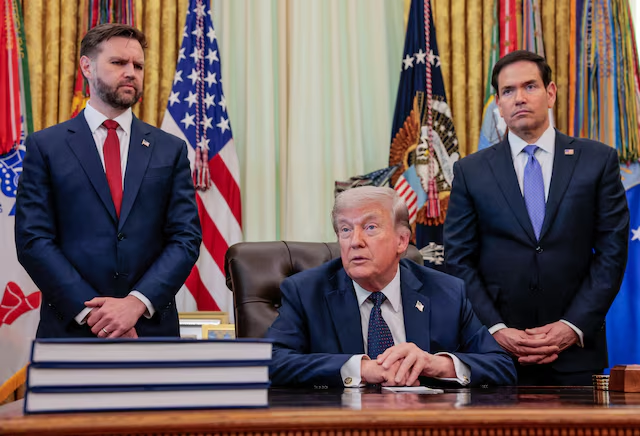
JD Vance and Marco Rubio are supposed to be on the same page when it comes to Iran and the Middle East. Lately, their public comments suggest otherwise.
Over the past week, the vice president and secretary of state have taken noticeably different tones on Israel’s operations in Lebanon and where things stand with Iran. The White House says there’s no daylight between them. Foreign policy analysts aren’t so sure.
Different Takes on Israel and Lebanon
The clearest split showed up over Israel’s campaign against Hezbollah in Lebanon. At the White House last week, Vance criticized parts of Israel’s approach, arguing that strikes on civilian infrastructure in Beirut could undercut U.S. diplomatic efforts in the region. He said Washington still backs Israel’s security, but warned that actions which escalate tensions make a broader peace deal harder to reach.
That kind of public pushback on Israeli strategy is unusual for a senior Republican official.
Rubio, touring the Gulf, took the opposite stance. He repeatedly defended Israel’s operations as a legitimate response to Hezbollah attacks on Israeli territory and military positions. Asked directly about Vance’s comments, he sidestepped the question and instead pointed to Israel’s right to defend itself, citing recent Hezbollah attacks as proof the threat is still real.
Iran Deal, Two Different Pitches
Both men have been selling the preliminary U.S.-Iran agreement reached on June 17, just not the same way.
Vance has leaned optimistic. During a trip to Switzerland for talks with Iranian officials, he floated the idea that Gulf states could eventually help rebuild Iran’s economy and talked up the possibility of warmer relations with Tehran if Iran sticks to the deal’s terms. He also revealed that the U.S. had invited an Iranian intelligence official to act as a liaison with the Pentagon in Qatar, a move meant to cut down the risk of miscalculation between the two militaries.
Rubio’s version has been far more guarded. On visits to the UAE, Kuwait and Bahrain, he focused on reassuring Gulf allies who’ve privately worried the interim deal gives Iran too much. He told them any final agreement has to protect both American and allied interests.
“While we want a deal, we don’t want a deal at any price,” Rubio said.
He also waved off the idea of Gulf states funding Iran’s reconstruction, calling that conversation premature.
The White House Says There’s No Rift
White House spokeswoman Anna Kelly rejected any suggestion of division.
“There is one camp, President Trump’s camp,” she said.
The administration says everyone shares the same goal: keeping Iran from getting a nuclear weapon while pursuing diplomacy that protects American interests. State Department spokesman Tommy Pigott called talk of a split a “fake narrative,” and a separate department official said there’s no real disagreement over Lebanon, since the broader goal is stabilizing Lebanon’s government.
Analysts See Something Real Underneath
Not everyone buys the unity message. Michael Rubin, a senior fellow at the American Enterprise Institute, said the differences track two distinct strands of Republican foreign policy thinking.
“At their core, they represent different strains of Republican foreign policy,” Rubin said.
The backgrounds support that read. Vance spent years before the White House criticizing foreign interventions as costly with little payoff. Rubio built his Senate career as a hawk pushing hard lines against Iran, Russia and Cuba.
A Preview of the Party’s Next Fight
Both men are seen as likely 2028 contenders, which gives their disagreement extra weight. It also reflects a split running through the broader Republican Party: one wing favors continued military engagement abroad as a way to maintain global stability, while a growing wing argues many past interventions were mistakes and wants a more cautious approach.
A recent Reuters/Ipsos poll found just 52% of Republicans think the current conflict has strengthened America’s standing in the world, a number that suggests the party is still working through where it lands on this.
Where They Agree
For all the differences in tone, Vance and Rubio have backed the same major decisions: military action against Iran, the effort to capture Venezuelan leader Nicolás Maduro, and the push for a diplomatic deal with Tehran. Both have used nearly identical language insisting the administration will judge Iran by its actions, not its promises.
When asked directly if his views differed from Vance’s, Rubio tried to shut the question down.
“Everyone here is aligned behind the president,” he said.
Whether that holds, or whether the gap between them widens as Iran talks continue, may say as much about the GOP’s direction as it does about this administration’s foreign policy.