

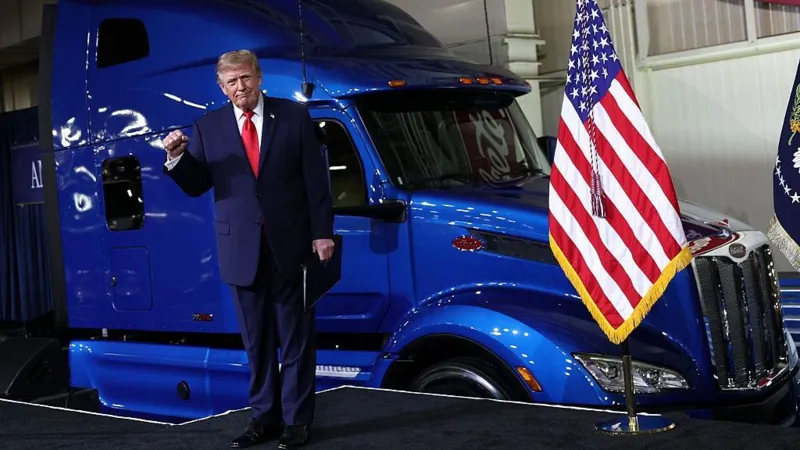
With a few weeks left before the US midterm elections, President Donald Trump on Friday announced a deal with Russian President Vladimir Putin to release Russian diesel to American and global markets. It is his latest attempt to bring down fuel costs that have more than doubled since the US-Israel conflict with Iran began in February. Analysts quoted by the BBC say high prices will outlast this announcement.
The price rise has hit transport businesses, farmers and anyone who drives a vehicle in America. Calls for action have grown as voters move toward the polls, and Trump has made several announcements aimed at getting costs down.
What Trump announced
Trump said the arrangement covers an immediate supply of over 300,000 tonnes of Russian diesel, 500,000 tonnes in November and a further million tonnes “immediately thereafter”. By his own account, diesel prices in the US and across the world “will be COMING DOWN, IN RECORD NUMBERS, AND FAST!”
“Lower prices for Americans, especially our Great Farmers, Ranchers, and Truckers, is my Greatest Priority,” he said.
He added that another 3m tonnes would be delivered “within a short period” after that, depending on the condition of Russia’s refineries. The three batches he named without conditions add up to at least 1.8 million tonnes. That total is our own arithmetic, not a figure either government has published.
Fuel prices and the midterm vote
Earlier in the week, at a campaign stop, Trump announced a waiver on red dye diesel. The move shows how much weight gas prices carry in an election dominated by affordability.
Public worry over the cost of fuel, food and other goods is widespread. Voters have tied the issue to Trump and his party, and it is weighing on Republicans running in November. Polls show a majority of Americans disapprove of how Trump is handling the economy and the war in Iran, which has contributed to high diesel and gasoline prices.
What is pushing prices up

Global oil supplies have been restricted since the conflict in the Middle East effectively halted the usual flow of oil and refined products through the Strait of Hormuz for months. Crude is flowing again at nearly pre-war levels, but the price remains above $100 a barrel. Those sustained crude prices have carried through to diesel and gasoline.
Russia’s war with Ukraine also plays a part. David Ruisard, pricing manager at the commodities intelligence firm Argus, put numbers on the split.
“Our estimates are that your price increase from about $3 a gallon up to $6 a gallon [for diesel] is 60% connected to the Strait of Hormuz, 40% connected to the Russia-Ukraine conflict,” he said.
Apply his percentages to the $3 increase and about $1.80 of it traces to Hormuz and about $1.20 to the Russia-Ukraine conflict. Those dollar amounts are our calculation from his estimate. They suggest the larger share of the increase comes from a disruption that Russian cargoes cannot reach.
Michael Pearce, chief US economist at Oxford Economics, said higher energy prices account for most of this year’s rise in inflation, which is pushing up interest rates. “The combined impact of higher rates and higher energy prices is squeezing household budgets and adding to firms’ costs,” he said.
Prices are still high, but Patrick De Haan, head of petroleum analysis at the fuel price tracking site GasBuddy, said gasoline and diesel have both seen modest declines recently. “A lot of that is likely due to some of the manoeuvres that we’ve seen the Trump administration employ over the last couple of weeks,” he said.
What Trump has already tried
Friday’s diesel deal follows a series of other policies and ideas.
Red dye diesel. This week Trump said he would let so-called red dye diesel, which is used off-road and carries no federal tax, be used on US highways without federal levies. Ruisard said the only difference between that fuel and the diesel used by truck drivers and everyday consumers is the dye.
The dye is the problem. “It’s extremely hard to clean it out of your tank,” Ruisard said. Trucking companies that fill up with dyed diesel face a question once the temporary tax relief ends. “The fines are pretty high for having that in your fuel tank because it’s considered tax evasion,” he said.
He raised a second issue. People and businesses, rail operators among them, usually set aside a fixed amount of red dye diesel. “If suddenly people go out and they start consuming that diesel, that depletes their available supply as well,” he said.
Stockpile releases. Last week the G7 countries announced they would release 100 million barrels of oil and diesel from stockpiles, after pressure from Trump. Analysts rate this one as more effective. De Haan said the announcement alone, whatever has physically been released so far, “has worked to push prices down to some degree”.
Pearce agreed but called the release temporary. “As long as energy exports from the Gulf remain disrupted, stocks will need to be drained further to supply the market,” he said. “And the need to refill those stocks will mean energy prices remain elevated for a period, even when disruption in the Middle East clears.”
State gasoline taxes. Trump has urged states to cut their own gasoline taxes, and several have, including Ohio and Georgia. De Haan said state taxes make up a “moderate portion” of what consumers pay at the pump, and the cuts have helped lower prices and national averages. They cost money. By De Haan’s estimate, Indiana’s May cut has cost the state government $1bn (£760m) in lost revenue.
The federal gasoline tax. Trump said earlier this week he was “thinking about” suspending it. That would need Congress to cooperate. “That may be difficult to obtain ahead of the midterm elections,” De Haan said.
A diesel export ban. Trump has previously supported calls to ban diesel exports from the US. Pearce said this would give partial relief in the Gulf and the Midwest, but “little benefit” to the Northeast and the West Coast. He also warned of a side effect. “The policy risks backfiring because it would result in stockpiling of diesel, and as that storage runs out, refineries would need to cut back on production,” he said. “That would raise prices of other energy products, including gasoline.”
The options that remain
De Haan thinks the president has “basically pulled all of the small levers that a president can pull, and we’re still seeing prices very elevated”.
In his view the remaining answer lies outside fuel policy. “The only way out of this to reduce gas prices in a meaningful way is solve one or both of the geopolitical tensions that are causing high prices,” he said. That means reaching a deal with Iran and helping to broker an agreement between Ukraine and Russia. Pearce noted that the White House cannot directly control either.
Even a settlement would not bring quick relief. Ruisard said damage to Middle East facilities from military strikes means production would still need four to six months to return to normal. Counted from today, that points to a window between February and April 2027, and only if a deal came immediately.
“The message to consumers and industry is that regardless of what happens and whether the president is able to successfully negotiate that kind of a deal,” Ruisard said. “High prices are here to stay for a little while at least.”
What to watch next
The first test of the Russian arrangement is the November shipment of 500,000 tonnes. The three million tonne batch after it depends on the condition of Russian refineries, so its timing is open.
Three other items will decide how drivers and businesses feel by election day. The first is whether Congress takes up a federal gasoline tax suspension, which De Haan expects to be hard to win. The second is whether more states follow Ohio and Georgia and cut their own taxes, with Indiana’s $1bn cost as a warning to state budgets. The third is whether talks on Iran or on Ukraine and Russia produce anything before November.
Each of those depends on governments the White House does not control, or on a legislature that has to agree. The analysts quoted here treat the Russian diesel deal as a modest, temporary help at best. Their shared view is that fuel prices will fall in a meaningful way only after the conflicts behind them are settled, and that even then relief would take months to reach the pump.
Sources: BBC News reporting on Trump’s Russian diesel announcement and US fuel prices; statements from Donald Trump; comments from David Ruisard (Argus), Michael Pearce (Oxford Economics) and Patrick De Haan (GasBuddy).