Clicxpost

World News

Flydubai Co-Pilot Accused of Trying to Crash Jet Bound for Israel

Smit Machchhar

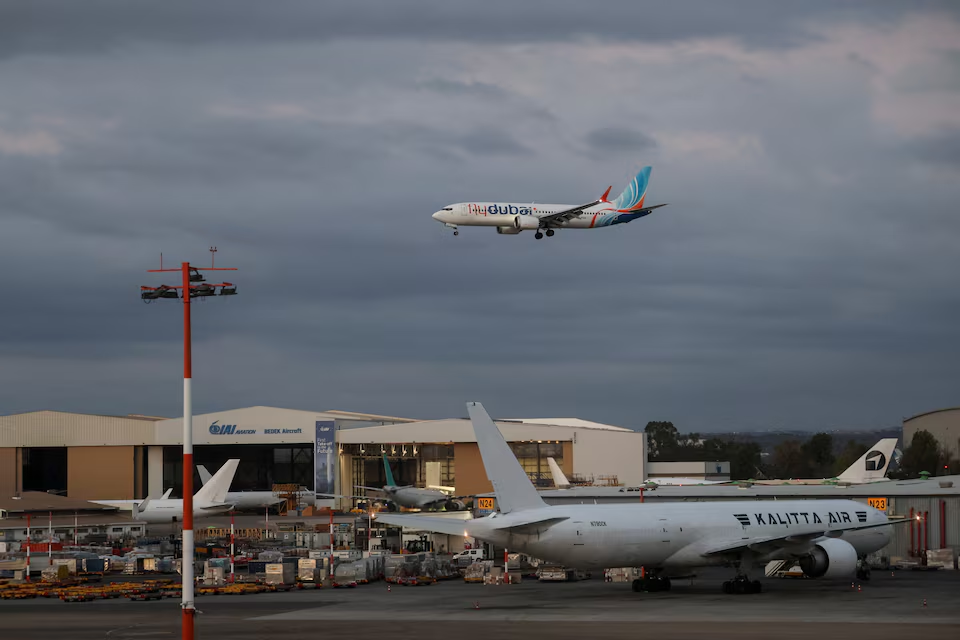
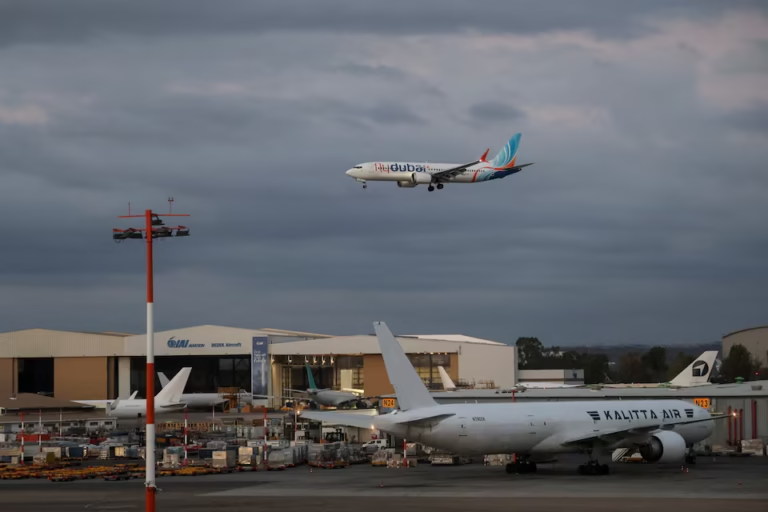
Questions remained on Thursday about the motives and background of a co-pilot who stabbed the captain of a passenger jet bound for Israel. Israeli officials say it was an apparent attempt to crash the plane, which had more than 170 people on board. Flydubai flight FZ1073 was flying from Dubai to Tel Aviv on Wednesday when the attack happened. The wounded captain managed to unlock the cockpit door, passengers subdued the attacker, and a reserve crew on board landed the plane in Saudi Arabia.

What Happened on Flight FZ1073

The flight dropped nearly 14,000 feet in less than 30 seconds while over Saudi Arabia. Passengers and crew then managed to subdue the attacker and land the aircraft at Tabuk airport.

Tabuk airport said both pilots were taken to hospital with injuries. Flydubai said the underlying reasons for the event remained unknown and warned against “premature speculation.” The airline confirmed an altercation in the flight deck and sent two replacement aircraft to Tabuk for the passengers and crew. Passengers were later flown back to Israel.

One of the men who helped overpower the attacker, Yaniv Hayun, described running to the cockpit as the plane nosedived. “We pulled the assailant out, I pulled him out,” he told reporters on his return to Israel on Wednesday. “After I pulled him out we took control of the plane, I pulled up the yoke (steering control of the plane), I straightened the plane out a bit.”

What Israeli Officials Says

Israeli Defense Minister Israel Katz said on Wednesday that Israel’s preliminary information indicated the co-pilot aimed to crash the plane. He described him as a terrorist. Prime Minister Benjamin Netanyahu used softer words and called it only “a serious security incident.”

Netanyahu said in a Fox News interview that the attacker was being investigated in Saudi Arabia and that he believed he would be taken to the United Arab Emirates. “We’ll be following and possibly also participating in this investigation,” he said.

Asked about Iran, Netanyahu said it was too early to tell. “We’ll get to the root of this attacker, whether he had accomplices, whether Iran was behind it,” he said. “I think we’ll find out very soon.” Israel has made no official suggestion of Iranian involvement.

The motive remains unestablished. Investigators have not said publicly whether the aim was to crash the plane or to take hostages.

Who Is Investigating

The UAE has opened investigations to establish the circumstances and motives. The UAE state news agency said they would seek to determine “whether the incident was linked to any terrorist activity or purpose, or involved prior planning or direction.”

UAE judicial authorities have jurisdiction because the aircraft is registered in the UAE and flies under its flag. The statement said UAE law applies to crimes committed on board even if they occur outside the country’s territory. Saudi Arabia has issued no statements on its own investigation.

Questions About the Co-Pilot

An Israeli official identified the attacker on Wednesday as an Omani national. Omani authorities have not commented on the report.

Israel Hayom reported that the co-pilot had worked for Flydubai for about nine months. Multiple Israeli agencies are examining how he was cleared to fly an Israel-bound service, what security checks came before his hiring and whether aviation-security arrangements were followed. His name has not been released.

The Captain

Netanyahu and Indian Prime Minister Narendra Modi have called the captain, Indian national Smit Machchhar, a hero. Netanyahu said Machchhar had apparently been stabbed or hit with an axe by the other pilot and had bled heavily. India’s ambassador to the UAE met Machchhar’s family and briefed him on the captain’s health and recovery, the Indian consulate in the UAE said.

Israel has also praised the passengers who subdued the attacker.

A Tense Backdrop

The incident raised security fears in Israel weeks before an election. It is the first since the Hamas-led attacks of October 7, 2023, and security features heavily in the campaign.

The United States and Israel launched strikes on Iran in February in a conflict that quickly spread to the Gulf and to Lebanon. Israel has been fighting Iran-backed Hezbollah there. That context is why Netanyahu was asked about Iran and why officials in several countries are treating the case carefully.

What Happens Next

Several questions are open. Authorities have not published a motive. They have not said whether he acted alone, or why he is thought to have tried to crash the aircraft. Accounts of exactly what happened in the cockpit differ, including which weapon was used.

The UAE inquiry will test whether the incident had a link to terrorist activity or to planning or direction by others. Saudi Arabia and Israel are running their own investigations. Netanyahu said on Thursday that answers could come “very soon,” but no official timetable has been given.
RECOMMENDED
World News

US Troops Leave Iraq as Iran’s Guards Tell Americans to Vote Out Trump’s Allies

By George Mensah 5 min read

Iran’s Islamic Revolutionary Guard Corps told Americans on Tuesday to vote out President Donald Trump’s allies in Congress. The message came a day before US forces were due to leave their last remaining bases in Iraq. The Guards published a 26-page letter through Iranian media, and it reached the public as the war between Iran and the United States entered its seventh month. Qatar, for its part, kept carrying messages between the two governments in an effort to end it.

Tehran sees the Iraq exit, scheduled for Wednesday, September 30, as a victory. Washington has not described it that way. The timing puts three things in one news cycle: a foreign military force appealing directly to US voters, the end of a US presence in Iraq that began in 2003, and a war with no settlement in sight.

What the Guards’ letter asks of Americans

The letter, published Tuesday, tells Americans to use their votes to remove the leaders now in office. It also asks them to reject US backing for Israel and American military action abroad. In one passage, the Guards tell readers to make sure their politicians understand the world has changed.

Few US voters are likely to read it. Iranian outlets carried the text, and it was not aimed at American media. Still, the subjects it raises are ones already dominating the campaign. Congressional elections take place on November 3, and the opposition Democrats have a chance to win back one or both chambers. A Democratic Congress could slow Trump’s agenda.

The polling behind the timing

Trump ran in 2024 promising to avoid new wars, end the ones already under way and bring down inflation. The war with Iran, which he started together with Israel, has pushed up fuel prices worldwide and spread fighting across the Middle East.

A Reuters/Ipsos poll released September 21 gives a sense of how that is landing. Only 17% of respondents approved of how Trump is handling the cost of living, which Americans name as the top issue for their vote in November. Just 34% approved of the strikes on Iran. Those are the same two subjects the Guards chose to press.

The last American troops in Iraq

The final pullout follows an agreement reached in 2024 under then-President Joe Biden. Trump let it go ahead. That fits a position he has held since 2016, when he broke with Republican orthodoxy by calling the US invasion of Iraq a major mistake.

The withdrawal arrives 23 years after US-led forces removed Saddam Hussein. The upheaval that followed eventually produced the rise of Islamic State.

Iran reads the departure through its own goals. Officials there say their ultimate aim is to force American troops out of the entire Middle East. They present Iraq as a win for the “axis of resistance,” their name for allied armed groups across the region.

Those groups are involved in the current war. The Houthis in Yemen, Hezbollah in Lebanon and militias in Iraq have all been drawn in. Saudi Arabia blamed the Iraqi militias for the September 10 attack that knocked the East-West Pipeline offline.

Qatar tries to broker a deal

Qatar is again acting as mediator. Its earlier role was smaller: it helped produce a June memorandum of understanding that led to a short ceasefire. Since then, rounds of talks and several ceasefires have failed to end the fighting.

US and Iranian officials spoke separately with Qatari mediators on Monday. It was not clear whether more exchanges took place Tuesday. Qatari Foreign Ministry spokesperson Majed al-Ansari described the process to reporters. “We are exchanging messages between the parties,” he said, adding that Qatar is working toward common ground for a deal.

Negotiations appeared to pick up last week around the UN General Assembly in New York. They have not produced an agreement to reopen the Strait of Hormuz. Before the war began in February, 20% of the world’s oil and liquefied natural gas moved through it. Its closure to normal traffic is a main reason energy prices have climbed.

Iran’s seven-day proposal and Trump’s answer

At the General Assembly, Iran put forward a plan that would start a seven-day countdown to reopening the strait and pause the fighting. Trump rejected it on Saturday.

Iranian Foreign Minister Abbas Araqchi said on Sunday that Washington had not formally passed a rejection through the mediators. The two sides therefore disagree on whether the proposal is dead or simply unanswered, and that gap is one of the more useful things to watch in the coming days.

Trump spoke to reporters on Tuesday and again predicted Iran would give up. He said he did not know when, but that it would happen, and that Iran is doing very poorly. He also repeated two positions: Iran must not obtain a nuclear weapon, and the war will end soon.

He has named three goals for the war. The first is weakening Iran’s nuclear capabilities. The second is ending its ability to attack neighbouring countries. The third is creating conditions in which Iranians could overthrow their leadership.

On the nuclear question, Iran does not have nuclear weapons and denies trying to build them. The United States is nuclear-armed. Tehran says that as a party to the Non-Proliferation Treaty it has the right to develop nuclear technology for peaceful purposes.

What the war has cost so far

The fighting has degraded Iran’s conventional forces and damaged an economy that was already struggling. Iran has not stopped responding. It has hit US allies in the Gulf with missiles and drones and has restricted oil tanker traffic through the strait.

Each side can point to something that supports its claim to be winning. Washington can cite damaged Iranian forces and a weaker economy. Tehran can cite a closed strait, higher prices for countries far from the fighting, and an American withdrawal from Iraq that it did not have to negotiate.

What happens next

The Iraq withdrawal is due to be complete Wednesday, which ends the US military presence there that began in 2003. Qatar’s message-passing continues, and the most immediate question is whether Washington gives a formal answer to the seven-day plan or lets it lapse.

The larger test is on November 3. If voters respond to prices and to the war the way the Reuters/Ipsos numbers suggest, Trump could face a Congress able to block his plans. Iran’s Guards are betting on that outcome. Whether their letter has any effect is uncertain, but the polling it points to is public and easy to check.

World News

Iran Says Only Diplomacy Can End US Standoff After Trump Rejects Hormuz Deal

By George Mensah 5 min read

Iran said Sunday that diplomacy remains the only path out of its conflict with the United States and Israel, a day after President Donald Trump said he had turned down an Iranian offer to reopen the Strait of Hormuz and halt the fighting.

Iranian Foreign Minister Abbas Araqchi posted on social media that Tehran’s position had not changed. “Our conditions are clear, and any move toward reopening the Strait of Hormuz is contingent on these conditions being met,” he wrote. “Only a negotiated solution can get them out of this deadlock.”

Iran put the proposal forward last week at the UN General Assembly in New York. Tehran said the offer reached Washington through Qatari mediators. Trump rejected it Saturday, telling reporters at the White House that Iran’s push for a deal was a sign of weakness, not goodwill.

“They want to make a deal to open the Hormuz Strait immediately because they’re losing so badly,” Trump said.

Mediators Have Not Confirmed a Formal Rejection

Araqchi said the mediators handling talks between Tehran and Washington had not officially informed Iran that the US had turned down the plan, despite Trump’s public comments.

“We are waiting for the mediators to convey the definitive views to us, and we will make a decision based on them,” Araqchi wrote.

The US has maintained an economic blockade on Iran meant to pressure Tehran into stopping attacks on vessels moving through the Strait of Hormuz. Those attacks have sharply cut shipping traffic through the waterway, even as Trump has repeatedly said the US controls it.

The Wall Street Journal first reported Trump’s rejection of the Iranian plan, citing unnamed US officials. The paper reported that Trump was privately doubtful Iran would meet his conditions and had told his staff he expects to resume bombing after the November US midterm elections.

One US official said earlier that talks with Iran through mediators had been “positive and constructive.”

Iranian Military Commander Warns of a Decisive Stage

Amir Hatam, commander-in-chief of Iran’s army, said the war had reached a critical and decisive point. He said Tehran would not accept a situation where foreign powers control regional shipping lanes while Iran is unable to trade.

“If Iran cannot trade, if Iran cannot live, no one will be able to trade or live,” Hatam said, according to comments carried by state media.

Conflict Has Cut Into Oil Flows and Regional Trade

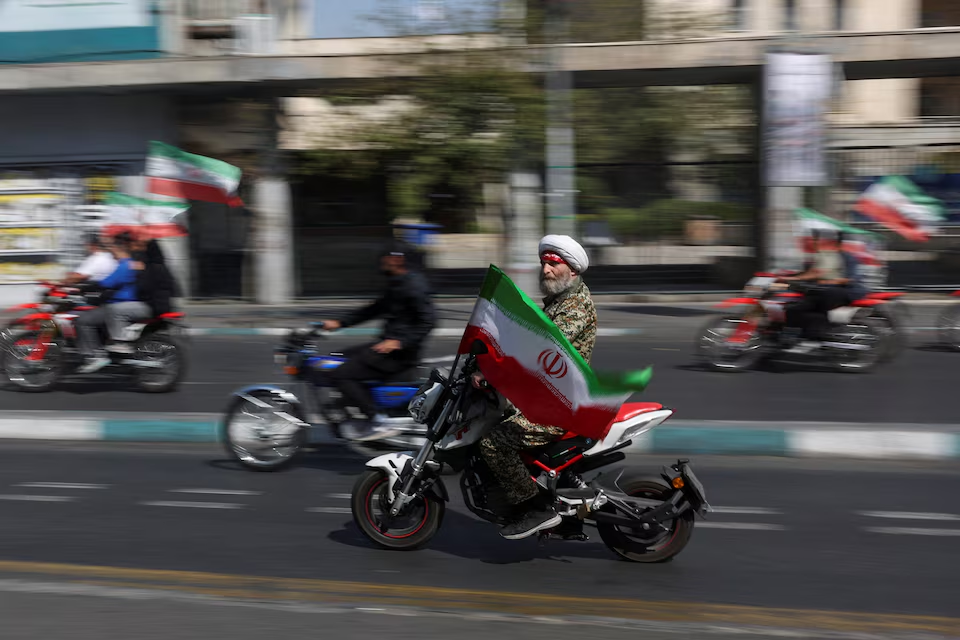
An Iranian woman shouts during a march in Tehran

Iran has also approached Saudi Arabia, a regional rival, over the Strait of Hormuz. The outreach reflects how much is riding on a war that has run for seven months, disrupted oil shipments through one of the world’s busiest maritime corridors, and weighed on the global economy.

Araqchi told reporters at the UN on Friday that the proposed deal would set off a seven-day countdown to reopening the strait alongside a pause in regional fighting.

“If there is seriousness on the US side to come to a deal and reopen the Strait of Hormuz, everything is now prepared,” Araqchi said. He added that if Washington agreed, the two sides could move into broader talks “on mutually agreed subjects.”

Those talks could eventually touch on Iran’s nuclear program. Trump has said stopping Iran from building a nuclear weapon was a central reason for launching the war, along with ending Iran’s capacity to strike its neighbors and creating conditions for Iranians to remove their government.

Iran Rules Out Nuclear Concessions

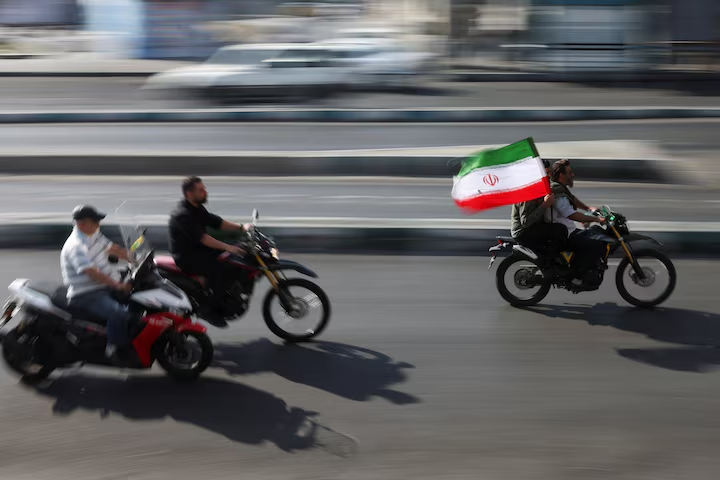
Members of Iranian militia forces (Basij) ride on motorcycles as they participate in a march in Tehran

A senior Iranian official told Reuters that Tehran would not soften its position on its nuclear program even if the US accepted the peace proposal. The official said Iran would not give up its right to enrich uranium or agree to ship its stockpile of highly enriched uranium out of the country.

Iranian President Masoud Pezeshkian struck a similar note in an interview with CBS’s “Face the Nation.” He said Iran was open to talks on its nuclear program and other issues but would not accept “bullying or coercion.”

“Iran is not seeking war, but will defend itself against pressure, threats and attacks,” Pezeshkian said. He added that Iran had already agreed that “we’re not supposed to develop nuclear weapons.”

A War That Has Resisted Diplomacy Since February

Earlier diplomatic efforts have failed to stop the fighting, which started on February 28 with US and Israeli strikes on Iran. The war has since moved between lulls and renewed attacks, killing thousands of people, weakening Iran’s conventional military, and adding further strain to an economy already under pressure.

Iran and its regional allies have widened the conflict well beyond their own borders. Iran has fired drones and missiles at US allies in the Gulf, while Yemen’s Houthi movement, aligned with Tehran, has struck Saudi targets.

Seven Killed in Yemen Strike

Yemen’s Houthi-run health ministry said a strike on shops at a market in the Mawiya junction area of Taiz province, in the southwest of the country, killed seven people and wounded 40 others, including children, on Sunday.

Yemen’s internationally recognized government said afterward that its forces had targeted a Houthi military camp and vehicles at the same junction.

The competing accounts point to how the war in Yemen, layered on top of the broader Iran-US-Israel conflict, continues to draw in civilians far from the original front lines. With mediators still working to confirm Washington’s position on the Hormuz proposal and both sides holding firm on the nuclear question, the chances of a near-term breakthrough remain uncertain.

ADVERTISEMENT
Scroll to Top