
The United States has secured control over more than 65 billion barrels of Venezuelan oil reserves under a new agreement announced by President Donald Trump on August 29, 2026. Trump said the deal would double America’s oil reserves and cut gas prices for consumers nationwide. Venezuela’s interim President Delcy Rodríguez called it a turning point for her country’s battered economy. The agreement covers 17 strategic oil fields and comes seven months after US forces captured former President Nicolás Maduro.
A Deal Struck After Maduro’s Capture
Trump has faced pressure at home to bring down fuel prices, which climbed after the war in Iran disrupted global oil supply. He said he would tap Venezuela’s reserves, the largest in the world, after US special forces captured Maduro and his wife, Cilia Flores, in a January raid on Caracas. Maduro now faces drug trafficking charges in New York.
Rodríguez, Maduro’s former vice-president and the official the US has backed since his capture, granted the new joint venture a 100-year concession to operate in the oil fields, according to an unnamed US official who spoke to CBS News, the BBC’s US partner. Under the terms described by that official, the US government will hold 55% control of the venture alongside an experienced private operator working inside Venezuela.
Trump said Secretary of State Marco Rubio and Defense Secretary Pete Hegseth negotiated the agreement with Venezuela’s leadership through a partnership with private business. He gave no further detail about that partnership or its specific obligations, but he said the deal came “at no cost to the American Taxpayer.”
What Each Side Says It Gets
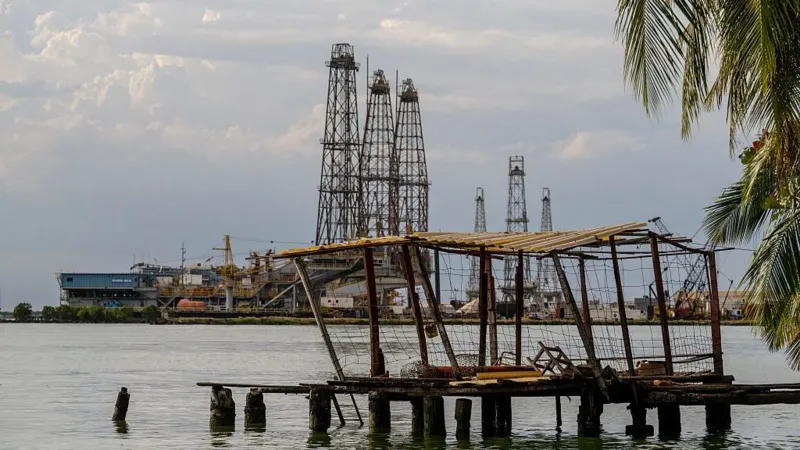
Rubio described the outcome in direct terms. “For the Venezuelan people, this deal will bring nearly $100bn in private investment, support thousands of high-paying jobs and drive the reconstruction of Venezuela’s economy,” he said.
Rodríguez framed the agreement as a lifeline for a country whose oil industry has been in decline for decades. She said it calls for developing the 17 fields, which hold a proven potential of 65 billion barrels, alongside more than $100bn in investment and over $209bn in tax revenue for Venezuela. “These investments will contribute not only to the recovery and modernisation of our industry, but also to our country’s economic growth, the energy security of our hemisphere and greater balance in international markets,” she said, describing the deal’s expected impact on the nation’s revival.
The Wall Street Journal reported on Friday that US energy companies Chevron and Halliburton were nearing separate agreements to invest billions of dollars overhauling infrastructure across Venezuela’s oil fields, many of which sit undeveloped after years of underinvestment.
Critics Question the Deal’s Legality
Not everyone views the arrangement as a partnership between equals. Ricardo Hausmann, a Harvard professor and former Venezuelan planning minister, dismissed the agreement outright. “An illegitimate interim government with an illegitimate hydrocarbons law has no legitimacy to strike this unconstitutional deal,” he wrote on X.
Francisco Rodríguez, a Venezuelan economist and senior research fellow at the Center for Economic and Policy Research in Washington, raised a similar objection. “Handing over Venezuela’s oil wealth to the US contravenes the constitution and is not in the interest of the Venezuelan people, much more when it is done at gunpoint,” he wrote.
Their objections point to a government installed with US backing after a military capture operation, rather than through an election, signing away control of the country’s most valuable natural resource. Trump has not released the full text of the agreement, and it remains unclear whether Venezuelan courts or future governments could challenge its terms.
A Scope Beyond Iraq’s Oil Arrangement
The agreement grants the US a direct role in governing a foreign country’s sovereign resources, a arrangement with few historical parallels. Its scope appears to exceed the authority the US-led Coalition Provisional Authority held over Iraq’s oil revenues following the 2003 invasion that removed Saddam Hussein from power. That earlier arrangement managed revenue on Iraq’s behalf under international oversight. This one hands the US government a 55% ownership stake in the operating venture itself.
Venezuela holds the largest proven oil reserves on Earth, estimated at 303 billion barrels. But output has fallen sharply since peaking in the late 1990s, driven by tighter state control over the national oil company and years of US sanctions targeting the country’s main source of foreign income.
Political Timing at Home
Trump’s emphasis on lower gas prices lands as global oil prices have surged following disruptions to shipping through the Strait of Hormuz in the Persian Gulf, a bottleneck for Middle East exports. That price spike has stirred public frustration ahead of the US midterm elections in November, giving Trump a political incentive to show quick results on energy costs.
The math complicates that promise. Venezuela’s reserves consist largely of heavy, sour crude, oil that requires more complex refining and is generally used for diesel and asphalt rather than gasoline. US refineries are built mostly to process light, sweet crude, the type used to make petrol. Converting Venezuelan output into lower pump prices for American drivers would require new refining capacity or major shifts in how existing refineries operate, neither of which happens quickly.
Trump has said he wants US oil companies to invest at least $100bn to rebuild Venezuela’s oil sector. He has also argued that Venezuela owes the US for past seizures of American oil assets and platforms, which he says cost the country billions of dollars over the years.
What Comes Next
The agreement’s next test will be whether Chevron, Halliburton and other companies formalize their investment plans and whether Venezuela’s fields can be brought back into production fast enough to matter at the pump before November. The unresolved legal questions in Caracas, paired with the unpublished terms of the deal itself, leave room for disputes that could shape how much of this arrangement actually holds.