

Venezuela’s interim administration and a segment of the opposition will meet for U.S.-backed talks on Saturday without the country’s most popular opposition member.
The negotiations are an attempt to change the Venezuelan political system before elections are held. They also illustrate how involved Washington has become in Venezuelan politics since the Trump administration ousted Nicolas Maduro in a raid in January and installed acting President Delcy Rodriguez.
Delcy’s brother Jorge Rodriguez, who also heads the National Assembly, will lead the government’s delegation. He has already negotiated with the U.S. and the opposition. Dinorah Figuera will lead the opposition side, a delegation backed by Washington in its campaign to reform the electoral council and top court so that future elections may be deemed free and fair. Three sources familiar with the case said the U.S. asked Figuera to take on the post as she heads an opposition-controlled national assembly group elected in 2015, which Washington still regards as the country’s last legitimately elected legislature.
A deliberate absence
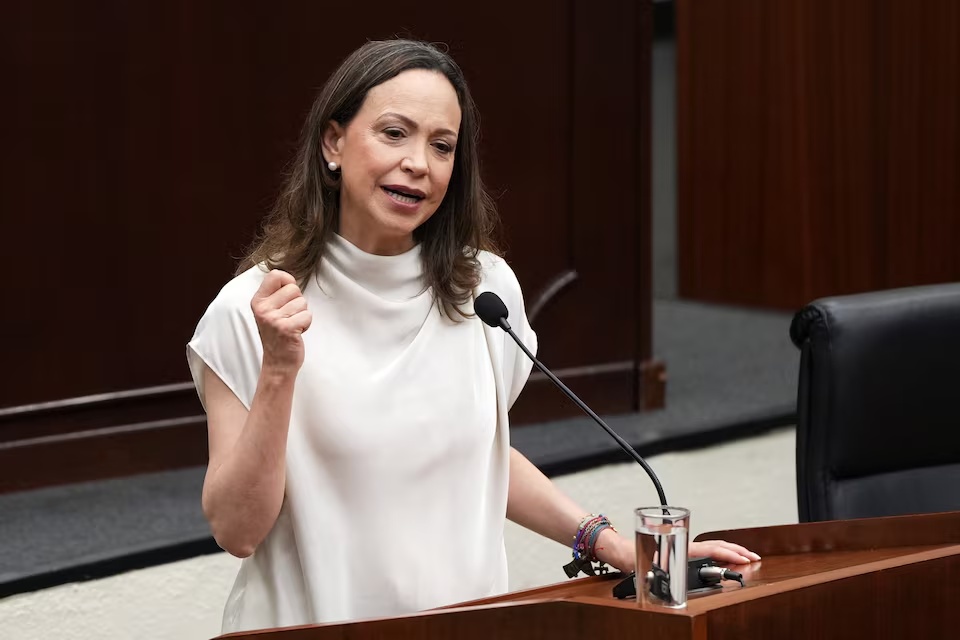
Nobel Peace Prize winner Maria Corina Machado, Venezuela’s most popular opposition member, will not be participating in the discussions, a move that has not gone over well with some watchers of the country’s politics.
Machado fled Venezuela late last year to collect her Nobel Prize, after months primarily spent in exile following a controversial 2024 presidential election. She has claimed she wants to go back to Venezuela to help the country recover following twin earthquakes in June, a proposal that U.S. officials think is ill-timed. Trump has refuted media claims that his administration told her not to return. Washington has frequently sidelined her since Maduro’s ouster, with U.S. officials saying she lacks sufficient backing to run the country.
Three individuals said Machado didn’t even know the conversations were being arranged until Figuera came to Caracas in mid-June. Machado was only told about the negotiations later and was never invited to join the opposition group, another source added, as she is not part of the 2015 assembly that Figuera represents.
“Machado is right to distance herself from this process,” said someone familiar with the negotiations. “If the negotiations go well and end up with free elections, she will be Venezuela’s first woman president. If the negotiations go badly, she will have made her point: that negotiations need people with legitimacy, accepted and seen in a positive light by the public.
That dynamic puts negotiators on the back foot from the start. They need results fast enough to generate public confidence and counter the fact that Venezuela’s most trusted opposition member is sitting this round out, the insider said.
Last week Machado said she would not be in the negotiations, but also said she would not block “real progress”, explaining her absence. She said she will measure the negotiations by concrete outcomes – restoration of democratic institutions, freeing of political prisoners and scheduling of elections. Machado and Figuera could not be reached for comment.
The government wants
The interim government hopes to utilize the talks to lobby for the lifting of the remaining U.S. sanctions. Washington has in the past relaxed sanctions on Venezuela’s oil, gas and gold sectors, usually linked to pacts struck between the government and opposition on free and fair elections.
This is no unfamiliar ground for the opposition in Venezuela. It bargained for years with the Maduro government, which stuffed the top courts and election authorities with loyalists. A 2024 accord had promised a fair contest and broad opposition participation, but Maduro’s regime blocked Machado from running. She won about two-thirds of the vote, according to U.S. and international election observers. Electoral and judicial institutions nevertheless certified Maduro the winner, and he stayed in office until the raid in January.
Ricardo Rios, chairman of the political risk consultancy Poder y Estrategia, stated that excluding Machado’s camp from the current discussions is excluding a considerable part of the population. But he added that Venezuela’s opposition has long been splintered so her absence is unlikely to cause new divides.
Washington’s stance
The United States has said that Venezuela needs to stabilize and recover economically before elections can be held. Since the transition, Trump has lifted some restrictions and has lauded Rodriguez’s efforts on multiple occasions.
This month Secretary of State Marco Rubio, a strong friend of Machado, informed journalists that she is free to participate in the negotiations if the Venezuelans wish for her attendance. “The U.S. role is not to lead the process, but to support it,” he said.
“Venezuela needs to have every element of Venezuelan society represented so that Venezuela can get the reconciliation it needs to move forward on all these other projects,” Rubio said. “And obviously, Maria Corina is an important element of that.”
U.S. engagement provides a degree of security to opposition figures who have been jailed and prosecuted on what they say are politically motivated charges, one opposition source said. Another source close to Figuera’s group said the U.S. was a “central player” in the discussions and would not stand on the sidelines.
A rehearsal before the real thing
Saturday’s meetings were the clearest indication so far of how much Washington controls the pace and shape of Venezuela’s democratic transition. The government seeks relief from sanctions. The opposition group is looking for assurances that the next election would be counted fairly, something the 2024 vote was not. And the country’s most famous opposition leader, watching from outside the chamber, is betting her absence will either smooth the path for a genuine decision or expose the process as flawed.
The question is whether Machado’s calculus will be vindicated by Figuera’s delegation being able to extract meaningful pledges on judicial and electoral change, not promises that evaporate like earlier agreements did. Her decision to remain out is proof of her contention that any process without her has less validity with voters, if the talks break down or lead simply to cosmetic modifications. If they win, she has the political opening without having used her own political capital to negotiate it.
In either case the outcome depends on actors that respond to Washington, differently. Rodriguez wants sanctions relief to stabilize the economy handled currently by his brother’s government. Figuera needs the support of the United States to offer legitimacy to her delegation with a Venezuelan population that has seen prior negotiations collapse. Absent by choice, Machado wants either a straightforward failure or a convincing success from the negotiations, because no one, least of all her, would gain from a convoluted outcome.