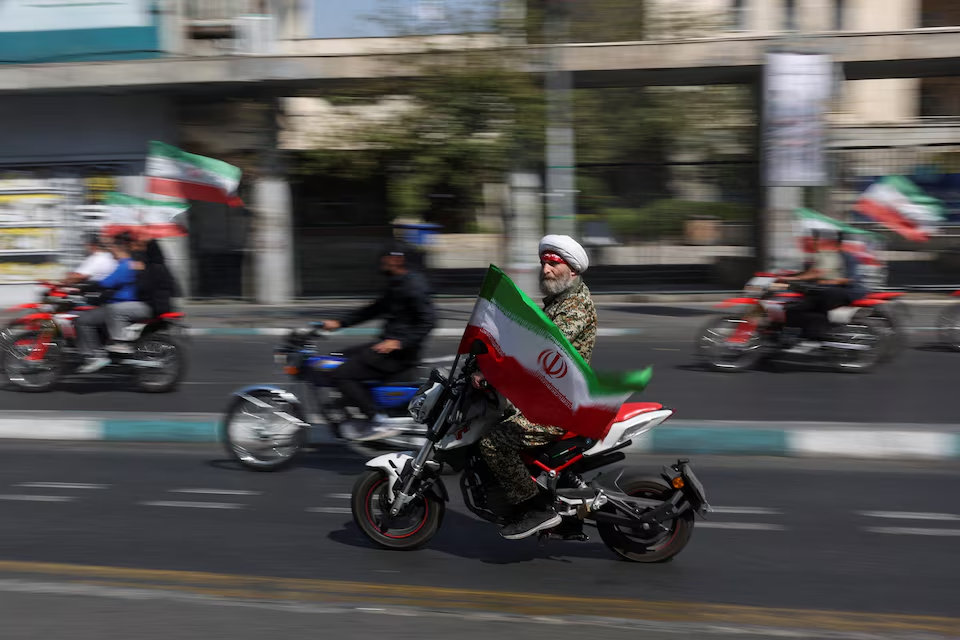

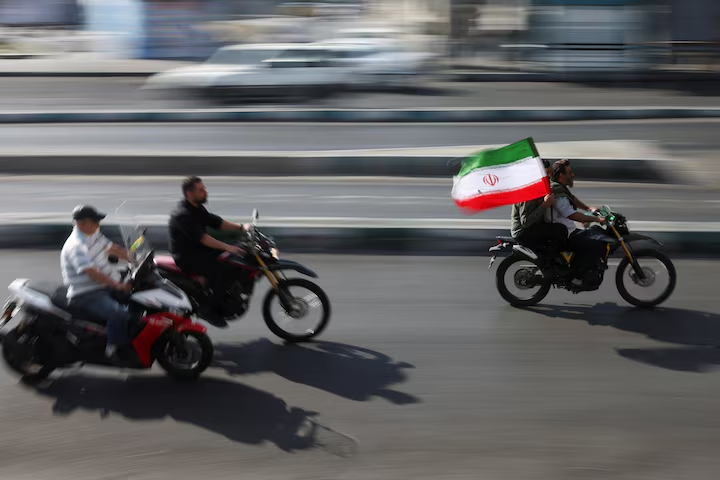
Iran’s Islamic Revolutionary Guard Corps told Americans on Tuesday to vote out President Donald Trump’s allies in Congress. The message came a day before US forces were due to leave their last remaining bases in Iraq. The Guards published a 26-page letter through Iranian media, and it reached the public as the war between Iran and the United States entered its seventh month. Qatar, for its part, kept carrying messages between the two governments in an effort to end it.
Tehran sees the Iraq exit, scheduled for Wednesday, September 30, as a victory. Washington has not described it that way. The timing puts three things in one news cycle: a foreign military force appealing directly to US voters, the end of a US presence in Iraq that began in 2003, and a war with no settlement in sight.
What the Guards’ letter asks of Americans
The letter, published Tuesday, tells Americans to use their votes to remove the leaders now in office. It also asks them to reject US backing for Israel and American military action abroad. In one passage, the Guards tell readers to make sure their politicians understand the world has changed.
Few US voters are likely to read it. Iranian outlets carried the text, and it was not aimed at American media. Still, the subjects it raises are ones already dominating the campaign. Congressional elections take place on November 3, and the opposition Democrats have a chance to win back one or both chambers. A Democratic Congress could slow Trump’s agenda.
The polling behind the timing
Trump ran in 2024 promising to avoid new wars, end the ones already under way and bring down inflation. The war with Iran, which he started together with Israel, has pushed up fuel prices worldwide and spread fighting across the Middle East.
A Reuters/Ipsos poll released September 21 gives a sense of how that is landing. Only 17% of respondents approved of how Trump is handling the cost of living, which Americans name as the top issue for their vote in November. Just 34% approved of the strikes on Iran. Those are the same two subjects the Guards chose to press.
The last American troops in Iraq
The final pullout follows an agreement reached in 2024 under then-President Joe Biden. Trump let it go ahead. That fits a position he has held since 2016, when he broke with Republican orthodoxy by calling the US invasion of Iraq a major mistake.
The withdrawal arrives 23 years after US-led forces removed Saddam Hussein. The upheaval that followed eventually produced the rise of Islamic State.
Iran reads the departure through its own goals. Officials there say their ultimate aim is to force American troops out of the entire Middle East. They present Iraq as a win for the “axis of resistance,” their name for allied armed groups across the region.
Those groups are involved in the current war. The Houthis in Yemen, Hezbollah in Lebanon and militias in Iraq have all been drawn in. Saudi Arabia blamed the Iraqi militias for the September 10 attack that knocked the East-West Pipeline offline.
Qatar tries to broker a deal
Qatar is again acting as mediator. Its earlier role was smaller: it helped produce a June memorandum of understanding that led to a short ceasefire. Since then, rounds of talks and several ceasefires have failed to end the fighting.
US and Iranian officials spoke separately with Qatari mediators on Monday. It was not clear whether more exchanges took place Tuesday. Qatari Foreign Ministry spokesperson Majed al-Ansari described the process to reporters. “We are exchanging messages between the parties,” he said, adding that Qatar is working toward common ground for a deal.
Negotiations appeared to pick up last week around the UN General Assembly in New York. They have not produced an agreement to reopen the Strait of Hormuz. Before the war began in February, 20% of the world’s oil and liquefied natural gas moved through it. Its closure to normal traffic is a main reason energy prices have climbed.
Iran’s seven-day proposal and Trump’s answer
At the General Assembly, Iran put forward a plan that would start a seven-day countdown to reopening the strait and pause the fighting. Trump rejected it on Saturday.
Iranian Foreign Minister Abbas Araqchi said on Sunday that Washington had not formally passed a rejection through the mediators. The two sides therefore disagree on whether the proposal is dead or simply unanswered, and that gap is one of the more useful things to watch in the coming days.
Trump spoke to reporters on Tuesday and again predicted Iran would give up. He said he did not know when, but that it would happen, and that Iran is doing very poorly. He also repeated two positions: Iran must not obtain a nuclear weapon, and the war will end soon.
He has named three goals for the war. The first is weakening Iran’s nuclear capabilities. The second is ending its ability to attack neighbouring countries. The third is creating conditions in which Iranians could overthrow their leadership.
On the nuclear question, Iran does not have nuclear weapons and denies trying to build them. The United States is nuclear-armed. Tehran says that as a party to the Non-Proliferation Treaty it has the right to develop nuclear technology for peaceful purposes.
What the war has cost so far
The fighting has degraded Iran’s conventional forces and damaged an economy that was already struggling. Iran has not stopped responding. It has hit US allies in the Gulf with missiles and drones and has restricted oil tanker traffic through the strait.
Each side can point to something that supports its claim to be winning. Washington can cite damaged Iranian forces and a weaker economy. Tehran can cite a closed strait, higher prices for countries far from the fighting, and an American withdrawal from Iraq that it did not have to negotiate.
What happens next
The Iraq withdrawal is due to be complete Wednesday, which ends the US military presence there that began in 2003. Qatar’s message-passing continues, and the most immediate question is whether Washington gives a formal answer to the seven-day plan or lets it lapse.
The larger test is on November 3. If voters respond to prices and to the war the way the Reuters/Ipsos numbers suggest, Trump could face a Congress able to block his plans. Iran’s Guards are betting on that outcome. Whether their letter has any effect is uncertain, but the polling it points to is public and easy to check.