Clicxpost

Politics

The Gap Between Rhetoric and Reality: How GOP Policies Are Tearing Families Apart

How GOP Policies Are Tearing Families Apart

In a case that has drawn national outrage, a Maryland father, Kilmar Abrego Garcia, was wrongfully deported to a notorious El Salvadoran prison despite legal protections granted by a U.S. immigration judge in 2019. Although the Trump administration admitted it was a mistake, officials refused to take action to return Garcia to his family.

Instead of acknowledging the humanitarian crisis, government spokespeople dismissed concerns. During a press briefing, White House Press Secretary Karoline Leavitt sarcastically remarked, “You’re acting like he’s father of the year,” minimizing the trauma inflicted on Garcia’s young son, who witnessed his father’s arrest in an IKEA parking lot.

Vice President JD Vance reinforced the administration’s dismissive stance, citing minor traffic violations as justification for Garcia’s deportation. However, Garcia’s legal team maintains he has no gang affiliations, despite Homeland Security officials attempting to label him as a member of MS-13 without evidence.

Meanwhile, Garcia’s family, fearing threats and public backlash, has gone into hiding. His attorney, Simon Sandoval-Moshenberg, voiced concern over potential right-wing vigilante violence, underscoring the dangerous consequences that inflammatory rhetoric can unleash.


Deportations Devastate More Than Individuals — They Shatter Communities

The ripple effects of deportations are far-reaching. According to the National Immigration Law Center, approximately 5 million children in the U.S. live with at least one undocumented parent. When families are ripped apart, children are left to grapple with profound trauma, often experiencing long-term mental health struggles like anxiety, depression, and PTSD.

Beyond emotional devastation, deportations carry severe economic consequences. Families often lose a primary source of income, forcing them into financial hardship and increasing their risk of poverty. As Jennifer Ibañez Whitlock, senior policy counsel at the National Immigration Law Center, explains, “Deportations are like a nuclear bomb: the immediate impact is devastating, and the long-term fallout reshapes lives for years to come.”


Republican “Family Values” — A Slogan at Odds With Reality

For decades, the Republican Party has marketed itself as the defender of “family values,” a cornerstone of its platform since Ronald Reagan’s era. Their 2024 platform, for instance, mentions “families” no less than 18 times, vowing to uphold the sanctity of marriage and support parents.

Yet the real-world impact of their immigration and reproductive policies tells a different story — one that often undermines the very families they claim to champion.


IVF Battles: A New Front in the GOP’s Policy Contradictions

The contradiction was glaringly evident following the Alabama Supreme Court’s 2023 ruling that embryos created through IVF are legally considered “children.” While the decision aligned with anti-abortion sentiments, it threw fertility clinics into chaos, effectively halting treatments and dashing the hopes of countless families yearning to conceive.

Although the Republican-controlled Alabama legislature scrambled to protect clinics from lawsuits, the inconsistency was evident: embryos are “children” when it serves anti-abortion rhetoric but disposable when it risks restricting access to fertility care.

Former President Trump attempted to pivot by promoting IVF access, claiming he would lower treatment costs through executive action. He even dubbed himself the “fertilization president” during a Women’s History Month event, promising “tremendous goodies” for women. Yet just days later, his Health and Human Services Department quietly eliminated the CDC’s Assisted Reproductive Technology Surveillance Team — the very experts responsible for monitoring IVF success rates and advancing treatment accessibility.

Barbara Collura, CEO of Resolve: The National Infertility Association, warned that gutting this program handicaps the administration’s ability to genuinely support families seeking fertility treatments. “These are the right people to have at your side,” she stressed.


Internal GOP Clashes Reveal Hypocrisy on Parental Support

Even within Congress, GOP divisions have exposed a disconnect between pro-family rhetoric and actual legislative support for parents.

Rep. Anna Paulina Luna (R-Texas), who gave birth in 2023, introduced a bill allowing new parents in Congress to vote by proxy for up to 12 weeks. Despite the measure aligning with pro-family ideals, key Republicans, including Speaker Mike Johnson, vehemently opposed it. Ironically, many had used proxy voting themselves during the COVID-19 pandemic.

After Johnson blocked the bill from a committee hearing, Luna gathered enough signatures to force a vote. In retaliation, Johnson canceled all votes for the week. Luna responded by resigning from the House Freedom Caucus, accusing her colleagues of betraying their stated family values.

Democratic Rep. Pete Aguilar summed up the hypocrisy bluntly: “Republicans should stop lecturing people on being pro-family when they’re opposing this uniformly.”

Even Trump, ever the political wildcard, contradicted GOP leadership by publicly supporting Luna’s bill — highlighting once again the inconsistency between Republican messaging and practice.


Conclusion: Family Values in Name Only?

Cases like Kilmar Abrego Garcia’s and legislative battles over parental rights expose a stark reality: the modern GOP’s claims to “family values” often serve more as political branding than a genuine commitment to families.

Whether through punitive immigration policies, chaotic approaches to fertility rights, or internal resistance to supporting working parents, the Republican Party continues to make decisions that fracture, rather than fortify, American families.

True support for families demands more than slogans — it requires consistent, compassionate policies that recognize the complex realities people face today.


RECOMMENDED
Politics

US Midterms on November 3: What Voters Decide and Who Leads

By George Mensah 8 min read

Americans vote on November 3 in congressional elections that will decide whether Republicans keep control of Washington for the last two years of Donald Trump’s second term. Fewer than four weeks remain, and the polls favor Democrats nationally. Several of the Senate races that decide control are close.

Voters will fill all 435 seats in the House of Representatives and 35 of the 100 seats in the Senate. They will also choose state officials in much of the country, including governors in California, Florida, Georgia and Michigan.

What the midterms are

Congress has two chambers, the House and the Senate, and together they write and pass federal laws that apply across the country. Elections happen every two years. The ones that fall in the middle of a president’s four-year term are called midterms.

Trump is not on the ballot. The result will still be read as a verdict on him, because it will show whether voters want to give him a Congress that backs his plans or one that blocks them.

Who is being elected

Members of the House serve two-year terms, so every seat is up every election. The House is where most bills are introduced and debated.

Senators serve six years, and about a third of the chamber is elected at each midterm. This year’s 35 seats are 33 regular contests and two special elections for the seats vacated by Marco Rubio and J.D. Vance, according to Ballotpedia. The Senate votes on bills passed by the House and approves or rejects presidential nominees.

The state of play in Congress

Republicans run both chambers today, but the margins are thin.

In the House, the BBC reports Republicans hold 218 seats, the minimum needed for a majority, plus one independent who votes with them. Counts of the exact split differ slightly between sources because of vacancies, so the safest summary is that a few seats decide control.

In the Senate, Republicans hold 53 of 100 seats. Democrats need to win 51 to take control. A 50-50 tie would go to the vice president, currently a Republican, who casts the deciding vote. Ballotpedia says that means Democrats need a net gain of four seats.

Democrats are defending Georgia and Michigan, two states Trump won in 2024. Republicans are defending Maine, which Kamala Harris won.

What voters care about most

Cost of living comes first. Voters are paying more for fuel, groceries, housing and healthcare, and four in 10 Iowa voters told a Fox News poll in late September that their families are falling behind. About six in 10 in that poll called cost of living extremely important to their Senate vote.

Inflation is still above the level the Federal Reserve targets. The BBC links part of that to the war the United States and Israel started with Iran in February. Democrats say Trump’s tariffs have pushed prices up too.

Silver Bulletin, a polling analysis site, rates Trump’s handling of the economy at a net negative 32 points. On inflation the figure is a net negative 46 points.

Immigration is the other major issue, and it favors Republicans more than the economy does. They say Trump delivered on a 2024 pledge by tightening the border and launching a broad crackdown on illegal immigration. The crackdown has drawn criticism for its tactics. In Iowa, voters who rank immigration first lean toward the Republican candidate.

Artificial intelligence has moved up the list in recent weeks. Senior figures in both parties say the technology needs regulation. Trump has rejected the idea of laws to control its development, which puts him at odds with lawmakers in his own party. In the Fox News Iowa poll, 27% of voters called AI extremely important.

What the polls show

Trump began his second term with an approval rating just above 50%, according to Silver Bulletin. In early October it was about 37%, and more than 60% of Americans disapproved. An NBC News average put the figures at 39% approve and 59% disapprove in late September.

On the generic congressional ballot, which asks voters which party they will support without naming candidates, NBC’s average of likely voters showed Democrats ahead 52% to 43%. Independent voters lean Democratic by about 16 points, down from roughly 20 points in spring.

History points the same direction. Voters often turn against the president’s party at midterms.

National numbers do not decide individual seats, though. Most districts and states lean heavily toward one party, and the fight is concentrated in a small number. The BBC’s US partner CBS News has identified ten Senate races and 42 House races to watch. The Senate list includes Iowa and New Hampshire. The House list includes seats in Arizona and Ohio.

The Iowa test

Iowa shows how much the national mood has changed. Trump won the state with nearly 56% of the vote in 2024, and Iowa has not sent a Democrat to the Senate in 18 years, since Tom Harkin won his final term.

The Fox News poll, conducted September 24 to 28, found Democrat Josh Turek ahead of Republican Ashley Hinson, 49% to 47% among likely voters. That gap sits inside the poll’s margin of error of three points. Among all registered voters, Turek led 50% to 46%, and that result has not moved since June.

Turek is a state representative. Hinson is a member of the US House and won the Republican nomination with Trump’s endorsement. Voters rate Turek more favorably, 48% to 40%. Hinson’s numbers are 42% favorable and 50% unfavorable.

Fifty-two percent of voters in the poll said Hinson is too close to Trump. Forty-three percent said Turek is too liberal. Trump’s approval in Iowa stands at 42%, with 57% disapproving.

A Republican pollster on the survey still sees an opening for Hinson. “Recent history and the state’s partisan makeup suggest Hinson can pull this out,” said Daron Shaw, who worked on the poll with a Democratic firm. The same poll has Democrat Rob Sand leading Republican Zach Lahn for governor, 53% to 44%.

The numbers that decide control

Count the seats and the math is tight for both sides.

In the Senate, Republicans can lose at most two seats and still hold the majority, because a 50-50 split goes to the Republican vice president. Democrats need a net gain of four. Ballotpedia notes that eight senators, four from each party, are not seeking re-election, which leaves several seats without an incumbent on the ballot.

In the House, Ballotpedia says Democrats need a net gain of only three seats, and Republicans can lose no more than two. The same page counts 14 Democratic-held districts that Trump won in 2024 and nine Republican-held districts that Harris won. Those 23 seats sit in territory that backed the other party’s presidential candidate two years ago, and they are where a national swing turns into a change of control.

The Iowa poll gives a closer look at how a swing happens. Turek holds 96% of Democrats, while Hinson holds 87% of Republicans. Turek leads among independents by about two to one, and 10% of Republicans say they will vote for him. Voters backing Turek are also more firmly committed: 88% say their choice is settled, compared with 77% of Hinson’s supporters. A small gap in loyalty in a state this evenly split can decide the race.

Not every poll points the same way, and Iowa’s result will depend on turnout. The same Fox poll found Iowans split almost evenly on which party should control the Senate, 49% for Democrats and 48% for Republicans.

The fight over district maps

The House picture is harder to read this year because both parties redrew congressional districts in the middle of the decade, which is unusual. Normally maps change once every ten years, after the census.

Republicans moved first. Texas adopted a new map in 2025 that Republicans hoped would gain them up to five seats, according to the Associated Press. Missouri and North Carolina each drew maps aimed at one more Republican seat, and Ohio’s new map targeted two.

Democrats answered. California voters approved Proposition 50 on November 4, 2025. It replaced the map drawn by the state’s citizens commission with one drawn by Democrats, who hoped to gain up to five seats. Virginia Democrats started the process of amending the state constitution to allow their own redraw.

Lawsuits followed in several states, and the AP’s account is a snapshot from November 2025. Some of the details have probably changed since, so check the latest status of any individual district before relying on it. The broad point holds: the new lines make forecasts for the House less certain.

What a Democratic win would mean for Trump

If Democrats win the House, the Senate or both, Trump will struggle to pass new laws. Bills need approval from both chambers. His domestic agenda could stall, though he has already shown he can use executive power to act without help from Congress.

Control of a chamber also gives Democrats the power to set the agenda on the floor and to run committee investigations. The BBC lists corruption allegations, the new White House ballroom and the tactics of Immigration and Customs Enforcement as possible subjects.

Democrats are also divided on impeachment. Impeachment means Congress brings charges against a president, and it works as a political process, not a criminal one. Some in the party want to pursue it. Others want to avoid it. A Democratic majority would force that argument into the open.

If Republicans hold both chambers, Trump can keep moving his plans forward for the rest of his term. He has asked Republican voters to treat the election as if his name were on the ballot and to vote for him as an endorsement of what he has done.

What comes next for 2028

Trump cannot run for president a third time. Once the results are in, attention will turn to who might become the Republican nominee in 2028 and who might run against that person for the Democrats.

Commentators will also use the results to argue about how voters feel about the country’s direction under Trump. Both parties will claim a mandate, so the margins will matter. A Democratic win by a handful of House seats would read differently from a landslide, and a Republican hold with a smaller majority would read differently from a gain.

Nothing in the polls guarantees any outcome. Midterm turnout is lower than in presidential years, and the voters who show up on November 3 will decide it.

Sources

Politics

Army Review Shows National Guard Troops Were Pushed Into a California Immigration Raid With No Plan

By George Mensah 8 min read

National Guard soldiers under federal control were pulled into a chaotic immigration raid in Southern California on short notice and with little guidance, according to an internal Army document obtained exclusively by MS NOW. The after-action review, written by U.S. Northern Command, also shows the Department of Homeland Security gave the soldiers duties that legal experts say may have broken a law that largely bars the military from domestic law enforcement.

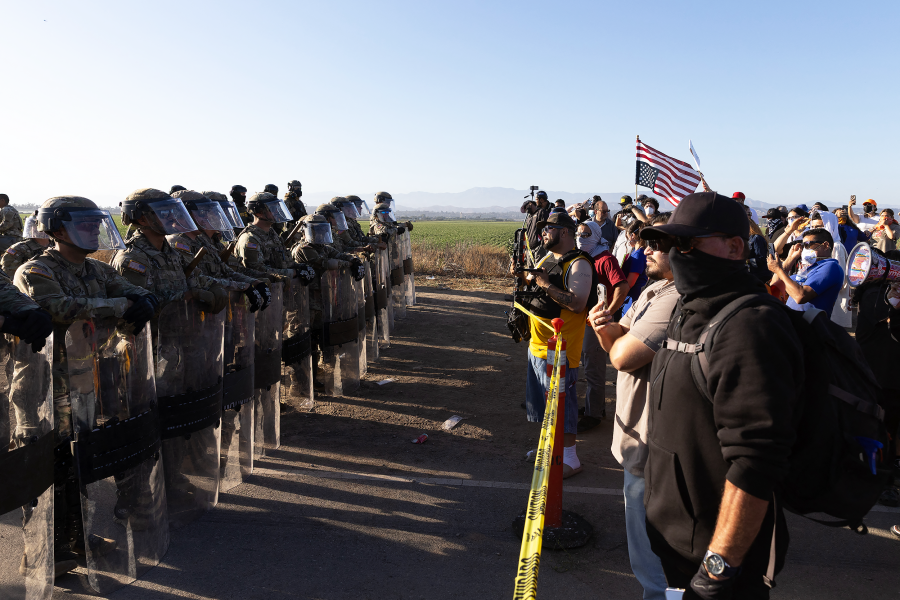
The operation took place July 10, 2025, at a cannabis farm in Camarillo, about 50 miles northwest of Los Angeles. The military’s role has not been reported before. It comes to light less than a month before the midterm elections, while President Donald Trump continues to refuse to rule out invoking the Insurrection Act to deploy troops.

The National Immigration Law Center obtained the document through the Freedom of Information Act. The center opposes Trump’s immigration enforcement policies. Ben Farley, its special counsel, said the review fits a pattern.

“This is yet more evidence of the willingness of the Trump administration to blow the hinges off the constraints of what the military can do domestically,” Farley said.

What the Army’s own review says

The report records the Army’s concerns about putting armed troops into volatile situations with hostile civilians and little direction on the limits of their authority. Experts who reviewed it for MS NOW said it strongly suggests soldiers from the National Guard’s 49th Military Police Brigade helped take custody of immigrant detainees and moved them from the farm to a nearby naval base.

The document also indicates the military’s actions were largely improvised, with little planning or coordination between the Defense Department and DHS. In one of several passages on the subject, it says: “A mission of this scale should have been planned out with DoD for support to work through those potential issues and have a better plan in place for transporting detainees.”

The review carries no time stamp. It indicates it was written on or shortly after July 19, 2025.

Northern Command denies its units moved detainees

A U.S. Northern Command spokesperson denied that troops took part in detaining or transporting anyone.

“Personnel did not conduct arrests, searches, seizures, detention, or detainee transportation during this operation, and no military vehicles were used to transport detainees,” the spokesperson said. “Federal law enforcement personnel retained responsibility for law enforcement and custody functions.”

Northern Command did not answer follow-up questions about the apparent conflict between that statement and its own review. The review says DHS agents had no clear plan for moving detainees. It says military personnel on the scene were told the Defense Department had authorized Guard troops to transport detainees in military vehicles. It says hundreds of detainees were taken to Naval Base Ventura County. It does not state who drove them or whose vehicles carried them.

DHS did not respond to questions about the roles of troops and federal agents. It referred all questions on the subject to the Defense Department.

A raid that came after weeks of protests

The Camarillo raid took place amid broad immigration sweeps by Immigration and Customs Enforcement and Border Patrol agents in Los Angeles and surrounding areas. Those sweeps set off protests that lasted weeks. In a presidential memorandum, Trump called the protests “a form of rebellion against the authority of the Government of the United States.” Over the objections of Gov. Gavin Newsom, he federalized 2,000 National Guard troops and ordered them to protect federal agents and property.

Thousands of federal law enforcement and military personnel arrived in the Los Angeles area from outside the region. The troops who responded to Camarillo belonged to the 49th Military Police Brigade, headquartered in Fairfield, near San Francisco.

The raid drew attention at the time for its scale and disorder. About 500 ICE and Border Patrol personnel detained at least 361 people on immigration counts over several hours. One immigrant died after falling from a roof while trying to flee. Hundreds of protesters blocked government vehicles and threw rocks and other objects at federal agents. Four U.S. citizens were charged with assaulting or resisting officers.

Reporters, photographers and court records described Guard troops helping set up a security perimeter around the farm. The Army review shows the more than 200 soldiers on the scene did far more than that.

Troops arrived without a briefing or routes

Border Patrol first asked the Guard for support, canceled the request two days before the raid, then asked for military help again after the operation had started, the review states.

That timing left units with almost nothing to work from. The document says it resulted “in units responding without an in-brief and no information on staging, routes, ingress, egress, and supporting medical facilities.”

The federal agents running the operation, it says, “were not tracking the plan or did not have a plan when it came to moving detainees.” The lead federal agent then told military personnel the Defense Department had issued approval for Guard “personnel to transport detainees in military vehicles.”

Sorting that out on the ground took time. “That information had to be deconflicted on the ground, taking additional time to get the detainees transported out of the area,” the document reads. “Ingress and egress routes were not identified, leading to vehicles being blocked in” by protesters’ vehicles.

The naval base was not ready either. “Naval Police did not have the capability to receive us at the same time as the arrival of the Federal Agents, resulting in unnecessary moves and confusion,” the document reads.

Soldiers also faced a hostile crowd. “During the operation, our freedom of movement was hindered by civilian vehicles in our formation,” the review states. “This left vehicles vulnerable to protestors who eventually climbed on vehicles and threw items at our Soldiers.”

Daniel Maurer, an associate professor of law at Ohio Northern University and a retired Army lieutenant colonel and judge advocate, called that an unusual experience for troops. “Normally, when the military deploys domestically, it’s for natural disaster relief, and they’re welcomed with open arms,” he said.

What legal experts say about the Posse Comitatus Act

The Posse Comitatus Act, a law from the late 19th century, prohibits using the armed forces for domestic law enforcement. Independent experts consulted by MS NOW said the document puts the Guard troops in a legally shaky position.

Chris Mirasola, an assistant professor at the University of Houston Law Center and a former Defense Department attorney, said the duties described in the review fall within the law’s reach.

“Detention and traffic management would both count as execution of the laws in the terms of the Posse Comitatus Act,” Mirasola said. “Those are usually very straightforward examples of a violation.”

The experts did not say the document alone proves a violation. They noted that courts have rarely tested the law. The review does not say whether federal agents rode in the vehicles that carried detainees. If they did, Mirasola said, the government could argue the agents, not the troops, technically had custody.

Maurer said that even with agents aboard, the more relevant question is which agency took the lead in planning and carrying out that part of the operation.

“The issue is, what are those federal agents doing?” Maurer said. “Are they acting like a brain for the operation, or more like the muscle for the operation?” If the military dominated that part of the operation, he said, “that’s concerning,” and it “approaches unlawfulness, because it has the military executing the law to some extent.”

Farley went further. He said the review leads him to conclude the Guard clearly violated the act.

“Having the military take custody, physical control, of people in this country is a shocking development,” Farley said. “There is a reason we don’t see the military doing this: There’s a 250-year history of people in this country being very, very opposed to and fearful of the military doing exactly this sort of thing.”

A federal judge has already ruled on the deployment

In September 2025, a federal judge ruled in a lawsuit filed by California that the Trump administration violated the Posse Comitatus Act when it deployed National Guard troops alongside immigration agents in Southern California. The ruling discussed the Camarillo raid in detail.

That decision did not consider any evidence that troops physically took custody of detainees and transported them. It covered only what was public at the time: troops had set up security perimeters and controlled traffic.

The administration appealed to the 9th U.S. Circuit Court of Appeals. The case stalled after the federalized troops returned to California’s control.

Questions about training and planning

The experts also pointed to the lack of planning the review describes. Mirasola raised the question of who ends up doing the work when DHS hands off enforcement tasks.

“It should concern all of us if we have DHS offloading law enforcement functions onto, most likely, incredibly young military personnel who don’t necessarily have any training in handling these kinds of interactions with protesters, with the public, and with detainees,” Mirasola said.

What comes next

No domestic deployment of military personnel alongside federal law enforcement has matched the scale and public visibility of the 2025 California operations. A deployment during similar immigration raids in Chicago was much smaller. Courts blocked other efforts to use Guard troops against protests, including in Portland.

Trump has repeatedly threatened to invoke the Insurrection Act and use troops against domestic unrest. Advocates and experts say that makes the Camarillo episode matter beyond one raid. In their view, it lowers the legal and institutional barriers to using the military in domestic conflicts, and it set a precedent for using troops to help round up immigrants.

“That’s not what the military does,” Maurer said.

Several questions remain open. Northern Command’s denial conflicts with its own after-action review, and the agency has not explained the gap. DHS has pointed to the Defense Department for answers about who did what. The review does not say who drove the detainees. The appeal over the September 2025 ruling has not moved since the troops left federal control.

ADVERTISEMENT
Scroll to Top