
US forces carried out a new round of strikes on Iranian military targets after Iran’s Revolutionary Guard hit a commercial ship in the Strait of Hormuz, deepening a conflict that has pushed the two countries to the edge of open war.
Iran’s Islamic Revolutionary Guard Corps announced the strait was closed until further notice and struck US bases and allied nations across the Gulf in response to the American attacks. The Guard said it hit a US base in Jordan, while the United Arab Emirates, Qatar, Kuwait and Bahrain all intercepted missiles and drones fired from Iranian territory.
The latest exchange follows attacks earlier in the week on three commercial tankers, which triggered a separate round of US and Iranian strikes. State media in Iran said the government shut the strait after firing a naval cruise missile at a vessel that tried to sail through an unapproved corridor. The Guard said the ship was “hit by warning shots and stopped” after ignoring repeated instructions, according to a statement carried by the state news agency. Iranian officials also warned that any US response to the closure would be met with “severity” and that new bases in the region would come under fire.
Mohammad Bagher Ghalibaf, Iran’s parliamentary speaker and chief negotiator with Washington, wrote on X that the “era of one-sided deals is OVER.” He added: “We told you: keep your word or pay the price. Reality is knocking.”
US Central Command launched its third round of strikes this week after accusing the Guard of attacking a Cyprus-flagged vessel in the strait. Centcom said the ship, the MV GFS Galaxy, suffered major damage to its engine room and could not continue its journey. One crew member was reported missing. The UK’s Maritime Trade Operations agency said military authorities told it the crew had abandoned ship and were adrift in a lifeboat.
“Iran was provided yet another opportunity to demonstrate adherence to the Memorandum of Understanding after being held accountable for earlier attacks on commercial vessels but has again failed,” Centcom said in a statement posted to X. The command said US forces hit 140 Iranian military targets, including missile and drone sites, communication networks and coastal surveillance posts.
US Secretary of Defense Pete Hegseth shared the statement and wrote: “Iran made a poor choice. Now they pay.” The Guard said the US had targeted “a number of coastal bases and telecommunications towers on the southern coast.”
Iran said its “first phase” of retaliation included a strike on Prince Hassan Air Base in Jordan, which it said destroyed the base’s command and control center along with hangars housing MQ-9 drones.
The Guard has published its own proposed shipping route through the strait, running between the Iranian islands of Qeshm and Larak and skirting a marked “dangerous area” before connecting the Persian Gulf to the Gulf of Oman. Iran has told shipping companies to use that route instead of a separate US-recommended path through Omani waters.
Three tankers came under attack earlier in the week while attempting to cross the US-recommended route. Iran has repeatedly said its own route is the only “safe” passage through the strait. The attacks prompted a series of US strikes that killed 17 people and injured 115, according to Iranian officials, followed by Iranian strikes on US allies across the Gulf.
The exchange pushed tensions higher. President Donald Trump said the Iranian attacks meant a prior ceasefire was over, while Iran’s Foreign Minister Abbas Araghchi accused the US of violating the agreement. Trump said talks would continue and that mediators were working to revive the process. US media outlets have reported that Iran told American officials the tanker attacks were a mistake carried out by a rogue internal group. American officials say they have told mediators that Iran must publicly confirm the Strait of Hormuz remains open and commit to stopping fire on commercial ships.
The closure came days after a call for revenge from Iran’s new supreme leader, Ayatollah Mojtaba Khamenei, in his first public address since taking power. His father and predecessor, Ali Khamenei, was killed in an air strike on February 28, the first day of the US-Israeli war against Iran, and was buried in Mashhad on Friday.
Reading a statement on state television, the new ayatollah said vengeance was the “will of the nation.” He said: “We pledge to avenge the blood of the martyred leader and all the martyrs of these two wars from the criminal and disgraced killers.” He added: “The matter depends neither on my personal existence nor on that of other officials. Whether we are present or not, it will come to pass.”
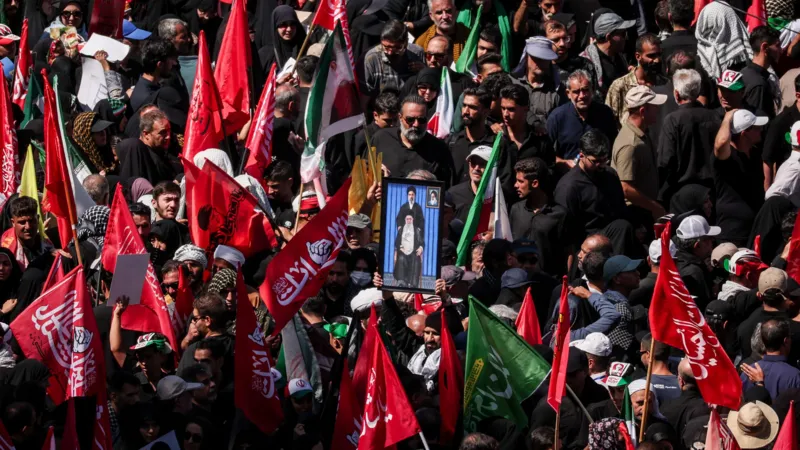
Mourners at funeral ceremonies for Ali Khamenei in Mashhad carried placards calling for the killing of Trump over the past several days. Trump said Saturday that any such plans would prompt the US to “decimate and destroy all areas” of Iran in response.
The Wall Street Journal and other US outlets reported this week that Israel had shared intelligence with Washington indicating Iran had recently drawn up a plan to assassinate the US president. Trump denied that Tehran had made a fresh plan or that Israel supplied any such intelligence. He told the New York Post that he had been “No. 1 [on Iran’s kill list] for a long time.”