

Chinese AI startup DeepSeek has taken a stake in humanoid robot maker Unitree and agreed to jointly develop AI models for the company’s machines, according to a filing with the Shanghai Stock Exchange.
DeepSeek put 140.8 million yuan, or roughly $20.8 million, into Unitree and received 933,399 shares in return. That allocation represents 2.31% of the shares set aside for strategic investors in Unitree’s Shanghai initial public offering.
Both companies are based in Hangzhou, a major technology center in eastern China. Under the agreement, DeepSeek will contribute its work on AI language models while Unitree, also known by its Chinese name Yushu Technology, brings its expertise in mechanical engineering, motion control and embodied intelligence, the term used in robotics for systems that learn to interact with and adapt to the physical world.
The filing outlines a preferential arrangement between the two companies. Unitree will give priority to DeepSeek when it needs model-training services or technical solutions. DeepSeek will do the same for Unitree when it needs to purchase robots or pursue projects involving embodied AI.
Targeting the robot “brain” problem
The partnership addresses a problem that has slowed progress across the humanoid robotics industry: giving robots a “brain” capable of interpreting unfamiliar environments and translating spoken or written instructions into precise physical movement.
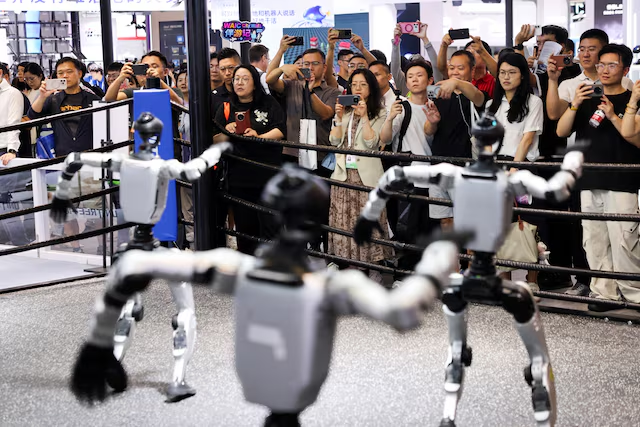
Chinese manufacturers have already built robots that walk, run and execute choreographed routines at relatively low cost. Turning those machines into workers capable of independent, useful labor is a different challenge. It requires AI models trained on physical-world data, and that kind of data is far scarcer than the text and images used to train most large language models.
To collect it, several Chinese robot makers now operate dedicated facilities where human workers guide humanoid robots through repetitive tasks such as folding laundry or opening doors, generating the demonstration data needed to teach the machines how to handle everyday objects and situations.
DeepSeek’s track record and its gap
DeepSeek built its reputation on language models that perform well on coding, mathematics and reasoning benchmarks, and it has competed aggressively on price against larger rivals. That strength has stayed concentrated in text-based language models rather than in a multimodal system that can process visual information alongside language in a single commercial product.
The company has released standalone vision-language research models, including one called VL2, but none of that work has been folded into its main commercial model. In April, a DeepSeek researcher published a separate project focused on improving visual reasoning through points and bounding boxes, a technique for identifying and interpreting objects within an image. The paper and its accompanying GitHub repository were withdrawn shortly afterward without explanation from the company.
The Unitree deal gives DeepSeek a path to close that gap. Access to Unitree’s robots and the physical-world data they generate could help DeepSeek build out the vision and spatial-reasoning capabilities it currently lacks in a commercial product, positioning the company to compete more directly in embodied AI rather than staying confined to text-based applications.
What the partnership means for Unitree
For Unitree, the arrangement secures a committed AI partner as the company works to move beyond demonstration robots and into machines capable of genuinely autonomous tasks. Unitree has built a public profile around videos of its robots performing acrobatics and coordinated movement, but the harder commercial problem is enabling robots to operate reliably in spaces they haven’t been specifically trained for.
The preferential purchasing terms in the filing suggest both companies expect the relationship to extend well beyond the initial investment, with Unitree treating DeepSeek as its default AI supplier and DeepSeek treating Unitree as its default hardware platform for embodied-AI experiments.
The deal also reflects a broader pattern in China’s technology sector, where AI model developers and robotics manufacturers are increasingly pairing up rather than trying to build every layer of the technology stack independently. Software companies get access to physical robots and the real-world data those robots generate. Hardware companies get access to AI models without having to build large research teams from scratch.
Context for the IPO
The investment came through the strategic placement portion of Unitree’s Shanghai IPO, a mechanism that allows select investors to buy shares ahead of the broader public offering, typically in exchange for a commitment to hold the stock for a set period. DeepSeek’s stake, while a small percentage of the total offering, signals confidence in Unitree’s approach at a moment when investor interest in humanoid robotics has grown sharply across China’s public markets.
Unitree’s ticker, 688836.SS, places it on Shanghai’s STAR Market, a board created to list technology companies, including firms that are not yet consistently profitable but show strong growth potential. The filing did not disclose additional financial terms of the AI development agreement beyond the share allocation and the preferential-purchasing arrangement.
Neither company detailed a timeline for releasing jointly developed AI models or robots, and the filing did not specify which of DeepSeek’s existing model architectures would form the basis of the collaboration. Analysts tracking China’s robotics sector will likely watch for follow-up announcements detailing specific products, given that both companies now have a direct financial incentive to show results from the partnership.