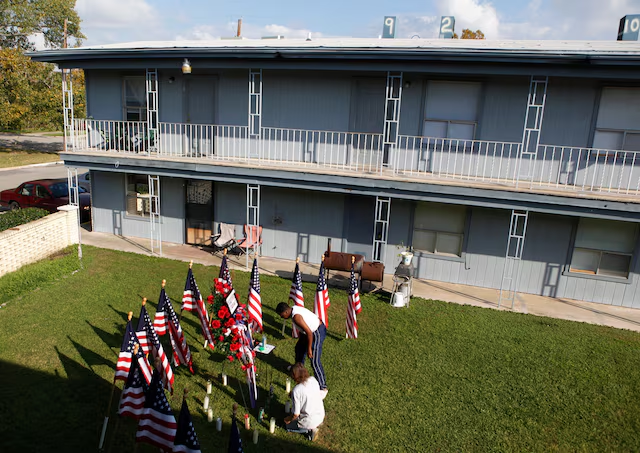

The US military plans to carry out a public execution by firing squad and broadcast it live, the first announcement of its kind in the United States in almost 90 years. US Secretary of Defense Pete Hegseth said the military would publicly execute Nidal Hasan, who killed 13 unarmed fellow soldiers at the Fort Hood base in Texas in 2009. The Pentagon later said the execution would be live-streamed.
“People need to understand that there’s serious consequences for these types of things,” Hegseth said.
The announcement has drawn alarm from a death penalty scholar, an author who researched the last major public hanging in America, a violence researcher and the chair of the US Conference of Catholic Bishops. President Donald Trump has said he approved the decision to livestream Hasan’s death. Vice-President JD Vance says he will not watch.
What was announced
The sources available so far describe the plan in broad terms. Hasan, who killed 13 people in the 2009 shooting at Fort Hood, would be executed by firing squad. The military would conduct the execution in public, and the Pentagon says it will be livestreamed.
Trump was asked whether he would tune in himself and avoided the question. He confirmed that he had approved the livestream. “I really don’t care how he goes as long as he goes,” Trump said. “And I think that the death penalty is a very worthy way of going for him.”
Vance, who is Catholic, has said he would not be watching the execution.
The reports do not say when the execution will take place, where it will be held or who will be able to view the stream. Those details have not been made public in the material reviewed for this article.
The last time America did this
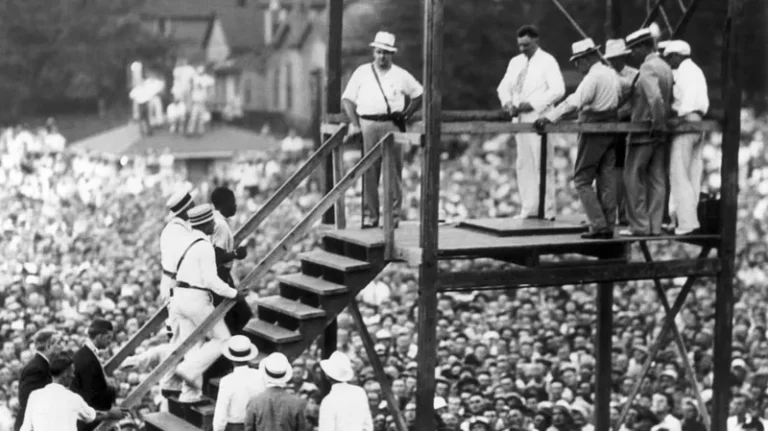
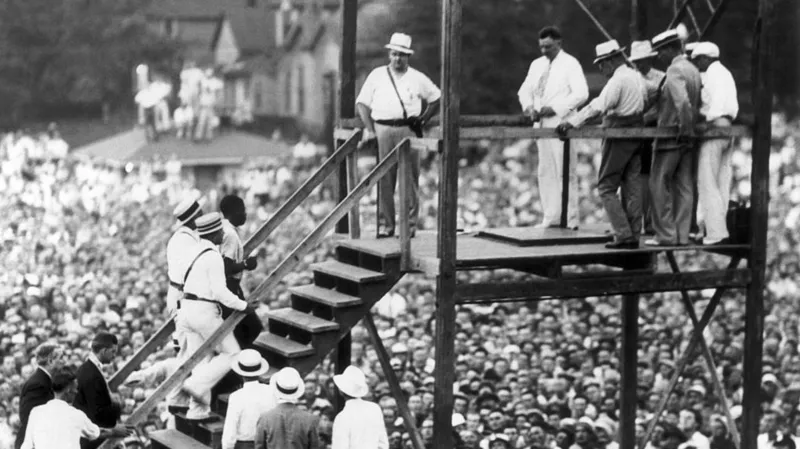
The previous public executions in the US belong to a different era. The most prominent took place on 14 August 1936 in Owensboro, Kentucky, during a heat wave. It was a Friday.
Rainey Bethea, an orphan in his 20s, was hanged on a riverfront gallows. He had been sentenced to death after allegedly confessing to robbing, raping and killing Lischia Edwards, 70, an elderly white widow. Bethea was black.
The scene around the gallows turned into a public event. Spectators arrived from near and far. Some slept overnight close to the gallows to keep their places. Others held “necktie” parties the evening before and arrived hungover. Teenagers sold popcorn and soda to the crowd.
By the time of the execution at 5am, the crowd was estimated at 20,000 people, including men, women and children. Reporters had come from as far away as Chicago and New York. Many spectators were there to see a rumoured “Lady Executioner”. The local sheriff had died four months earlier and his widow had taken over the post. She declined to pull the lever herself, and hired hangmen carried out the hanging.
Bethea had eaten his last meal the previous afternoon: fried chicken, pork chops, mashed potatoes, pickled cucumbers, cornbread, lemon pie and ice cream.
The spectacle embarrassed many in Kentucky. Eighteen months later, the governor outlawed public executions. By then most states had already stopped holding executions in view of the public, as attitudes turned toward more humane and private methods. A hanging in Missouri in 1937 drew a few hundred people. It was less well known, and it is recorded as the final public execution in America.
Hegseth’s announcement comes a little more than 90 years after Bethea’s death.
A scholar who did not expect it
Michael Radelet, a professor emeritus at the University of Colorado and a long-time scholar of capital punishment, said the announcement shocked him. “I never imagined [another] public execution,” he told the BBC.
He pointed to falling public support for the death penalty. Backing for capital punishment was 80% in 1994 and stands at 52% now. That is a drop of 28 percentage points, or a fall of 35% from the 1994 level, by our calculation. “It’s gone down precipitously, especially when you give the alternative of life without parole,” Radelet said.
It is too soon to know what Americans think of livestreaming an execution. The BBC’s reporting assumes a large audience, saying it is nearly certain that millions of people or more would tune in.
That prospect troubles Radelet. With Hegseth’s announcement, he said, “the justification for the death penalty becomes entertainment … bring your popcorn, invite your friends”.
An author with a family link to 1936
Sonya Lea published a book last year about Bethea’s execution. When she heard of the planned livestream, she “felt absolute horror for our descendants”.
“What they called it in 1936 was a carnival of sadism,” she said. “That we now have the technology that can make it go wider than the 20,000 people who showed up … to witness in Owensboro, Kentucky, it just makes it even more horrific.”
Her connection is personal. Lea’s grandparents were teenage newlyweds in the 1936 crowd. She learned that only after her grandmother died in 2002, when she read an account her grandmother had left. It said they stood close enough to hear Bethea’s neck snap.
Years of research afterward taught Lea that many Kentuckians were “haunted” by the execution. She had believed that kind of event belonged to the past.
“I really thought, with all my heart, that we had put this in the rearview mirror, this level of grotesquery that only a few countries in the world engage in – Iran, North Korea, Afghanistan,” she said. “Are we now, as the United States of America, considering ourselves to be part of that kind of government? It’s just horrific.”
Polarisation and desensitisation
Kurt Gray, a social psychology professor at Ohio State University, said the polarised tone of American politics may have made the announcement possible. He does not think most Americans want to see it.
“Some Americans might thirst for blood, but I think a lot of Americans don’t, and, if anything, I think a lot of other Americans are just kind of maybe desensitised,” he said. “So it’s not like they’re cheering a public execution; they’re just like, ‘Oh, yeah, I guess that’s where we’re at now.’”
Gray’s point separates two groups. Some Americans may welcome the broadcast. Many others, in his view, may simply accept it as normal.
A reading of the country that may be wrong
Other research suggests Hegseth and the administration may be misjudging the public. Garen Wintemute, director of the Violence Prevention Research Program at the University of California, Berkeley, said survey data point to a declining appetite for violence in the US.
He also cited the response from religious leaders. “This morning, the chair of the US Conference of Catholic Bishops labeled this [livestream execution announcement] as barbaric,” Wintemute said. “And I think he speaks for a lot of people.”
“I think it’s this: A public execution is not who we are,” he added. “It’s not who we aspire to be as a country.”
Vance is a Catholic. The chair of the bishops’ conference has called the plan barbaric, and Vance has said he will not watch.
The case and the reaction
The criticism in the BBC’s reporting is aimed at the method and the broadcast, not at the verdict. Radelet objects to turning a punishment into entertainment. Lea objects to the technology. Gray and Wintemute talk about what the plan says about the country. None of them is quoted disputing that Hasan killed 13 people.
Hegseth framed it as a response to that crime. His stated reason was that people need to understand there are serious consequences for such acts. Trump’s reason was blunter: he said he did not care how Hasan dies as long as he does.
What to watch
The material reviewed so far leaves several questions open. The date of the execution is not given. Neither is the format of the stream, or whether the public will be allowed to attend in person. The sources also do not say whether any legal challenge is planned.
Opinion surveys will be worth watching. Public support for the death penalty is at 52%, the current figure Radelet cited, and no poll yet measures how Americans feel about a livestreamed execution. The first such numbers will show whether Gray’s reading of a desensitised public or Wintemute’s reading of a country that rejects the idea is closer to the truth.
The 1936 hanging in Owensboro shows how long the memory of such a spectacle can last. Many Kentuckians were haunted by it, and the governor acted within 18 months. Whether the Hasan execution produces a similar reaction depends on how many people watch and what they make of it.
Sources: BBC News reporting on the planned execution of Nidal Hasan; statements from Pete Hegseth, Donald Trump and JD Vance; comments from Michael Radelet (University of Colorado), Sonya Lea, Kurt Gray (Ohio State University) and Garen Wintemute (University of California, Berkeley).