
Clicxpost

Life

Trump’s FDA Chief Just Stepped Down — And The Consequences Are Worrying Experts

The resignation of former Food and Drug Administration Commissioner Dr. Marty Makary has intensified concerns among public

The resignation of former Food and Drug Administration Commissioner Dr. Marty Makary has intensified concerns among public health experts about growing political influence within America’s top health agencies under President Donald Trump’s administration.

Makary stepped down on Tuesday, becoming the fifth Senate-confirmed federal health official to leave office since early 2025. His departure adds to a widening leadership vacuum across several key institutions responsible for overseeing public health, medical research, vaccine regulation and disease prevention in the United States.

Legal scholars and health policy experts warn that the increasing reliance on temporary “acting” officials — many of whom have not undergone Senate confirmation — could weaken scientific independence at agencies traditionally designed to operate with bipartisan oversight and professional autonomy.

Growing Turnover Across Federal Health Agencies

Makary’s resignation is part of a broader reshaping of the federal health system that has accelerated over the past year. Several senior officials at agencies including the FDA, Centers for Disease Control and Prevention (CDC), and National Institutes of Health (NIH) have either resigned, been dismissed or replaced amid policy disagreements with the administration.

Under the Federal Vacancies Reform Act, President Trump has increasingly appointed acting officials to temporarily fill leadership positions. Unlike Senate-confirmed appointees, these officials can assume authority without congressional approval.

Critics argue the trend risks concentrating more control within the White House and reducing independent oversight over public health decisions that affect millions of Americans.

Lawrence Gostin, a professor of global health law at Georgetown University, said the growing number of acting leaders raises serious concerns about accountability and scientific integrity.

“If you don’t have Senate-confirmed leadership, those officials become far more vulnerable to political pressure,” Gostin said. “The traditional checks and balances designed to protect science-based decision-making are weakened.”

Why Senate Confirmation Matters

The Senate confirmation process has long served as a safeguard intended to ensure that top federal officials possess the expertise, independence and credibility required to lead critical public institutions.

Confirmed officials typically undergo public hearings, extensive background reviews and questioning from lawmakers before assuming office. Once confirmed, they also enjoy greater legal protections and cannot be removed as easily as temporary appointees.

By contrast, acting officials often serve at the direct discretion of the administration and can be replaced quickly if disagreements emerge.

Experts say this dynamic may discourage acting leaders from challenging politically sensitive decisions, particularly on issues involving vaccines, pharmaceuticals, environmental safety and public health regulations.

“There is a fundamental difference between someone confirmed by the Senate and someone temporarily installed,” Gostin explained. “One can resist political interference. The other often cannot.”

Under federal law, acting officials also face a 210-day limit on their authority unless formally nominated by the president for permanent appointment.

Leadership Vacancies Raise Alarm

Several key federal health agencies are now operating under temporary leadership arrangements.

Kyle Diamantas currently serves as acting FDA commissioner, while Katherine Szarama leads the FDA’s Center for Biologics Evaluation and Research in an acting capacity. Neither has undergone Senate confirmation.

Similarly, Rear Admiral Denise Hinton served as acting U.S. surgeon general in 2025 without Senate approval.

Although Dr. Jay Bhattacharya was confirmed as NIH director, he is simultaneously serving as acting CDC director without a separate confirmation process for that role.

President Trump has since nominated Dr. Nicole Saphier for surgeon general and Dr. Erica Schwartz to permanently lead the CDC, though both nominations remain politically contentious.

Public health observers say the instability has created uncertainty across agencies responsible for responding to disease outbreaks, regulating medical products and issuing health guidance.

Clashes Over Science and Policy

Many of the recent departures appear linked to growing tensions between scientific officials and the administration’s political priorities.

Former CDC Director Susan Moranz was reportedly dismissed after disagreements over the administration’s “Make America Healthy Again” agenda. Former National Institute of Allergy and Infectious Diseases Director Dr. Jeanne Marrazzo also reportedly clashed with Health and Human Services Secretary Robert F. Kennedy Jr. over vaccine research policies before leaving her role.

Dr. Peter Marks, who headed the FDA’s vaccine division, resigned earlier this year following disputes over vaccine approvals and public health recommendations.

Observers say these exits suggest an increasingly difficult environment for career scientists and health administrators attempting to maintain evidence-based policymaking.

“Having this constant turnover sends a message that political loyalty matters more than scientific expertise,” Gostin said.

Questions Surround Makary’s Departure

Makary’s resignation has attracted particular attention because it followed reports of tensions between the White House and the FDA over electronic cigarette regulation.

According to reports, Trump had grown frustrated after the FDA delayed approval of certain fruit-flavored vaping products. The president had publicly pledged during the 2024 campaign to protect vaping products and maintain support from portions of the tobacco and vaping industries.

The FDA later approved several flavored vaping products despite Makary previously signaling a tougher stance on illegal e-cigarettes.

Days after those approvals, Makary stepped down.

The episode has fueled broader concerns among critics who argue economic and political interests are increasingly influencing public health decisions.

Controversial Health Policies Spark Debate

Several recent administration actions have already generated intense debate within the medical and scientific communities.

Earlier this year, the administration released revised dietary guidelines that significantly altered long-standing federal nutrition recommendations. Critics argued the changes contradicted decades of established research and could impact school meals, military nutrition programs and federal food assistance policies.

The administration has also faced scrutiny over environmental health policies, particularly after President Trump declared glyphosate — a controversial herbicide ingredient used in Roundup weedkiller — critical to national agriculture despite ongoing legal disputes linking the chemical to cancer risks.

That decision reportedly came after meetings between White House officials and executives from Bayer, the company facing thousands of lawsuits related to glyphosate exposure.

The move even drew criticism from members of the “Make America Healthy Again” movement, including some aligned with Kennedy, who had previously criticized the chemical’s safety.

Experts Fear Long-Term Consequences

Public health experts warn the erosion of independent scientific leadership could have long-term consequences for trust in federal institutions.

Agencies like the FDA and CDC play central roles in approving medications, regulating vaccines, responding to outbreaks and issuing public safety guidance. Their credibility depends heavily on public confidence that decisions are grounded in scientific evidence rather than political pressure.

Health policy analysts worry that continued reliance on acting officials may further politicize agencies already operating in an increasingly polarized environment.

“There’s a danger when science becomes secondary to politics,” one former federal health adviser said. “Public health decisions affect every American family. They require stability, expertise and independence.”

A Changing Public Health Landscape

The Trump administration maintains that its changes are part of a broader effort to reform what it views as an overly bureaucratic and politically biased federal health system.

Supporters argue the administration is prioritizing transparency, consumer choice and accountability. Critics, however, say the rapid turnover and concentration of authority threaten the independence that has historically guided U.S. public health policy.

As more agencies operate under temporary leadership and new nominations face uncertain confirmation battles, the future direction of America’s federal health infrastructure remains increasingly uncertain.

For now, Makary’s resignation stands as the latest sign of a public health system undergoing one of its most significant political transformations in decades.

RECOMMENDED
Life

Heatwaves scorch England’s apples, starve cattle and cut grain yields

By George Mensah 5 min read

England’s summer heatwaves are pushing fruit growers, cattle farmers and grain producers into a season of shrinking harvests, spoiled crops and tough financial choices, with growers in Kent, Surrey and West Horsley all reporting damage that in some cases has cut yields by nearly half.

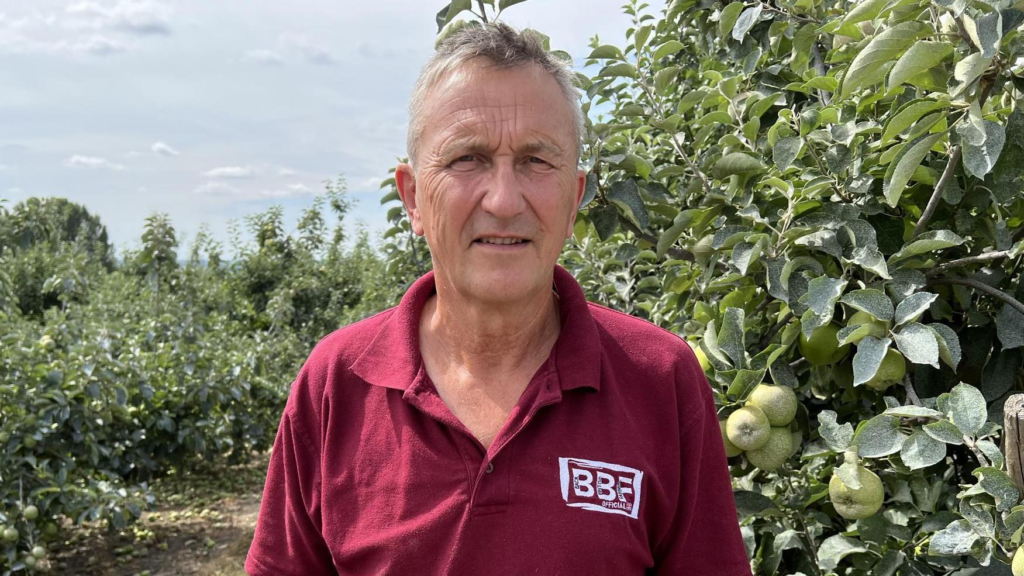
At Amsbury Farm near Maidstone, Kent, Clive Baxter manages roughly 200 acres (81 hectares) of fruit trees. He says the repeated spells of extreme heat this summer have hit nearly every part of his operation. “Everything is suffering now in the heatwaves,” Baxter said.

Bramley apples, a variety long associated with English cooking, are proving especially vulnerable. “Bramley apples are very susceptible to sunburn so we are spraying them with a clay substance that acts like suncream,” Baxter said. He explained that traditional English varieties, including Bramleys and Coxes, were never bred to withstand the kind of sustained heat the region has experienced this year.

The damage becomes severe once temperatures climb past a certain threshold. “Once the temperature gets to 30 degrees and above, if there is no wind, the juice starts to boil in the apples and cooks the fruit,” Baxter said. “When this happens it means the fruit is of no value at all.”

To protect what remains of the crop, Baxter’s team has started thinning the trees, deliberately removing some fruit so the rest has a better chance of surviving. He said the trees themselves are showing signs of strain. “So stressed” is how he described them, adding that the practice, while necessary, means lower yields and smaller apples overall.

Cattle farmers run out of grass

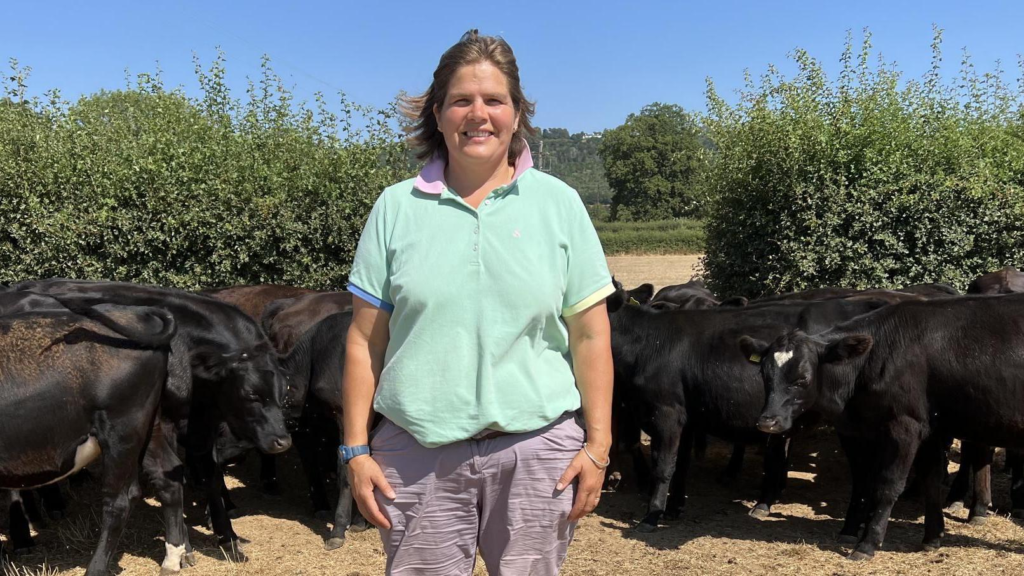
The heat is creating a different kind of pressure eighty miles away in Brockham, Surrey, where Nellie Budd raises 247 cows. For Budd, the central problem this summer has been simple: there is not enough food for the herd to eat.

“We have had 47 days now with no rain,” Budd said. “Grass normally is so resilient, once we cut it for hay or cut it for silage it will come back and we can continue grazing, but, this year, with the heat, there has been no let up.”

With pasture failing to regrow, Budd has started feeding her cattle hay that was meant to carry them through winter, a move that leaves her with a shortfall she will need to make up before the cold months arrive. The shortage is already changing the size of the animals she can bring to market.

“With limited food to eat, the carcasses are just not getting big enough which means they are not going to be the size for what we want because they are beef cattle,” Budd said.

Cutting the size of her herd is not something she is willing to consider, even as costs rise. “We have been putting an overlay in our grasslands to try and help but, this year, with no moisture in the ground, we couldn’t do anything,” she said. Reducing cattle numbers, she added, is not an option, because her family “could not afford to live” if she scaled back.

Budd said she is left hoping conditions change before next year’s growing season begins. “Everything is a gamble for farmers and we just hope weather patterns cause a wetter year next year,” she said.

Grain yields down by a third or more

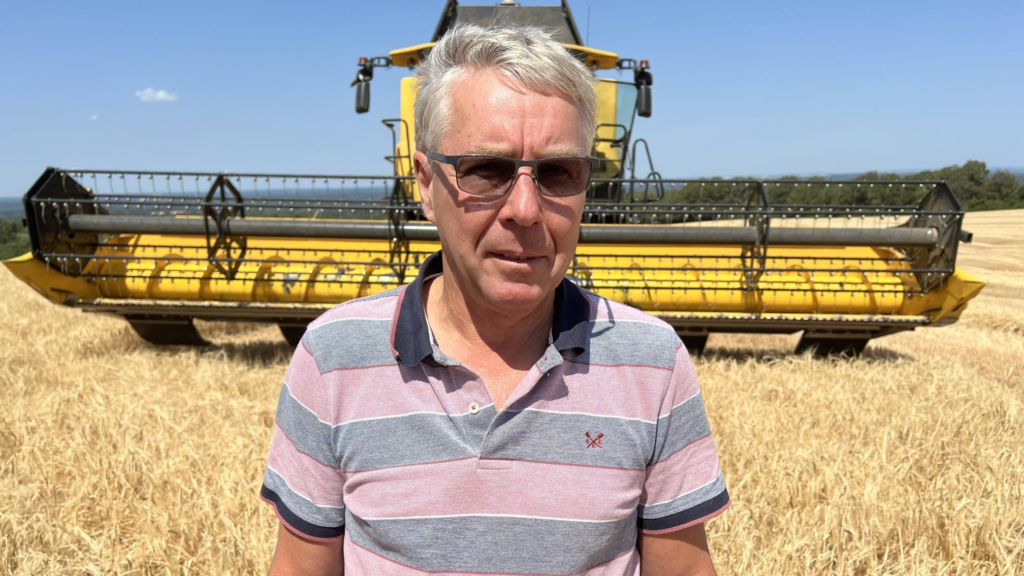
Further west, at Woolgars Farm in West Horsley, arable farmer and contractor Peter Knight is currently harvesting around 2,000 acres (809 hectares), and the numbers coming in are worse than he expected. He traces the trouble back to the first heatwave in May, which struck right as his spring barley, a crop used mainly for brewing beer, needed steady moisture to establish itself.

“Spring barley, which is used for making beer, is planted in March and it has had very little rain on it since then,” Knight said. The timing compounded the damage. “The crops flower in early June but, at that time the heat puts it under stress, which means we immediately know the yield is going to be impacted,” he said.

Knight said the dry spell never really let up through the grain-filling period, the weeks when kernels normally bulk up in size and weight. Without rain during that window, the plants simply could not put on the growth needed for a strong harvest.

He is now watching a pattern repeat itself. “We are very worried because three out of the last five years we have had very similar weather patterns in terms of drought-like conditions and trying to manage our way through that is very difficult,” Knight said.

Unlike some fruit and vegetable operations, arable farms of this scale have few tools to fight back against drought. Knight said irrigating thousands of acres of grain is not realistic given the cost and infrastructure it would require. Instead, he has adjusted his methods where he can. “We are doing our best by trying to sow earlier in the spring and we are doing less cultivations which helps preserve moisture but this year the yield here is reduced by around 30-40% on what we would normally expect,” he said.

Knight said the consequences extend beyond his own farm. If the current weather pattern continues to disrupt arable output across the country, he expects Britain will need to lean more heavily on imported grain to make up the difference.

A season of adjustments across the industry

Baxter’s spraying regimen, Budd’s early dip into winter feed stores, and Knight’s earlier sowing and reduced cultivation all point to the same reality: farmers across different sectors are making real-time changes to how they operate, not waiting for the season to end before responding.

None of the three describe the heat as a one-off. Knight’s reference to three drought-affected years out of the last five suggests a pattern rather than an isolated bad summer, and Budd’s decision to protect her herd size despite the financial strain signals she expects to need that stock again once conditions improve.

For now, the fruit that survives will carry a higher cost of production, the cattle coming to market will run smaller than usual, and the grain harvest at Woolgars Farm will fall well short of a typical year. Whether next year brings the wetter conditions farmers are hoping for remains the open question hanging over the rest of the 2026 growing season.


Life

Vozinha’s world cup heroics earn him a sea slug named in his honour

By George Mensah 4 min read

Cape Verde goalkeeper Vozinha has picked up an unexpected honour after his run at the World Cup, with scientists naming a newly identified sea slug species after him.

The Cape Verde islanders pushed Argentina to extra time before falling 3-2, a result that capped a tournament run few had predicted for the small West African nation. Before that exit, Vozinha kept a clean sheet in a goalless draw against European champions Spain, a result that gave Cape Verde its first-ever point at a World Cup.

That performance changed his profile almost overnight. His Instagram following jumped from 50,000 to 17.4 million, a number that puts him ahead of NFL veteran Tom Brady in social media reach.

A New Species Named In His Honour

Biologist Jesus Ortea, a professor emeritus at the University of Oviedo, found the small red mollusc in the Caribbean and gave it the name Aldisa vozinha, tying it directly to the 40-year-old goalkeeper.

In his published report on the discovery, Ortea wrote that he wanted to mark Vozinha’s role at the tournament. He also pointed out a detail that made the choice feel deliberate rather than arbitrary: the slug’s red colouring mirrors the nickname of Spain’s national team, La Roja, the side against whom Vozinha delivered his best-remembered display.

“The red colour of the dedicated species is a reminder of his feat,” Ortea wrote.

A Scientist With A Football Habit

This isn’t the first time Ortea has mixed marine biology with football. At 75, he has built a pattern of naming new species after players who catch his attention during major tournaments.

He previously named a species discovered in Costa Rica after Keylor Navas, the goalkeeper who played for Costa Rica at several World Cups and spent time at Real Madrid, Paris Saint-Germain and Nottingham Forest.

Ortea also named a separate creature after Quini, the former Sporting Gijon striker, picking a species whose colours matched the club’s kit.

His connection to Cape Verde goes beyond this latest naming. Ortea received the country’s Medal of Merit in 2023 for his research in the waters surrounding the island nation, work that had already put him in contact with Cape Verdean officials before Vozinha’s World Cup run began.

A Breakthrough Run For Cape Verde

Cape Verde’s World Cup campaign stood out as one of the tournament’s more unexpected stories. A nation of roughly 500,000 people reached a stage most had not anticipated, and Vozinha’s saves against Spain became the moment that defined the run for many watching outside the country.

The draw with Spain secured a point that Cape Verde had never managed at a World Cup before that match. Reaching the knockout stage and taking Argentina to extra time added to a run that turned Vozinha into one of the tournament’s more recognisable figures, despite representing one of its smaller footballing nations.

His social media numbers reflect how quickly that recognition spread. Going from 50,000 followers to 17.4 million in the span of a single tournament put him among the most-followed athletes to emerge from this World Cup, regardless of how his side’s run ultimately ended.

Science Meets Sport

Ortea’s naming choices follow a consistent logic. Rather than picking names at random, he has tied each species to a detail about the player or club being honoured, whether through colour, geography, or timing. The Vozinha naming continues that approach, linking a mollusc found in the Caribbean to a goalkeeper who plays his football thousands of miles away in Africa and Europe.

Species names given in honour of public figures are not unusual in taxonomy, but Ortea’s specific focus on footballers gives his research a public profile that pure marine biology often doesn’t attract. Each naming tends to draw attention back to his broader work cataloguing new mollusc species, work that includes his research around Cape Verde’s coastline.

For Cape Verde, the timing adds another layer of recognition to a tournament that already delivered milestones the country had not reached before. Vozinha’s clean sheet against Spain and the near-miss against Argentina will likely remain the sporting highlights of the run, but the naming of Aldisa vozinha gives the goalkeeper a mark tied to the tournament that will outlast this particular World Cup cycle.

Ortea’s report on the discovery did not indicate whether he plans to name further species after players from this tournament, though his history suggests Vozinha may not be the last footballer to receive this kind of tribute.

ADVERTISEMENT
Scroll to Top