
Clicxpost

Politics

Trump’s deportation push forces dozens of LGBT migrants onto hostile terrain

LGBT asylum seekers

The United States has deported at least 40 LGBT migrants who had won legal protection from persecution to African countries that criminalise same-sex relations or have been described by the State Department as hostile to LGBT people, according to a Reuters investigation. The cases date from the Trump administration’s expanded use of third-country deportations this year.

One of them is Abdou Latifou, a gay man from Togo. In June, US officials put him on a deportation plane to Sierra Leone, where gay men can be sentenced to life in prison under colonial-era laws. A US immigration judge had ruled in November that it was not safe to send him home.

A mob attack, then a court win

Two years ago, a mob assaulted Latifou and threatened to kill him after he was seen kissing the man he loved, according to his asylum application. He fled Togo and sought refuge in the United States.

When the immigration judge ruled in his favour last November, he felt he had reached safety. ‘I told myself, “From this day on, I’m entering a world where I’m free to live as myself,”‘ he said.

The judge granted him a lesser form of protection than asylum. It barred the government from deporting him to Togo but allowed his removal to other countries.

Sent to Sierra Leone, then back to Togo

Latifou, a gay Togolese man, sits on a beach overlooking the Atlantic Ocean in Abidjan

After he landed in Sierra Leone, Latifou was held for two weeks in a hotel under police surveillance. Guards then put him on a flight back to Togo. He arrived with a few items of clothing and $100.

He went to his village to see his mother. A relative soon warned him that he was not safe, and helped him cross the border into Benin. He continued to Ivory Coast, where he now lives with a friend and works as a security guard.

Same-sex relations are legal in Ivory Coast, but Ivorian activists have reported rising homophobic violence. Latifou avoids the Togolese community ‘so I don’t get recognized.’

What Reuters found across 40 cases

A gay Mauritanian man walks through a neighbourhood in Matam

Reuters tracked all 40 people, who come from across Africa and from Iraq, Jamaica and Russia. Reporters interviewed a dozen deportees and immigration lawyers and reviewed hundreds of pages of legal documents.

Sixteen remain in the countries they were deported to, and some are still detained. Sixteen others, like Latifou, were sent back to their home countries against their will. Nine are in hiding in third locations. One Ghanaian man is no longer in contact with his lawyers or relatives, they said.

The 40 cases involve deportations to three countries that explicitly criminalise same-sex sexual acts: Sierra Leone, Cameroon and Eswatini. Three others have no such laws, but the State Department has documented abuses of LGBT people there, including ‘corrective rape’ and conversion therapy. They are the Central African Republic, Equatorial Guinea and the Democratic Republic of Congo. Government spokespeople for all six countries did not respond to requests for comment.

More than half of the 40, including Latifou, were not eligible for asylum because they had not applied in countries they passed through before entering the US illegally. That rule came from Biden-era restrictions, which a federal court vacated in May.

Bridget Crawford, director of law and policy at the LGBT advocacy group Immigration Equality, said the US has repeatedly granted asylum to LGBT people from these countries. Her group has helped 12 Cameroonians and one person from Congo win asylum in recent years.

Where they ended up

Latifou, a gay Togolese man, walks along a beach in Abidjan

Many deportees told Reuters they wound up wherever someone would take them in.

A bisexual Ghanaian woman was deported to Cameroon in January and stayed for seven months. She could not speak French, the main local language, and feared for her safety in Ghana. She moved in with a relative in northern Nigeria, where penalties for same-sex sexual acts can include lashes or death by stoning. Most days she does not leave the house, she said.

A gay man from Ghana was deported to Sierra Leone and then forcibly repatriated. He has spent four months hiding in the forests of neighbouring Togo and lives on small sums his mother sends him. Most nights he sleeps on a blanket on the ground. When it rains, he shelters in an abandoned, half-finished house.

A 44-year-old Mauritanian man had lived in the US for more than a decade when ICE detained him in January and flew him to Eswatini, a small southern African kingdom he had never heard of. He spent a month and a half in a mosquito-infested prison with no hot water, he said. He eventually agreed to be flown back to Mauritania and slipped across the border into Senegal, where the government recently doubled the maximum penalty for same-sex sexual acts.

He is now staying with relatives in a remote town and trying to find out whether any countries in Europe or Asia would accept him. ‘My life just got turned upside down,’ he said.

A tactic that was rare before 2025

Third-country deportations were uncommon before Donald Trump’s second term. Since he returned to office and began a broad immigration crackdown, ICE and Border Patrol have deported more than 40,000 people to countries that are not their own, according to preliminary government data shared with Reuters. That is far above earlier estimates from advocates. About 900 people were sent to African countries.

Trump’s administration has made deals with impoverished foreign governments to take them.

Courts and the government’s response

In a February order in a case challenging the policy, US District Judge Brian Murphy addressed the risk to gay people. He called the government’s claim that those targeted had not explicitly asked not to be deported to repressive third countries an ‘absurdity.’

‘No person could reasonably be expected to make detailed, prophylactic claims about every country on Earth to which she might have a valid claim against removal,’ he wrote.

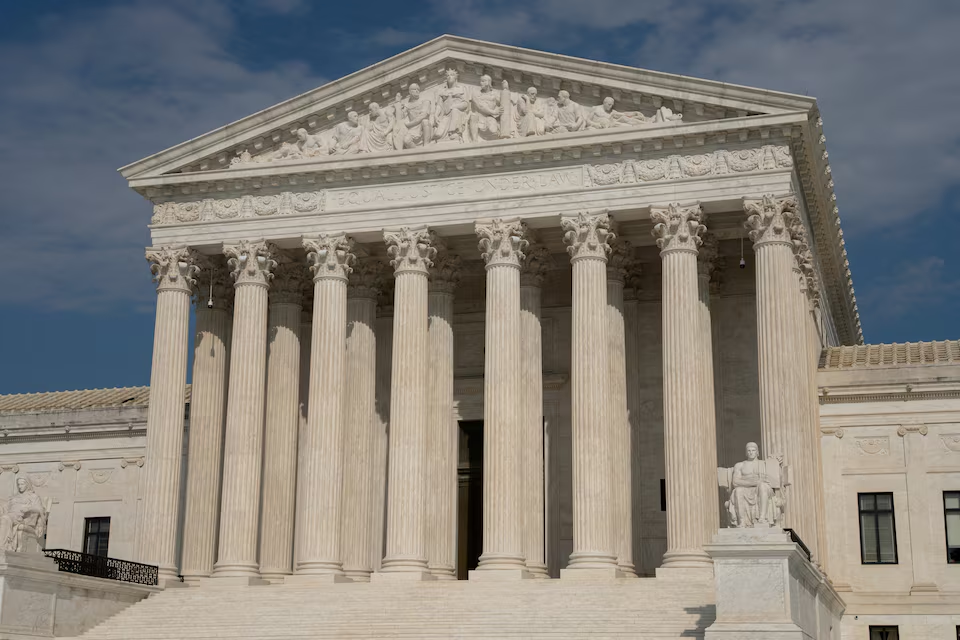
The Supreme Court has now put a hold on Murphy’s ruling, which lets the administration continue third-country deportations. The court will hear arguments in December.

Claire Trickler-McNulty, a former senior US immigration official, said sending people ‘to a third country where they face the very persecution we recognized makes a mockery of our protection systems.’

Chandler Rebel, a spokesman for the Department of Homeland Security, which oversees ICE, said in a statement that the agency ‘does not enforce the law on the basis of sexual orientation, that would be illegal.’ He added: ‘Third country removals are an essential public safety tool.’

On people who leave ICE custody, Rebel said: ‘When an individual is no longer in ICE custody then ICE will no longer be responsible for them.’

What happens next

The Supreme Court’s December hearing will decide whether the policy continues in its current form. Until then, the government can keep removing people to third countries, and the 40 documented cases show what that has meant for LGBT migrants who had won protection in US courts.

RECOMMENDED
Politics

Ohio Town Bans Data Centers It Doesn’t Have, and the Fight Reshapes the Midterms

By George Mensah 6 min read

No company has announced any plan to build a data center in Defiance, Ohio, a city of 17,000 people surrounded by soybean fields in the state’s northwest corner. Residents are moving to ban one anyway. On November 3, voters there will decide a ballot measure that would prohibit all but the smallest data center projects, after the county’s economic development office confirmed it had fielded inquiries from tech companies. City officials have already imposed a six-month moratorium on new project approvals.

Defiance is one front in a fight now playing out across Ohio and much of the country, where anxiety about AI infrastructure has turned data center construction from a routine economic development pitch into a live issue in the 2026 midterms.

A $2 billion number changed the debate

Residents in Defiance already worried about what data centers would do to farmland, electricity demand and water supply. Those worries hardened this summer when state tax records showed Ohio had given up more than $2 billion in sales-tax revenue through data-center incentives across 2024 and 2025, with Amazon and Meta among the companies benefiting.

A Bowling Green State University poll taken August 31 found 71 percent of Ohioans would support a temporary ban on new data center construction. That is not a narrow plurality. It is close to three in four residents of a state that has spent a decade courting this exact industry.

Becca Rupp, who founded Citizens for Responsible Development in Defiance, put the sentiment plainly. Most people feel preyed upon by big business, she said.

Governor Mike DeWine, a Republican, has suspended new applications for data-center tax exemptions while lawmakers work on reforms. Those lawmakers left for summer recess without acting, so the incentive program sits frozen and undefined heading into an election where it has become a talking point on its own.

Democrats find an opening in rural Ohio

Big tech fast-tracking new off-grid power plants, leaving communities in the dark about their pollution

For Democrats, who have struggled for a decade to win rural votes in the Trump-era Midwest, the data-center backlash has opened a rare line of attack in exactly the territory they need.

Representative Marcy Kaptur is running for reelection in a newly redrawn district that now includes Defiance and other conservative rural counties, in what she has called one of the hardest races of her four-decade career. She has built television ads around data centers, accusing Republican opponent Derek Merrin of backing the tax breaks residents now resent.

Politicians are letting these companies pass their enormous energy and utility costs onto Ohio ratepayers, Kaptur said in a statement, then handing them billions in tax breaks on top of it. FirstEnergy data backs part of her argument: residential electricity bills in Defiance rose 10 to 15 percent in June compared with a year earlier.

Merrin has not responded to requests for comment on the ads. In a Facebook post last week, he wrote that Kaptur was blaming him for a tax break enacted before he was elected to the Ohio legislature.

The Senate race turns on the same issue

State of the Union address at the U.S. Capitol in Washington D.C.

The same fight is shaping Ohio’s Senate race between Republican incumbent Jon Husted and Democrat Sherrod Brown, who is trying to reclaim the seat he lost in 2024. Recent polling shows Brown ahead, and Republican groups responded by spending $14 million on Ohio advertising in a single week.

Brown has called Husted “data centers’ best friend” and criticized him for promoting the tax incentives now under fire. Ohioans, not Jon Husted and his billionaire friends, should decide whether data centers get built in their community, Brown’s campaign said.

Husted’s campaign points to legislation he has sponsored that would require data-center operators to pay for the electricity generation and transmission capacity their facilities need. Spokesperson Amy Natoce argued Brown had three decades in Congress to address the issue and did nothing, then started caring the moment an election arrived.

From zoning disputes to a governor’s race

Lyn Cox, who leads the advocacy group Conserve Ohio from rural Waterville Township about 40 miles from Defiance, said the tax-subsidy disclosure turned a series of scattered local zoning fights into a statewide issue overnight. She called it a huge turning point, one that has pushed candidates in both parties to develop actual policy positions instead of vague talking points.

That pressure has reached the governor’s race. Republican Vivek Ramaswamy, who previously supported attracting tech investment to Ohio, released a proposal that would eliminate local property-tax abatements for data centers, redirect the revenue into homeowner rebates, and require developers to cover any increase in residential electricity costs their projects cause.

His Democratic opponent, Amy Acton, wants to restrict the tax incentives, require developers to fund their own power infrastructure, and mandate union labor standards on construction. Both candidates have also called for limits on building data centers on productive farmland.

Cox is not impressed by either platform. They’re just words, she said. Both sides came up with a policy because they’re starting to understand this is a sleeper issue.

Conserve Ohio is now pursuing a 2027 state constitutional amendment that would ban construction of any data center using more than 25 megawatts of power, while backing similar local ballot measures around the state. The group is also pushing state officials to disclose how much revenue local governments have given up through their own separate tax agreements with data-center operators, numbers that remain unpublished.

What the companies say

Amazon says it has invested close to $40 billion in Ohio since 2015. Meta points to more than $2.3 billion in state investment since 2018. Both companies argue their facilities generate tax revenue, jobs and broader economic activity in the communities where they operate.

For Rupp, the argument has moved past any single project. The real question, she said, is whether elected officials will defend the public interest against big tech at all. She called it a breakdown between what government was supposed to do for small America and what it has failed to do, and said data centers now sit at the center of that failure.

What happens next

Three dates will show whether this backlash has staying power beyond one election cycle.

November 3 is the first test. If Defiance voters approve a ban on a data center that does not exist yet, expect similar preemptive measures to appear on ballots in other Ohio counties next cycle, and expect other states watching AI infrastructure expansion to take notice.

The Senate and gubernatorial races are the second test, and the clearest read on whether this issue moves votes rather than headlines. A Brown win in a state Trump carried twice would tell national Democrats that utility bills and tax giveaways, not just AI abstractly, are the frame that works in rural districts.

The third is legislative. Ohio lawmakers left the DeWine moratorium in place without passing reform before recess. Whatever they do when they return, whether that is capping incentives, mandating developer-funded infrastructure, or letting the freeze lapse, will set the template other state legislatures either copy or avoid as this fight spreads.

Politics

Trump Lashes Out at His Own Supreme Court Appointees Over Mail-In Ballot Ruling

By George Mensah 5 min read

President Donald Trump attacked his own Supreme Court appointees on Tuesday, a day after the nation’s highest court blocked a U.S. Postal Service rule that would have restricted mail-in ballots ahead of the November midterm elections. The outburst marked the latest in a string of public criticisms Trump has leveled at the court following rulings that have gone against him.

“This Supreme Court is bullied and cajoled by the Radical Left into making decisions that have set America back at least a hundred years,” Trump wrote on social media.

Writing on Truth Social, Trump did not name any specific justices but made clear his frustration extended to the court as a whole, including the three justices he appointed during his first term. “These are not the people I interviewed to serve on the United States Supreme Court, they are merely a shell of their original selves,” he wrote. “It is a Court that will go down as having rendered some of the most destructive, hurtful, and damaging decisions in our Country’s history.”

A Court Reshaped by Trump Himself

The criticism is notable given that Trump built the court’s current conservative majority. During his first term, he appointed Neil Gorsuch, Brett Kavanaugh and Amy Coney Barrett, cementing a 6-3 conservative bloc that has steered the court rightward since 2020. That the president now regularly criticizes justices he selected underscores how personally he has taken a series of rulings that have not gone his way, even as the court has largely maintained a conservative tilt on most issues.

The Ruling at the Center of the Dispute

On Monday, the Supreme Court issued a brief, unsigned order preventing the Postal Service from implementing a rule restricting mail-in ballots, a format typical of how the court handles emergency requests. The regulation had been adopted at Trump’s direction and would have required states to submit voter-specific data and use agency-approved mail-ballot envelopes tracked by barcodes. Under the rule, the Postal Service could have refused to deliver ballots that failed to meet the new standards or that were linked to voters not appearing on approved lists.

Critics of the measure warned it risked disrupting the delivery of large numbers of legitimate ballots as the November 3 election approaches, particularly with many states preparing to send mail ballots to eligible voters in the coming weeks. The Trump administration defended the rule as a safeguard against voter fraud, though evidence of such fraud in U.S. elections remains rare.

Trump called the court’s decision a “horrible, highly political, ruling.” Only two conservative justices, Samuel Alito and Clarence Thomas, publicly dissented from the majority. Trump singled them out for praise, calling them “legends, both.”

Attorney General Todd Blanche told reporters afterward that the administration would comply with the court’s decision, signaling that despite Trump’s public frustration, the ruling would stand and the disputed rule would not move forward as originally planned.

Not the First Clash With His Own Appointees

Tuesday’s outburst continues a pattern. In February, the Supreme Court struck down Trump’s sweeping global tariffs, ruling that he had imposed them illegally by invoking a law intended for national emergencies. In that 6-3 decision, both Gorsuch and Barrett sided with the majority against the administration, drawing some of Trump’s sharpest criticism yet.

“I think it’s an embarrassment to their families, you wanna know the truth, the two of them,” Trump said at the time, speaking from a White House lectern.

In his post on Tuesday, Trump revisited those grievances, referencing both the tariffs ruling and a separate decision in June that blocked his effort to restrict birthright citizenship. Taken together, the remarks suggest a president increasingly willing to publicly criticize the court’s conservative majority even when it includes justices he handpicked, particularly on cases touching immigration, trade and now election administration.

Political Stakes of the Mail-In Ballot Fight

The mail-in ballot rule sits at the center of a broader political battle as Republicans work to retain control of Congress in the midterms. Restricting mail-in voting would likely benefit Republicans, according to various surveys showing that Democratic voters disproportionately rely on mail ballots. That dynamic has made the issue a flashpoint well beyond the specifics of postal regulation.

Trump signed the executive order targeting mail-in ballots in March, following years in which he repeatedly cast doubt on their security, despite having voted by mail himself on multiple occasions. He has also made false claims of widespread fraud in past U.S. elections, including his 2020 loss to former President Joe Biden, claims that have been repeatedly disproven by courts, state election officials and independent audits.

“It is a big loss for Republicans, and America itself,” Trump wrote of Monday’s ruling.

A Mixed Record on Election Cases

U.S. President Donald Trump speaks to members of the media after traveling to Ireland

The Supreme Court’s relationship with Trump’s political interests has not been one-directional. The court has issued several election-related rulings in recent months that have benefited Republicans, reinforcing the party’s view of the court as broadly sympathetic to its priorities. But last Thursday, the court blocked Missouri from using a redrawn congressional map that favored Republicans, a decision that dealt a setback to the party’s efforts to protect its narrow majority in the U.S. House of Representatives ahead of November’s elections.

That mixed record complicates the narrative Trump has pushed in his social media posts. While he has portrayed the court as uniformly hostile to his agenda, its recent rulings show a more complicated picture, one in which the conservative majority has sided with Republican interests in some cases while rejecting administration positions in others, including the tariffs case, the birthright citizenship ruling and now the mail-in ballot rule.

What Comes Next

With the Postal Service rule blocked, states are expected to proceed with plans to distribute mail-in ballots without the tracking and eligibility requirements the administration had sought to impose. The Justice Department’s confirmation that it will comply with the ruling suggests no immediate legal escalation, though Trump’s public attacks on the court suggest the dispute is far from resolved politically.

As the midterms approach, both parties are likely to keep close watch on further legal battles over redistricting, mail-in voting procedures and other election administration questions, with the Supreme Court positioned to remain a central and unpredictable player in shaping how the November elections unfold. Trump’s willingness to publicly criticize even his own appointees signals that further friction between the White House and the court is likely as more election-related cases reach the justices in the weeks ahead.

ADVERTISEMENT
Scroll to Top