Clicxpost

Nepal Races to Free Hundreds Trapped in Flooded Hydropower Tunnels as Death Toll Tops 900

Nepal flood disaster

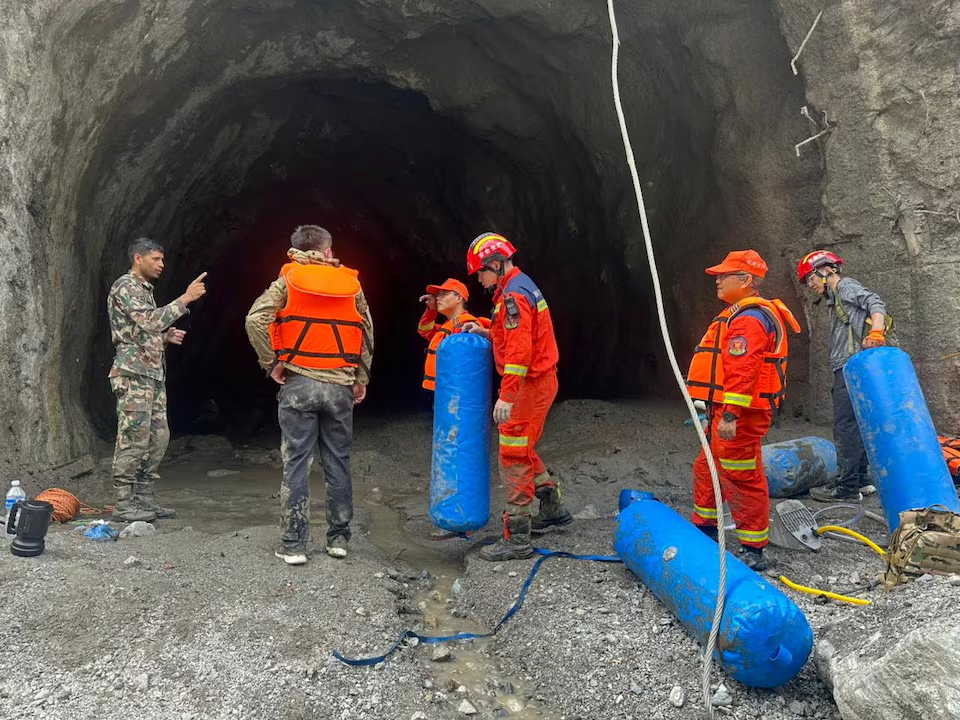
Nepal’s rescue teams pushed deeper into blocked hydropower tunnels on Monday, working alongside Chinese and Indian experts to reach hundreds of workers still believed trapped nearly a week after a catastrophic Himalayan flood.

The disaster struck last Wednesday, when a wall of ice, rock, mud and debris tore through valley towns and villages in Nepal and crossed into neighboring China. The flood has killed more than 900 people, and almost 5,000 remain missing. Officials believe a glacier collapse triggered the collapse.

Rescuers Turn to Controlled Blasts

Nepali officials said the immediate priority is reaching 933 workers trapped at 11 hydropower projects, many of them inside roughly half a dozen tunnels, in the hard-hit districts of Rasuwa and Nuwakot.

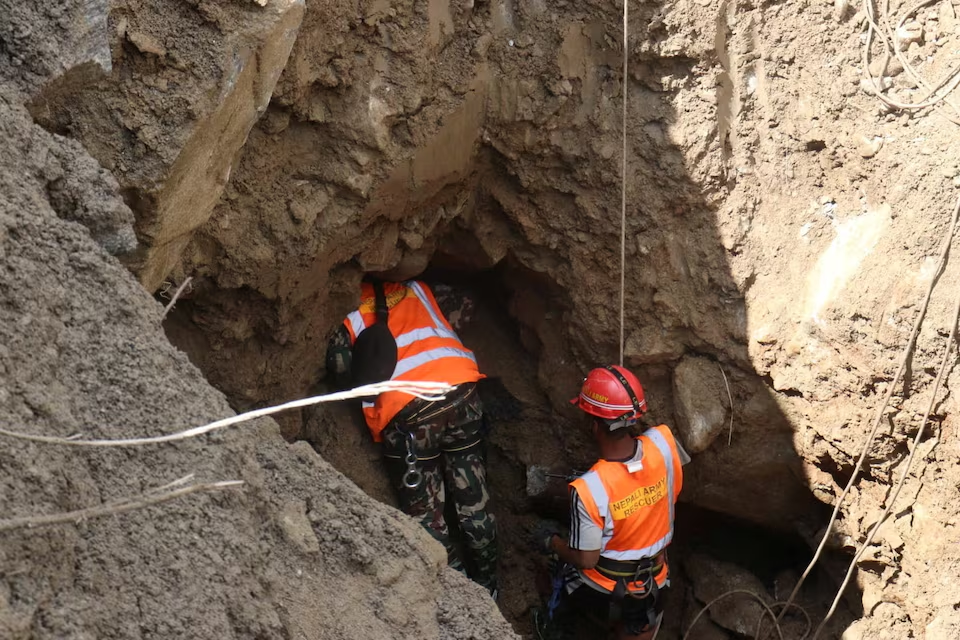
Video and photos released by rescue teams showed excavators clearing mud and rock under floodlights through the night, while soldiers used torches to search a large pit dug in hopes of reaching one blocked tunnel.

The Nepali army said search teams are using controlled blasts, excavators and searchlights to clear water and debris and reach anyone still trapped. Crews recovered three bodies after entering two tunnels, while other sections remain buried and are still being searched, the army said.

“A large amount of debris has been deposited and that is posing us a big challenge to open the tunnels,” Nepali army spokesperson Raja Ram Basnet said. “Our main focus is on opening the tunnels.”

Death Toll Climbs Past 900
Nepali authorities confirmed 903 deaths on Monday, with 4,247 people still missing, a figure that includes the 933 workers unaccounted for at hydropower sites. Across the border in China’s Gyirong County, authorities reported 16 deaths and 546 people missing.

Nepal’s foreign ministry said roughly 590 foreign nationals from 39 countries remain missing. More than 10,000 people have been pulled from the flood zone so far, including 323 foreign nationals, the ministry added.

The Red Cross estimates the disaster has affected more than 90,000 people. China has tied the flooding to the broader effects of climate change.

A Booming Industry Built on Mountain Tunnels

Nepal has seen a surge in hydropower development since the early 2000s, as the country has worked to harness its Himalayan rivers to ease chronic power shortages at home and expand electricity sales to India.

Building that industry in Nepal’s terrain requires tunnels. Developers rely on them to channel river water through steep mountainsides, using the sharp drop in elevation between Himalayan rivers and powerhouses below to generate electricity. Those same tunnels are now where hundreds of workers remain trapped.

Prime Minister Balendra Shah called the flood an “unprecedented and devastating natural disaster” and said officials still cannot compile a full damage assessment.

China Reports Its Own Missing
Beijing said 261 foreign nationals from 23 countries remain unaccounted for in Tibet, near a major border crossing with Nepal. Chinese foreign ministry spokesperson Guo Jiakun said Monday that nearly 100 Chinese citizens have not been reachable on the Nepalese side of the border.

State broadcaster CCTV reported that a Chinese cabinet meeting called for an all-out search effort, along with transparent public information, risk assessment and stronger emergency management systems going forward.

New Lakes and Unstable Glaciers Threaten Fresh Flooding

Nepal has said it does not need outside help for general search and rescue work, but it has turned to India and China for specialized tunnel rescue expertise.

Rescue efforts have been suspended multiple times due to bad weather, and officials remain concerned about a lake that formed across the Nepal-China border after the disaster. That lake has already begun overflowing into Nepal’s river system, raising fears of renewed flooding.

CCTV reported Monday that glaciers surrounding an impact crater near last week’s collapse site remain at risk of further collapse. Drone footage showed landslide deposits along both riverbanks, raising the possibility of additional collapses and the formation of new lakes.

State media said last week’s flood was caused by glacier instability linked to long-term global warming.

Nepal Says Data-Sharing With China Has Fallen Short

Two Nepali officials told Reuters that China had not shared substantial information on glacier risks and water levels since a meeting earlier this year meant to strengthen cooperation between the two countries. The officials said they worry the lack of shared data could weaken disaster preparedness going forward.

China’s foreign ministry said Beijing has continuously supplied Nepal with meteorological and hydrological data and will keep supporting Nepal’s disaster relief work while safeguarding what it called the two countries’ shared interests.

What Comes Next

With thousands still missing and unstable glaciers looming over the disaster zone, Nepal’s rescue operation faces a narrowing window. Crews are racing to reach the hydropower tunnels before weather or new flooding forces another pause, even as questions grow over whether both governments shared enough warning to limit the damage in the first place.

RECOMMENDED

UP NEXT

Airlink stadium flypast

South African airline defends low-altitude aerial stunt over packed stadium

A South African airline has pushed back against criticism of a daring flypast that sent two of its aircraft skimming close to the top of a packed rugby stadium in Cape Town. The jets streaked over DHL Stadium on Saturday, where more than 50,000 fans had gathered to watch South Africa face New Zealand. Smoke flares shot into the sky as the planes roared past just before kickoff. Reaction Splits Between Awe and Alarm Footage of the manoeuvre spread quickly online, drawing sharply divided reactions. Some viewers called the stunt reckless given the density of the crowd below. Others praised the precision and skill needed to execute it. Airlink, the airline behind the flypast, insisted the display was far from improvised. The carrier said it worked closely with aviation authorities to plan every detail in advance. “Planning. Precision. Performance,” the airline wrote in a social media post accompanying the footage. Airline Details the Safety Measures Behind the Stunt In a more detailed statement carried on a South African government news site, Airlink described the experience level of the crews involved. “The two aircraft were flown by highly experienced crew, with each comprised of three senior captains operating in the roles of commander, co-pilot and safety/technical officer,” the airline said. The company added that both flights stayed within “approved and rehearsed safety altitude and speed limits” set specifically for the flypast. Flight tracking website Flightradar24 offered its own read on the numbers. Based on its analysis, the site said the lead aircraft passed within roughly 50 feet, or about 15 metres, of the stadium’s highest point. National Pride Outweighs Safety Concerns for Many Despite the risk raised by critics, of two aircraft flying low over a stadium filled with tens of thousands of people, many South Africans responded with pride rather than alarm. Sports Minister Gayton McKenzie framed the flypast as proof of national aviation talent. “It’s a well known fact that we have the best pilots in the world, that was spectacular,” he wrote on X. That sense of pride reflects a broader pattern: low-altitude flybys have become something of a tradition ahead of major rugby matches in South Africa, timed to heighten the atmosphere before kickoff. A Tradition Rooted in 1995 The most famous precedent dates back three decades. A South African Airways jet flew low over Johannesburg’s Ellis Park stadium before the 1995 Rugby World Cup final, a match South Africa won against New Zealand. That game carries deep symbolic weight in South African history. It was immortalised in the Hollywood film “Invictus,” which depicted Nelson Mandela, the country’s first Black president, wearing the jersey of the national rugby team. The gesture mattered because the Springboks jersey had long been associated with the apartheid government. For decades, the national side had excluded players who were not white, making Mandela’s decision to wear it a powerful signal of reconciliation. Weekend Flypast Echoes That Legacy Saturday’s stunt over DHL Stadium drew on that same tradition of pairing rugby’s biggest moments with displays of aviation skill, even as it reignited debate over how much risk is acceptable for spectacle. Airlink’s defense centered on process: experienced crews, government coordination, and rehearsed limits on altitude and speed. Critics, meanwhile, focused on outcome, questioning whether any margin of error is appropriate when a packed stadium sits directly below. For now, the airline shows no sign of stepping back from the practice. Its statement framed the flypast not as a one-off risk but as a demonstration of exactly the planning and precision it says defined the event. What Comes Next Aviation authorities have not indicated any investigation is underway, and Airlink has not said whether similar flypasts are planned for future matches. But with South Africa’s rugby calendar featuring more high-profile fixtures against rivals like New Zealand, the debate over how low is too low seems likely to resurface the next time smoke flares and jet engines announce kickoff.

Read More »
Lake America Trump

Trump Pushes Apple to Rename Lake Ontario “Lake America” After Google Makes the Switch

U.S. President Donald Trump has personally asked Apple to rename Lake Ontario as “Lake America” on its Maps platform, according to Interior Secretary Doug Burgum, extending a renaming fight that has already strained relations with Canada. Burgum told Fox News on Monday that “the president has reached out to Apple directly,” adding, “I’m sure we may be seeing that change coming up soon.” Google already made the change for its U.S.-based users over the weekend. Canadian users still see the lake, which sits on the border between the province of Ontario and the state of New York, labeled as Lake Ontario. The BBC has contacted Apple for comment. An Executive Order Sparked the Dispute Trump signed the order on Thursday, directing that Lake Ontario be renamed Lake America. The move came after trade negotiations between the United States and Canada broke down. The order instructs Burgum to “take all appropriate actions” to carry out the change, including updating the Geographic Names Information System, the federal government’s official map database. Google confirmed in a statement Saturday that its maps will show the Lake America name to U.S. users to comply with that federal database. Canadian users will continue seeing Lake Ontario. Everywhere else in the world, the platform will display both names together: Lake Ontario (Lake America). Canadian Utilities Caught in the Crossfire The switch has triggered pushback across Ontario, where several public agencies briefly displayed the new name without intending to. Hydro One, a Toronto-based utility, apologized on Sunday after its map began showing “Lake America.” The company said in a post on X that the label appeared because of a third-party mapping service it relies on. “We are working with our vendor to correct the issue as quickly as possible and restore the proper geographic reference,” Hydro One said. “We regret the error and apologise for any confusion it has caused.” Maps used by Hydro Ottawa and the Liquor Board of Ontario also briefly showed the Lake America label. Not Every Map Provider Is Following Along MapQuest, the American web mapping service that launched in 1996, announced it has no plans to change the name. “We’re not changing it,” the company said in a short Facebook post on Friday. MapQuest went further, rolling out a tool that lets users rename the lake to anything they like and share their creations online. The stance appears to have resonated in Canada: by Monday morning, MapQuest had climbed to the top of the free-app charts on the Canadian Apple App Store. Ontario Pushes Back With a Lakeside Sign Ontario Premier Doug Ford installed a large sign along the lakeshore on Saturday reading “Lake Ontario Now and Always,” written in both English and French, Canada’s two official languages. Ford dismissed the renaming effort during an interview with American TV host George Stephanopoulos on Sunday. “No one’s going to call it Lake of America,” Ford said. “It’s been Lake Ontario for hundreds of years. It’s going to continue being Lake Ontario.” A Name Rooted in Indigenous History The renaming push touches a naming history that predates both countries in their current form. Four of the five Great Lakes, Ontario, Huron, Michigan and Erie, trace their names to Indigenous words. That history has added weight to Canadian objections, with critics framing the proposed change as an erasure of longstanding regional identity rather than a simple branding update. Part of a Wider Trade Standoff The lake-naming dispute has unfolded against the backdrop of a broader trade war between the two countries. Trade talks between Washington and Ottawa collapsed last week, and the renaming order followed shortly after. Canadian officials have treated the mapping changes as symbolic of a rockier relationship between the two governments, one that has already produced friction over tariffs and cross-border commerce. What Happens Next Whether Apple follows Google’s lead remains unclear. Burgum’s comments suggest the White House expects the company to fall in line soon, but Apple has not publicly responded to Trump’s outreach or confirmed any changes to its Maps platform. The split among map providers, Google complying, MapQuest refusing, leaves U.S. and Canadian users seeing different names depending on which app they open. That inconsistency is likely to persist until either more companies adopt the federal naming change or the underlying trade dispute between Washington and Ottawa is resolved. For now, Ford’s lakeside sign and MapQuest’s rebellion suggest the renaming effort faces real resistance north of the border, even as it moves ahead unchallenged within official U.S. government systems.

Read More »
Trump Iran strikes

Trump Vows Harder Strikes on Iran After Overnight Missile Exchange Near Jordan

U.S. President Donald Trump warned on Monday that Washington would strike Iran again after the first exchange of fire in a month, pulling a war that had settled into an economic standoff back toward the edge of open combat. Iran fired missiles overnight at two U.S. air bases in Jordan. Tehran launched the barrage after American forces hit Iranian launchers on Larak Island, a strike Washington said targeted equipment used to fire sea mines into the Strait of Hormuz. Overnight Strikes Follow U.S. Attack on Larak Island The exchange began on Sunday, when U.S. forces struck two Iranian launchers on Larak Island. A U.S. official said Islamic Revolutionary Guard Corps troops had been observed preparing to launch rockets carrying sea mines into the strait. Iran’s Tasnim news agency reported that three people died in the U.S. strike. The state-affiliated outlet Nournews identified two of them as members of the Revolutionary Guards Navy. Larak sits near Bandar Abbas, a strategically vital Iranian port. The Strait of Hormuz normally carries a fifth of the world’s crude oil and gas shipments, but it has been effectively closed since the war began. U.S. Central Command described its action as “limited, precise” and said it targeted minelaying forces that posed an “imminent threat” in the strait. It offered no further details. Iranian state television carried a Revolutionary Guards claim that a supertanker caught fire and stopped after being hit by two naval mines in the strait’s southern waters. The U.S. military denied that account. Trump Threatens a Harder Response Trump told Fox News he intends to escalate. “We’re going to hit them hard,” he said, according to the network. “There will be a response.” A senior Iranian source told Reuters the overnight fighting, the first since late July, amounted to a “limited and contained confrontation.” The source warned Tehran would answer forcefully if attacked again. Trump also said U.S. air defenses intercepted every Iranian missile capable of causing damage, and that fresh American sanctions were already inflicting serious harm on Iran’s economy, according to Fox News. Fake Videos Add Confusion to the Standoff Trump posted two videos on social media showing explosions engulfing Iran’s main oil export terminal on Kharg Island, writing, “Kharg island being blown to smithereens!!!” The footage was generated by artificial intelligence. No such attack occurred. Iran dismissed the post as “laughable.” Vice President JD Vance told reporters that Trump “likes to switch it up on social media a little bit” and was “sending a message” rather than describing real events. Washington has largely avoided striking Iran’s major oil and gas infrastructure directly. Iran has warned that any such attack would draw devastating retaliation against Gulf neighbors allied with the United States. Economic Pressure Keeps Building The war Trump launched alongside Israel six months ago has mostly turned into an economic standoff since late July, with each side wagering that rival shipping blockades in the Gulf will eventually force the other to back down. U.S. Treasury Secretary Scott Bessent said Monday that Iran’s latest attacks reflect the toll of new secondary sanctions targeting countries that buy Iranian oil. Speaking to reporters at a G20 finance ministers meeting in North Carolina, Bessent said, “They’re in shock at the state of their economy. I would think that they are lashing out kinetically because they are losing economically.” Bessent told Reuters on Sunday that Washington plans to roll out additional secondary sanctions weekly, starting with measures aimed at banks that handle Iranian transactions. A Fragile Push for Talks Iranian President Masoud Pezeshkian struck a softer tone on Monday during a regional security meeting in Kyrgyzstan. He told Indian Prime Minister Narendra Modi that Tehran still wants a negotiated end to the conflict. “We believe that continuing the war is in no one’s interest, neither ours, nor the region’s, nor humanity’s,” Pezeshkian said, according to Iran’s semi-official Tasnim news agency. The diplomatic opening comes after months of failed attempts to end the fighting. Trump halted his intensive bombing campaign, which he called “Operation Epic Fury,” in April through a ceasefire. The two sides agreed in June on an interim framework meant to lead toward broader talks, but that arrangement collapsed, triggering fresh clashes and two weeks of renewed U.S. bombing in July. For the past month, Washington has bet that a blockade of Iranian ports would inflict enough economic pain to force Tehran into compliance. Iran has held firm that the Strait of Hormuz remains closed and will reopen only on its own terms. The senior Iranian source told Reuters that conditions in the strait will “become worse” for any vessel that violates the passage rules Tehran has set. What Comes Next Trump has not achieved the goals he set when the war began: dismantling Iran’s nuclear program, limiting its capacity to strike regional rivals, and creating conditions that could push Iranians to challenge their clerical leadership. With new sanctions arriving weekly and both sides signaling readiness to strike again, the coming days will test whether Monday’s exchange stays contained or marks a return to sustained combat in the Gulf.

Read More »
Niger military mutiny Niamey

Niger Says It Has Regained Control After Soldiers Mutiny at Niamey Airbase

Nigerien authorities said Saturday they had restored order after a group of soldiers rebelled against their commanding officers at a key military base and opened fire on sensitive sites across the capital, Niamey. The mutiny triggered hours of gunfire and explosions overnight, rattling a government already navigating a fragile security situation nearly two years after a military takeover. Trouble Starts at Base 101 Defense Minister Gen. Salifou Mody said the unrest began with what he described as a “break with discipline and military regulations” at Base 101, a military airbase located at Diori Hamani International Airport. He said a group of soldiers attempted to rebel against their officers at the base and fired on sensitive locations in the capital before security forces managed to bring the situation under control. Mody did not detail what triggered the rebellion or specify how many soldiers took part. His public statement focused primarily on confirming that the immediate threat had passed, without addressing the underlying grievances that may have driven the mutiny. A Night of Gunfire Near the Presidential Palace Sustained gunfire and explosions rang out from shortly after midnight into Saturday morning, concentrated around the airport and in the Plateau administrative district, home to the presidential palace and other key government institutions. The overlap between the mutiny’s targets and the seat of government underscored how directly the unrest threatened Niger’s ruling authorities. Security forces moved quickly to secure both areas. A major road leading into Niamey was closed as part of the response, cutting off a key route into the capital while the situation remained unresolved. State broadcaster RTN halted its live transmission for several hours Saturday morning before resuming broadcasts later in the day, a pause that limited public access to information during the most active hours of the unrest. Ruling Council Calls for Unity Niger’s ruling military council, the National Council for the Safeguard of the Homeland, urged the public to remain united and vigilant in a statement issued as the situation unfolded. The council said defense and security forces had been mobilized to respond to the mutiny, though it offered few additional details about the scale of the rebellion or the response operation itself. The council has governed Niger since a 2023 coup that removed the country’s elected government, and Saturday’s mutiny represents a rare instance of internal military unrest reaching the capital’s most sensitive districts since that takeover. A rebellion originating within the armed forces poses a different kind of challenge for the ruling council than the external threats it has spent much of the past two years confronting. Third Security Incident at the Airport This Year Saturday’s unrest marked the third security incident this year involving Diori Hamani International Airport, a strategic site that hosts a Nigerien air force base along with the headquarters of the joint Niger-Burkina Faso-Mali military force. That regional force was formed as the three military-led governments deepened security cooperation following their respective breaks from Western allies and traditional regional bodies. Jihadi militants had attacked the airport on two previous occasions earlier this year, part of a broader pattern of extremist violence that has plagued Niger and its neighbors across the Sahel. Authorities, however, were explicit in describing Saturday’s incident as a rebellion involving soldiers rather than attributing it to militant groups, distinguishing it from the airport’s two earlier attacks. That distinction matters. An external militant attack and an internal mutiny point to very different vulnerabilities. The airport’s role as home to both the national air force and a multinational military headquarters makes it one of the most strategically significant sites in the country, and repeated security breaches there, regardless of the source, raise questions about how well the site is defended. A Sahel Region Under Strain Niger sits at the center of a Sahel region where military governments have increasingly taken power through coups over the past several years, citing failures by elected governments to contain jihadist violence. Niger’s own military council seized power in July 2023, deposing elected President Mohamed Bazoum in a move that drew international condemnation and sanctions. Since then, Niger has joined Mali and Burkina Faso, both also under military rule, in forming closer security and political ties, including the joint military force headquartered at the Niamey airport. All three countries have distanced themselves from former colonial power France and other Western partners, turning instead toward alternative security arrangements as they continue battling jihadist insurgencies within their borders. An internal mutiny within Niger’s own armed forces, even one authorities say has now been contained, adds a new layer of uncertainty to that regional picture. Militaries that seize power through coups often face heightened risk of internal fractures themselves, as competing factions within the armed forces vie for influence or grow dissatisfied with the ruling leadership’s direction. What Remains Unclear As of Saturday, Nigerien authorities had not released casualty figures from the overnight violence, nor had they named specific individuals involved in the rebellion or detailed what consequences those soldiers might face. The closure of the road into Niamey and the broadcaster’s temporary blackout suggest authorities moved to control both the physical security situation and the flow of information as events unfolded. Whether Saturday’s mutiny reflects an isolated incident or a deeper strain within Niger’s military ranks is a question that is likely to shape how the ruling council manages security in the capital going forward. With the airport already the site of three separate incidents this year, and with the presidential palace itself coming under threat overnight, Nigerien authorities now face pressure to explain how the rebellion started and what steps they intend to take to prevent a repeat.

Read More »
Iceland EU referendum vote

Icelanders Vote on Whether to Restart EU Membership Talks

Icelanders headed to the polls Saturday to decide whether their government should resume European Union accession negotiations, 13 years after Reykjavik broke off the process. The referendum, which runs from 09:00 to 22:00 GMT, comes down to a question that sounds procedural but carries deep stakes for a nation of under 400,000 people: control over its fishing grounds, its currency, and its long-guarded independence. A Race Too Close to Call The latest opinion poll put the No campaign ahead with 51.6% support, a reversal from an earlier poll that had shown the Yes side leading. That volatility signals a genuinely undecided electorate heading into voting day. More than one in five voters had already cast ballots in early voting before Saturday, according to Iceland’s public broadcaster RUV, and the final result is expected in the early hours of Sunday. Prime Minister Kristrún Frostadóttir’s centre-left government had already planned to hold the referendum, but she moved the timeline up in response to turbulent international affairs. Despite that geopolitical trigger, the campaign itself has centered on domestic concerns rather than security questions. What Icelanders Are Actually Voting On The ballot asks a single question: “Should Iceland resume accession negotiations with the European Union?” A Yes vote would not commit Iceland to joining the bloc. It would restart formal talks toward an accession agreement, which would then require approval in a second referendum, a vote in parliament, a constitutional amendment, and sign-off from all 27 EU member states. A No vote, meanwhile, would not permanently close the door. Iceland could still choose to resume talks at a later date. Iceland is already deeply tied to the EU through the European Economic Area, which gives it access to the single market and the Schengen border-free zone. Full membership would go further, bringing Iceland into the customs union and, eventually, the euro. The country’s accession bid was well advanced when talks were suspended in 2013. European Commission officials have indicated a deal could be finalized within one or two years if negotiations resumed. Of the 35 negotiating chapters covering areas from fisheries and economic policy to freedom of speech and the free movement of goods, 27 had already begun and 11 were provisionally complete before talks stopped. One pro-EU group, Yes to See, argues Icelanders should at least find out what terms they could negotiate before making a final call, so voters have complete information ahead of any binding decision. Fishing Grounds and National Sovereignty Take Center Stage The dominant issue in the campaign has not been security or geopolitics but sovereignty, and specifically, control over Iceland’s fishing industry. Fishing and marine exports make up almost 40% of the country’s total exports, and No campaigners have warned that EU membership could strip Iceland of authority over its own waters under the bloc’s Common Fisheries Policy. They have vowed never to share those waters with outside nations. Brussels has signaled that Iceland could receive some form of exemption from the common policy, but the fisheries question remains widely viewed as the single biggest obstacle to any eventual agreement. Many Icelanders still remember the Cod Wars with the United Kingdom, a series of fishing disputes Iceland won in the 1970s, and fisheries has historically been the sticking point that derailed EU membership talks before. Iceland’s relationship with Europe shifted after the 2008 financial crisis, when the collapse of the country’s banking system pushed Reykjavik to open accession talks in 2009. Those talks were shelved in 2013. Since then, Iceland has become one of Europe’s wealthiest nations, a turnaround Eirikur Bergmann, professor of politics at Bifröst University, said many Icelanders credit to the country’s independence. A Wealthy but Expensive Country Weighing the Numbers Iceland ranks fifth in the world for GDP per capita, but that wealth comes with a steep cost of living. One Icelandic trade union survey found this year that Iceland was more expensive than the next 10 most expensive countries in the world combined. Interest rates remain stubbornly high at 8%, and inflation has climbed to 5.6%. Yes campaigners argue EU membership, and eventually euro adoption, would help bring those rates down by anchoring Iceland’s economy to the eurozone. No campaigners have not focused their opposition on economics, instead framing the debate around control and decision-making power. Security Concerns Simmer Below the Surface Iceland is a founding member of Nato but maintains no military of its own, relying instead on allied nations for defense. A bilateral defense agreement with the United States has been in place since 1951, and No campaigners argue that Iceland’s security already rests on Nato and its US partnership, meaning EU membership would not substitute for those existing arrangements. Iceland has been among Ukraine’s strongest supporters since Russia’s full-scale invasion, and officials have watched Russia’s increased maritime activity near the island with growing concern. At the same time, unease has grown over US President Donald Trump’s expressed interest in acquiring Greenland, compounded by instances in which he has confused Greenland with Iceland. Earlier this year, the EU and Iceland signed a security and defence partnership. EU officials described the agreement as offering Iceland “an anchor in a community of values, prosperity and security.” Despite that framing, Hallgrimur Oddsson, director of the EU-Iceland think-tank European Currents, said geopolitics has played a smaller role in the campaign than many expected. “It’s lower on the agenda than many would think,” he said. Frostadóttir and Hafsteinsdóttir Face Off The referendum’s two leading voices faced each other directly in a televised debate ahead of the vote. Prime Minister Kristrún Frostadóttir led the Yes campaign, while Guðrún Hafsteinsdóttir, chair of the opposition Independence Party, headed the No side. Kristrún told viewers that Iceland is already closely integrated with the EU and that membership would represent “one of the biggest risk-reducing steps we can take.” She also emphasized that a Yes vote would not automatically mean Iceland joins the bloc, and pledged that a No result would be respected by her government. Guðrún pushed back on the premise that the vote was about Iceland’s relationship with Europe at all. “We already do, and we want that to continue,” she said, referring to Iceland’s existing cooperation with the continent. Instead, she cast the referendum as a question of whether Icelanders were willing to hand decision-making power over fisheries, agriculture and natural resources to Brussels. What Happens After the Polls Close Voting continues until 22:00 GMT Saturday, with results expected in the early hours of Sunday. Given how narrowly the polls have shifted between the two campaigns in recent weeks, the outcome remains genuinely uncertain heading into election night. Whichever way the vote falls, it marks only the first of several steps required before Iceland could formally rejoin the path toward EU membership, a path that would still need to clear a second referendum, parliamentary approval, and unanimous backing from all 27 current EU member states.

Read More »
Kyiv weapons depot strike

37 Killed as Russian Drone Strike Detonates Kyiv-Area Weapons Depot

A Russian drone strike hit a weapons depot storing munitions for Ukraine’s military near a residential area on the outskirts of Kyiv late Friday, killing 37 people and forcing the evacuation of nearly 400 residents. The blast set off shells, mines and drones stored at the site, damaging nearby homes and a care facility for elderly and disabled residents. President Volodymyr Zelensky has ordered an investigation into what he called negligence by officials who allowed explosives to be stored beside a residential neighborhood. A Blast That Should Never Have Happened, Zelensky Says Zelensky said the depot’s location was the core failure behind Friday night’s deaths. “Definitely shouldn’t have been there,” he said of the storage site, adding that an investigation had been opened into “terrible negligence on the part of those who stored explosive right next to people.” Four children are among the 42 people injured in the explosion, regional head Tymur Tkachenko said. A rescue operation continued into Saturday at the site in Bucha district, where crews worked through damaged buildings searching for survivors and clearing debris from the blast. Zelensky called the decision to store explosives there “absolutely unacceptable” and confirmed that criminal proceedings had been opened on charges of official negligence. “There are regulations in place. Ammunition cannot be stored near homes or other residential areas,” he said. “Appropriate conclusions will certainly be drawn.” Russia Confirms the Target, Names the Cargo Russia’s Ministry of Defence said in a statement that its forces had targeted an ammunition depot in Myla, a village west of Kyiv, describing the site as holding components and launch boosters for FP-1 and FP-2 long-range unmanned aerial vehicles. The statement did not address the residential damage or the death toll on the ground. Ukraine’s prosecutor general’s office said it was reviewing the legality of storing explosive materials near residential buildings in Myla, and that the actions of officials who made the underlying decisions would also face investigation. The dual inquiries, one from Zelensky’s office and one from prosecutors, point to a government response focused as much on accountability at home as on the strike itself. A Second Depot Hit in Recent Months Friday’s attack marks the second time in recent months that a munitions depot near Kyiv has been struck, and the repeat incident has fueled fresh anger among officials and residents. Zelensky referenced the earlier strike on an ammunition warehouse in Vyshneve in July, which triggered a secondary detonation that killed nine people, injured dozens more and damaged more than 280 homes. The pattern of secondary detonations, where a drone strike ignites stored munitions and multiplies the damage far beyond the initial impact, has become a recurring danger for Ukrainian civilians living near military storage sites. Both incidents raise the same question Zelensky’s investigation is now meant to answer: why explosives were positioned close to homes in the first place. Additional Deaths Across Kyiv and the Country The depot strike was not the only fatal attack to hit the Kyiv area over the past day. Tkachenko said a 14-year-old was killed in a separate attack in the Boryspil district. Kyiv Mayor Vitaliy Klitschko said a two-year-old died after a Russian drone crashed in the Obolonskyi district of the capital. Klitschko added that five people, including an 18-year-old girl, were injured in fresh strikes on Kyiv on Saturday morning. Five people have been killed across Ukraine over the past day, according to local officials. Zelensky reported further overnight strikes in Odesa, Dnipropetrovsk, Sumy and Zaporizhzhia. The Ukrainian army said it shot down 233 Russian drones during the same period, a figure that gives some sense of the scale of the aerial assault Ukrainian air defenses are absorbing on a nightly basis. Cross-Border Strikes Continue in Russia The exchange of strikes has not been one-sided. Local officials in Russia said two people were killed and 25 injured in strikes on the Belgorod and Rostov regions over the past 24 hours. In the Moscow-annexed Ukrainian region of Zaporizhzhia, the Russia-appointed governor said four people were injured after a Ukrainian strike hit a shopping center. Russian online retailer Ozon said one of its logistics centers was hit in an overnight Ukrainian drone strike. The company said it had also suspended operations at a second logistics center and evacuated staff because of the danger in the surrounding area. Ozon’s facilities in Krasnodar, Dagestan, Stavropol and Adygea were targeted in strikes earlier in the week, causing several injuries and widespread damage to the company’s infrastructure. Ukraine’s Shift Toward Economic Targets The Ozon strikes reflect a broader shift in Ukraine’s targeting strategy. Russia and Ukraine have been intensifying their aerial campaigns against each other in recent months, with Kyiv increasingly directing its operations at Russian economic targets rather than purely military sites. Ukraine has for weeks struck facilities belonging to Wildberries, Russia’s largest online retailer, describing the company as a legitimate military target because it supplies components used by Russian forces, a claim Moscow denies. The strikes on Ozon appear to extend that same logic to a second major Russian retailer, suggesting Ukraine views commercial logistics networks as intertwined with Russia’s war supply chains. What the Investigation Will Determine The immediate focus in Kyiv now shifts to the investigation Zelensky has ordered into how the Bucha depot came to be located near a residential neighborhood and a care home. Ukrainian regulations explicitly prohibit storing ammunition near homes, according to Zelensky’s own account, which raises the question of how the rule was bypassed or ignored at this specific site. Criminal proceedings on charges of official negligence are already underway, and the prosecutor general’s review of the site’s legality runs in parallel. Whether the investigation identifies specific individuals responsible for the storage decision, and what consequences follow, will likely shape how Ukraine handles ammunition storage near populated areas going forward, particularly given that this is the second such incident in as many months. For residents of Bucha district, the immediate priority remains the rescue operation still underway at the blast site as of Saturday, with crews continuing to search damaged structures for anyone still unaccounted for following Friday night’s explosion.

Read More »
Nepal high alert new floods

Nepal on High Alert as Flood-Hit Border Region Turns to Swampland

Nepal’s foreign minister has placed the country on high alert for further flooding, warning that the hard-hit Himalayan border region with Tibet has turned into swampland following Wednesday’s glacial flash floods. The warning comes as Chinese state media reported a lake formed by the disaster is now at high risk of breaching its banks and sending fresh floodwaters downstream. A Second Flood Threat Builds Chinese state news agency Xinhua said Thursday that continued rainfall could push inflows into the newly formed lake to about 3 million cubic meters, roughly 3 billion litres, over the next three days. That volume is equivalent to around 1,200 Olympic-sized swimming pools. Xinhua warned the surge could cause further damage in areas including Gyirong Port and other locations downstream from the lake, according to the AFP news agency. The lake formed after the initial glacial-lake-triggered flash flood tore through Nepal’s Rasuwa district near the Tibet border, one of the deadliest disasters of its kind in the Himalayan region in recent years. Rescue teams already working through mud and debris in the area now face the added risk of a second flood event before recovery efforts are complete. Terrain Turned to Swamp Slows Rescue Work Nepal’s foreign minister described the border region as having transformed into swampland, a shift that complicates an already difficult search and rescue operation. Rescue crews have relied on heavy machinery, helicopters and sniffer dogs to dig through the debris left by the initial flooding, and waterlogged, unstable ground adds a further obstacle to teams trying to reach areas that remain cut off. The high-alert warning follows a pattern authorities on both sides of the border have tracked since the disaster began. China’s CCTV had earlier reported that overflow from the barrier lake had stopped, easing immediate fears and allowing rescue workers to prepare to resume operations after an earlier suspension. Xinhua’s updated assessment shows that pause in risk did not last, with forecasters now projecting a sustained rise in the lake’s water level driven by ongoing monsoon rain. Rescue and Recovery Continue Under Pressure The renewed flood risk arrives as Nepal’s disaster relief agency continues to report a rising human toll from the initial disaster. Nearly 2,000 people remain missing, and the confirmed death count has reached 579. Rescue teams have pulled 3,742 people from the affected areas so far, and workers are still trying to reach around 100 people trapped inside a tunnel at a hydropower project that flooded when the disaster first struck. Authorities are using satellite imagery to monitor the region, though officials have said that monitoring remains limited by the availability of usable images. The threat of a new lake breach adds urgency to that monitoring effort, since a sudden surge downstream could put both rescue crews and stranded residents at further risk before search operations are complete. Cross-Border Impact Remains Significant The disaster has affected communities on both sides of the Nepal-Tibet border. Chinese state media has reported at least three deaths in Gyirong County, with 558 people missing there, including 260 foreign nationals. India’s Ministry of External Affairs has said 400 Indian citizens stranded on the Chinese side after the floods are now safe, while roughly 320 Indians remain unaccounted for. Any new flooding from the lake breach Xinhua described could compound the difficulty of locating those still missing, particularly in areas downstream from Gyirong Port that authorities have flagged as vulnerable. Rescue coordination between Nepal and China has continued through the week, with both sides tracking the risk of secondary flooding as closely as the ongoing search for survivors. What Comes Next Forecasters expect the rainfall driving the lake’s rise to continue over the next three days, the window Xinhua identified as the period of highest risk for a breach. Nepal’s high-alert status signals that authorities expect the situation to remain unstable through that window, with officials watching both the lake’s water level and the broader monsoon pattern that has fed it. For rescue teams already working in swamped, debris-covered terrain, the warning means operations may need to pause again if conditions deteriorate, a scenario that has already played out once this week when China suspended work over renewed flood risk. Whether the lake breaches, and how much additional damage it causes downstream, will depend largely on how much rain falls in the coming days.

Read More »
Nepal flash floods death toll

Nepal Flash Flood Death Toll Hits 579 as Nearly 2,000 Remain Missing

Nepal’s death toll from Wednesday’s glacial flash floods and landslides has climbed to 579, with nearly 2,000 people still unaccounted for, the country’s disaster relief agency said Friday. Rescue teams have pulled 3,742 people from the wreckage so far, working through mud and debris with heavy machinery, helicopters and sniffer dogs in the Rasuwa district near the Tibet border. A Mass of Ice and Rock Comes Down the Mountain Experts describe the disaster as a glacial-lake-triggered flash flood, one of the deadliest events of its kind in the Himalayan region in recent years. A mass of ice and rock broke away from a glacier, possibly set off by seismic activity, and slid down the mountainside, sending a wall of water and debris through Rasuwa. The US Geological Survey pointed to a glacial collapse and landslide as the likely trigger, though officials say a full assessment is still underway. The scale of the damage has made search efforts slow and dangerous. Around 100 people remain trapped inside a tunnel at a hydropower project that flooded two days ago, and rescue workers are still trying to reach them. The Nepal Army has pulled two people from a separate flood-hit hydropower tunnel in Rasuwa, and searches continue there for others who may still be trapped. China Reports Separate Toll, Warns of Barrier Lake Risk The disaster’s reach extends across the border. Chinese state media reported at least three deaths in Gyirong County, Tibet, with 558 people missing there, including 260 foreign nationals. Beijing said nearly 100 Chinese citizens remain missing on the Nepal side. Chinese authorities had warned of a high risk that a barrier lake formed by the landslide could breach and send a fresh surge of water downstream. That immediate threat has since eased. China’s CCTV reported the overflow from the barrier lake near the Nepal border has stopped, and rescue workers who had suspended operations over renewed flood risk are preparing to resume. Forecasters have flagged more monsoon rain in the coming days, adding further danger for rescue teams and survivors still in the field. India Reports the Highest Number of Missing Nationals India’s Ministry of External Affairs said Friday that 400 Indian citizens who had been stranded on the Chinese side after the floods are now safe. Roughly 320 Indians remain unaccounted for or missing, and more than 100 additional people of Indian origin, who may hold other nationalities, are also unreported. Among the missing are around 200 pilgrims who were on the Kailash Mansarovar Yatra when the floods struck and became stranded on the Chinese side of the border. India has sent two consignments of relief material to the region, including more than 47 tonnes of aid, medicine and food, and has rescued 21 people from Tamil Nadu. The country’s disaster relief effort is continuing, with the Ministry of External Affairs saying around 12 to 13 tonnes of additional relief material would be sent to Nepal on Friday evening. The Embassy of India in Kathmandu has issued updated emergency helpline numbers for anyone seeking information or assistance. People can reach the embassy by phone or WhatsApp at +977 985 131 6807, +977 970 910 7500, or +977 981 032 6117. Rescue Effort Relies on Machinery, Dogs and Satellite Images Nepal’s disaster management authority is coordinating the search using every tool available, a Nepal disaster management authority official told Reuters. Teams are combing through debris fields with heavy machinery and helicopters, while sniffer dogs help locate survivors and remains buried under mud and rock. Satellite imagery is also being used to monitor the affected areas, though the official said that monitoring remains limited by the availability of usable images. The mismatch between the number of confirmed dead and the number still missing points to how difficult identification and recovery have become. Bodies buried under thick layers of mud and debris, combined with damaged infrastructure and disrupted communications in the worst-hit areas, has slowed the pace at which authorities can confirm who has been found and who has not. A Cross-Border Disaster Still Being Assessed Officials on both sides of the border have described the death and missing figures as provisional, subject to revision as search teams reach areas that have so far been inaccessible. Earlier tallies from Nepal’s disaster management authority put the death count at 538, with around 910 people missing, including more than 500 foreign nationals. That figure has since risen, with the agency now reporting 579 dead and roughly 2,000 missing, an indication that the true scale of the disaster is still coming into focus. Officials said 50 foreign nationals had been airlifted to safety so far, though rescue workers say the terrain in Rasuwa is severely hampering further operations. Steep slopes, unstable ground and continued rainfall have made helicopter access difficult in several of the worst-hit zones. What Comes Next Rescue teams in both Nepal and China are working against a narrowing window. The renewed monsoon rain forecast for the coming days threatens to further destabilize already loosened terrain, raising the risk of additional landslides in areas where search crews are still digging. Authorities in China have not ruled out further barrier lake breaches even after the current overflow subsided, and monitoring teams are expected to keep watching the site closely. For families in India, China and Nepal still waiting on word of missing relatives, embassies and disaster agencies are coordinating updated contact channels as the identification process continues. With the death toll rising through the week and the number of missing still measured in the thousands, officials say the full human cost of the disaster may not be clear for some time.

Read More »
US Venezuela oil deal

Trump Says US-Venezuela Deal Puts 65 Billion Barrels Under American Control

The United States has secured control over more than 65 billion barrels of Venezuelan oil reserves under a new agreement announced by President Donald Trump on August 29, 2026. Trump said the deal would double America’s oil reserves and cut gas prices for consumers nationwide. Venezuela’s interim President Delcy Rodríguez called it a turning point for her country’s battered economy. The agreement covers 17 strategic oil fields and comes seven months after US forces captured former President Nicolás Maduro. A Deal Struck After Maduro’s Capture Trump has faced pressure at home to bring down fuel prices, which climbed after the war in Iran disrupted global oil supply. He said he would tap Venezuela’s reserves, the largest in the world, after US special forces captured Maduro and his wife, Cilia Flores, in a January raid on Caracas. Maduro now faces drug trafficking charges in New York. Rodríguez, Maduro’s former vice-president and the official the US has backed since his capture, granted the new joint venture a 100-year concession to operate in the oil fields, according to an unnamed US official who spoke to CBS News, the BBC’s US partner. Under the terms described by that official, the US government will hold 55% control of the venture alongside an experienced private operator working inside Venezuela. Trump said Secretary of State Marco Rubio and Defense Secretary Pete Hegseth negotiated the agreement with Venezuela’s leadership through a partnership with private business. He gave no further detail about that partnership or its specific obligations, but he said the deal came “at no cost to the American Taxpayer.” What Each Side Says It Gets Rubio described the outcome in direct terms. “For the Venezuelan people, this deal will bring nearly $100bn in private investment, support thousands of high-paying jobs and drive the reconstruction of Venezuela’s economy,” he said. Rodríguez framed the agreement as a lifeline for a country whose oil industry has been in decline for decades. She said it calls for developing the 17 fields, which hold a proven potential of 65 billion barrels, alongside more than $100bn in investment and over $209bn in tax revenue for Venezuela. “These investments will contribute not only to the recovery and modernisation of our industry, but also to our country’s economic growth, the energy security of our hemisphere and greater balance in international markets,” she said, describing the deal’s expected impact on the nation’s revival. The Wall Street Journal reported on Friday that US energy companies Chevron and Halliburton were nearing separate agreements to invest billions of dollars overhauling infrastructure across Venezuela’s oil fields, many of which sit undeveloped after years of underinvestment. Critics Question the Deal’s Legality Not everyone views the arrangement as a partnership between equals. Ricardo Hausmann, a Harvard professor and former Venezuelan planning minister, dismissed the agreement outright. “An illegitimate interim government with an illegitimate hydrocarbons law has no legitimacy to strike this unconstitutional deal,” he wrote on X. Francisco Rodríguez, a Venezuelan economist and senior research fellow at the Center for Economic and Policy Research in Washington, raised a similar objection. “Handing over Venezuela’s oil wealth to the US contravenes the constitution and is not in the interest of the Venezuelan people, much more when it is done at gunpoint,” he wrote. Their objections point to a government installed with US backing after a military capture operation, rather than through an election, signing away control of the country’s most valuable natural resource. Trump has not released the full text of the agreement, and it remains unclear whether Venezuelan courts or future governments could challenge its terms. A Scope Beyond Iraq’s Oil Arrangement The agreement grants the US a direct role in governing a foreign country’s sovereign resources, a arrangement with few historical parallels. Its scope appears to exceed the authority the US-led Coalition Provisional Authority held over Iraq’s oil revenues following the 2003 invasion that removed Saddam Hussein from power. That earlier arrangement managed revenue on Iraq’s behalf under international oversight. This one hands the US government a 55% ownership stake in the operating venture itself. Venezuela holds the largest proven oil reserves on Earth, estimated at 303 billion barrels. But output has fallen sharply since peaking in the late 1990s, driven by tighter state control over the national oil company and years of US sanctions targeting the country’s main source of foreign income. Political Timing at Home Trump’s emphasis on lower gas prices lands as global oil prices have surged following disruptions to shipping through the Strait of Hormuz in the Persian Gulf, a bottleneck for Middle East exports. That price spike has stirred public frustration ahead of the US midterm elections in November, giving Trump a political incentive to show quick results on energy costs. The math complicates that promise. Venezuela’s reserves consist largely of heavy, sour crude, oil that requires more complex refining and is generally used for diesel and asphalt rather than gasoline. US refineries are built mostly to process light, sweet crude, the type used to make petrol. Converting Venezuelan output into lower pump prices for American drivers would require new refining capacity or major shifts in how existing refineries operate, neither of which happens quickly. Trump has said he wants US oil companies to invest at least $100bn to rebuild Venezuela’s oil sector. He has also argued that Venezuela owes the US for past seizures of American oil assets and platforms, which he says cost the country billions of dollars over the years. What Comes Next The agreement’s next test will be whether Chevron, Halliburton and other companies formalize their investment plans and whether Venezuela’s fields can be brought back into production fast enough to matter at the pump before November. The unresolved legal questions in Caracas, paired with the unpublished terms of the deal itself, leave room for disputes that could shape how much of this arrangement actually holds.

Read More »
Brian Mundubile treason Zambia

Zambian Opposition Leaders Mundubile, Zulu Taken Into Police Custody Over Treason Allegations

Opposition leader Brian Mundubile and his running mate, Makebi Zulu, are now in the custody of the Zambia Police Service after being handed over for questioning “in connection with an alleged offence of treason,” police said in a statement on Thursday, ending a tense standoff that had kept the pair sheltering inside United Nations premises in Lusaka for nearly two weeks. Mundubile finished second in Zambia’s August 13 general election and has accused President Hakainde Hichilema’s government of rigging the vote, a claim Hichilema denies. Mundubile has said he intends to challenge the outcome in court. A raid, a killing, and a retreat to the UN The standoff traces back to August 14, when a security operation at Mundubile’s home in the Kabulonga area of Lusaka ended with the shooting death of Mutotwe Kafwaya, the country’s former Minister of Transport and Communications. Eleven people present during the raid were later charged with treason, an offense that under Zambian law carries no possibility of bail. Fearing for their safety, Mundubile and Zulu sought protection inside the United Nations compound on Alick Nkhata Road in Lusaka. Zambia’s Inspector General of Police, Graphael Musamba, subsequently issued a call-out demanding the two report to police to answer allegations of treason and insurrection, which authorities have linked to claims that Mundubile’s camp assembled an armed group with intent to destabilize the government. Mundubile has rejected the allegations, calling them fabricated. Diplomatic talks collapse A representative for United Nations Secretary-General António Guterres spent days in Lusaka attempting to broker a resolution, including proposals for safe passage out of the country for the two politicians. Hichilema rejected those proposals and insisted the pair submit to Zambian law, according to people close to the negotiations. Church leaders, including Bishop Trevor Mwamba, were brought in to help mediate the impasse, though the talks ultimately produced only an agreement for the handover itself, with religious figures set to witness the transfer. Mwamba is among 11 individuals already facing treason charges tied to the August 14 raid, alongside lawyer George Chisanga and Lusaka businessman Patrick Mwansa. By Thursday, the United Nations had agreed to release Mundubile and Zulu into Zambia Police Service custody. Authorities gave assurances to the organization sheltering the pair that “there is no harm intended to be done on them in any way,” according to the police statement. Rights groups raise alarm The case has drawn scrutiny from international rights bodies. Amnesty International has warned of a widening crackdown on peaceful dissent in Zambia and called on authorities to end what it described as arbitrary arrests of opposition figures. United Nations Human Rights Chief Volker Türk separately urged the Zambian government to halt arbitrary detentions following the election, calling for full respect of due process for anyone held in custody. Beyond the 11 people already charged, authorities have detained or arrested more than 300 members of the Tonse-Pamodzi Alliance, the opposition coalition backing Mundubile’s candidacy, without bringing formal charges or court appearances against most of them, according to alliance officials. What happens next Neither the Zambia Police Service nor the Attorney General’s office has said whether Mundubile and Zulu will face formal charges following Thursday’s questioning, or how long the interrogation is expected to last. Police spokesperson Godfrey Chilabi has said officers were conducting the interviews with the pair’s lawyers present and that a further statement would follow once questioning concluded. The government has framed the case as a matter of national security, while Mundubile’s supporters describe it as an attempt to sideline a candidate who came close to unseating Hichilema at the ballot box. The outcome of Thursday’s questioning, and whether it leads to formal treason charges, will likely shape how Zambia’s post-election crisis develops in the coming days. Mundubile has already signaled he plans to pursue his election challenge through the courts regardless of the criminal case against him.

Read More »
Scroll to Top