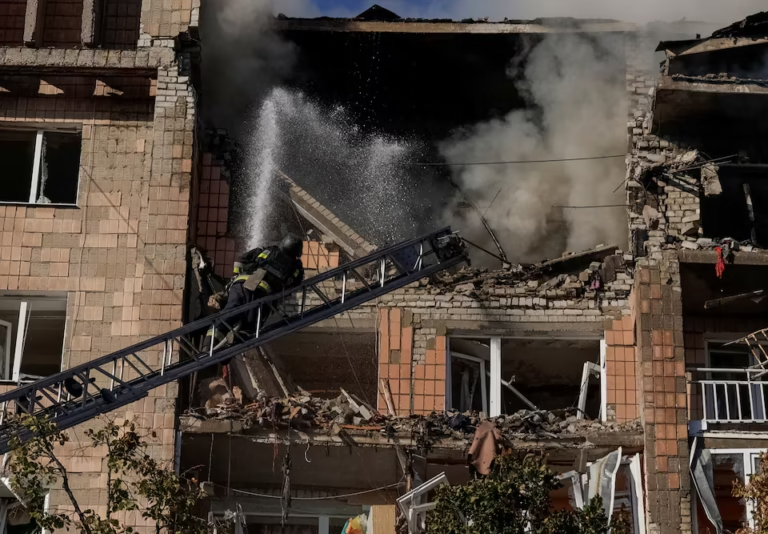

Nepal’s death toll from Wednesday’s glacial flash floods and landslides has climbed to 579, with nearly 2,000 people still unaccounted for, the country’s disaster relief agency said Friday. Rescue teams have pulled 3,742 people from the wreckage so far, working through mud and debris with heavy machinery, helicopters and sniffer dogs in the Rasuwa district near the Tibet border.
A Mass of Ice and Rock Comes Down the Mountain
Experts describe the disaster as a glacial-lake-triggered flash flood, one of the deadliest events of its kind in the Himalayan region in recent years. A mass of ice and rock broke away from a glacier, possibly set off by seismic activity, and slid down the mountainside, sending a wall of water and debris through Rasuwa. The US Geological Survey pointed to a glacial collapse and landslide as the likely trigger, though officials say a full assessment is still underway.
The scale of the damage has made search efforts slow and dangerous. Around 100 people remain trapped inside a tunnel at a hydropower project that flooded two days ago, and rescue workers are still trying to reach them. The Nepal Army has pulled two people from a separate flood-hit hydropower tunnel in Rasuwa, and searches continue there for others who may still be trapped.
China Reports Separate Toll, Warns of Barrier Lake Risk
The disaster’s reach extends across the border. Chinese state media reported at least three deaths in Gyirong County, Tibet, with 558 people missing there, including 260 foreign nationals. Beijing said nearly 100 Chinese citizens remain missing on the Nepal side.
Chinese authorities had warned of a high risk that a barrier lake formed by the landslide could breach and send a fresh surge of water downstream. That immediate threat has since eased. China’s CCTV reported the overflow from the barrier lake near the Nepal border has stopped, and rescue workers who had suspended operations over renewed flood risk are preparing to resume. Forecasters have flagged more monsoon rain in the coming days, adding further danger for rescue teams and survivors still in the field.
India Reports the Highest Number of Missing Nationals
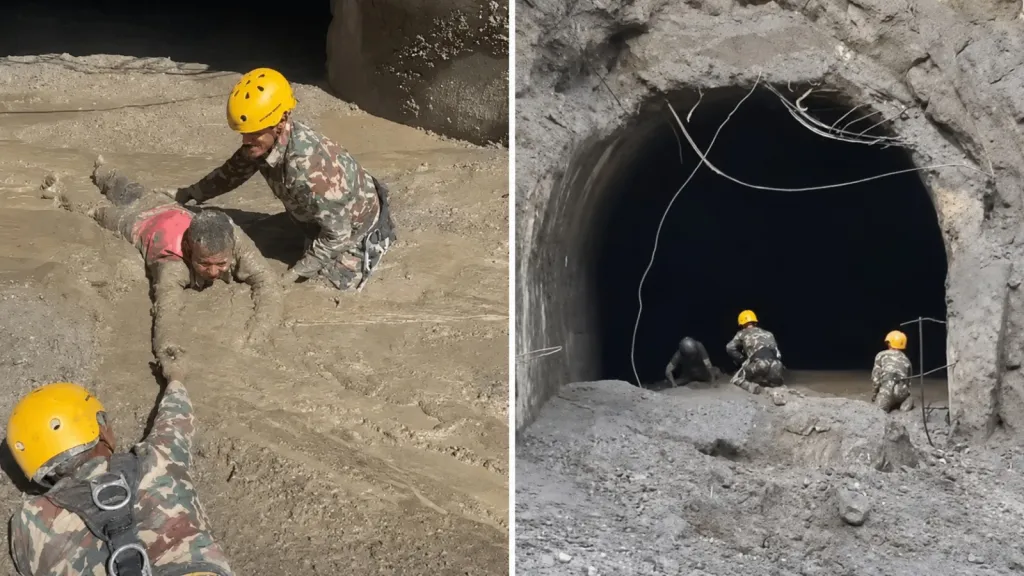
India’s Ministry of External Affairs said Friday that 400 Indian citizens who had been stranded on the Chinese side after the floods are now safe. Roughly 320 Indians remain unaccounted for or missing, and more than 100 additional people of Indian origin, who may hold other nationalities, are also unreported. Among the missing are around 200 pilgrims who were on the Kailash Mansarovar Yatra when the floods struck and became stranded on the Chinese side of the border.
India has sent two consignments of relief material to the region, including more than 47 tonnes of aid, medicine and food, and has rescued 21 people from Tamil Nadu. The country’s disaster relief effort is continuing, with the Ministry of External Affairs saying around 12 to 13 tonnes of additional relief material would be sent to Nepal on Friday evening.
The Embassy of India in Kathmandu has issued updated emergency helpline numbers for anyone seeking information or assistance. People can reach the embassy by phone or WhatsApp at +977 985 131 6807, +977 970 910 7500, or +977 981 032 6117.
Rescue Effort Relies on Machinery, Dogs and Satellite Images
Nepal’s disaster management authority is coordinating the search using every tool available, a Nepal disaster management authority official told Reuters. Teams are combing through debris fields with heavy machinery and helicopters, while sniffer dogs help locate survivors and remains buried under mud and rock. Satellite imagery is also being used to monitor the affected areas, though the official said that monitoring remains limited by the availability of usable images.
The mismatch between the number of confirmed dead and the number still missing points to how difficult identification and recovery have become. Bodies buried under thick layers of mud and debris, combined with damaged infrastructure and disrupted communications in the worst-hit areas, has slowed the pace at which authorities can confirm who has been found and who has not.
A Cross-Border Disaster Still Being Assessed
Officials on both sides of the border have described the death and missing figures as provisional, subject to revision as search teams reach areas that have so far been inaccessible. Earlier tallies from Nepal’s disaster management authority put the death count at 538, with around 910 people missing, including more than 500 foreign nationals. That figure has since risen, with the agency now reporting 579 dead and roughly 2,000 missing, an indication that the true scale of the disaster is still coming into focus.
Officials said 50 foreign nationals had been airlifted to safety so far, though rescue workers say the terrain in Rasuwa is severely hampering further operations. Steep slopes, unstable ground and continued rainfall have made helicopter access difficult in several of the worst-hit zones.
What Comes Next
Rescue teams in both Nepal and China are working against a narrowing window. The renewed monsoon rain forecast for the coming days threatens to further destabilize already loosened terrain, raising the risk of additional landslides in areas where search crews are still digging. Authorities in China have not ruled out further barrier lake breaches even after the current overflow subsided, and monitoring teams are expected to keep watching the site closely.
For families in India, China and Nepal still waiting on word of missing relatives, embassies and disaster agencies are coordinating updated contact channels as the identification process continues. With the death toll rising through the week and the number of missing still measured in the thousands, officials say the full human cost of the disaster may not be clear for some time.