
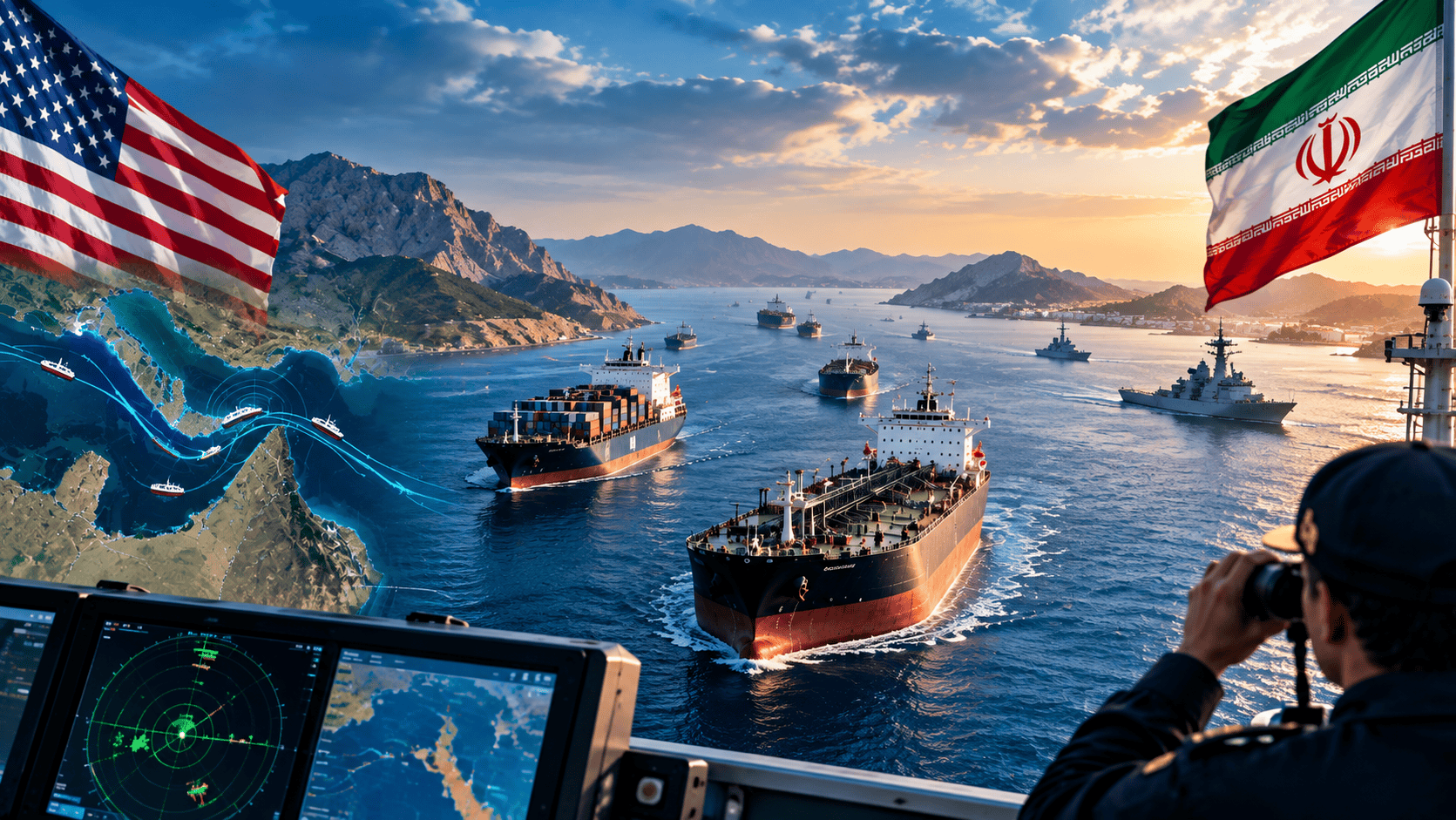
Strait of Hormuz Updates on September 21 show a sharp split between two accounts of the same waterway. Kpler data reported by Reuters shows a dozen commodity vessels crossed over the weekend, down from 35 the weekend before. Meanwhile, US Central Command (CENTCOM) says volumes over the past two weeks are the highest in six months. Oil, LNG, insurance and diplomacy all depend on which picture is closer to the truth. This article separates verified data from claims made by each side.
What Is the Strait of Hormuz and Why Is It Important?
The strait separates the Arabian Peninsula from Iran and connects the Persian Gulf with the Gulf of Oman and the Arabian Sea. At its narrowest it is 21 nautical miles (39 km) wide. Iranian and Omani territorial waters overlap in the passage. Saudi Arabia, Iraq, Kuwait, Qatar, the UAE and Bahrain all sit behind it.
In 2025, about 20 million barrels per day (mb/d) of crude and products moved through it, roughly 25% of seaborne oil trade, with about 80% headed for Asia. Before the war it also carried about a fifth of the world’s LNG.
The sections below combine this background with the latest Strait of Hormuz Updates on shipping, diplomacy and oil supply.
Latest Strait of Hormuz Updates
Traffic. Before the war began on February 28, the strait handled about 125 large commercial vessels a day. Kpler counted just four trackable exits on Sunday, September 20. Producers keep exporting on tankers with transponders off, so tracked counts understate real flows.
LNG. Bloomberg data shows at least two LNG carriers transited this week, while two others made ship-to-ship transfers outside the strait, offshore Oman.
Attacks. Iran said it attacked a Togo-flagged oil tanker on Thursday night, September 17, and maritime incident monitors said another ship was struck on Wednesday.
Diplomacy and prices. Brent traded around $101.71 on Monday, its lowest since September 10, as traders weighed hopes for UN-week diplomacy. President Trump said he would be open to meeting Iranian President Masoud Pezeshkian.
Strait of Hormuz Updates: Iran’s Position
Iran’s positions come from officials and state media, and are not independently verified.
In August, Iran said it would not fully reopen the strait until the US meets conditions including war compensation, sanctions relief and a permanent end to the conflict. On September 19, Iran’s security chief Mohsen Rezaei said Tehran had conveyed its conditions to mediators.
Iran’s own institutions are not fully aligned. Its Foreign Ministry said on August 5 that it was finalizing a shipping-route agreement with Oman. Iranian state media reported that parliament was reviewing a plan to ban vessels linked to the US, Israel and other “hostile countries” and to charge other ships fees of up to 7% of cargo value. The two tracks have not been reconciled.
Iran and the US have also given opposing accounts of conditions on the water. In June, Iran’s foreign ministry said shipping was “operating normally,” while CENTCOM said Iran did not control the strait.
Strait of Hormuz Updates: US Position and Maritime Operations
A US official told NPR in August that no party controls the lanes and that temporary routes must carry no approvals, permissions or tolls. Secretary of State Marco Rubio said in June that the strait would be toll-free under any final agreement.
On September 19, CENTCOM commander Adm. Brad Cooper said US forces had assisted more than 2,000 commercial transits with coordinated protection, and that all Iranian mines had been cleared from the primary transit lanes. He also said about one billion barrels of oil left the Gulf in recent months, while Iran exported “zero barrels” because of a US blockade. Trump has said the waterway’s condition is acceptable for now with US military escorts. These are US military claims, and Iran disputes the US account of control over the lanes.
Strait of Hormuz Updates: Shipping and Tanker Traffic
The numbers differ because sources measure different things. Lloyd’s List Intelligence counted 114 transits from August 17 to 23, a rise of more than 30% on the week before, and said figures could rise as “dark” transits are confirmed. Lloyd’s List’s editor said cargo now moves through a relay of shuttles, ship-to-ship transfers and a limited pool of willing vessels, which concentrates the risk. CENTCOM counts escorted transits, while Kpler counts trackable commodity vessels. Neither is a full census.
Costs. S&P Global reported in July that war-risk insurance had risen from 1–3% of hull value to 7.5–10%. Other trade estimates are lower and vary by date and voyage. Reuters-sourced reporting says freight from the Gulf of Oman to China hit a record $11.50 a barrel after the Saudi pipeline attack.
Strait of Hormuz Updates: Impact on Global Oil and Gas Supplies
EIA figures show Hormuz oil flows fell from 21.6 mb/d in the fourth quarter of 2025 to 4.9 mb/d in the second quarter of 2026. JPMorgan analysts said total Middle East oil flows averaged 17.1 mb/d over the past 10 days, 6.1 mb/d below the 2025 average. Saudi crude exports slumped to 2.4 mb/d in August, the lowest since at least 2013, and recovered to over 4 mb/d in September. The IEA estimates 410 million barrels have been drawn from global stockpiles since the war began.
LNG is tighter. Executives told The National that about 36 million tonnes of Qatari and Emirati supply has been missing this year compared with 2025. The market has absorbed about three-quarters of the early-March losses, mainly through US production and redirected cargoes.
Strait of Hormuz Updates: Alternative Routes and Shipping Options
Only Saudi Arabia and the UAE have crude pipelines that can bypass the strait, with an estimated 3.5 to 5.5 mb/d of capacity. Saudi Arabia’s East-West pipeline was expanded to 7 mb/d, but the Yanbu terminals on the Red Sea have nominal loading capacity of only about 4.5 mb/d.
That route is now under pressure. Reuters attributes attacks on the pipeline to the Houthis, and Saudi Aramco has halted some Yanbu shipments. The Houthis have also declared a blockade at Bab el-Mandeb, and going around Africa adds 20 to 25 days. Qatar’s LNG has no overland export option. The IEA’s Rebecca Schulz said that even after new pipeline projects finish, more than 10 mb/d would still need to pass through the strait to restore Gulf exports.
Strait of Hormuz Updates and Iran-US Relations
The waterway is now bound up with almost every dispute in Iran-US relations: the US blockade of Iranian exports, sanctions, compensation demands and Iran’s claim to oversight of the strait. The June memorandum of understanding required Iran to reopen the strait and charge no fees during its 60-day negotiating period. That framework has since broken down.
The legal question is contested too. Under UN maritime law, ships have a right of transit passage through international straits, and Article 26 bars charges for mere passage. Iran’s toll plan directly challenges that reading.
Strait of Hormuz Updates: Recent Diplomatic Efforts
No signed reopening agreement exists. What exists are proposals and stalled talks.
- Iran-Oman corridor (proposal): Iran said in August it was finalizing a route agreement with Oman. A Malaysian Reserve report on September 17 said the two were close to a deal, but no major outlet reported one concluded.
- Salalah meeting (postponed): Oman’s foreign minister announced on September 13 that the September 14 meeting between Gulf diplomats and Iran was indefinitely postponed “in the interests of consensus.” Saudi Arabia had submitted amendments over concerns that the language could create a new status quo. Bahrain had refused to attend, while the UAE was pursuing quiet diplomacy.
- China: Iranian sources say China asked Iran to help rein in the Houthis after a Saudi appeal.
Strait of Hormuz Updates: What Happens Next?
Few next steps are confirmed. UN General Assembly week is the main diplomatic window, and Trump has said he is open to meeting Pezeshkian. No meeting has been announced. The postponed Salalah meeting has no new date, and no change in shipping restrictions has been announced. Aramco plans to raise exports through Hormuz this month and next. Whether traffic recovers, or whether attacks on ships continue, remains uncertain. Check back for further Strait of Hormuz Updates as diplomatic and shipping developments unfold.
Strait of Hormuz Updates Timeline
- February 28: war begins and commercial traffic collapses.
- Late March: Lloyd’s List reports an IRGC-linked vetting scheme for approved transits.
- Mid-June: MoU signed, and the US lifts its blockade on June 18 according to one tracker. Iran re-declares closure on June 20, which CENTCOM disputes.
- August 5–6: Iran announces the Oman route work, and parliament reviews toll and ban plans.
- August 17–23: Lloyd’s List counts 114 transits.
- September 11: The East-West pipeline shuts down.
- September 13–14: Salalah meeting postponed.
- September 16–17: two tankers reported struck.
- September 19: CENTCOM update.
- September 21: Brent around $101.71, with Kpler reporting a weekend drop to 12 vessels.
Frequently Asked Questions About Strait of Hormuz Updates
What is the current situation in the Strait of Hormuz?
Traffic is far below prewar levels by tracker data, while CENTCOM says volumes are at a six-month high. Attacks on ships continue.
Why is the strait important to global oil supplies?
About 20 mb/d passed through it in 2025, around 25% of seaborne oil trade, and bypass options are limited.
How do Strait of Hormuz Updates affect shipping costs?
Higher insurance, record freight rates, ship-to-ship transfers and longer alternative routes.
What is Iran’s position on the Strait of Hormuz?
Iran says it will not fully reopen the strait until its conditions are met, and its parliament is weighing tolls.
How are Iran-US tensions affecting the strait?
Disputes over the blockade, tolls, compensation and control of the lanes keep traffic depressed.
Are ships currently passing through the Strait of Hormuz?
Yes, but in reduced numbers, and many transit with transponders off.