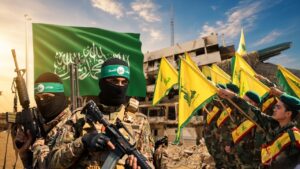


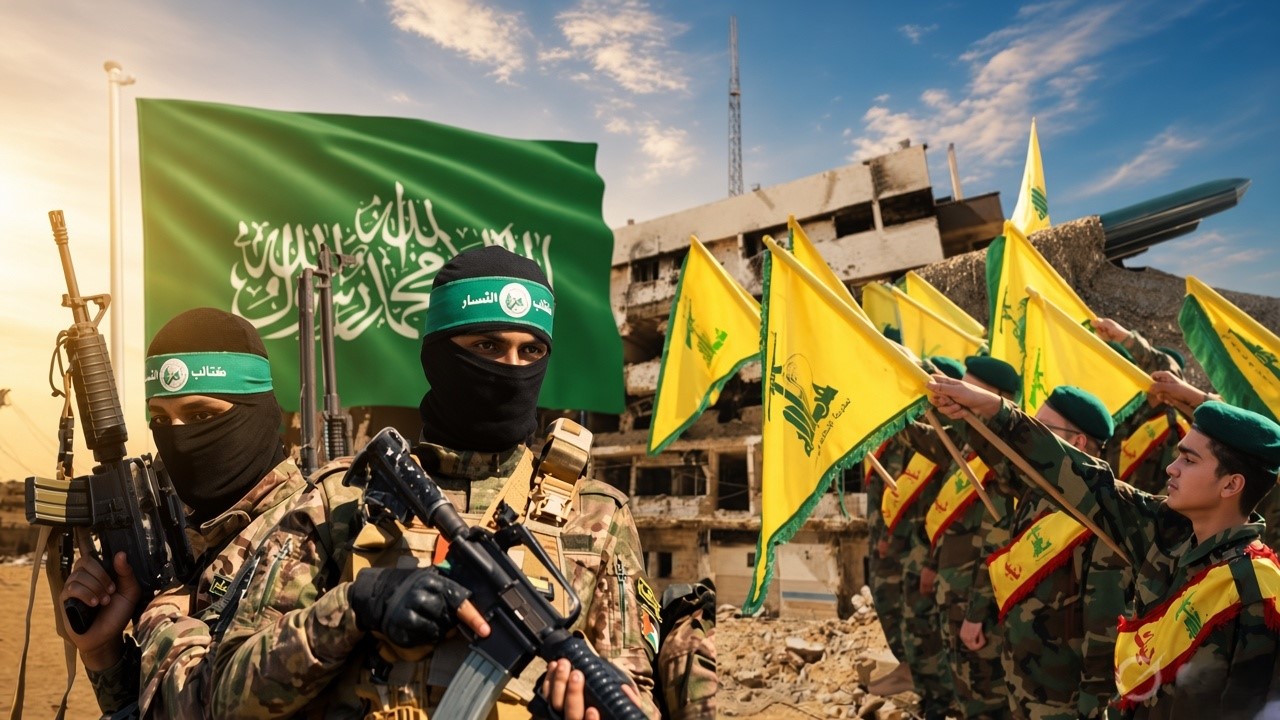
Hezbollah vs Hamas is a comparison that comes up constantly in Middle East coverage — if you’ve been following the news, you’ve probably heard the two names mentioned in the same breath, almost like they’re two branches of the same organization. They’re not. The Hezbollah vs Hamas comparison actually reveals two groups with different roots, different religious identities, and different playbooks, even though both end up on the same side of the fight against Israel.
Hamas operates out of the Gaza Strip and grew from the Palestinian nationalist movement. Hezbollah is based in Lebanon and grew out of a very different set of circumstances tied to Iran’s Islamic Revolution. Both receive backing from Tehran, both are labeled terrorist organizations by the US and several Western governments, and both have fought bloody wars with Israel. But once you dig past the surface, the Hezbollah vs Hamas story splits into two separate paths worth understanding on their own terms.
What Is Hamas?
Hamas is short for Harakat al-Muqawama al-Islamiyya, which translates to the Islamic Resistance Movement. The group was founded in 1987 during the First Intifada, the Palestinian uprising against Israeli occupation, and it grew out of the Palestinian branch of the Muslim Brotherhood. Its founders, including Sheikh Ahmed Yassin, wanted an organization that mixed Islamist ideology with Palestinian nationalism.
Hamas is a Sunni Muslim organization, and its founding charter called for the establishment of an Islamic state across historic Palestine. The group won legislative elections in 2006, then took full control of the Gaza Strip in 2007 after a violent split with its rival, Fatah, which continued running parts of the West Bank instead. From that point on, Hamas functioned as both a governing authority in Gaza and an armed resistance movement, with its military wing, the Izz ad-Din al-Qassam Brigades, carrying out attacks against Israel for decades.
Leadership has shifted a lot in the past two years. Longtime political chief Ismail Haniyeh was assassinated in Tehran in mid-2024, and Yahya Sinwar, the architect of the October 7, 2023 attack, was killed by Israeli forces later that same year. Khalil al-Hayya now leads the group’s political bureau. Under the 2025 Gaza peace plan, Hamas formally stepped back from day-to-day civil administration of Gaza, though disputes over its disarmament continue to stall the next phase of that agreement.
What Is Hezbollah?
Hezbollah, which means “Party of God” in Arabic, formed in 1982 in the middle of the Lebanese Civil War, right after Israel invaded Lebanon to push out the Palestine Liberation Organization. Iran’s Revolutionary Guard Corps helped train, fund, and organize the new group almost from day one, and that relationship has never really loosened since.
Unlike Hamas, Hezbollah is a Shia Muslim organization, drawing much of its support from Lebanon’s Shia population in the south of the country, the Bekaa Valley, and parts of Beirut. It describes itself as a resistance movement against Israeli occupation and Western influence in the region. Over the decades, though, Hezbollah built something far bigger than a militia. It runs hospitals, schools, and social services, and it holds seats in the Lebanese parliament, functioning as a genuine political powerbroker inside Lebanon’s government.
Hassan Nasrallah led Hezbollah for 32 years and turned it into arguably the most capable non-state armed actor in the world. Israel killed Nasrallah in a September 2024 airstrike on Beirut, and Naim Qassem, his longtime deputy, took over as secretary-general shortly after. A ceasefire between Israel and Hezbollah took effect in late November 2024, though tensions along the border have flared repeatedly since.
Hezbollah vs Hamas: How Are the Two Groups Different?
The sectarian divide is the starting point of any Hezbollah vs Hamas comparison. Hamas follows Sunni Islam, while Hezbollah follows Shia Islam, and that split shapes almost everything else about the two groups, including their theological outlook and their patron-client relationship with Iran, a Shia-majority state.
Geography matters just as much. Hamas is rooted in the Gaza Strip and the Palestinian cause specifically, aiming for Palestinian statehood and the end of Israeli control over Palestinian territory. Hezbollah, on the other hand, operates from Lebanon and frames its mission around resisting Western and Israeli influence across the whole region, not just the Palestinian issue. It rallied behind Hamas after October 7, but Hezbollah’s core purpose was never exclusively about Gaza.
Their level of integration into formal politics also diverges quite a bit. Hezbollah holds a real, entrenched role inside Lebanon’s parliamentary system alongside its armed wing. Hamas briefly governed Gaza as a de facto authority, but it never operated as a conventional political party embedded in a functioning national government the way Hezbollah does in Lebanon.
What Is the Relationship Between Hamas, Hezbollah, Iran, and Israel?
Iran sits at the center of the Hezbollah vs Hamas relationship, though it holds the reins far more tightly with one group than the other. Hezbollah was essentially built by Iran’s Revolutionary Guard, and analysts widely describe it as the most loyal and controlled member of Iran’s so-called “Axis of Resistance,” a loose network that also includes Yemen’s Houthi movement and various Iraqi militias. Hezbollah’s weapons, training, and much of its funding trace directly back to Tehran.
Hamas is different. Iran supplies money, weapons, and training, but Hamas is a Sunni group with its own independent leadership structure and its own decision-making process, so Tehran’s influence over Hamas is real but noticeably looser than its grip on Hezbollah. Both groups, though, share Israel as their primary adversary, and both have called for its destruction at various points in their history, even as their tactics and priorities diverge.
Hamas and Hezbollah’s Military Capabilities
This is where the gap in the Hezbollah vs Hamas comparison becomes obvious. Hezbollah fields what many analysts consider a small national army rather than a typical militia, with Nasrallah himself once claiming over 100,000 fighters. Its arsenal reportedly includes precision-guided missiles, Russian-made Yakhont and Chinese Silkworm anti-ship missiles with ranges stretching past 180 miles, and a substantial drone fleet used for both surveillance and strikes. Years of fighting alongside Iranian and Russian forces in Syria also gave Hezbollah fighters real battlefield experience.
Hamas relies on a different approach. Its Qassam Brigades built an extensive underground tunnel network beneath Gaza, used for storing weapons, moving fighters, and sheltering hostages, alongside shorter-range rockets and small arms. Hamas leans heavily into asymmetric warfare and urban combat rather than the kind of longer-range precision arsenal Hezbollah has assembled. Israel’s military campaigns since 2023 and 2024 have degraded both groups’ capabilities substantially, killing senior commanders and destroying large stockpiles of weapons.
A History of Hamas and Hezbollah’s Conflict With Israel
Hezbollah’s most defining clash with Israel came in the 2006 Lebanon War, a 34-day conflict triggered by a cross-border raid that killed and captured Israeli soldiers. Hamas, meanwhile, has fought Israel repeatedly since taking control of Gaza, including major rounds of fighting in 2008-09, 2014, and 2021.
| Year | Event |
| 2006 | Israel-Hezbollah war in Lebanon |
| 2008-09 | Israel-Hamas conflict (Gaza) |
| 2014 | 50-day Gaza war |
| Oct 2023 | Hamas-led attack on southern Israel; Gaza war begins |
| Sept-Nov 2024 | Israel kills Nasrallah; Israel-Hezbollah ceasefire |
| Oct 2024 | Israel kills Yahya Sinwar |
| Oct 2025 | Gaza peace plan ceasefire takes effect |
| 2026 | Disarmament talks continue amid disputes |
Everything changed on October 7, 2023, when Hamas launched a coordinated assault on southern Israel, killing roughly 1,200 people and taking around 250 hostages back into Gaza. Israel’s retaliation turned into the deadliest war in the territory’s history. Hezbollah opened a second front along the Lebanese border soon after in solidarity with Hamas, which eventually escalated into a full Israeli ground and air campaign that killed Nasrallah and much of Hezbollah’s senior leadership by late 2024. A ceasefire with Hezbollah followed in November 2024, and a phased Gaza peace plan between Israel and Hamas took effect in October 2025, though disarmament remains a sticking point well into 2026.
Why Hamas and Hezbollah Matter in the Wider Middle East Conflict
Neither group operates in isolation. Both function as pieces of Iran’s broader regional strategy, which also leans on Yemen’s Houthis and various militias in Iraq and Syria to pressure Israel and US interests without Tehran directly entering a war itself. When Hamas and Hezbollah act together, or even just rhetorically support each other, the risk of a wider regional war involving Iran, Israel, and potentially the United States rises sharply.
The Hezbollah vs Hamas dynamic also shapes Lebanese and Palestinian domestic politics far beyond the battlefield. Hezbollah’s grip on southern Lebanon complicates any lasting peace deal with Israel, and Hamas’s post-war role in Gaza’s governance remains a central unresolved question in the current ceasefire negotiations. Neither conflict can really be settled without addressing the other, which is part of why global powers keep treating them as connected crises rather than separate regional disputes.
For background on how each group is officially classified, both are listed on the U.S. State Department’s Foreign Terrorist Organizations register, and independent backgrounders from the Council on Foreign Relations cover each group’s origins in more depth:
U.S. State Department: Foreign Terrorist Organizations
CFR Backgrounder: What Is Hamas?
CFR Backgrounder: What Is Hezbollah?
Hamas vs Hezbollah: Key Similarities and Differences
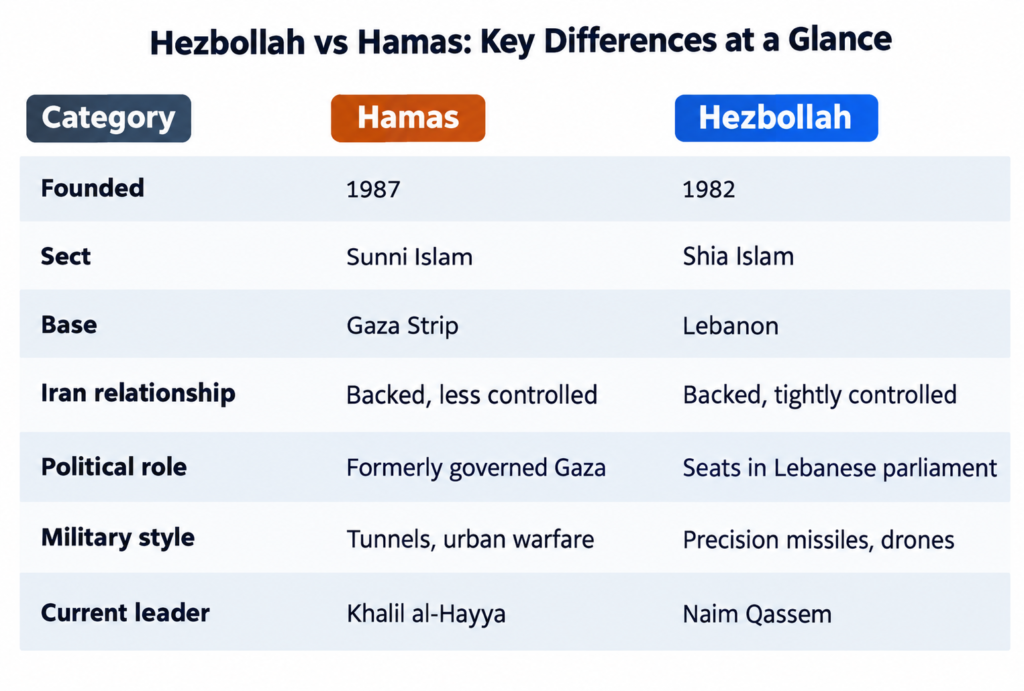
Here’s the full Hezbollah vs Hamas comparison in one place:
| Category | Hamas | Hezbollah |
| Founded | 1987 | 1982 |
| Sect | Sunni Islam | Shia Islam |
| Base | Gaza Strip | Lebanon |
| Iran relationship | Backed, less controlled | Backed, tightly controlled |
| Political role | Formerly governed Gaza | Seats in Lebanese parliament |
| Military style | Tunnels, urban warfare | Precision missiles, drones, larger force |
| Current leader | Khalil al-Hayya | Naim Qassem |
| Shared goal | Opposing Israel | Opposing Israel |
Frequently Asked Questions
Are Hamas and Hezbollah the same organization?
No. They’re separate groups with different founding histories, different religious sects, and different bases of operation, even though they share Iranian backing and hostility toward Israel.
Does Iran control both groups equally?
Not really. Iran built Hezbollah from the ground up and maintains close command over it, while Hamas receives Iranian support but keeps more independent decision-making.
Which group is militarily stronger?
Hezbollah generally fields a larger, better-armed force with longer-range missiles and more battlefield experience, though both groups have suffered major losses since 2023.
Do Hamas and Hezbollah work together?
They coordinate at times and share a common enemy in Israel, but they don’t operate under a single unified command, and each group sets its own strategy.
What’s the current status of conflicts involving these groups?
A ceasefire between Israel and Hezbollah has held since late 2024 with occasional flare-ups, while the Israel-Hamas ceasefire under the 2025 Gaza peace plan remains fragile, with disarmament negotiations still unresolved in 2026.