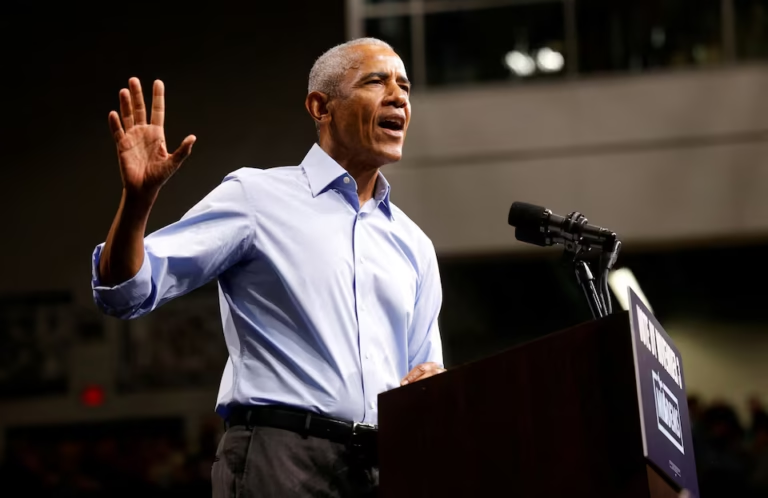

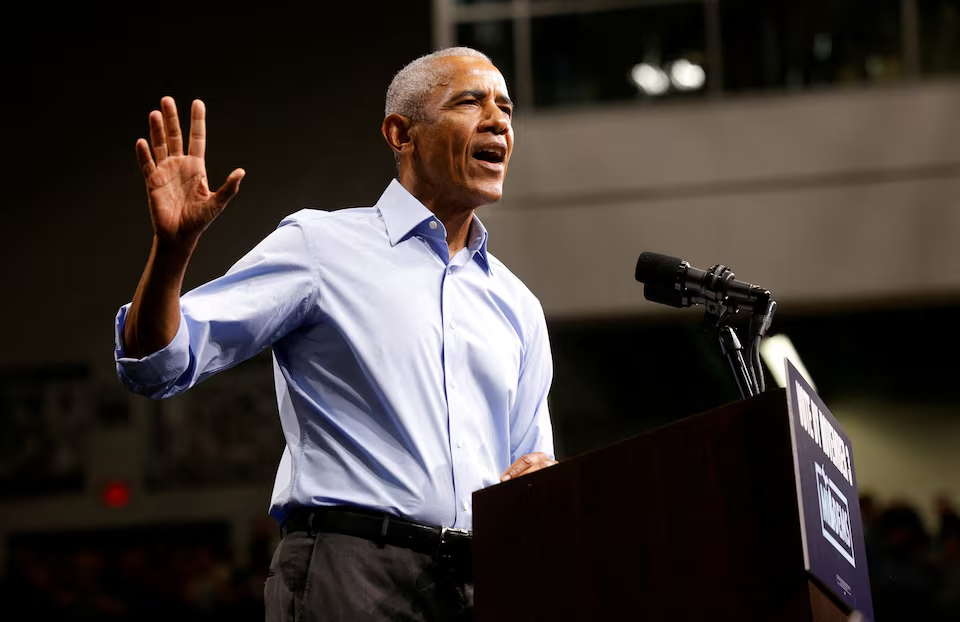
Barack Obama returned to the campaign trail on Saturday and went after Donald Trump’s presidency on three fronts: corruption, Iran policy and the look of the White House. The former Democratic president spoke at rallies in Cleveland and Detroit, ten days before the November 3 midterm elections that will decide control of a closely divided Congress.
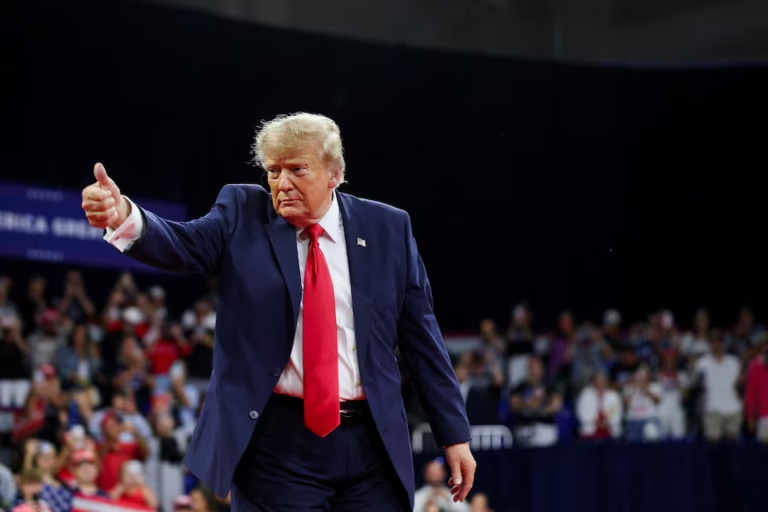
Trump has asked voters to treat the midterms as a vote on him personally. Obama accepted that framing in Michigan and told the crowd to use the election as a check on the Republican president. Trump answered early Sunday on Truth Social, calling Obama a “grossly incompetent President.”
Obama Asks Michigan Voters to Flip a “Circuit Breaker”
In Detroit, Obama campaigned for Abdul El-Sayed, the Democratic nominee for US Senate, and Jocelyn Benson, the Democratic candidate for governor. He described the November 3 vote as a “circuit breaker” that would “at least rein in some of the foolishness” of the Trump presidency.
“We got to flip that circuit breaker, bring some accountability to this government,” Obama said.
Democrats see Obama as one of their strongest draws. He was president from 2009 until Trump took office for his first term in 2017, and he remains one of the most popular figures in the party. Democrats hope his appearance will energize their supporters in a tight Senate race, where El-Sayed faces Republican Mike Rogers, a former US representative.
Obama gave the Michigan crowd what it came for. He repeated the criticisms Democrats make most often about Trump, and he added a charge against Republicans in Congress, saying they have been willing to go along with him.
The Corruption Charge

The sharpest section of the speech dealt with money. Obama said no earlier president has made personal gain so visible while in office.
“We have never seen a president excel in straight-up grifting, on your dime, like this,” Obama said. “Never seen a president so intent on selling favors like this … Now the party seems to stand for corrupt government, or inept government, or no government.”
The White House did not immediately respond to a request for comment on the remarks.
Public opinion gives Obama some room to make this argument. A Reuters/Ipsos poll in August found that 63% of Americans think the president and his family have inappropriately profited from cryptocurrency since he returned to the White House last year. The same poll found that 69% believe his policy decisions are influenced by his private business dealings. Put another way, roughly two of every three respondents already hold the view Obama was selling on Saturday, so he was speaking to an audience that had mostly made up its mind.
That matters for how the argument is likely to be used. A message that a majority already accepts does not need to persuade anyone. Its job in the final ten days is to give Democratic voters a reason to turn out, and Obama is the person Democrats chose to deliver it.
Iran and the Strait of Hormuz

Obama also took on the administration’s claims of victory in its war with Iran. He said the conflict has left Iran with more economic power than before, because its threats to attack shipping in the Strait of Hormuz have unsettled oil exporters.
“Iran now has veto power over the Strait of Hormuz, where oil goes through to get to the world,” Obama said.
His point was about outcomes. The administration says it won. Obama’s reply was that a country able to threaten a major oil route, and make exporters nervous by doing so, has gained influence rather than lost it. Voters who judge the war by what they pay for fuel may find that argument easier to follow than one about military objectives.
Trump’s reply on Truth Social went back to Obama’s own record on Iran. He said Obama “paid off Iran with $Billions, and gave them a road to a Nuclear Weapon” through the 2015 Joint Comprehensive Plan of Action, the nuclear accord between Iran and world powers. The United States withdrew from that agreement during Trump’s first term.
So the two men are now arguing about Iran with two different histories. Obama points to the results of the current war. Trump points to the deal he cancelled. Neither answer addresses the other’s main claim, which is usual for a campaign exchange and leaves voters to pick the framing they find more believable.
Hegseth and the White House Renovations

Obama spent part of his speech on what he called misplaced priorities. He said the administration spends its attention on unimportant matters, and he mocked Defense Secretary Pete Hegseth as someone “laser-focused on important matters like the jawline and testosterone levels of our troops.”
He then turned to the White House renovations, which have given the building a gilded look. He ridiculed the result as tacky.
“He’s got the White House looking like Saddam Hussein opened a Cheesecake Factory,” Obama said.
The line is blunt and easy to repeat, and it had a job in the speech. After the serious charges about corruption and the Strait of Hormuz, the jokes about Hegseth and the decor gave the crowd something to laugh at and gave reporters something to quote. Campaign speakers use humor this way when they want a clip to travel beyond the room.
Trump Responds on Truth Social
Trump did not wait long. In a Truth Social post early Sunday, he called Obama a “grossly incompetent President.” He then turned to the Michigan Senate race and described El-Sayed as a “Muslim Brotherhood Jihadist, who hates Jews and Blacks and AMERICANS and TRUMP.”
Reuters reported the post as written. The White House had not commented on Obama’s speech when the report was filed. Trump’s post attacked Obama and the Democratic candidate directly, and it made no reference to the poll numbers on profiting from cryptocurrency or to the Strait of Hormuz.
The Michigan Race and the Wider Contest
Michigan is where the exchange has the most direct effect. El-Sayed faces Rogers in a race described as tight, and a Senate seat in a closely divided Congress can shift control of the chamber. Democrats want Obama’s appearance to raise enthusiasm among supporters who might otherwise sit out a midterm. Republicans, for their part, get a chance to use Obama as a reminder of the Democratic record they want voters to reject, which is the approach Trump took in his reply.
Obama’s stops in Cleveland and Detroit also show how Democrats plan to use him in the closing stretch. He is campaigning for named candidates in specific races, and he is using the same national message in each place: the election is a chance to hold the administration to account. Trump’s own request that voters treat the midterms as a referendum on him makes that message easy to deliver, because the two sides now agree on how the contest should be framed even though they disagree about who deserves to win it.
How Democrats Are Using Obama
The Saturday schedule shows a plan. Obama spent the day in two cities in the Midwest and went from one rally to the next with a single message. Democrats do not need him to introduce new facts. The poll numbers on cryptocurrency and business dealings were already public. What he adds is reach. A former president who remains popular with the party’s voters can fill a hall, get covered by every outlet in the state and make a Senate candidate’s name known to people who have not followed the race.
El-Sayed gets the most direct benefit. A Senate nominee running against a former US representative needs name recognition and a large turnout, and an Obama rally supplies both in one evening. Benson, running for governor on the same Detroit stage, shares that benefit.
The risk runs the other way. Trump’s reply shows how quickly a visit like this can turn into a fight over the Democratic nominee himself. His description of El-Sayed will now be repeated in Michigan alongside Obama’s speech, and the El-Sayed campaign will have to decide how much of its remaining time goes to answering it.
What Comes Next
Voters in Michigan and across the country will decide on November 3. Between now and then, expect both parties to keep spending their most recognizable figures on the final week and a half. Obama has shown he will take on Trump directly and by name. Trump has shown he will answer within hours and in personal terms.
The poll figures above, 63% on cryptocurrency profits and 69% on business influence over policy, come from an August Reuters/Ipsos survey and have not been updated in this report. Whether those views hold through Election Day, and whether they translate into votes in a state like Michigan, will become clear when ballots are counted.