
The United States has deported at least 40 LGBT migrants who had won legal protection from persecution to African countries that criminalise same-sex relations or have been described by the State Department as hostile to LGBT people, according to a Reuters investigation. The cases date from the Trump administration’s expanded use of third-country deportations this year.
One of them is Abdou Latifou, a gay man from Togo. In June, US officials put him on a deportation plane to Sierra Leone, where gay men can be sentenced to life in prison under colonial-era laws. A US immigration judge had ruled in November that it was not safe to send him home.
A mob attack, then a court win
Two years ago, a mob assaulted Latifou and threatened to kill him after he was seen kissing the man he loved, according to his asylum application. He fled Togo and sought refuge in the United States.
When the immigration judge ruled in his favour last November, he felt he had reached safety. ‘I told myself, “From this day on, I’m entering a world where I’m free to live as myself,”‘ he said.
The judge granted him a lesser form of protection than asylum. It barred the government from deporting him to Togo but allowed his removal to other countries.
Sent to Sierra Leone, then back to Togo

After he landed in Sierra Leone, Latifou was held for two weeks in a hotel under police surveillance. Guards then put him on a flight back to Togo. He arrived with a few items of clothing and $100.
He went to his village to see his mother. A relative soon warned him that he was not safe, and helped him cross the border into Benin. He continued to Ivory Coast, where he now lives with a friend and works as a security guard.
Same-sex relations are legal in Ivory Coast, but Ivorian activists have reported rising homophobic violence. Latifou avoids the Togolese community ‘so I don’t get recognized.’
What Reuters found across 40 cases

Reuters tracked all 40 people, who come from across Africa and from Iraq, Jamaica and Russia. Reporters interviewed a dozen deportees and immigration lawyers and reviewed hundreds of pages of legal documents.
Sixteen remain in the countries they were deported to, and some are still detained. Sixteen others, like Latifou, were sent back to their home countries against their will. Nine are in hiding in third locations. One Ghanaian man is no longer in contact with his lawyers or relatives, they said.
The 40 cases involve deportations to three countries that explicitly criminalise same-sex sexual acts: Sierra Leone, Cameroon and Eswatini. Three others have no such laws, but the State Department has documented abuses of LGBT people there, including ‘corrective rape’ and conversion therapy. They are the Central African Republic, Equatorial Guinea and the Democratic Republic of Congo. Government spokespeople for all six countries did not respond to requests for comment.
More than half of the 40, including Latifou, were not eligible for asylum because they had not applied in countries they passed through before entering the US illegally. That rule came from Biden-era restrictions, which a federal court vacated in May.
Bridget Crawford, director of law and policy at the LGBT advocacy group Immigration Equality, said the US has repeatedly granted asylum to LGBT people from these countries. Her group has helped 12 Cameroonians and one person from Congo win asylum in recent years.
Where they ended up

Many deportees told Reuters they wound up wherever someone would take them in.
A bisexual Ghanaian woman was deported to Cameroon in January and stayed for seven months. She could not speak French, the main local language, and feared for her safety in Ghana. She moved in with a relative in northern Nigeria, where penalties for same-sex sexual acts can include lashes or death by stoning. Most days she does not leave the house, she said.
A gay man from Ghana was deported to Sierra Leone and then forcibly repatriated. He has spent four months hiding in the forests of neighbouring Togo and lives on small sums his mother sends him. Most nights he sleeps on a blanket on the ground. When it rains, he shelters in an abandoned, half-finished house.
A 44-year-old Mauritanian man had lived in the US for more than a decade when ICE detained him in January and flew him to Eswatini, a small southern African kingdom he had never heard of. He spent a month and a half in a mosquito-infested prison with no hot water, he said. He eventually agreed to be flown back to Mauritania and slipped across the border into Senegal, where the government recently doubled the maximum penalty for same-sex sexual acts.
He is now staying with relatives in a remote town and trying to find out whether any countries in Europe or Asia would accept him. ‘My life just got turned upside down,’ he said.
A tactic that was rare before 2025
Third-country deportations were uncommon before Donald Trump’s second term. Since he returned to office and began a broad immigration crackdown, ICE and Border Patrol have deported more than 40,000 people to countries that are not their own, according to preliminary government data shared with Reuters. That is far above earlier estimates from advocates. About 900 people were sent to African countries.
Trump’s administration has made deals with impoverished foreign governments to take them.
Courts and the government’s response
In a February order in a case challenging the policy, US District Judge Brian Murphy addressed the risk to gay people. He called the government’s claim that those targeted had not explicitly asked not to be deported to repressive third countries an ‘absurdity.’
‘No person could reasonably be expected to make detailed, prophylactic claims about every country on Earth to which she might have a valid claim against removal,’ he wrote.
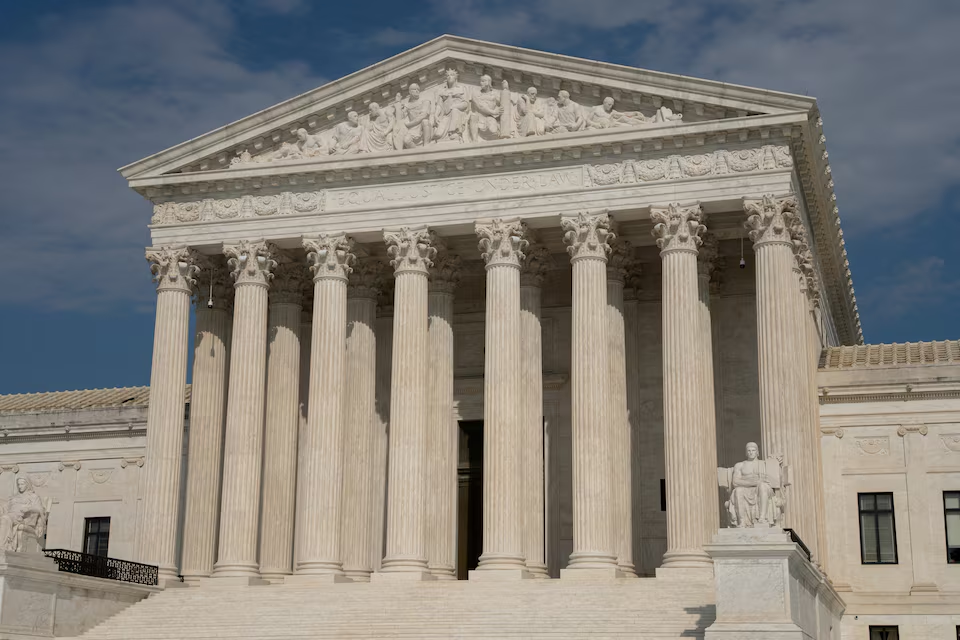
The Supreme Court has now put a hold on Murphy’s ruling, which lets the administration continue third-country deportations. The court will hear arguments in December.
Claire Trickler-McNulty, a former senior US immigration official, said sending people ‘to a third country where they face the very persecution we recognized makes a mockery of our protection systems.’
Chandler Rebel, a spokesman for the Department of Homeland Security, which oversees ICE, said in a statement that the agency ‘does not enforce the law on the basis of sexual orientation, that would be illegal.’ He added: ‘Third country removals are an essential public safety tool.’
On people who leave ICE custody, Rebel said: ‘When an individual is no longer in ICE custody then ICE will no longer be responsible for them.’
What happens next
The Supreme Court’s December hearing will decide whether the policy continues in its current form. Until then, the government can keep removing people to third countries, and the 40 documented cases show what that has meant for LGBT migrants who had won protection in US courts.