

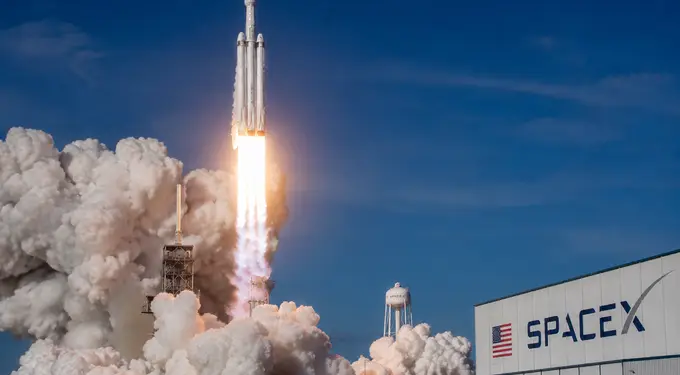
SpaceX posted a 92% jump in quarterly revenue on Tuesday in its first earnings report since going public, with the company crediting rapid growth in its Starlink satellite internet business and its expanding artificial intelligence operations for the surge.
The company reported $7.8 billion in revenue for the second quarter, beating analyst expectations, even as it posted a net loss of $541 million for the period. The results mark the first real test of how investors will judge SpaceX now that its finances are subject to public scrutiny rather than the private disclosures the company relied on for two decades.
A rocky start as a public company
SpaceX shares have pulled back sharply since the company’s stock market debut, as investors weighed whether a valuation of 77 times expected revenue can hold up over time. That kind of multiple puts SpaceX in territory usually reserved for early-stage software companies rather than a business built on rockets, satellites and heavy infrastructure spending, and some investors have questioned whether the numbers justify the price.
Tuesday’s earnings report gives those investors their first hard data since the IPO to test that skepticism. A revenue jump of 92% is a strong number by almost any standard, but the accompanying net loss shows that SpaceX is still spending heavily to build out the businesses driving that growth, particularly its satellite network and its newer AI ventures.
Starlink and AI drive the numbers
Starlink has grown from a niche satellite internet service into one of SpaceX’s core revenue engines, and the company pointed to that business as a primary driver of the quarter’s growth. The unit provides internet access through a constellation of low-orbit satellites, a model that has expanded well beyond its original use case of connecting remote areas and now serves customers ranging from individual households to airlines and government agencies.
SpaceX also cited its AI business as a contributor to the revenue increase, though the earnings materials released so far do not break out exactly how much of the $7.8 billion came from each unit. That lack of detail is likely to be a focus for analysts on Tuesday’s call, given how closely investors are watching whether the company’s spending on AI and space projects can be supported by the profits Starlink generates.
Leadership set to face investor questions
SpaceX leaders were scheduled to host a webcast at 4:30 p.m. in New York, 2030 GMT, to walk through the results and take questions. Chief executive Elon Musk, president Gwynne Shotwell and chief financial officer Bret Johnsen were all set to speak on the call.
The session gives Musk his first opportunity as a public-company CEO to defend SpaceX’s spending plans directly to shareholders, a dynamic that did not exist when the company operated as a private business answerable mainly to a smaller group of institutional investors and insiders.
Analysts are expected to press the leadership team on whether Starlink’s margins are strong enough to keep funding the company’s ambitions in AI and deep space projects without further diluting shareholders or taking on additional debt. The size of the quarterly net loss, even against a large revenue beat, suggests that question will not go away regardless of how strong the growth numbers look on the surface.
Merger talk with Tesla looms over the call
Investors are also expected to raise questions about a potential merger between SpaceX and Tesla, an idea that has circulated with increasing seriousness in recent months. Complicating that prospect is Tesla’s business footprint in China, which adds regulatory and political layers to any combination between the two companies that Musk also leads.
A merger of that scale would tie together two of Musk’s largest ventures under one corporate structure, something that has no clean precedent given the different regulatory environments each company operates under. Tesla is an automaker with significant manufacturing and sales operations in China, a market where SpaceX has essentially no presence due to national security restrictions on satellite and launch technology. Any merger discussion would need to navigate that gap carefully, and it remains unclear how far talks have actually progressed beyond public speculation.
Executives may address the merger question directly on the earnings call, given how much attention it has drawn from investors trying to understand SpaceX’s long-term corporate structure now that it trades publicly.
What the numbers mean going forward
Tuesday’s report gives the market its clearest picture yet of how SpaceX’s underlying businesses are actually performing, separate from the hype that surrounded its IPO. A 92% revenue increase signals real demand for Starlink and the company’s AI offerings, but the accompanying loss shows SpaceX has not yet reached the point where that growth translates into profit.
For a company trading at nearly 80 times expected revenue, that gap between growth and profitability is likely to remain the central question for investors in the coming quarters. Tuesday’s webcast, and any details Musk, Shotwell or Johnsen offer about spending plans, margin timelines or the Tesla merger question, will shape whether Wall Street views the pullback in SpaceX shares since the IPO as a temporary correction or the start of a longer reassessment of the company’s valuation.
The next earnings report will show whether the growth pace seen this quarter can continue, and whether the losses tied to AI and space spending begin to narrow as those businesses mature.