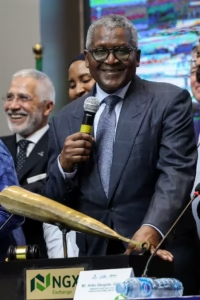


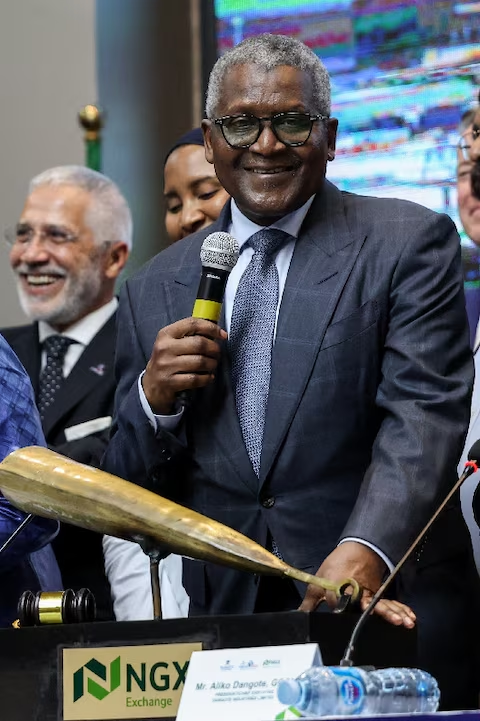
Nigerian billionaire Aliko Dangote launched Africa’s largest share sale to date on Monday, opening the initial public offering of his oil refinery to the general public in a bid to raise as much as $2.1 billion for the plant’s expansion. The offer marks a milestone moment for African capital markets and for Dangote himself, already the continent’s richest man.
Dangote is selling a roughly 3% stake in the refinery and has framed the offer as a “people’s IPO,” pitching it as a chance for ordinary Nigerians to share directly in the success of one of the continent’s most significant industrial projects. Speaking at a Nigerian stock exchange event on Monday, Dangote said the goal of the share sale was to “democratise wealth creation.”
A Refinery Riding Global Disruption
The timing of the IPO comes as the refinery benefits from unusual market conditions. Supply disruptions tied to the ongoing Iran war have reshaped global fuel flows, and the plant has capitalized on the shift by selling jet fuel to western European countries that would otherwise have relied on different supply routes. That demand boost has strengthened the refinery’s commercial position heading into the public offering.
Retail Investors Pay More Than Institutions Did
While Dangote has emphasized broad public participation, the terms are not identical for all investors. Retail buyers in the IPO will pay a higher price than the institutional investors who took part in a private placement in July, which raised $2.5 billion for a 6% stake in the company.
That earlier private placement valued the refinery at $40 billion. The current IPO pushes the valuation closer to $49 billion, according to the company’s prospectus, a notable jump in just two months. Refinery CEO David Bird told Reuters the discount offered to institutional investors in July reflected specific conditions those investors agreed to, including a lockup period restricting when they could sell their shares.
Dangote has also said the United Arab Emirates’ state oil company ADNOC expressed interest in investing in the refinery alongside other parties, though he declined to provide further detail, citing non-disclosure agreements. The Africa Finance Corporation, one of the institutional backers from the private placement round, said the group of investors also included sovereign wealth funds and development finance institutions, underscoring the scale of international interest in the project even before the public offering opened.
A Low Barrier to Entry

One of the defining features of the IPO is its accessibility. If fully subscribed, the offer on Nigeria’s main stock exchange would raise 2.15 trillion naira, or roughly $1.6 billion. That figure could climb toward $2.1 billion if the offer is oversubscribed and the company opts to use a greenshoe option to issue additional shares.
Individual investors can take part with a minimum purchase of just 10 shares, translating to an entry cost of about $4, a figure available to buyers through fintech platforms and other digital investment services. That threshold is notably low compared with past large Nigerian IPOs. When telecoms firm MTN Nigeria opened its offer to retail investors in 2021, the minimum investment stood at roughly $8 at the exchange rate of the time, nearly double what Dangote is asking.
The low entry point appears to be driving strong demand. Nigerian investment app Bamboo said it was seeing significantly higher-than-usual traffic because of the IPO, to the point that some users were unable to log in. Chris Chijioke, a Lagos-based business owner, told Reuters he planned to buy 2,000 shares. He said he had reservations about the sale price but ultimately trusted Dangote’s track record enough to move forward with the purchase.
Bigger Ambitions Beyond This Offering
Dangote used Monday’s event to outline plans well beyond the refinery itself. He said he eventually intends to list every company within his broader business conglomerate, one of Africa’s largest industrial groups, with operations spanning cement, sugar and salt production. He also raised the possibility of a secondary listing for the oil refinery business in the United States within three to four years, a move that would extend the company’s reach into international capital markets.
Reshaping Nigeria’s Fuel Market
The refinery itself has already had a transformative effect on Nigeria’s economy since beginning operations in 2024. Built at a cost of about $20 billion on the outskirts of Lagos, the facility currently processes 700,000 barrels of crude per day, with a target of raising that to 1.4 million barrels by 2029.
Analysts at Renaissance Capital Africa said in a note that the refinery has shifted Nigeria from a net importer to a net exporter of refined petroleum products, describing it as a “systemically important institution for the nation.” That shift marks a significant change for a country that had long depended on imported fuel despite being one of Africa’s largest crude oil producers, a contradiction that shaped Nigerian energy policy for decades before the refinery came online.
A Symbol of African Self-Reliance

Market watchers outside Nigeria have also taken note of the offering’s significance. Charles Robertson, head of macro strategy at FIM Partners, called the share sale a major event for Nigeria and a symbol of African self-reliance on the world stage.
“Nigerian equities have boomed on the back of retail interest since 2024 and there’s evident excitement among domestic investors,” Robertson said, pointing to a broader pattern of growing local investor participation in the country’s stock market over the past two years.
What Comes Next
The success of the offering will be watched closely as a test of investor appetite, both domestic and international, for large-scale African industrial projects. With Dangote signaling plans to eventually list additional companies from his conglomerate and to explore a U.S. secondary listing for the refinery, the current IPO may prove to be the opening chapter in a much larger push to bring African industrial giants onto global capital markets. For now, the immediate focus remains on how much of the $2.1 billion target the offering ultimately raises once subscriptions close.