

Iranian President Masoud Pezeshkian has publicly denied claims that he repeatedly offered to resign, pushing back against hardline critics as his government edges toward a deal with the United States over shipping access through the Strait of Hormuz.
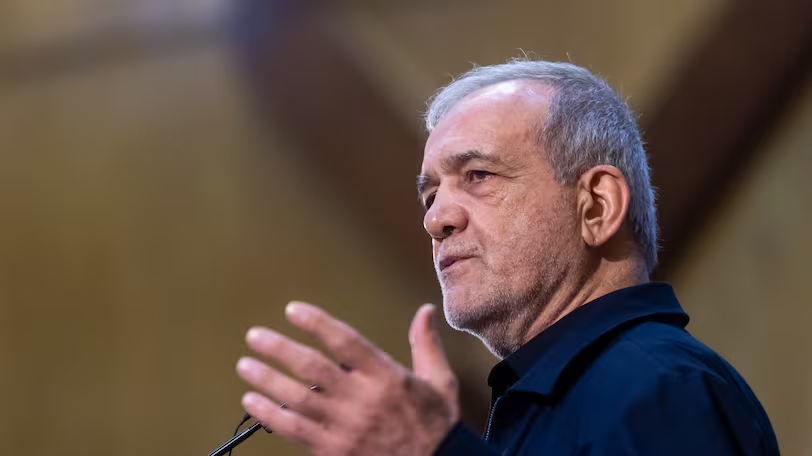
The denial came during a television interview marking two years since Pezeshkian took office, a broadcast that was meant to showcase progress but instead turned into a defense of his authority. “If I want to resign, I will officially announce that I have resigned. I will not resign, I will stand,” Pezeshkian said, accusing unnamed rivals of trying to create division inside the country.
A resignation claim with a powerful source
The allegations against Pezeshkian did not come from a minor figure. Mohammad Bagher Kharazi, who is connected by marriage to Mojtaba Khamenei, Iran’s new supreme leader, told Iranian media that Pezeshkian had grown frustrated at being shut out of major decisions. Kharazi said the president had offered to resign so many times, both verbally and in writing, that Khamenei eventually warned him he would accept the next threat as final.
Khamenei’s office rejected the claim outright on Tuesday, calling it “fundamentally false and untrue.”
Kharazi’s account gained traction partly because of who he is related to. He is the brother-in-law of Massoud Khamenei, the supreme leader’s younger brother. Iranian reporters who cover the government say Kharazi has previously made allegations that were never substantiated, and it remains unclear whether he has met with the supreme leader since Khamenei’s appointment to the role in March.
The timing of the dispute matters. Mojtaba Khamenei took over the supreme leader position after his father was killed in an Israeli bombing on the first day of the war between the two countries. Khamenei has not appeared or spoken publicly since, and his exact location has been withheld, according to Kharazi’s claims, out of concern that foreign intelligence services could track him.
Officials close to Pezeshkian call the claims lies
Mehdi Tabatabaei, a senior member of the president’s office, dismissed the resignation reports as “complete nonsense and lies.” Writing on social media, he described the source of the allegations as a “sinister coalition of lying, deceitful and reckless extremism” and argued its backers were still trying to overturn results from an election they lost two years ago. “They have become puppets of Iran’s enemies,” Tabatabaei wrote.
Ahmad Zeidabadi, a reformist journalist inside Iran, said the claims served no purpose beyond stoking tension between factions already at odds over how to handle relations with Washington.
A dispute over the Strait of Hormuz sits behind the politics
The resignation controversy erupted as the United States and European governments push for a deal to reopen the Strait of Hormuz, one of the world’s most important oil shipping routes. Under the arrangement being discussed, ships would enter the strait along a path close to Iranian territory but would exit through a route running through both Iranian and Omani waters.
American and European officials are pressing Oman to accept a temporary version of the agreement. Officials in Muscat are reportedly concerned that the terms would leave Iran with lasting control over a channel that much of the world’s oil trade depends on.
Pezeshkian addressed the broader US relationship on Sunday, describing a memorandum of understanding reached with Washington in June as a foundation for Iran’s future foreign policy. He said Iran “must strive to compel the enemy to remain committed to what it has signed,” a comment aimed at reassuring skeptics that the agreement would not simply be discarded by the American side.
That reassurance has done little to satisfy Iran’s hardline establishment. On Monday, the conservative-dominated Assembly of Experts issued a statement calling any hope for a settlement with the US “futile.” The body went further, describing what it called “whispers of capitulation in the name of defending peace” as an “unforgivable betrayal,” and said trusting the current American government was nothing more than a mirage.
Khamenei himself weighed in on the broader question of talks with Washington back in April, saying he opposed negotiations with the US in principle but had allowed them to proceed out of deference to Pezeshkian.
Pezeshkian defends his record on the military and January protests
During the same interview, Pezeshkian said he remained in full agreement with Iran’s military leadership, pushing back on any suggestion that he had been sidelined by war-time commanders. He also addressed casualty figures from protests in January, saying that claims of 30,000 deaths were never backed up by anyone willing to provide evidence.
The interview appeared designed to counter a growing perception in Tehran that Pezeshkian’s preference for consensus-building amounts to weakness, particularly at a moment when hardline factions are gaining louder platforms to argue against any accommodation with Washington.
What comes next
The dispute over Pezeshkian’s future leaves Iran’s government publicly split at a delicate moment in the Hormuz negotiations. With Oman under pressure to accept terms it views warily, and with hardliners inside Iran calling any US deal a betrayal, Pezeshkian’s ability to hold his position, both politically and literally, may determine whether the shipping agreement moves forward or stalls entirely. His office has made clear it intends to fight the resignation narrative directly rather than let it stand unanswered, a sign that the coming weeks are likely to bring further public clashes between his government and its hardline critics.