

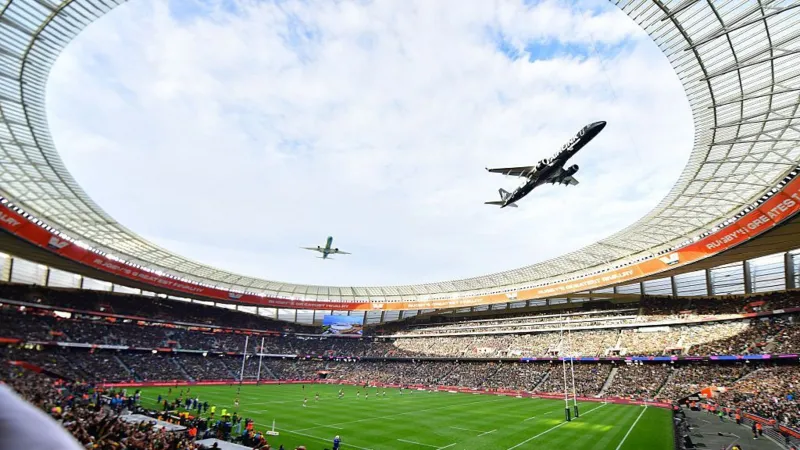
A South African airline has pushed back against criticism of a daring flypast that sent two of its aircraft skimming close to the top of a packed rugby stadium in Cape Town.
The jets streaked over DHL Stadium on Saturday, where more than 50,000 fans had gathered to watch South Africa face New Zealand. Smoke flares shot into the sky as the planes roared past just before kickoff.
Reaction Splits Between Awe and Alarm
Footage of the manoeuvre spread quickly online, drawing sharply divided reactions. Some viewers called the stunt reckless given the density of the crowd below. Others praised the precision and skill needed to execute it.
Airlink, the airline behind the flypast, insisted the display was far from improvised. The carrier said it worked closely with aviation authorities to plan every detail in advance.
“Planning. Precision. Performance,” the airline wrote in a social media post accompanying the footage.
Airline Details the Safety Measures Behind the Stunt
In a more detailed statement carried on a South African government news site, Airlink described the experience level of the crews involved.
“The two aircraft were flown by highly experienced crew, with each comprised of three senior captains operating in the roles of commander, co-pilot and safety/technical officer,” the airline said.
The company added that both flights stayed within “approved and rehearsed safety altitude and speed limits” set specifically for the flypast.
Flight tracking website Flightradar24 offered its own read on the numbers. Based on its analysis, the site said the lead aircraft passed within roughly 50 feet, or about 15 metres, of the stadium’s highest point.
National Pride Outweighs Safety Concerns for Many
Despite the risk raised by critics, of two aircraft flying low over a stadium filled with tens of thousands of people, many South Africans responded with pride rather than alarm.
Sports Minister Gayton McKenzie framed the flypast as proof of national aviation talent. “It’s a well known fact that we have the best pilots in the world, that was spectacular,” he wrote on X.
That sense of pride reflects a broader pattern: low-altitude flybys have become something of a tradition ahead of major rugby matches in South Africa, timed to heighten the atmosphere before kickoff.
A Tradition Rooted in 1995
The most famous precedent dates back three decades. A South African Airways jet flew low over Johannesburg’s Ellis Park stadium before the 1995 Rugby World Cup final, a match South Africa won against New Zealand.
That game carries deep symbolic weight in South African history. It was immortalised in the Hollywood film “Invictus,” which depicted Nelson Mandela, the country’s first Black president, wearing the jersey of the national rugby team.
The gesture mattered because the Springboks jersey had long been associated with the apartheid government. For decades, the national side had excluded players who were not white, making Mandela’s decision to wear it a powerful signal of reconciliation.
Weekend Flypast Echoes That Legacy
Saturday’s stunt over DHL Stadium drew on that same tradition of pairing rugby’s biggest moments with displays of aviation skill, even as it reignited debate over how much risk is acceptable for spectacle.
Airlink’s defense centered on process: experienced crews, government coordination, and rehearsed limits on altitude and speed. Critics, meanwhile, focused on outcome, questioning whether any margin of error is appropriate when a packed stadium sits directly below.
For now, the airline shows no sign of stepping back from the practice. Its statement framed the flypast not as a one-off risk but as a demonstration of exactly the planning and precision it says defined the event.
What Comes Next
Aviation authorities have not indicated any investigation is underway, and Airlink has not said whether similar flypasts are planned for future matches. But with South Africa’s rugby calendar featuring more high-profile fixtures against rivals like New Zealand, the debate over how low is too low seems likely to resurface the next time smoke flares and jet engines announce kickoff.