
Japan’s Defence Ministry has begun making an argument that would have seemed unusual just a few years ago: that building more weapons is not simply about safety, but about making the country richer. The claim appears throughout the ministry’s newly released annual white paper, which frames the country’s expanding military buildup as a driver of economic growth rather than a drain on public resources.
The document arrives as Japan continues to shed decades of postwar restraint on military activity, restrictions that once capped defence spending and limited the scope of what Japanese forces could do. This year’s assessment calls for the country to lean harder into defence-related technology, funnel support toward startups working in the sector, and rely more heavily on commercial components when building weapons systems, an approach that mirrors how militaries elsewhere have tried to speed up production while cutting costs.
A pitch aimed at the public purse
According to a Defence Ministry presentation accompanying the report, the white paper “stresses that investment in defence benefits the wider economy and people’s lives.” That framing is not incidental. It tracks closely with Prime Minister Sanae Takaichi’s broader economic approach, which has leaned on large-scale state spending as a tool to stimulate growth across multiple sectors, defence now among them.
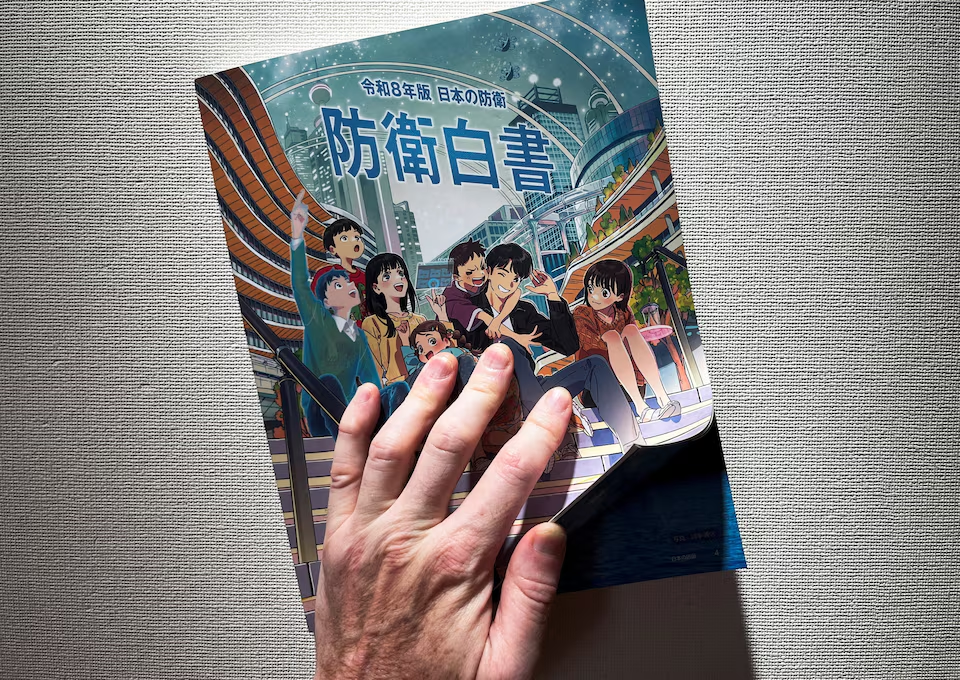
The messaging shift is visible even on the cover of the document itself. Rather than the soldiers, weapons hardware and military insignia that have marked previous editions, this year’s white paper features an anime-style illustration of a smiling family set against a gleaming, futuristic city skyline. A Defence Ministry official said the artwork was chosen deliberately to project a “futuristic image,” a marked departure from the more traditional, hardware-focused visuals Japan’s defence establishment has used in the past.
The redesign signals an attempt to soften how the buildup is presented to ordinary citizens, positioning it less as preparation for conflict and more as an investment in national advancement.
China named as the central concern
Beneath the rebranding, the substance of the white paper remains focused on regional threats, particularly from China. The report states plainly that “China’s military activities and other actions are a matter of serious concern to Japan and the international community, and represent Japan’s greatest strategic challenge.”
That language lands amid an already tense diplomatic backdrop. In November, Chinese officials reacted angrily after Takaichi suggested that Japan’s Self-Defense Forces could be deployed if a Chinese attack on Taiwan also threatened Japan’s own survival. Beijing labeled the comment “egregious” and demanded she withdraw it, a sign of how sensitive the Taiwan question has become for Tokyo’s relationship with its largest regional rival.
Military analysts expect Takaichi’s government to build on that concern in a forthcoming national security strategy, which is widely anticipated to call for further increases in defence spending. The core rationale, according to those familiar with the government’s thinking, is deterrence: convincing Beijing that any move against Taiwan would carry costs steep enough to avoid, given the risk that such a conflict could draw Japan into a prolonged and direct confrontation.
The financing question remains open
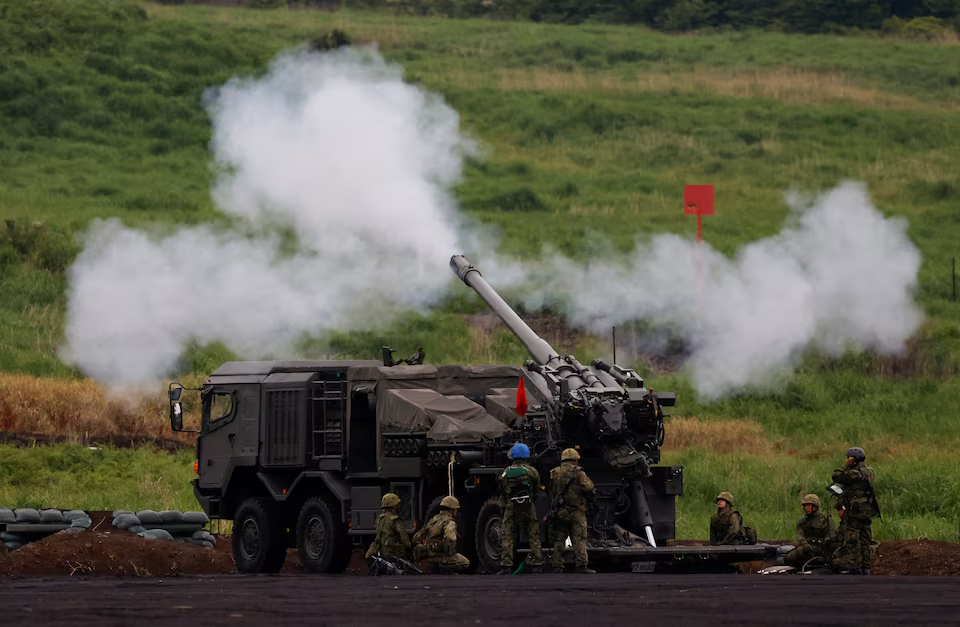
Japan’s military expansion is already the largest since the Second World War, and financing it has required a mix of tax increases, spending reforms, and one-off revenue measures. That combination has helped push defence-related spending to roughly 2 percent of gross domestic product, a threshold that would have been politically difficult to reach even a decade ago.
What remains unresolved is how Takaichi’s government plans to fund any additional expansion beyond that level. Japan’s public finances are already under considerable strain, and the prime minister has not laid out a clear plan for covering further increases without adding to that pressure.
The scale of competing budgetary demands is evident in the government’s recent fiscal decisions. Takaichi’s administration secured a record 122.3 trillion yen budget for the fiscal year running through March 2027, then followed it with a supplementary package worth 3.1 trillion yen intended to help households and businesses absorb higher energy costs. Balancing that kind of household relief spending against a growing defence budget will likely become a defining fiscal challenge for her government in the years ahead.
Where the money is going
The bulk of Japan’s new defence spending to date has been directed toward long-range missile systems, particularly those capable of striking targets more than 1,000 kilometers, or about 621 miles, away. That capability marks a significant shift for a country that long avoided developing strike capacity beyond its own borders, reflecting how far Tokyo’s security posture has moved from its postwar defensive-only stance.
Looking ahead, officials expect a growing share of any additional spending to shift toward drones and other unmanned systems, a category of weaponry that has taken on outsized importance since Russia’s invasion of Ukraine. Ukrainian forces have relied extensively on unmanned systems throughout that conflict, both for reconnaissance and direct strikes, and Japanese planners appear to be drawing lessons from that experience as they consider how future conflicts, including any potential crisis over Taiwan, might unfold.
A buildup with economic ambitions
Taken together, the white paper reflects a Japan trying to do two things simultaneously: respond to a security environment its own government describes as increasingly dangerous, and convince a public wary of past militarism that the resulting spending will pay economic dividends rather than simply draining the treasury. Whether that argument holds up will depend largely on how Takaichi’s administration answers the financing question it has so far left open, and on how the security picture in East Asia continues to evolve in the months ahead.