
A naval blockade ordered by President Donald Trump against Iran’s ports in the Strait of Hormuz is testing an already fragile cease-fire between Washington and Tehran, reviving fears over a waterway that carries roughly a fifth of the world’s oil production.
Trump launched the blockade Monday morning, vowing to stop any ship “trying to enter or leave” Iranian ports. The order came after a 21-hour negotiation between U.S. and Iranian officials in Islamabad over the weekend ended without a deal, capping weeks of pressure from Trump demanding that Iran lift its restrictions on the waterway.
Soon after the blockade took effect, Trump warned Iran against retaliating with what he called “fast attack” ships. “If any of these ships come anywhere close to our blockade, they will be immediately eliminated, using the same system of kill that we use against the drug dealers on boats at sea,” he said, an apparent reference to U.S. strikes on Venezuelan vessels in the Caribbean Sea and Eastern Pacific Ocean.
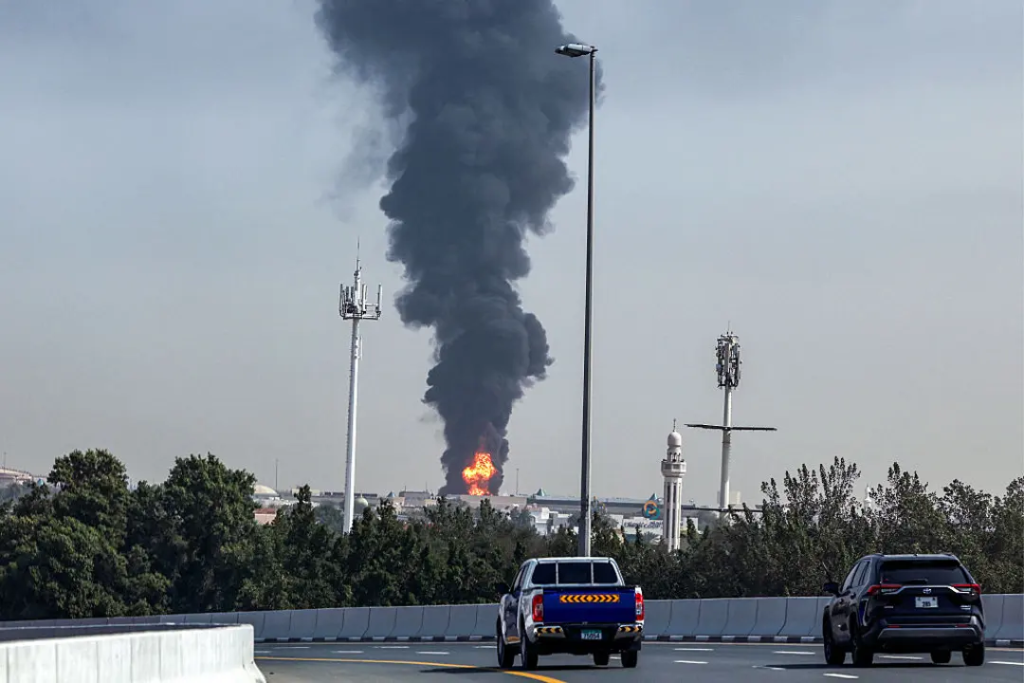
Trump told reporters at the White House that Iran is currently doing no business in the strait and that the U.S. intends to keep it that way “very easily.”
Iran responded with its own warning, threatening retaliation against Gulf ports. An Iranian military spokesperson said any U.S. restriction on vessels in international waters would be illegal and amount to piracy. If Iranian ports come under threat, the spokesperson said, no port in the Gulf or Gulf of Oman will remain safe, according to state media.
Oil prices climbed again Monday morning, reaching around $102 a barrel as the two sides traded threats.
A Narrow Passage With Outsized Weight
The Strait of Hormuz sits between Iran to the north and Oman and the United Arab Emirates to the south, narrowing to just 30 miles at its tightest point. Saudi Arabia, Kuwait, Iraq, Qatar and the UAE export most of their oil and liquefied natural gas cargo through the passage by tanker.
“It’s a critical node in the global economy for all sorts of commodities, energy and otherwise,” said Jim Krane, a fellow for energy studies at Rice University’s Baker Institute for Public Policy. He noted the strait also carries about 45% of global sulfur exports, a material used in fertilizer production and in refining metals such as copper, cobalt and nickel.
Under the U.S. Navy’s own handbook on naval operations law, a blockade is an operation meant to stop vessels or aircraft, enemy or neutral, from entering or leaving ports, airfields or coastal areas controlled by an enemy state. Only the president or the secretary of defense, in this case Pete Hegseth, can order U.S. forces to establish one, and the blockade cannot bar access to neutral ports and coasts.
Trump and U.S. Central Command said ahead of Monday’s action that vessels moving in and out of Iranian ports will be targeted, while ships tied to other ports in the region will not.
Enforcement Still Taking Shape
The blockade on ships entering or leaving Iranian ports in the strait took effect at 10 a.m. ET Monday. Central Command said it will be enforced impartially against vessels of all nations moving through Iranian ports and coastal areas, including those on the Arabian Gulf and Gulf of Oman. What that enforcement will look like in practice over the coming days remains uncertain.
“What I’m seeing is most likely an attempt to replicate the pressure campaign on Venezuela against Iran right now,” said Noam Raydan, a senior fellow at The Washington Institute for Near East Policy. “Iran has military capabilities, and most likely it will retaliate. This is the difference between Iran and Venezuela.”
Krane called the operation a gamble, one that raises pressure on Iran while carrying the risk of pushing the situation toward wider conflict or toward a return to talks. “That’s the Trump Administration’s logic, to crank up the pressure in a way that doesn’t get anybody killed and keeps the cease-fire intact,” he said. He added that the U.S. held this option in reserve in case negotiations collapsed, and is now using it, betting that pressure on Iran’s finances will bring Tehran back to the table.
The blockade follows reports that Iran has been charging some vessels tolls for safe passage through the strait. Trump said he has directed the Navy to “seek and interdict every vessel in international waters that has paid a toll to Iran,” adding that no one who pays what he called an illegal toll will have safe passage on the high seas. He also pledged to clear any sea mines Iran may have laid. Central Command has said forces already set conditions for mine clearance, with two Navy guided-missile destroyers conducting operations in the strait. Krane described de-mining as slow, painstaking work, far harder than laying mines in the first place.
Oil and Gas Prices Jump
Brent crude reached $102 a barrel Monday as markets opened, up from $94 when trading closed Friday. The national average gas price hit $4.12 a gallon Monday, up from $3.12 a gallon the week before the initial U.S.-Israeli strikes on Iran.
Iran’s parliament speaker, Mohammed Ghalibaf, responded to the market swings by telling Iranians to expect worse. “Enjoy the current pump figures. With the so-called ‘blockade,’ soon you’ll be nostalgic for $4–$5 gas,” he said.
Unlike earlier stages of the conflict, the current blockade is expected to remove Iranian oil from the market entirely, oil that had continued moving through the strait despite the fighting. Krane estimated the blockade takes nearly 2 million barrels a day of oil and refined products off the world market. “From an oil market perspective, this is just adding to the pressure on oil markets. It’s taking more supply offline at a time when there’s already a shortage,” he said.
Allies Keep Their Distance
Trump’s relations with several European leaders have grown strained during the Iran war, particularly after he threatened to pull the U.S. out of NATO when allies declined an earlier request to send warships to the strait. The blockade has added to that friction.
British Prime Minister Keir Starmer said the U.K. will not take part in the U.S. effort. “It is, in my view, vital that we get the Strait open and fully open, and that’s where we’ve put all of our efforts in the last few weeks and we’ll continue to do so,” he said, adding that Britain is not supporting the blockade.
French President Emmanuel Macron said France and the U.K. will organize a conference in the coming days with countries willing to join a peaceful multinational mission to restore freedom of navigation in the strait. He described the mission as strictly defensive and separate from the warring parties, to be deployed once conditions allow.
Spanish Defense Minister Margarita Robles criticized the blockade directly, saying it makes no sense. “This is another episode in the downward spiral the world has been dragged into,” she said.
A Waterway Used as Leverage Before
Iranian officials have treated the strait as a bargaining chip since the U.S. and Israel first struck Iran on February 28. In March, Iran’s new Supreme Leader Mojtaba Khamenei, in his first statement after succeeding his father, said he would keep holding the waterway as leverage.
At least 17 tankers have been hit in the region since, slowing transit nearly to a stop as vessels avoid the route. On April 7, a vessel 25 nautical miles off Iran’s coast was struck by an unknown projectile that damaged the ship above the waterline, according to the United Kingdom Maritime Trade Operations center.
Gulf producers exported 3.3 million barrels a day of refined products and 1.5 million barrels a day of liquefied petroleum gas in 2025, according to the International Energy Agency. More than 3 million barrels a day of regional refining capacity has already shut down because of attacks and the lack of viable export routes.
When the U.S. and Iran entered a two-week cease-fire on April 7, Trump conditioned it on a complete and immediate opening of the strait. That opening never happened.
“The key point when it comes to the Strait of Hormuz is that there is really no other exit point for the magnitude of energy flow,” said Joel Hancock, an energy analyst at Natixis CIB. “The Strait of Hormuz is a true chokepoint in the sense that you are seeing production being shut in, because there isn’t really an alternative exit route.”
Iran’s geography gives it unusual power to restrict the passage. During cease-fire talks, one of Tehran’s proposals called for full Iranian control over the strait, a demand the U.S. and Gulf states would likely reject.
Michael Eisenstadt, director of the military and security studies program at The Washington Institute for Near East Policy, said Iran has spent decades building up systems designed to deny access to the strait, including anti-ship cruise missiles, mines, submarines, surface-to-air missiles and drones.
The current disruption echoes the Tanker War of the 1980s, when Iran and Iraq launched hundreds of attacks on oil tankers in the Persian Gulf and the strait during their war. Krane said those attacks struck far more ships than the current conflict has, yet did less damage to the global economy. “You had hundreds of ships that were hit,” he said. “But the impact on the global economy was not nearly as dire. Current attacks are having a much larger impact on oil markets in the global economy with much less hostile action by Iran.” Eisenstadt noted that 1980s attacks, while frequent, never fully halted passage through the strait, unlike the near standstill seen in recent weeks.
In 2011, then-Vice President Mohammad Reza Rahimi warned that oil would stop flowing through the strait if Western sanctions over Iran’s nuclear program widened. A similar threat resurfaced during last year’s so-called 12-day war, when the U.S. joined Israel in striking three Iranian nuclear facilities. Iran’s parliament voted at the time to close the strait, a largely symbolic move since it has no formal authority over the passage. Crude futures still jumped to $80 a barrel immediately after the vote, a preview of the volatility that has followed.