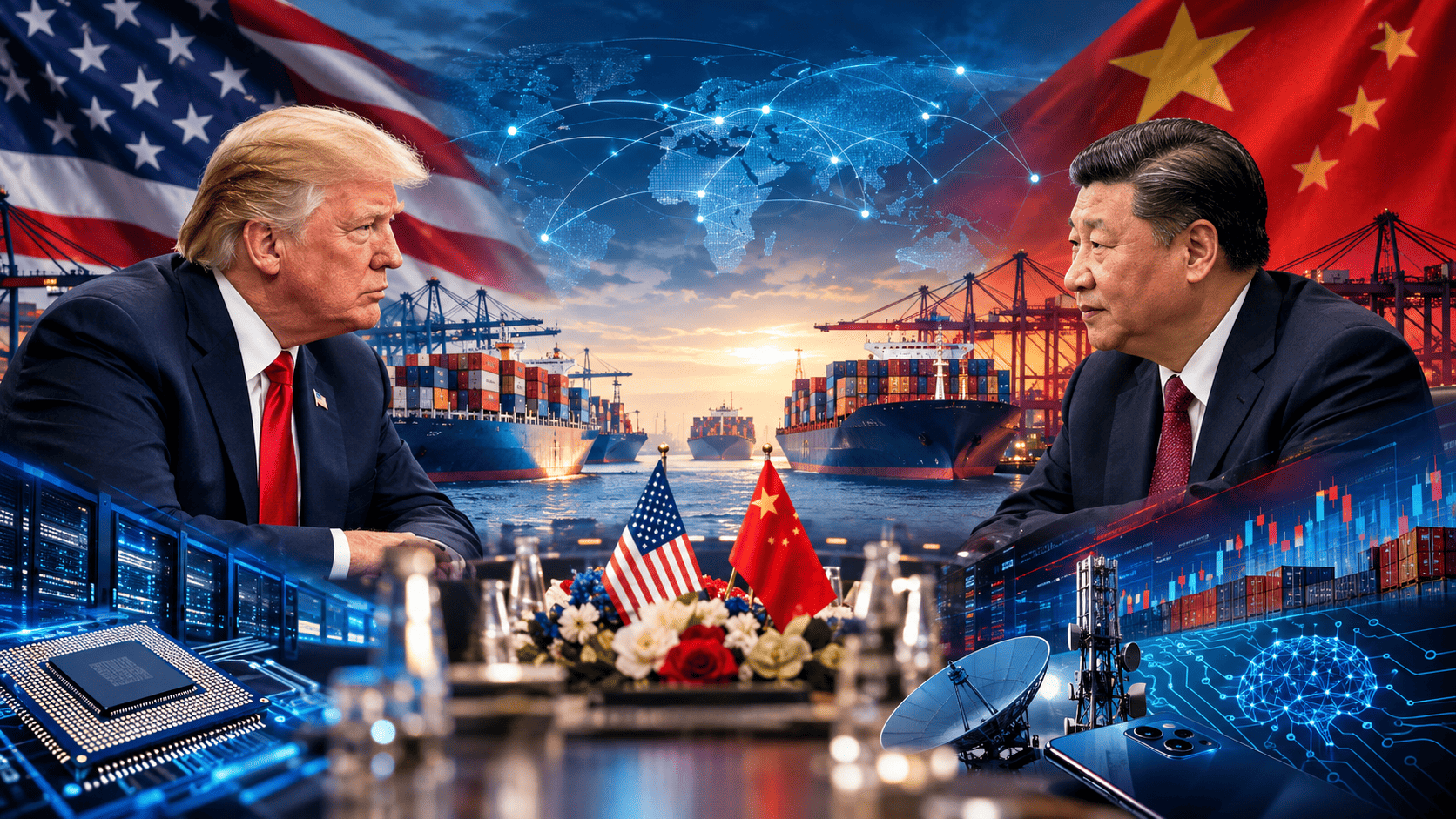
Three days, one state dinner and a lot of red carpet. The Trump China summit 2026 in Washington (September 23–25) looked huge on TV. The actual deal list? Much shorter. Here’s what happened, what it means for your wallet and what to watch before the leaders meet again.
Trump and China Summit 2026: What Happened?
Key outcomes of the Trump-Xi meeting
Xi Jinping made his second state visit to the U.S. since 2015. Trump greeted him at the airport, a rare gesture (CNBC). The headline result was small: the trade truce was pushed back from November 10 to January 10 (The Epoch Times). Pageantry won over policy. It was also the leaders’ second meeting this year, after May in Beijing.
Main agreements announced
The White House fact sheet lists a few concrete items. A Board of Trade and a Board of Investment now operate. Each side will ease tariffs on $30 billion of non-sensitive goods. China will import at least 10 million metric tons of U.S. coal in 2027 and 2028. A new “super intelligence” dialogue also starts.
What remains unresolved
Taiwan, chip controls and rare earth volumes all stayed open. There was no joint press conference either. Experts at the Atlantic Council described the truce extension as a “punt” that keeps both sides at the table without solving anything.
What the New U.S.-China Trade Truce Means
Tariffs and trade commitments
The truce builds on the Busan deal of October 2025, which trimmed tariffs and paused China’s rare earth export controls for a year (Council on Foreign Relations). U.S. Trade Representative Jamieson Greer calls the extra two months “compliance periods”. Think of it as a probation window.
China’s commitments to the U.S.
Beijing has promised farm purchases and Boeing jets. Progress is uneven (CNBC analysis; Ag Bull):
| Commitment | Details | Status (late Sept.) |
| Soybeans | 25 million metric tons | Nearly half bought |
| Other farm goods | $17 billion a year, 2026–28 | About $5 billion so far |
| Boeing jets | 200 aircraft | About 140 in a “good state” |
Impact on businesses and consumers
If the recommendations stick, toys, small appliances and car seats could get cheaper. Farmers may see more buying during harvest. Still, a two-month horizon makes planning hard for importers. Greer says the U.S. goods deficit with China fell nearly 40%, though some trade simply moved elsewhere (CNBC interview).
Trump’s China Trade Policy and the Tariff Dispute
How the trade conflict developed
In 2025 the two sides traded escalating tariffs. China’s rate on some goods peaked at 145%. Then Busan cooled things down. The relationship has since run on short, renewable truces rather than a lasting settlement.
Latest changes to tariffs
On February 20, 2026 the Supreme Court struck down the emergency-law tariffs (Global Trade Alert). A 10% Section 122 surcharge filled the gap until July 24. New Section 301 duties of 10% to 12.5% then replaced it (Ginger Control). Older China-specific duties remain. Estimates put many goods near 37.5% (one tracker). Check your product code.
Why trade remains a major sticking point
Both sides guard their leverage. Washington wants purchases and rare earths on time. Beijing wants fewer chip limits. Greer named no penalty for missed commitments (Ag Bull). That gap keeps every truce fragile.
AI, Semiconductors and the U.S.-China Technology Race
Competition over artificial intelligence
The leaders agreed to say “super intelligence” instead of “artificial intelligence”. They also created an SI Dialogue, with the next exchange due by November (White House fact sheet). Analyst Kenton Thibaut noted the talks produced no specific safety mechanisms (Atlantic Council).
Chip and technology restrictions
Greer said U.S. controls on advanced chips stay in place (The Epoch Times). Nvidia’s H200 has U.S. approval. Yet Chinese authorities have not let domestic firms buy it (Brookings).
Areas where Washington and Beijing could cooperate
The new channel for reporting SI incidents is the most practical opening. Thibaut expects real progress to come from technical exchanges and unofficial dialogues rather than leader-level announcements.
Taiwan and Other Major Issues in U.S.-China Relations
Taiwan’s importance to the relationship
Beijing says Xi urged Trump to oppose Taiwan’s independence. U.S. Ambassador David Perdue replied that Washington isn’t changing its language or position (The Epoch Times).
Security and geopolitical tensions
A major Taiwan arms package is still unapproved. Rubio hinted the delay may continue (Atlantic Council). Trump also scaled back U.S.-South Korea drills last month. Beijing offered no public thanks.
Iran and other international issues
Perdue says Trump called any Chinese support for Iran “unacceptable”. The fact sheet adds that Iran can never have a nuclear weapon and that no one may impose tolls on international waterways. Trump also asked Xi for more refined fuel output. Russia and North Korea came up too. For more on that wider diplomacy, read our coverage of the US and Kyiv peace plan and the Israel-Gaza ceasefire deal.
Issues the summit did not resolve
Reporters got little access to Xi. Questions about Hong Kong’s Jimmy Lai went unanswered. Taiwan arms, chips and rare earth flows all stayed parked for later.
Rare Earths and the Battle Over Critical Supply Chains
Why rare earths matter
These minerals sit inside magnets, electronics and defense systems. The May fact sheet named yttrium, scandium, neodymium and indium as shortage concerns (May fact sheet).
China’s role in global supply chains
China dominates refining (CNN). Financial Times data cited by Tipp Insights showed U.S.-bound magnet shipments fell 20% in August. Some American buyers still face long license delays.
How critical minerals affect negotiations
Beijing made no new rare earth pledges. The text only promises shipments at “appropriate levels”. Perdue described a “Manhattan Project-level effort” to cut U.S. reliance (The Epoch Times). Until then, China holds a strong card.
What the Trump-China Meeting Says About Their Broader Relationship
Cooperation versus strategic competition
Both sides now use the phrase “constructive relationship of strategic stability”. Scott Kennedy of CSIS said the fact sheets show how wary each side remains (CNBC). Cooperation is real. So is rivalry. The Trump China summit 2026 confirmed that both capitals prefer managed competition over open confrontation.
Economic interdependence and national security
Trade ties keep people talking. Security worries keep them guarded. U.S. soybeans fell from 40% of China’s imports before 2018 to 23% early this year (CNBC analysis). Decoupling is partial; dependence still bites.
The role of personal diplomacy between Trump and Xi
Trump loves the personal touch. Melanie Hart of the Atlantic Council argues Xi responds to strategy rather than flattery (Atlantic Council). Both leaders plan to attend each other’s summits: APEC in Shenzhen in November and the G20 in Miami in December.
What Happens Next for Trump and China?
Implementing the latest agreements
Greer promised more detail on Monday. Watch the Board of Trade’s tariff lists and the farm-market working group, which China says will start talks before year-end (CNBC).
Potential sources of renewed tensions
Four triggers stand out: a Taiwan arms decision, chip rules, rare earth licensing and Iran. Any one could sour the mood before the January 10 deadline.
Future trade and diplomatic negotiations
November and December are the real tests. The two-month truce gives each leader a reason to show up, as Josh Lipsky of the Atlantic Council put it (Atlantic Council). Expect either another short extension or a bigger bargain. Either way, the Trump China summit 2026 will be judged by what happens before January rather than by the state dinner.
Trump-China Summit 2026: Key Takeaways
What changed
The truce runs to January 10. Two trade boards are live. $30 billion in goods get friendlier tariff treatment. An SI dialogue and incident channel exist.
What did not change
Chip controls, U.S. Taiwan policy and China’s grip on rare earths all look the same as before the visit.
The biggest unresolved questions
Will China meet its purchase targets? Will Washington approve the Taiwan arms package? Can the truce become a lasting deal?
Frequently Asked Questions About Trump and China
What did Trump and Xi agree on?
They agreed to extend the truce, tariff relief on $30 billion of goods each way, a coal purchase, a super intelligence dialogue and mutual attendance at APEC and the G20.
What is the latest U.S.-China trade truce?
It’s the Busan arrangement from October 2025, now extended to January 10. It covers the tariff pause and China’s suspension of rare earth export controls (The Epoch Times).
What happened to tariffs on Chinese goods?
The Supreme Court voided the emergency-law tariffs in February. Section 301 duties now do most of the work. No broad new cut came from this summit.
What role does Taiwan play in U.S.-China relations?
It’s the most sensitive security issue. Beijing wants Washington to oppose independence; Washington says its policy is unchanged.
What are the biggest issues between Trump and China?
Tariffs, chips, rare earths, Taiwan and Iran top the list. Purchases of soybeans and Boeing jets are the current test of good faith.