
Turkey, Saudi Arabia and Pakistan will establish joint political and military coordination bodies, conduct combined military exercises and expand defense industry cooperation under a pact signed between the three nations last week, Turkey’s defense ministry said Thursday.
The announcement provides the first detailed roadmap for how the three Sunni Muslim countries, all close U.S. allies, intend to implement the agreement they signed on August 7 amid rising alarm over a regional conflict that has sent Iranian missile fire toward Gulf oil exporters. The pact represents one of the most significant new security arrangements to emerge from the wider instability that has gripped the Middle East since fighting broke out between the United States, Israel and Iran earlier this year.
Pact modeled on NATO’s collective defense clause
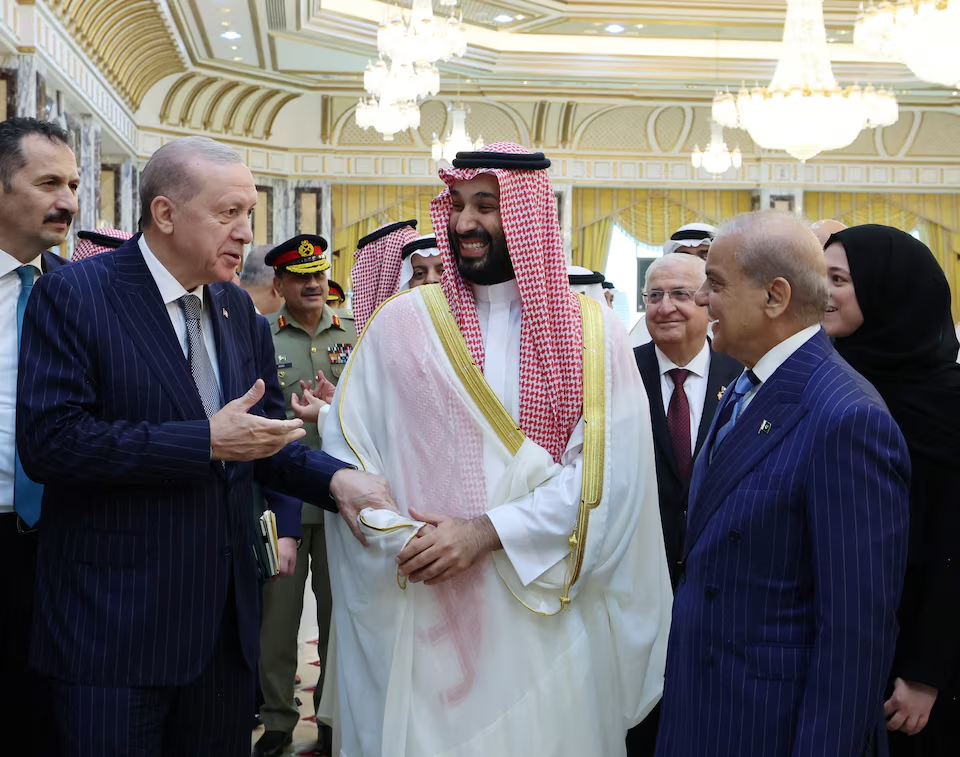
The three nations signed what they called the Mecca Joint Defence Agreement on August 7, stipulating that an armed attack against any one member would be treated as an attack against all three. The provision closely mirrors Article 5 of NATO’s founding treaty, the collective defense clause that obligates alliance members to respond jointly to an attack on any member state.
The comparison to NATO’s Article 5 has drawn particular attention given the makeup of the three signatories. Pakistan is a declared nuclear power, while Saudi Arabia remains the world’s largest oil exporter and Turkey fields the second-largest standing army in NATO. A mutual defense commitment binding these three militaries together marks a notable departure from the more informal security cooperation that has traditionally characterized relations among Sunni Muslim-majority states in the region.
At a weekly briefing in Ankara, Turkey’s defense ministry said the pact’s central purpose was to place defense and military ties among the three countries on a “more institutional and sustainable” footing going forward, rather than relying on the ad hoc bilateral arrangements that have governed cooperation in the past.
New coordination bodies planned
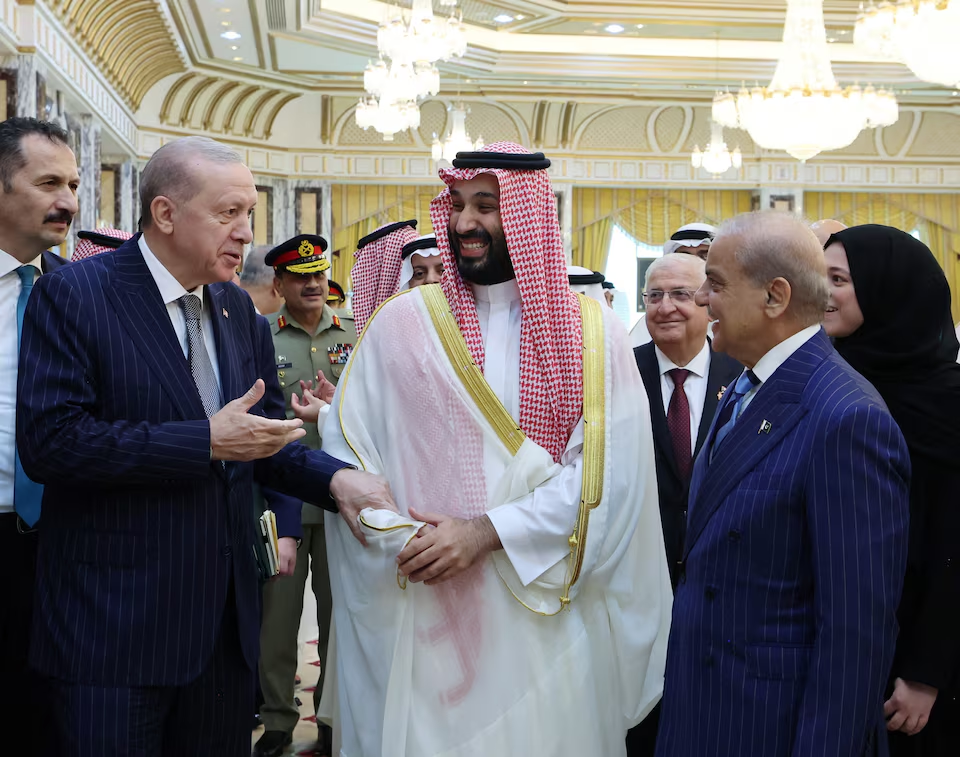
According to the ministry, the agreement calls for the creation of strategic political and military mechanisms involving each country’s defense ministers, foreign ministers, and chiefs of general staff or armed forces commanders. Coordination among the three nations will take place “at the highest level,” the ministry said, suggesting the pact is designed to function as a standing forum for regular consultation rather than a one-time declaration of solidarity.
The ministry did not specify how frequently these bodies would meet or where they would be headquartered, but described the arrangement as intended to give the three countries a durable structure for managing shared security concerns as the regional situation evolves.
Joint exercises to span multiple domains
The ministry also outlined plans for joint military exercises spanning land, naval and air forces, along with cooperation on air defense systems and unmanned military technology. The scope of the planned exercises suggests the three militaries intend to build interoperability across a broad range of combat domains rather than limiting cooperation to a single branch of their armed forces.
Naval cooperation in particular carries added significance given Saudi Arabia’s exposure to Gulf shipping routes and the broader disruption to regional maritime traffic caused by the ongoing conflict involving Iran. Coordinated air defense planning also reflects the immediate concern driving the pact: the threat of missile and drone strikes that has already reached Gulf oil-exporting states during the current fighting.
Defense industry cooperation to expand
Beyond joint exercises, the three countries plan to deepen cooperation across their defense industries. The ministry said the goal extends beyond simply supplying military products and systems to one another.
“The aim is to provide not only product and system supply, but also joint development and production, technology cooperation, and sustainable maintenance and logistics support,” the ministry said. It added that unmanned and autonomous systems, electronic warfare capabilities and artificial intelligence would be treated as priority areas for cooperation.
The emphasis on joint development rather than one-way arms sales points to an ambition among the three countries to build shared defense manufacturing capacity rather than simply relying on purchases from outside powers. Turkey has invested heavily in recent years in domestic drone and defense technology production, an industry that could form the backbone of the pact’s technology-sharing ambitions with Saudi Arabia and Pakistan.
Pact open to expansion, Turkey says
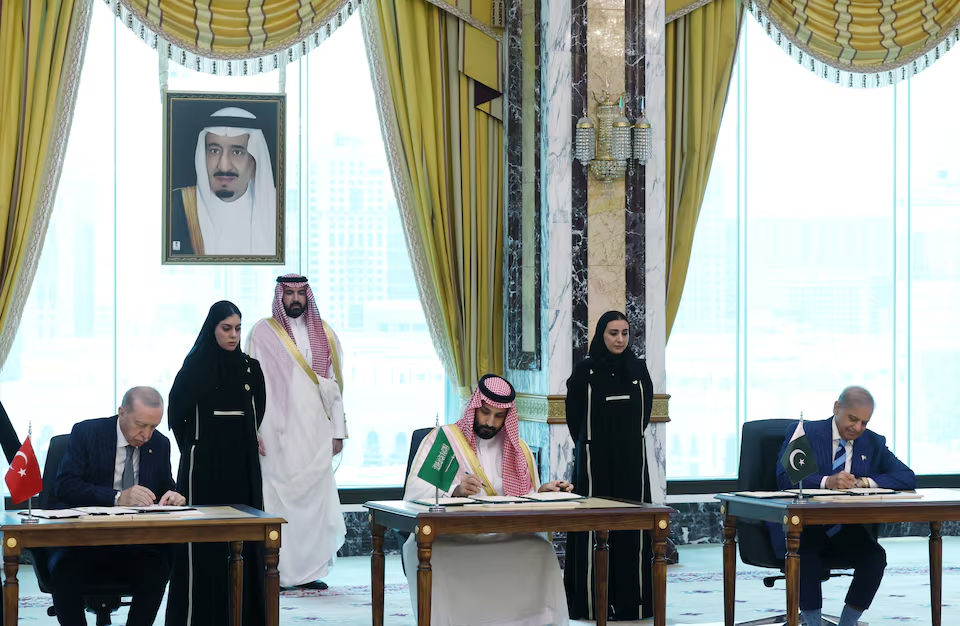
Turkey, which maintains NATO’s second-largest army, said the agreement with nuclear-armed Pakistan and top global oil exporter Saudi Arabia remains open to additional members, naming Egypt as a potential future candidate. Turkish officials stressed the pact is not intended to replace any of the countries’ existing alliances or defense commitments, an apparent effort to reassure Washington and other Western partners that the arrangement is additive rather than a realignment away from established security relationships.
The openness to expansion, particularly the mention of Egypt, signals that the three founding members may see the pact as the foundation for a broader Sunni Muslim security bloc rather than a fixed trilateral arrangement. Egypt, like Turkey, Saudi Arabia and Pakistan, maintains close security ties with the United States while also navigating its own relationship with Iran and other regional powers.
Turkey also joins Red Sea shipping talks
Separately, the defense ministry said Turkey is participating in meetings in Jeddah aimed at building an international coalition to protect shipping in the Red Sea from attacks linked to Yemen’s Houthi movement. The talks come as regional powers work to shore up maritime security across multiple Middle East shipping corridors amid the broader escalation involving Iran.
The Jeddah talks run parallel to the trilateral defense pact and reflect a wider pattern of regional states moving to coordinate security responses as instability spreads across multiple fronts, from the Gulf to the Red Sea. Saudi Arabia, which has led the push for an international coalition to protect Red Sea shipping, has positioned itself at the center of both initiatives, underscoring the kingdom’s efforts to shape the region’s evolving security architecture as the fallout from the Iran conflict continues to spread.