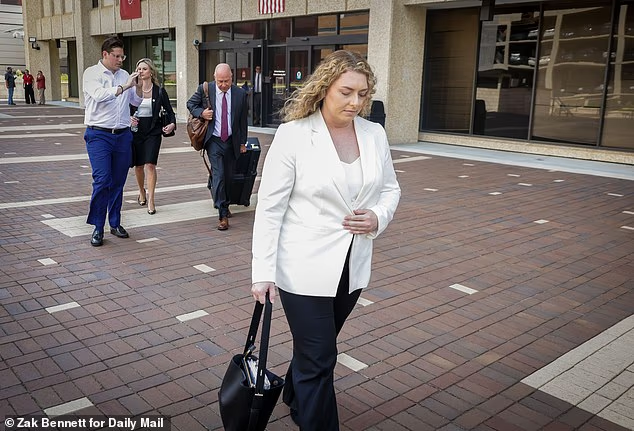
A Houston immigration judge has refused to pause deportation proceedings against Anyi Hernandez-Escobar, a Honduran mother of two. Her husband, Patrick Keating, a US citizen from Bellaire, says the family may now have to leave the country. Keating and his parents voted for Donald Trump because they believed his immigration crackdown would remove criminals. They never imagined it would reach their own home.
If Hernandez-Escobar returns to Honduras, she would take the couple’s 16-month-old daughter, Emma, with her. Her seven-year-old son, Daniel, whom Keating has raised since the boy was about 18 months old, might have to stay in the United States.
A Vote the Family Now Questions

Keating and his parents backed Trump at the ballot box, expecting the policies to target criminals and people who posed a threat. Hernandez-Escobar cannot vote, but she supported the promise to remove criminals too.
“There was a lot of crime in the country. I thought it was good to deport the bad people,” she said. “Now, it doesn’t matter if you’re a good person or a bad person.”
Keating says the past months have changed how he sees it. “If I could go back, if my vote would somehow change everything, I’d go back and vote Kamala just so we don’t have to deal with this,” he said.
How the Case Reached a Houston Courtroom

Hernandez-Escobar arrived from Honduras in 2018, eight months pregnant, fleeing what she described as a desperate situation. She was detained for four days after crossing into Texas, then granted parole to stay temporarily.
She reunited with her sister and built a life in Texas. She attended every required immigration check-in and gave birth to Daniel. She later met Keating, and the two married. Keating became a father figure to Daniel, and in May 2025 the couple had Emma.
The couple knew that marrying a US citizen would not automatically give Hernandez-Escobar legal status. They also knew that having American-born children would not by itself stop her removal. They believed they were following the available legal process. In June, after almost two years of waiting, her I-130 and I-130A petitions were approved.
The Ruling That Changed Everything
Then the Houston judge rejected her request to temporarily close her removal proceedings while she pursued the next stage of her application.
Her attorney, Jennifer Lopez, said the decision followed a June agreement between Texas Attorney General Ken Paxton and the Department of Justice. The agreement ended a Biden-era policy that let immigration judges administratively close certain cases.
Lopez said the judge had previously signaled he would close the case. “Originally, the judge had told her, when Biden was in, ‘Go ahead and file your I-130, come back to me and I will administratively close your case,'” Lopez said. “They did that, but by the time they got back to him, Trump had been sworn in and they had changed all the rules.”
Why Leaving May Be the Only Path
Hernandez-Escobar entered the country without authorization, so she cannot simply stay in America while applying for a green card. Under the route Lopez described, she would have to go to Honduras and seek an immigrant visa through the US consular process. She would also need a waiver of inadmissibility.
That waiver is available only to immigrants who are not in removal proceedings. Administrative closure would have taken Hernandez-Escobar out of that position for a time. Without it, Lopez says, the family may have little choice but to relocate to Honduras, nearly 2,000 miles from their home.
Daniel’s Uncertain Future
The move raises a second problem. Daniel may not be able to go with his mother.
Keating has no legal custodial rights over the boy. Daniel’s biological father lives in Maryland. He has reportedly refused to surrender his rights and does not communicate with his son.
“I’ve raised him basically since he was a year and a half, but I have no custodial rights over him,” Keating said. “Only Anyi and his biological father do. But both parents have to sign off on the passport.”
The family is paying a family-law attorney to look into whether Keating can adopt Daniel. They are also weighing whether Daniel could stay with his grandparents if his mother, stepfather and baby sister leave.
Keating’s worst fear is what happens if neither option works. “The scary part would be that Daniel can get lost in the legal foster care system, or somehow end up with a man he doesn’t know,” he said.
A Grandmother Who Still Supports Trump, With Limits
Ingrid, Keating’s mother, may end up raising Daniel as she and her husband approach retirement. Neither expected that.
“We’ll do what it takes to get through this,” she said. “It’s been very stressful because we know it stresses their family. It is a different world from what my husband and I anticipated.”
She has not turned against the president. “I still like a lot of what he’s done, though not everything,” she said. “When you’re going for the gang members and closing the borders, I think that’s really important.”
She does say the case changed how she thinks about immigration. “Immigration has been such a mess for so many years, but of course it’s easy not to pay too much attention when it’s not your immediate family,” she said. “Now, all of a sudden, it really brings it home.”
One point she will not bend on is Daniel. “Daniel needs to be with his parents and his sister,” she said. “He loves them dearly. He loves us, but as his grandparents. But children need to be with their parents.”
What Happens Next
The judge’s refusal leaves Hernandez-Escobar in removal proceedings, which blocks the waiver she needs. The only route her attorney has described runs through Honduras.
Two questions remain open. One is whether Keating can legally adopt Daniel. The other is whether the boy’s biological father will sign off on a passport or give up his rights. Until both are settled, the family cannot say whether they would leave together or split across two countries.