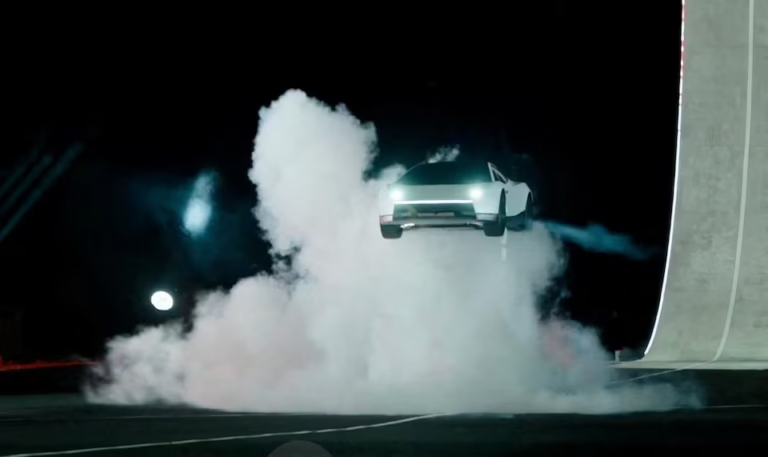

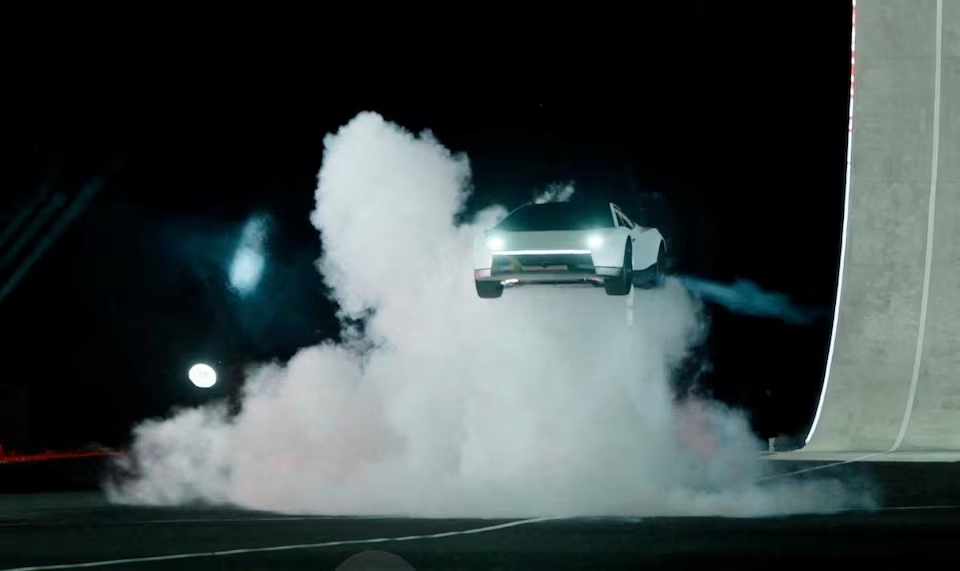
Tesla (TSLA.O) unveiled a redesigned Roadster powered by rocket-style thrusters on Thursday, October 15, and said production will start in 2028. The event took place at a SpaceX test site in McGregor, Texas. The white two-seater was developed with SpaceX, the rocket company run by Tesla CEO Elon Musk, and it arrives nearly a decade after Tesla first showed a next-generation version of its electric sports car.
Tesla shares rose 5% in premarket trading on Friday, Reuters reported. Investors now have a second date to watch: Tesla reports third-quarter results on October 21.
A car that drove upside down, then flew
The Roadster drove upside down along a ramp, held in place by a suction system. It then turned in the air and landed using built-in thrusters. Later in the event, the car fired those thrusters to jump over a truck and several other vehicles, twisting in mid-air as it cleared them.
The staging followed the pattern of earlier Musk product reveals. Dramatic music played, smoke drifted across the stage, mechanical hissing sounds filled the site and a launch countdown ran before each stunt. Musk, wearing a silver Western-style belt buckle with the Tesla logo, spoke to a cheering crowd of enthusiasts and investors.
“This is the culmination of incredible work by Tesla and SpaceX engineers working closely together to make something that you haven’t seen in any movie,” Musk told the crowd.
Sawyer Merritt, a Tesla fan and investor who attended, was among those won over. “That was the most insane product demo I’ve ever seen,” he posted on X. “I just saw this in person, and I’m still asking how this wasn’t AI.”
Performance claims: under one second to 60 mph
Lars Moravy, Tesla’s vehicle engineering chief, said the Roadster can reach 60 mph (97 kph) from a standstill in less than one second and hit a top speed of more than 230 mph (370 kph). Musk was not satisfied with those figures.
“Definitely much faster than that,” he said. “I think you’ve got to crack halfway to the speed of sound.”
Half the speed of sound at sea level is roughly 380 mph, far above the 230 mph figure Moravy gave. Musk offered no figure of his own, so Moravy’s number is the one on the record.
Tesla also said the Roadster can travel more than 300 miles (480 km) on a single charge. That is less than half of what Musk promised in 2017, when Tesla first revealed a prototype of the second-generation car and said deliveries would begin in 2020. At that reveal, Tesla put the range at 620 miles.
Three versions, three deposit levels
Musk and other executives did not name target prices on Thursday. Tesla quoted a base price of $200,000 for the car nearly a decade ago, and that figure has not been repeated.
Tesla’s reservation page, updated after the event, lists three versions:
- Performance: requires a $50,000 deposit.
- Thrust: has “acceleration thrusters” and requires a $250,000 deposit.
- Rocket: described as “invite only,” a single-seat model with a “full flight system.”
A deposit is not a price. Still, the Thrust deposit alone is $50,000 above the 2017 base price, so buyers of the thruster versions should not assume the final cost will match what Tesla first advertised. No price or deposit amount was reported for the Rocket variant, and nothing in the event coverage explained how a single-seat car with a “full flight system” would be certified to fly.
Eight years after the first promise
The original Roadster went on sale in 2008 and stayed on the market until 2012. Built on a Lotus Elise chassis, it was Tesla’s first electric vehicle and changed how many drivers viewed battery-powered cars. Since then, Tesla has become known for the Model Y SUV, the Model 3 sedan and, until this year, the Model S and Model X.
Measured against the 2017 schedule, the new production date is eight years late. Range has dropped by more than half from the promised figure. The 2028 start is about two years away. Reuters’ account of the event did not include where the car will be built or how many units Tesla plans to make.
The gap between promise and delivery is easy to line up. In 2017, Tesla offered a $200,000 car with 620 miles of range and deliveries in 2020. In 2026, it offers deposits of $50,000 to $250,000, a range above 300 miles and a 2028 start. Only the acceleration claim has moved in the buyer’s favor, and nobody outside Tesla has measured it.
The comparison with the first Roadster is instructive. That car was a small-volume product too, built on another company’s chassis, and it gave Tesla a reason to be taken seriously by buyers who had never considered an electric vehicle. The 2026 version is a different kind of bet. It is built with a partner company, sold through deposits before prices exist, and aimed at a market where Tesla’s standing is already established. Its job is to remind people what Tesla can engineer.
Musk, SpaceX and the merger question
Some watchers saw the joint project as Musk drumming up interest in a merger of the two large companies he controls, an idea he has explored by discussing their overlap.
Gene Munster, managing partner at Tesla investor Deepwater Asset Management, took that view on X. “The Roadster event is the latest example of why Elon can’t wait to bring (Tesla) and (SpaceX) together,” Munster wrote.
He was blunt about the car itself. “It was an engineering flex with no commercial value beyond embarrassing traditional car makers,” Munster said.
Musk has himself played down the Roadster’s financial weight. In 2023 he described it as a “small potato situation” that would not “move the needle in a major way financially.”
That description and Thursday’s production sit side by side without much strain. A car that sells in small numbers can still pull attention toward a company, and the 5% jump in premarket trading shows the event reached investors. One session of premarket trading is a thin basis for judging a product that will not ship for two years, though, and Tesla’s share price will respond to the October 21 report as well.
A halo car for a company changing direction
SpaceX’s role is the part of the project without precedent among car makers. Tesla credited engineers from both companies with the work, and the thrusters that landed the car after its upside-down run come from the rocket side of Musk’s business. Whether those parts can be built at road-car volumes, and sold to people who are not invited to a test site, is the question the 2028 date has to answer.
The car still carries symbolic weight. Morningstar analyst Seth Goldstein wrote in a note last month that Tesla has no halo car, meaning a high-performance luxury vehicle built to display an automaker’s best engineering and technology. “The Roadster will be Tesla’s new halo car,” Goldstein said.
The timing is awkward for a company that is moving away from cars driven by people. Tesla stopped selling the Model S and Model X this year to free up space for production of its Optimus humanoid robots. It also launched the Cybercab, a two-seater robotaxi with no steering wheel, pedals or mirrors.
Sales of Tesla’s older vehicle lineup have declined over the past two years. High gas prices lifted deliveries in the third quarter, but the underlying trend has been downward. A sports car that will not reach customers until 2028 does nothing for the numbers Tesla will report this month.
Josh Gilbert, lead analyst for Asia-Pacific at trading platform eToro, said as much. “The margin and cash flow numbers will carry far more weight with investors than anything they saw at the reveal,” he said.
What to watch on October 21
Three things will show whether Thursday’s event changes any part of the investment case.
First, the third-quarter report on October 21 will show how much of the delivery gain came from fuel prices rather than demand for Tesla’s own products. Second, margins and cash flow, the figures Gilbert named, will indicate how much room Tesla has to fund the Roadster alongside Optimus and Cybercab. Third, any comment from Musk on a Tesla and SpaceX combination would give weight to Munster’s reading of the event.
For buyers, the open questions are simpler. Tesla needs to publish prices, confirm which versions will have thrusters, and explain how a road car will fire them safely near other traffic. Until then, the $50,000 and $250,000 deposits are the only firm numbers on the table.
Tesla has missed Roadster deadlines before, first with the 2020 delivery date from the 2017 reveal, and Thursday’s demonstration did not change that record. What it did produce is a firm year, 2028, backed by an open reservation page, that owners, investors and critics can now check.
Source: Reuters reporting on the Tesla Roadster launch event. Quotes from Musk, Munster, Goldstein, Gilbert and Merritt are as reported by Reuters.