

Chief Justice John Roberts and President Donald Trump share little in temperament or background, yet the Supreme Court’s most recent term showed how much power flows from their occasional alignment. Roberts, an even-keeled institutionalist from the Midwest, and Trump, a brash New York developer turned president, found themselves on the same side often enough to produce a string of major wins for the White House during the nine-month term that closed Tuesday.
The biggest of those wins came in a Roberts-authored opinion granting Trump wide latitude to remove heads of regulatory agencies, a result conservative legal thinkers had been chasing for decades. Across the board, the court gave Trump considerable room to maneuver this term as he worked to expand presidential authority over both domestic policy and foreign affairs, despite facing a wave of lawsuits challenging those moves.
But the term also exposed where Roberts and Trump part ways. In three major cases, their interests diverged, and Trump lost each time, with Roberts writing all three opinions.
Those three defeats spanned tariffs, birthright citizenship and Trump’s attempt to remove a Federal Reserve governor. Each ruling drew support from a different mix of justices, but all three included the court’s three liberal members. John Yoo, a law professor at the University of California, Berkeley, said the pattern undercuts any claim that the court simply does Trump’s bidding. “This term shows that Trump wins at the court only when his agenda coincides with Roberts’ agenda,” said Yoo, who worked as a Justice Department lawyer under President George W. Bush.
A Rightward Drift That Predates Trump
Roberts has led the court for two decades, spanning four presidencies split evenly between the two parties. A 5-4 conservative majority defined most of that stretch, with former Justice Anthony Kennedy often casting the deciding vote.
That balance shifted once Trump filled three seats during his first term: Neil Gorsuch in 2017, Brett Kavanaugh in 2018 and Amy Coney Barrett in 2020. The resulting conservative supermajority has pushed American law rightward throughout this decade, rolling back abortion rights and affirmative action, expanding gun and religious rights, and curbing regulatory agency power.
The latest term extended that trajectory. The court gutted a central provision of the Voting Rights Act in April and struck down a campaign finance restriction on Tuesday, both long-standing goals for the Roberts Court. Syracuse University College of Law professor Jenny Breen described the continued weakening of the Voting Rights Act as part of “a decades-long project for Chief Justice Roberts.”
Justice Samuel Alito wrote the 6-3 Voting Rights Act decision, which makes it harder for minority voters to challenge district maps as racially discriminatory under the 1965 law. The ruling gives Republican-controlled states in the South an opening to redraw majority-Black and majority-Latino districts before the November midterms. Black and Latino voters lean Democratic, and Republicans are trying to hold onto their congressional majorities in those elections.
Republican campaign committees already carry a significant financial edge over their Democratic counterparts heading into the midterms, and Tuesday’s ruling adds to that advantage. The court struck down federal limits on coordinated spending between political parties and their candidates, citing free speech protections, echoing similar campaign finance rulings the Roberts Court has issued before.
Redefining Presidential Power
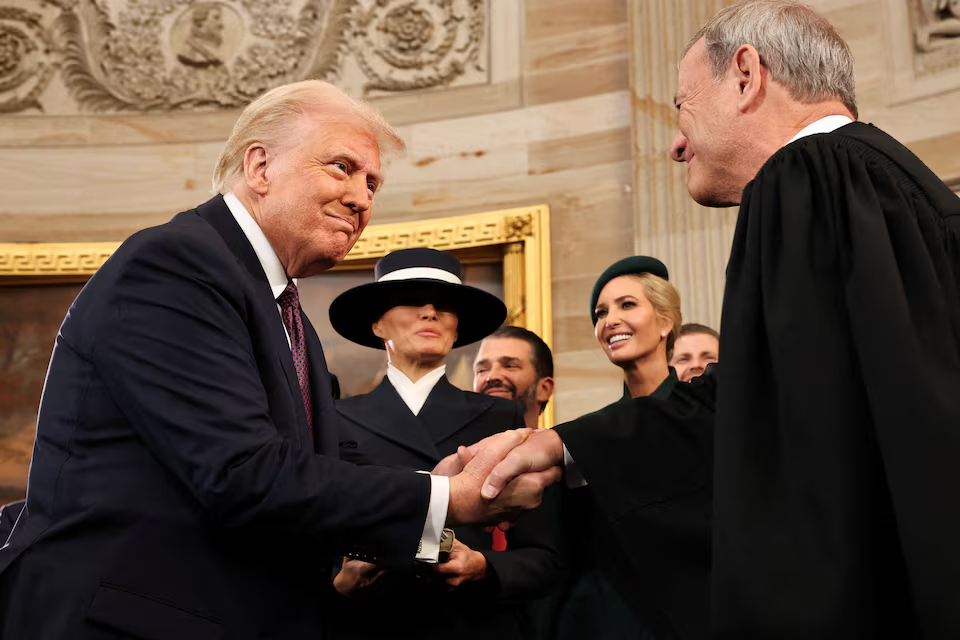
The decision that drew the most praise from conservative legal circles and Trump allies may also be the one with the widest reach. Some legal analysts say Monday’s 6-3 ruling in Trump v. Slaughter did more to expand presidential power than any Supreme Court decision before it.
Written by Roberts, the opinion overturned a 1935 precedent that had let Congress shield leaders of independent regulatory agencies from being fired by the president at will. The case arose from Trump’s removal of Federal Trade Commission member Rebecca Slaughter, and the ruling gives the president broader control over the executive branch.
Robert Luther III, a George Mason University law professor who served in the White House Counsel’s Office during Trump’s first term, said Roberts tends to do his most consequential work under pressure. “His best work has come when the limits of the executive branch have been tested by Trump’s adversaries,” Luther said.
Legal scholars view the Slaughter ruling as the peak so far of the “unitary executive” theory, a conservative legal framework that gained traction under President Ronald Reagan in the 1980s. The theory holds that the president alone controls the executive branch, including the power to fire and replace agency heads without cause.
American University Washington College of Law professor Elizabeth Beske traced the theory’s rise directly back to Roberts. “Roberts has always been a unitary executive guy, since his days in the White House Counsel’s office” under Reagan, Beske said. She added that the ruling faced considerable academic pushback in recent years. “There have been a lot of scholarly headwinds in the past few years against the moves taken in Slaughter,” Beske said, “but I think he set out to do it long ago and could not be stopped.”
Where Trump Lost Ground
Trump’s economic agenda took two direct hits this term. In February, a 6-3 decision written by Roberts struck down Trump’s broad global tariffs, which he had imposed under a law intended for national emergencies. On Monday, another Roberts opinion blocked Trump’s attempt to fire Fed governor Lisa Cook, protecting the central bank’s independence.
Breen tied both rulings to the court’s caution around economic disruption. “Both of those decisions reflect the Supreme Court’s discomfort with changes that they fear might disrupt the market or economy more broadly,” she said. “Those decisions, in other words, are entirely consistent with the conservative economic orientation of the court.”
On the term’s final day, the court issued its third major rebuke of Trump, again authored by Roberts. The justices ruled that Trump’s executive order attempting to deny birthright citizenship to children of certain immigrants violated the 14th Amendment’s guarantee of citizenship to anyone born in the United States who is “subject to the jurisdiction thereof.”
Yoo pointed out that Trump’s push to undo birthright citizenship ran up against more than a century of settled law, including the Supreme Court’s 1898 ruling in United States v. Wong Kim Ark. “Where Trump seeks outcomes because of their political salience, but he comes into conflict with these long-held Roberts Court principles, he has lost,” Yoo said.
A Pattern, Not a Rupture
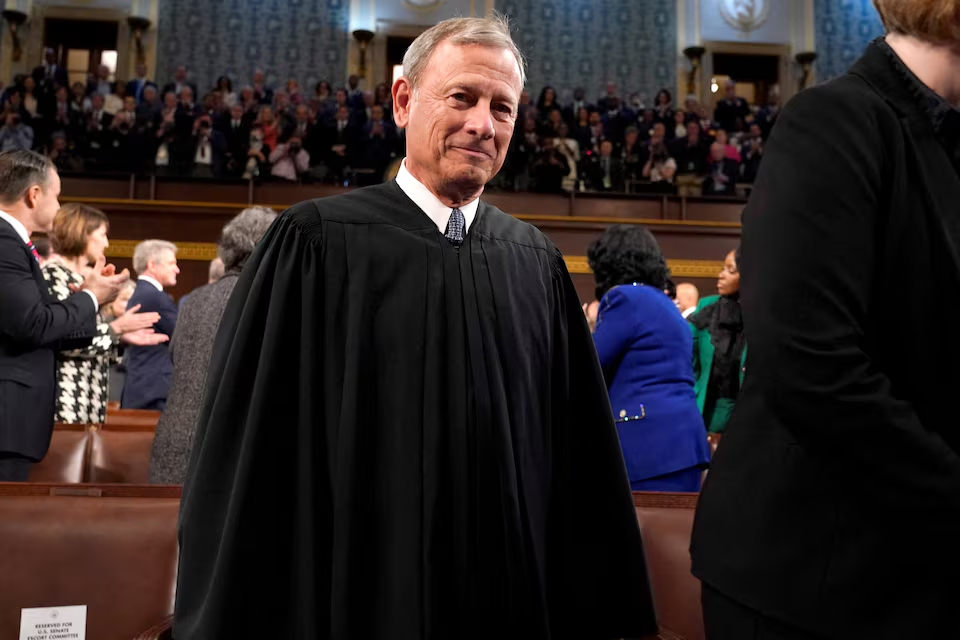
Taken together, the term’s rulings suggest less a rupture between Roberts and Trump than a set of boundaries. When Trump’s priorities line up with the Roberts Court’s longstanding conservative project, expanding executive authority, narrowing voting rights protections, loosening campaign finance limits, he tends to win, often with Roberts writing the opinion himself. When Trump pushes into territory that threatens institutional stability the court has spent decades protecting, tariffs upending trade law, an independent Fed, more than 125 years of birthright citizenship precedent, he loses, and again it’s frequently Roberts holding the pen.
That distinction matters heading into future terms. Trump has shown a willingness to test the outer edges of executive power repeatedly, and the court has shown it will grant him significant room, right up until his ambitions collide with doctrines the Roberts Court itself built over twenty years. The three defeats this term, on tariffs, the Fed and birthright citizenship, all trace back to legal principles Roberts had a hand in shaping long before Trump entered politics.
For now, the net effect favors Trump. He secured a landmark expansion of presidential removal power, benefited from a weakened Voting Rights Act ahead of a critical midterm election, and watched the court clear away campaign finance restrictions that could help his party keep its congressional majorities. The three losses sting, but they came on issues where Trump broke from decades of legal precedent rather than building on it. Whether that pattern holds will depend on which fights Trump picks next, and whether they test Roberts’ conservatism or collide with it.