Clicxpost

Life

Gen Z Goes Analogue; What’s behind the comeback of retro items

Gen Z Goes Analogue

Generation Z, often described as the first fully digital generation, grew up surrounded by smartphones, social media and constant internet access. But in an unexpected cultural shift, many young people are now stepping away from hyper-connectivity and embracing analogue lifestyles built around simplicity, physical experiences and intentional living.

From flip phones and vinyl records to disposable cameras and handwritten journals, Gen Z is increasingly drawn to older technologies and offline habits that offer a sense of calm in an age dominated by algorithms and endless scrolling.

What once looked outdated is now becoming a symbol of authenticity and personal freedom.

A Generation Raised Online Is Searching for Balance

Unlike previous generations, Gen Z has rarely known life without the internet. Social media platforms, streaming services and digital communication shaped much of their childhood and teenage years.

However, constant exposure to screens and online content has also created growing concerns around mental health, burnout and digital fatigue. Experts say many young people are beginning to question whether permanent connectivity is improving their quality of life.

As a result, analogue experiences are being rediscovered not as relics of the past, but as tools for mindfulness and emotional balance.

Many Gen Z consumers now prefer activities that feel slower, more tactile and less dependent on notifications or algorithms. Listening to music on vinyl, writing with fountain pens or using wired earphones offers a level of intentionality that digital experiences often lack.

The Rise of “Digital Minimalism”

The movement toward analogue culture is closely tied to the growing popularity of digital minimalism — a lifestyle focused on reducing unnecessary screen time and regaining control over personal attention.

Young consumers are increasingly setting boundaries around technology use by deleting social media apps, limiting notifications or switching to simpler devices known as “dumb phones,” which offer only basic calling and texting features.

For many, the appeal lies in escaping the pressure of constantly being available online.

Disposable cameras and instant photography have also returned to popularity because they encourage people to enjoy moments without obsessing over filters, edits or social media engagement.

Instead of chasing perfection, Gen Z appears to be embracing imperfection as something more human and meaningful.

Nostalgia Becomes a Cultural Trend

Part of the analogue revival is driven by nostalgia, even for eras many Gen Z consumers never personally experienced.

Influenced by films, music, fashion and internet culture, younger audiences are romanticizing elements of the 1980s, 1990s and early 2000s. Vintage electronics, cassette tapes and retro fashion have become symbols of individuality and emotional connection.

Cultural analysts say this “borrowed nostalgia” offers comfort during uncertain times marked by economic anxiety, rapid technological change and global instability.

Physical objects also provide a stronger sense of permanence in a world where much of modern life exists digitally and disappears instantly.

A vinyl record collection, a handwritten notebook or printed photographs can feel more personal and emotionally valuable than files stored in the cloud.

Brands and Businesses Respond to the Shift

The trend has not gone unnoticed by businesses. Technology companies, fashion brands and entertainment industries are increasingly adapting products to meet the demand for analogue-inspired experiences.

Sales of vinyl records continue to grow globally, while brands producing retro cameras, mechanical keyboards and paper planners are seeing renewed interest from younger consumers.

Even social spaces are evolving. Cafés, bookstores and creative workshops that encourage offline interaction are becoming increasingly popular among Gen Z audiences seeking real-world connection.

Experts believe the movement reflects a deeper cultural shift rather than a temporary trend.

Redefining What Connection Means

While Gen Z remains deeply connected to technology, the generation is also reshaping the conversation around what healthy connectivity should look like.

Rather than rejecting technology entirely, many young people are seeking a balance between digital convenience and meaningful offline experiences.

The renewed interest in analogue living highlights a growing desire for authenticity, focus and emotional presence in a world that often feels overstimulated and fast-moving.

In choosing slower and more physical experiences, Gen Z is redefining modern identity — proving that sometimes disconnecting can be the most powerful way to reconnect.


RECOMMENDED
Life

Heatwaves scorch England’s apples, starve cattle and cut grain yields

By George Mensah 5 min read

England’s summer heatwaves are pushing fruit growers, cattle farmers and grain producers into a season of shrinking harvests, spoiled crops and tough financial choices, with growers in Kent, Surrey and West Horsley all reporting damage that in some cases has cut yields by nearly half.

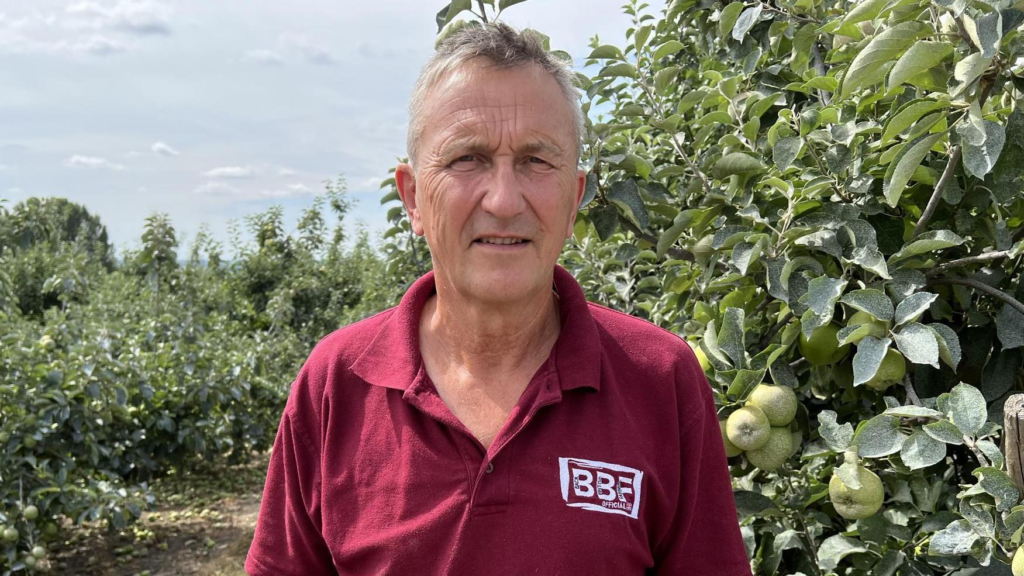
At Amsbury Farm near Maidstone, Kent, Clive Baxter manages roughly 200 acres (81 hectares) of fruit trees. He says the repeated spells of extreme heat this summer have hit nearly every part of his operation. “Everything is suffering now in the heatwaves,” Baxter said.

Bramley apples, a variety long associated with English cooking, are proving especially vulnerable. “Bramley apples are very susceptible to sunburn so we are spraying them with a clay substance that acts like suncream,” Baxter said. He explained that traditional English varieties, including Bramleys and Coxes, were never bred to withstand the kind of sustained heat the region has experienced this year.

The damage becomes severe once temperatures climb past a certain threshold. “Once the temperature gets to 30 degrees and above, if there is no wind, the juice starts to boil in the apples and cooks the fruit,” Baxter said. “When this happens it means the fruit is of no value at all.”

To protect what remains of the crop, Baxter’s team has started thinning the trees, deliberately removing some fruit so the rest has a better chance of surviving. He said the trees themselves are showing signs of strain. “So stressed” is how he described them, adding that the practice, while necessary, means lower yields and smaller apples overall.

Cattle farmers run out of grass

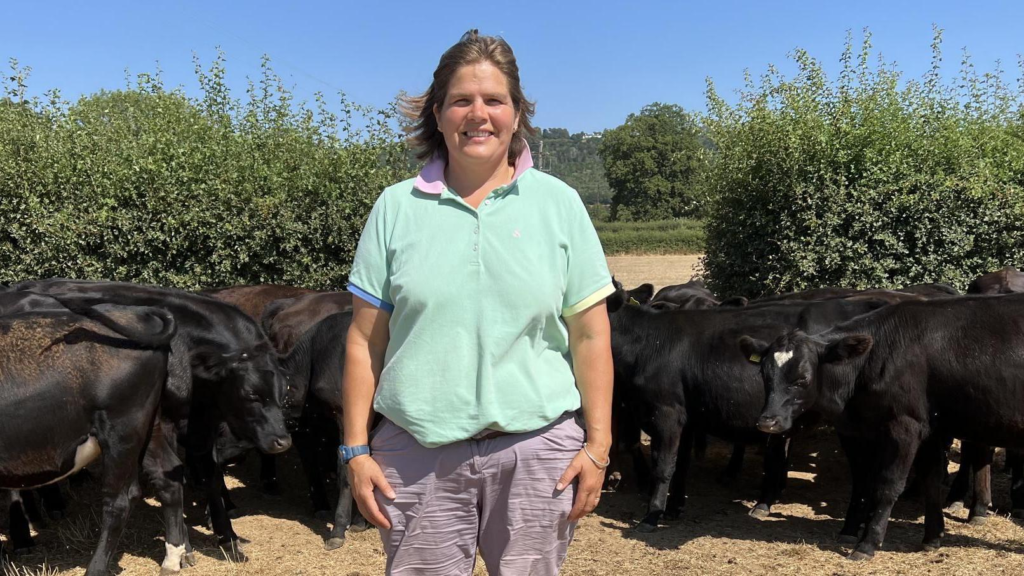
The heat is creating a different kind of pressure eighty miles away in Brockham, Surrey, where Nellie Budd raises 247 cows. For Budd, the central problem this summer has been simple: there is not enough food for the herd to eat.

“We have had 47 days now with no rain,” Budd said. “Grass normally is so resilient, once we cut it for hay or cut it for silage it will come back and we can continue grazing, but, this year, with the heat, there has been no let up.”

With pasture failing to regrow, Budd has started feeding her cattle hay that was meant to carry them through winter, a move that leaves her with a shortfall she will need to make up before the cold months arrive. The shortage is already changing the size of the animals she can bring to market.

“With limited food to eat, the carcasses are just not getting big enough which means they are not going to be the size for what we want because they are beef cattle,” Budd said.

Cutting the size of her herd is not something she is willing to consider, even as costs rise. “We have been putting an overlay in our grasslands to try and help but, this year, with no moisture in the ground, we couldn’t do anything,” she said. Reducing cattle numbers, she added, is not an option, because her family “could not afford to live” if she scaled back.

Budd said she is left hoping conditions change before next year’s growing season begins. “Everything is a gamble for farmers and we just hope weather patterns cause a wetter year next year,” she said.

Grain yields down by a third or more

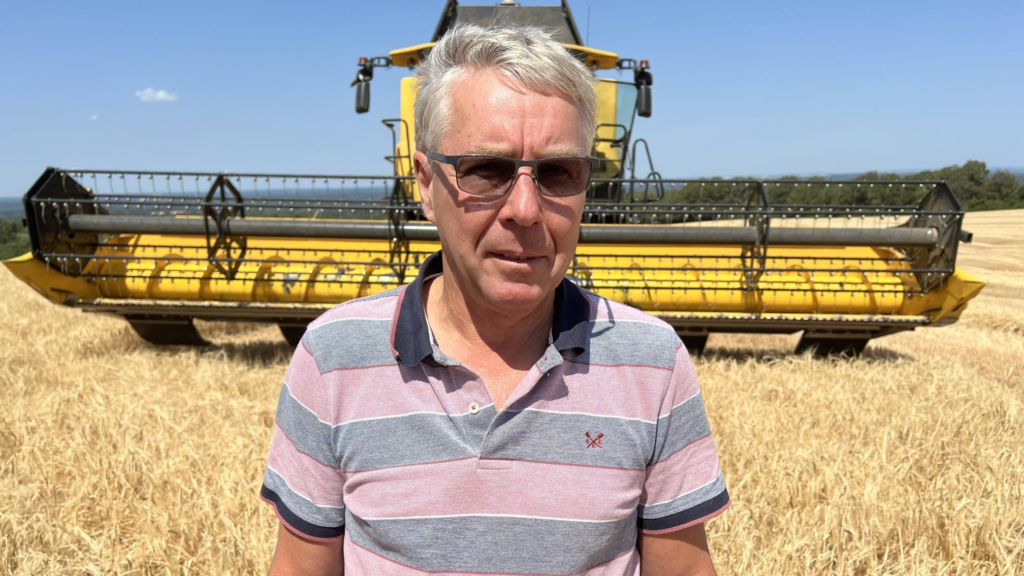
Further west, at Woolgars Farm in West Horsley, arable farmer and contractor Peter Knight is currently harvesting around 2,000 acres (809 hectares), and the numbers coming in are worse than he expected. He traces the trouble back to the first heatwave in May, which struck right as his spring barley, a crop used mainly for brewing beer, needed steady moisture to establish itself.

“Spring barley, which is used for making beer, is planted in March and it has had very little rain on it since then,” Knight said. The timing compounded the damage. “The crops flower in early June but, at that time the heat puts it under stress, which means we immediately know the yield is going to be impacted,” he said.

Knight said the dry spell never really let up through the grain-filling period, the weeks when kernels normally bulk up in size and weight. Without rain during that window, the plants simply could not put on the growth needed for a strong harvest.

He is now watching a pattern repeat itself. “We are very worried because three out of the last five years we have had very similar weather patterns in terms of drought-like conditions and trying to manage our way through that is very difficult,” Knight said.

Unlike some fruit and vegetable operations, arable farms of this scale have few tools to fight back against drought. Knight said irrigating thousands of acres of grain is not realistic given the cost and infrastructure it would require. Instead, he has adjusted his methods where he can. “We are doing our best by trying to sow earlier in the spring and we are doing less cultivations which helps preserve moisture but this year the yield here is reduced by around 30-40% on what we would normally expect,” he said.

Knight said the consequences extend beyond his own farm. If the current weather pattern continues to disrupt arable output across the country, he expects Britain will need to lean more heavily on imported grain to make up the difference.

A season of adjustments across the industry

Baxter’s spraying regimen, Budd’s early dip into winter feed stores, and Knight’s earlier sowing and reduced cultivation all point to the same reality: farmers across different sectors are making real-time changes to how they operate, not waiting for the season to end before responding.

None of the three describe the heat as a one-off. Knight’s reference to three drought-affected years out of the last five suggests a pattern rather than an isolated bad summer, and Budd’s decision to protect her herd size despite the financial strain signals she expects to need that stock again once conditions improve.

For now, the fruit that survives will carry a higher cost of production, the cattle coming to market will run smaller than usual, and the grain harvest at Woolgars Farm will fall well short of a typical year. Whether next year brings the wetter conditions farmers are hoping for remains the open question hanging over the rest of the 2026 growing season.


Life

Vozinha’s world cup heroics earn him a sea slug named in his honour

By George Mensah 4 min read

Cape Verde goalkeeper Vozinha has picked up an unexpected honour after his run at the World Cup, with scientists naming a newly identified sea slug species after him.

The Cape Verde islanders pushed Argentina to extra time before falling 3-2, a result that capped a tournament run few had predicted for the small West African nation. Before that exit, Vozinha kept a clean sheet in a goalless draw against European champions Spain, a result that gave Cape Verde its first-ever point at a World Cup.

That performance changed his profile almost overnight. His Instagram following jumped from 50,000 to 17.4 million, a number that puts him ahead of NFL veteran Tom Brady in social media reach.

A New Species Named In His Honour

Biologist Jesus Ortea, a professor emeritus at the University of Oviedo, found the small red mollusc in the Caribbean and gave it the name Aldisa vozinha, tying it directly to the 40-year-old goalkeeper.

In his published report on the discovery, Ortea wrote that he wanted to mark Vozinha’s role at the tournament. He also pointed out a detail that made the choice feel deliberate rather than arbitrary: the slug’s red colouring mirrors the nickname of Spain’s national team, La Roja, the side against whom Vozinha delivered his best-remembered display.

“The red colour of the dedicated species is a reminder of his feat,” Ortea wrote.

A Scientist With A Football Habit

This isn’t the first time Ortea has mixed marine biology with football. At 75, he has built a pattern of naming new species after players who catch his attention during major tournaments.

He previously named a species discovered in Costa Rica after Keylor Navas, the goalkeeper who played for Costa Rica at several World Cups and spent time at Real Madrid, Paris Saint-Germain and Nottingham Forest.

Ortea also named a separate creature after Quini, the former Sporting Gijon striker, picking a species whose colours matched the club’s kit.

His connection to Cape Verde goes beyond this latest naming. Ortea received the country’s Medal of Merit in 2023 for his research in the waters surrounding the island nation, work that had already put him in contact with Cape Verdean officials before Vozinha’s World Cup run began.

A Breakthrough Run For Cape Verde

Cape Verde’s World Cup campaign stood out as one of the tournament’s more unexpected stories. A nation of roughly 500,000 people reached a stage most had not anticipated, and Vozinha’s saves against Spain became the moment that defined the run for many watching outside the country.

The draw with Spain secured a point that Cape Verde had never managed at a World Cup before that match. Reaching the knockout stage and taking Argentina to extra time added to a run that turned Vozinha into one of the tournament’s more recognisable figures, despite representing one of its smaller footballing nations.

His social media numbers reflect how quickly that recognition spread. Going from 50,000 followers to 17.4 million in the span of a single tournament put him among the most-followed athletes to emerge from this World Cup, regardless of how his side’s run ultimately ended.

Science Meets Sport

Ortea’s naming choices follow a consistent logic. Rather than picking names at random, he has tied each species to a detail about the player or club being honoured, whether through colour, geography, or timing. The Vozinha naming continues that approach, linking a mollusc found in the Caribbean to a goalkeeper who plays his football thousands of miles away in Africa and Europe.

Species names given in honour of public figures are not unusual in taxonomy, but Ortea’s specific focus on footballers gives his research a public profile that pure marine biology often doesn’t attract. Each naming tends to draw attention back to his broader work cataloguing new mollusc species, work that includes his research around Cape Verde’s coastline.

For Cape Verde, the timing adds another layer of recognition to a tournament that already delivered milestones the country had not reached before. Vozinha’s clean sheet against Spain and the near-miss against Argentina will likely remain the sporting highlights of the run, but the naming of Aldisa vozinha gives the goalkeeper a mark tied to the tournament that will outlast this particular World Cup cycle.

Ortea’s report on the discovery did not indicate whether he plans to name further species after players from this tournament, though his history suggests Vozinha may not be the last footballer to receive this kind of tribute.

ADVERTISEMENT
Scroll to Top