
A 30-year-old man from Bellingham, Washington, has been arrested over the February 10 school shooting in Tumbler Ridge, British Columbia. Federal prosecutors charged James Cody Bryant on Tuesday with conspiracy to murder persons in a foreign country. They allege he gave tactical advice, money and technical help to 18-year-old shooter Jesse Van Rootselaar, then agreed to help her broadcast the attack online.
The charge is an allegation, and Bryant has not been convicted of anything. It carries a potential sentence of up to life in prison. The attack killed eight people and wounded 25 others, and the shooter also died.
What Prosecutors Allege

According to the criminal complaint, Bryant and Van Rootselaar began conspiring on Discord in August 2025, about six months before the shooting. Authorities say the conversations moved from casual chat to discussions about killing multiple people in Canada.
The complaint alleges Bryant helped test equipment for a planned livestream and agreed to record and broadcast the attack. It says he gave tactical advice, sent money for items connected to the plot, and told her how to hide the plan, including by deleting messages and using virtual private networks. Prosecutors also allege he advised her on how to increase the number of casualties and recommended firearms. They say he sent money for an item she intended to use in building an explosive device.
Prosecutors allege Bryant confirmed he was receiving the livestream shortly before the shooting began.
How the Two Allegedly Connected

Federal law enforcement says the pair met three years ago on the chat site Omegle. They lost touch twice while Van Rootselaar was admitted to a mental health facility. In the six months before the shooting, they spoke daily on Discord. Among other topics, they discussed sending 3D-printed weapons across the US-Canada border.
A Mixed Picture in the Messages
The complaint describes a relationship that was not one-sided. The text messages appear to show that Bryant first suggested a shopping center as a target instead of a school. Authorities also allege he sometimes tried to talk Van Rootselaar out of carrying out the attack.
He did not contact police, prosecutors say. They allege he agreed to help with the livestream and said he would not “snitch.”
The Day of the Shooting

Van Rootselaar’s attack began at a home, where her mother and her 11-year-old stepbrother were killed. Police have identified the other victims at the residence as 39-year-old Jennifer Jacobs and her 11-year-old son, Emmett Jacobs.
She then drove to Tumbler Ridge Secondary School. There she shot and killed five children aged 12 or 13 and a 39-year-old educational assistant, Shannda Aviugana-Durand. The students were Abel Mwansa, Ezekiel Schofield, Kylie Smith, Zoey Benoit and Ticaria Lampert.
Police say Van Rootselaar used an improvised explosive device at the school, fired through locked classroom doors and exchanged gunfire with officers. She died from a self-inflicted gunshot wound. Counting the shooter, nine people died.
According to the complaint, after the killings at the home, Van Rootselaar could not start a family vehicle. Bryant allegedly advised her on getting it running so she could continue to the school. Prosecutors cite that exchange as evidence that his involvement went well beyond knowing an attack was being contemplated.
An Investigation on Both Sides of the Border
The Royal Canadian Mounted Police (RCMP) have investigated for months. Officers have examined physical evidence, electronic devices and online accounts. By July, they said they had reviewed more than 100 statements from students, educators and first responders and were working with the FBI on digital forensic analysis. They also said at that point that further charges had not been ruled out.
Court documents released earlier gave a partial picture of the shooter. An RCMP investigator described Van Rootselaar as having “mental health problems” and being “fascinated by firearms.” Investigators traced her online activity and seized electronic devices, trying to learn how the attack was planned and whether anyone else knew about it.
Tuesday’s case alleges that Bryant was one of those people.
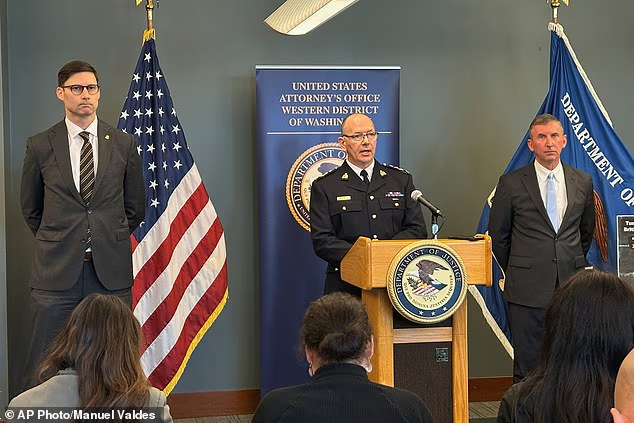
The FBI worked with Homeland Security Investigations and the RCMP. American prosecutors brought the conspiracy charge because the alleged planning took place partly in Washington state, while the intended killings were in Canada.
Mike Herrington, Special Agent in Charge of FBI Seattle, said no investigation can bring back the eight people killed. He said US and Canadian officials are committed to bringing justice and holding those responsible accountable. He also thanked the RCMP for its help throughout the investigation that led to Tuesday’s charges.
A Town Still Recovering
Tumbler Ridge has not returned to normal. The original secondary school has not reopened for regular operation, and the community continues to need mental-health and victim-support services.
The shooting has also produced separate legal fights over what authorities and technology companies knew beforehand. One involves OpenAI and allegations about Van Rootselaar’s use of ChatGPT. The company has said it did not alert authorities at the time because the chats did not meet its threshold for a credible or imminent plan to seriously harm others.
OpenAI CEO Sam Altman has since apologized to the victims’ families. “I am deeply sorry that we did not alert law enforcement,” Altman wrote in an open letter in April.
What Happens Next
The arrest answers one question and opens another. Investigators wanted to know whether anyone besides the shooter knew about the plan. The complaint says Bryant did, and that he took part in it.
The court now has to decide whether the alleged online relationship between Bryant and Van Rootselaar amounts to a criminal conspiracy. Prosecutors say the messages, money transfers and livestream preparations show an agreement to carry out the attack. Bryant’s defense has not been made public in the information available. The RCMP said earlier this year that more charges remained possible, and Tuesday’s arrest shows the investigation is still producing results eight months after the shooting.
For the families in Tumbler Ridge, the charge is the first time a second person has been accused in connection with the attack.