
Clicxpost

US News

Air Ambulance With Six Aboard Missing Off Nantucket

air ambulance missing

The US Coast Guard is searching the Atlantic south of Nantucket, Massachusetts, for an air ambulance jet carrying six people that lost contact with air traffic control early Saturday, October 3. The Gulfstream G100 was flying from Bermuda to Boston after a medical evacuation mission. As of mid-morning, no debris or survivors had been publicly reported, and officials had not named the people on board.

The Federal Aviation Administration lost contact with the aircraft early Saturday and issued a Search and Rescue alert at about 1:20 a.m., according to FAA spokesperson Rick Breitenfeldt. The Coast Guard’s Northeast District announced the search on X at about 6:15 a.m. and said air and surface crews had launched.

What officials have confirmed

The aircraft is a Gulfstream G100 with Canadian registration C-GRJP. Latitude Air Ambulance, a company based in Hamilton, Ontario, operates it. The jet left L.F. Wade International Airport in Bermuda at 11:41 p.m. ET on Friday, according to flight-tracking data. It was due to land at Boston Logan International Airport at about 1:25 a.m. Saturday.

The Boston Globe reported that four crew members and two passengers were on board. Latitude says its air ambulance flights typically carry two pilots, a nurse and a respiratory therapist, and sometimes a physician. Officials have not said whether a patient was on the flight, and nobody has released the identities of those aboard. The Coast Guard said it is working with the FAA and the agency’s Rescue Coordination Center.

The Coast Guard said the search area lies off the coast of Nantucket. The Nantucket Current reported that the search began about 13 nautical miles south of the island.

What the flight data shows

Public flight-tracking records list the aircraft under the call sign HTT104, according to the New Bedford Guide. The same records show the jet flew from Bermuda to Boston in June 2025, so the route is one this aircraft has flown before.

Here is the timeline as reported so far. The jet left Bermuda at 11:41 p.m. ET Friday. The altitude drop came shortly after 1 a.m. The FAA issued its alert at about 1:20 a.m. The scheduled landing was about 1:25 a.m. The Coast Guard posted about the search at about 6:15 a.m., and the search was still under way at 10 a.m., Boston.com reported.

FlightAware data showed the plane dropping from roughly 25,000 feet to about 11,000 feet shortly after 1 a.m., according to the Daily Mail’s reporting. CBS News reported that the aircraft lost contact after about one hour and 45 minutes in the air. The Daily Mail said the final ping came at around 1:30 a.m., shortly before the scheduled landing.

The exact times differ between reports, and neither the FAA nor the Coast Guard has described what happened to the plane. Investigators have not given a cause, and nothing in the public record yet explains the drop in altitude.

NBC News obtained air traffic control audio from Boston that appears to show controllers asking the aircraft whether it was “coming in blind.” Authorities have not commented on it.

Who is searching

Several Coast Guard units are on scene. The service said crews from Air Station Cape Cod, Station Brant Point on Nantucket and the cutter William Sparling are responding. Boston 25 News reported that the air assets include an HC-144 Ocean Sentry fixed-wing aircraft and an MH-60 Jayhawk helicopter from Air Station Cape Cod. Master Chief John Lowell told the Nantucket Current that the Brant Point station’s 47-foot motor lifeboat was already in the search area.

The Coast Guard said it will post updates as information becomes available. The FAA is coordinating with the Coast Guard to locate the aircraft.

At Boston Logan, Massachusetts Port Authority Fire Rescue began staging to meet the plane, which did not arrive, Massport spokesperson Jennifer Mehigan told the Globe. Massport confirmed the jet did not land as scheduled.

What Latitude Air Ambulance has said

Clarence Togeretz, Latitude’s director of flight operations, told NBC News that the crew was carrying out a medical evacuation in Bermuda. He said Latitude has an emergency response plan “absolutely for anything that might occur to any of our missions.”

Togeretz acknowledged the company’s concern. He said Latitude gets worried when a crew “doesn’t report to us in a timely manner.” He also said he was staying hopeful. In his words, the delay “doesn’t mean that the worst has happened.”

The company had not issued a fuller statement when these reports were published. The Daily Mail said it had contacted both Latitude and the Coast Guard for comment.

About the company and the aircraft

Latitude launched in 2009 and flies patients to hospitals and back to their home countries. The Daily Mail reported that the Canadian company has a fleet of 10 aircraft, including four Gulfstream G100s. A listing with the European air ambulance accreditation body EURAMI describes a smaller fleet of five aircraft, three of them G100-type jets, so published counts vary by source.

The G100 is a twin-engine business jet originally developed in Israel, and the Daily Wire reported that some are equipped as intensive care transport aircraft. Bermuda is a British overseas territory in the North Atlantic, about 650 miles from North Carolina. The flight path to Boston runs northwest across open ocean and ends near the Massachusetts coast, where the search is concentrated.

What happens next

The Coast Guard has not given an end time for the search. Crews will keep working the area south of Nantucket, and the service has said more information will follow. The reporting available so far does not identify any of the six people on board or their families.

Several questions remain open: who was aboard, whether a patient was on the flight, what caused the loss of contact, and where the aircraft is. No agency has announced an investigation in the coverage available so far.

This is a developing story. The Coast Guard and the FAA are the main sources for confirmed updates.

RECOMMENDED
US News

US-Iran Negotiations: Latest Talks, Key Issues and Diplomatic Developments

By George Mensah 5 min read

US-Iran negotiations have moved through more than a year and a half of talks, collapsed ceasefires, and renewed fighting, and as of late September 2026 the two sides are once again engaged in indirect diplomacy in New York, centered on a narrower, faster proposal to reopen the Strait of Hormuz. For the broader backdrop, see our coverage of Iran-US relations.

US-Iran Negotiations: How the Talks Began

The current round of US-Iran diplomacy traces back to April 12, 2025, when Iran and the United States began a series of talks aimed at a nuclear agreement, following a letter from President Donald Trump to Iranian Supreme Leader Ali Khamenei, with Trump setting a 60-day deadline for a deal. The first high-level meeting was held in Oman, led by US special envoy Steve Witkoff and Iranian Foreign Minister Abbas Araghchi, with both sides initially describing the discussions as constructive.

Several more rounds followed in Rome and Muscat, with expert-level talks eventually joining the high-level discussions. Central sticking points emerged early and would recur throughout the process: whether Iran could retain any domestic uranium enrichment capability, what would happen to its enriched uranium stockpile, and what sanctions relief Iran would receive in exchange.

US-Iran Negotiations: The Collapse Into War

When the 60-day deadline passed without an agreement, Israel launched large-scale strikes against Iran in June 2025, targeting military leadership and nuclear scientists, which prompted Iran to suspend the nuclear talks indefinitely and led the United States to carry out its own strikes on Iranian nuclear sites at Fordow, Natanz, and Isfahan. A ceasefire followed, but diplomacy stayed largely frozen for months.

Talks resumed in early 2026 after large-scale protests inside Iran, even as the US military buildup in the Middle East continued. That opening proved short-lived: on February 28, 2026, the United States and Israel launched a new round of large-scale strikes on Iran, marking the start of what is now referred to as the 2026 Iran war, an escalation that included the assassination of Khamenei and of Ali Larijani, a senior figure who had been involved in the negotiations.

US-Iran Negotiations: The June 2026 Memorandum and Its Breakdown

By late May 2026, reports indicated the US and Iran were nearing a broader agreement, with Trump suggesting the Strait of Hormuz could soon reopen under a ceasefire framework. On June 17, 2026, Trump and Iranian President Masoud Pezeshkian signed what became known as the Islamabad Memorandum, setting out a 60-day ceasefire period during which further talks were meant to resolve the final status of Iran’s nuclear program.

The arrangement didn’t hold. Technical talks scheduled in Switzerland were postponed within days, and by late June both sides had traded accusations of ceasefire violations, with the US striking Iranian missile, drone, and radar infrastructure and Iran firing missiles and drones at US positions in Kuwait and Bahrain in response.

US-Iran Negotiations: Where Talks Stand Now

The US-Iran negotiations drawing attention in late September 2026 center on a narrower, Qatari-mediated proposal rather than a comprehensive settlement. Iran presented the US with a road map calling for a regionwide ceasefire of up to 60 days, a phased reopening of the Strait of Hormuz, and an end to the US naval blockade of Iranian ports.

Iran has reportedly softened its position on both the strait and its nuclear program in exchange for an easing of the US blockade and the release of frozen funds, with discussions continuing quietly in New York as a prelude to more formal negotiations. The emerging proposal would first reopen the strait and lift the US blockade, with sanctions relief to follow — similar in structure to the June memorandum, but with Iran pushing for a much faster timeline this time.

The path forward remains unsettled. Trump reportedly told journalists he had rejected Tehran’s latest proposal to reopen the strait within a week, even as Iran’s foreign minister stayed in New York awaiting word from Qatari mediators. By September 30, Iran had received a formal US response to its seven-day trust-building proposal, though the contents weren’t disclosed publicly and a dispute reportedly remained over sequencing. Trump has framed his own choice bluntly, saying the US will either “blow them up or make a deal.”

US-Iran Negotiations: Core Issues Still Dividing Both Sides

  • Uranium enrichment — the US wants it dismantled entirely; Iran has offered limits, dilution, or pauses, but not a permanent end.
  • The Strait of Hormuz — reopening it, and in what order relative to other steps, has become a central sticking point.
  • Sanctions and frozen assets — Iran wants funds released and sanctions lifted; the US ties this to nuclear compliance.
  • Regional conflicts — disputes over Lebanon and Hezbollah complicate the broader picture, with Israel saying it isn’t bound by earlier provisions there.
  • Trust — both sides have accused the other of bad faith, and that’s arguably the hardest issue to resolve.

US-Iran Negotiations: What Comes Next

Araghchi has said the negotiations have become more “serious,” while cautioning that Tehran’s core position hasn’t changed, and other reporting suggests a full deal remains unlikely before the US midterm elections. With both sides signaling openness to a deal while also preparing for renewed conflict, the US-Iran negotiations remain a genuinely fluid situation heading into October 2026 — worth checking current reporting from sources like the United Nations or the U.S. Department of State for the latest, since it’s shifted direction multiple times already this year.

Frequently Asked Questions About US-Iran Negotiations

When did the current US-Iran negotiations begin?

The current round traces back to April 12, 2025, following a letter from President Trump to Iran’s Supreme Leader and a 60-day deadline for a nuclear deal.

Why did the talks collapse into war?

When the original 60-day deadline passed without an agreement, Israel struck Iran in June 2025, and a second, larger round of US-Israeli strikes on February 28, 2026 escalated into what’s now called the 2026 Iran war.

What was the June 2026 memorandum?

Signed by Trump and Iranian President Masoud Pezeshkian on June 17, 2026, the Islamabad Memorandum set out a 60-day ceasefire meant to resolve Iran’s nuclear program, but it broke down within weeks.

What is the current state of US-Iran negotiations?

As of late September 2026, both sides are engaged in Qatari-mediated indirect talks in New York over a narrower proposal to reopen the Strait of Hormuz and lift the US naval blockade.

What are the biggest obstacles to a deal?

Uranium enrichment limits, the sequencing of a Strait of Hormuz reopening, sanctions relief, regional conflicts involving Lebanon, and a basic lack of trust between both sides.

US News

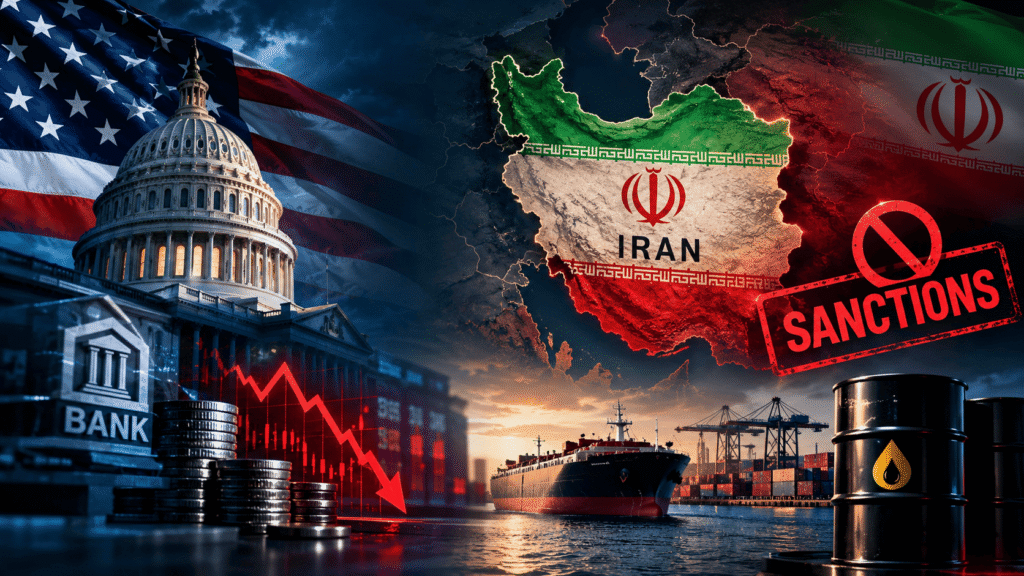
Iran Sanctions: US Sanctions on Iran, Their Impact and Latest Developments

By George Mensah 7 min read

Iran sanctions are legal and financial restrictions that governments and international bodies place on trade, banking, energy and individuals connected to Iran. US sanctions on Iran are the most extensive, and they have shaped almost every phase of Iran-US relations since 1979. This guide explains who imposes them, why, how they evolved, and what has changed most recently. It is current as of September 30, 2026.

What Are Iran Sanctions?

Sanctions are coercive tools short of military force. They restrict economic activity in order to change a government’s behaviour or limit its capabilities. Typical measures include asset freezes, trade bans, restrictions on banks and blacklisting of specific people and companies.

Several actors impose sanctions on Iran:

  • The United States is the largest source. Its measures come through executive orders and laws, and are enforced mainly by the Treasury’s Office of Foreign Assets Control (OFAC) and the State Department.
  • The European Union and United Kingdom maintain their own restrictions.
  • The United Nations has imposed nuclear-related sanctions through Security Council resolutions.

The distinction matters. UN sanctions are binding on all member states. US sanctions are national law, but they carry global reach through “secondary sanctions,” which threaten non-US companies and banks that deal with sanctioned Iranian parties. So the answer to “are all Iran sanctions imposed by the United States?” is no, although the US layer is the broadest.

Why Does the US Impose Sanctions on Iran?

The reasons below are the US government’s stated positions, not independent findings. Washington has cited several themes over time:

  • Nuclear activities: concern that Iran’s programme could produce weapons. Iran says its programme is peaceful.
  • Regional security: Iran’s military role in the Middle East.
  • Missile and drone programmes: ballistic missile development and weapons procurement.
  • Support for armed groups: the US designates several groups Iran backs as terrorist organisations.
  • Human rights: repression of protesters and other rights abuses.

Analysts disagree about whether sanctions achieve these goals. Supporters see leverage that limits Iran’s resources. Critics point to humanitarian costs and to Iran’s record of withstanding decades of pressure. Both views are analysis, not settled fact.

History of US Sanctions on Iran

  • 1979–1980s: After the Islamic Revolution and the embassy hostage crisis, the US froze Iranian assets. Iran was later designated a state sponsor of terrorism (1984), and further trade limits followed.
  • 1990s: The US broadened restrictions into a near-total trade and investment embargo (1995) and penalised foreign investment in Iran’s energy sector (1996).
  • 2006–2012: Iran’s nuclear programme led to UN Security Council sanctions. The US and EU added tougher oil, banking and shipping measures, including cutting Iranian banks off from the SWIFT messaging network.
  • 2015: The JCPOA nuclear agreement traded limits on Iran’s nuclear programme for sanctions relief.
  • 2018: The US withdrew from the JCPOA and reimposed its sanctions, followed by a “maximum pressure” campaign.
  • 2025: France, Germany and the UK triggered the JCPOA’s “snapback” clause. Snapback reimposed previously lifted UN sanctions on September 27, 2025.
  • 2026: Sanctions escalated during the US-Israel war with Iran, covered below.

For the wider diplomatic background, see our Iran-US relations history explainer.

Major Types of Iran Sanctions

  • Economic and trade restrictions: bans on most US trade with Iran and limits on exports of sensitive goods.
  • Financial and banking restrictions: Iran financial sanctions block designated banks from the US financial system and warn foreign banks against dealing with them.
  • Oil and energy sanctions: measures against buyers, sellers and intermediaries of Iranian crude and petrochemicals.
  • Shipping restrictions: designations of vessels and shipping networks used to move sanctioned cargo.
  • Individual and entity designations: asset freezes and transaction bans on named people and companies on the SDN List.

Iran Oil Sanctions

Oil is central to Iran’s economy and government income, which is why Iran oil sanctions have been a US priority. Restrictions on buyers, refiners, tankers and payment channels aim to reduce export earnings. The effects reach beyond Iran, since they can influence energy markets and the routes and intermediaries used in international trade.

China is widely reported to be Iran’s largest oil buyer. CNBC describes China as Iran’s top trading partner and oil buyer. Current production and export volumes are difficult to verify and contested, so this article does not cite figures. For live shipping developments, see our Strait of Hormuz updates.

Impact of Iran Sanctions on the Iranian Economy

Documented effects include restricted access to international banking, higher costs for imports, reduced foreign investment and pressure on energy revenue. Iranian residents have described the effects in interviews. A Tehran realtor told AFP that sanctions affect people’s lives and that price controls are needed.

Currency weakness is one visible indicator. According to the AP, Iran’s rial fell to a record low of about 2.02 million per US dollar on August 24, 2026. Attributing that solely to sanctions would be a mistake. Inflation, domestic policy, and the ongoing war also affect the currency. Sanctions are one factor among several, and economists differ on how much weight each deserves.

Iran Sanctions and Iran-US Relations

Sanctions are both a source of tension and a bargaining chip. Sanctions relief was the core exchange in the JCPOA, and relief remains central to any new negotiation. Reports about potential relief are sensitive: President Trump has said he has offered “nothing” and rejected an Axios report that he would grant some sanctions relief and access to frozen funds. For the negotiating track, see Iran-US nuclear talks and Iran nuclear inspections.

Latest Iran Sanctions Developments (as of September 30, 2026)

The current phase is the US Treasury’s “Operation Economic Outcast.” Key verified developments:

  • August 24, 2026: Treasury Secretary Scott Bessent announced Operation Economic Outcast, which Treasury says targets remaining sources of revenue for Iran. OFAC also issued determinations covering five more Iranian economic sectors, designated nearly 60 individuals, entities and vessels, and suspended five general licenses. The new categories of potential secondary-sanctions exposure cover digital assets, technology, gold, aviation and shipping, according to Wikipedia’s summary of the announcement.
  • September 4: OFAC designated Türkiye-based Golden Global Bank and two subsidiaries.
  • September 8: OFAC designated 36 targets in Iran’s aviation sector. On the same date, OFAC suspended several Iran-related general licenses indefinitely.
  • September 10: OFAC said specific-licence applications involving Iran would be treated with a presumption of denial, with limited exceptions.
  • September 14: The US sanctioned Russia’s VTB Bank over alleged help to Iran in evading sanctions, according to a State Department statement.
  • September 29: OFAC sanctioned 10 individuals and entities accused of procuring weapons and components for Iran’s Ministry of Defense and Armed Forces Logistics.

The wider context is a war that began on February 28, 2026. President Trump declared a ceasefire over in early July, and peace talks have been on hold since, according to CBS News. Iran has proposed a seven-day ceasefire and a phased reopening of the Strait of Hormuz. Follow Iran-US ceasefire updates for changes. Note that Iranian and US accounts of these events often conflict.

Iran’s Response to US Sanctions

Iranian officials have generally dismissed the measures. Iranian parliament speaker Mohammad Bagher Qalibaf downplayed the expected measures ahead of the August announcement, and security chief Mohsen Rezaei threatened a “seismic” response, according to NPR. Rezaei also described the airline sanctions as an “air blockade” and a sign of desperation. Tehran also disputes the legality of nuclear-related sanctions. At the UN, an Iranian representative called the snapback effort baseless and said the nuclear programme remains peaceful.

International Response

Positions are divided:

  • E3 and EU: France, Germany and the UK triggered snapback, citing Iran’s “significant non-performance” of JCPOA commitments. The EU Council then reimposed the measures that had been lifted after the JCPOA.
  • China and Russia: They pushed a failed Security Council effort to extend sanctions relief by six months.
  • China’s exposure: Al Jazeera reports that larger Chinese banks have not been targeted so far, though VTB has a licensed branch in mainland China.

Iran Sanctions Timeline

  • 1979: US freezes Iranian assets
  • 1995–1996: Broad embargo and energy-investment penalties
  • 2006–2010: UN nuclear sanctions begin
  • 2015: JCPOA agreed
  • 2018: US withdraws; sanctions return
  • September 27–28, 2025: UN snapback takes effect
  • February 28, 2026: War begins
  • August 24, 2026: Operation Economic Outcast launched
  • September 14, 2026: VTB Bank designated
  • September 29, 2026: Latest verified designations

Frequently Asked Questions

What are Iran sanctions?

Legal and financial restrictions on trade, banking, energy and individuals linked to Iran, imposed by the US, UN, EU and others.

Why does the US sanction Iran?

Washington cites nuclear activity, missiles, support for armed groups, regional security and human rights. Iran disputes these characterisations.

When did US sanctions on Iran begin?

Major measures began after the 1979 revolution and hostage crisis, and have expanded since.

What do Iran oil sanctions affect?

Oil exports, government revenue, shipping and payments, and the trading networks connecting Iran with buyers.

How do sanctions affect Iran’s economy?

They restrict banking, trade and investment. Inflation, currency weakness and the war also play a role, so effects are hard to isolate.

Are all Iran sanctions imposed by the United States?

No. The UN, EU and UK also maintain measures.

How do sanctions affect Iran-US relations?

They function as pressure and as a bargaining issue in negotiations.

ADVERTISEMENT
Scroll to Top