

AI & Tech Business news moves fast enough that opening your phone on any given day, there’s a decent chance the top headline mentions AI. This guide is an attempt to keep up with the pace of AI & Tech Business without making you read a hundred press releases yourself.
What Is AI & Tech Business?
Strip away the jargon and it’s a simple idea: AI & Tech Business is the intersection of AI technology with the companies, markets, and money built around it. Research labs build smarter models on one side. Investors, regulators, startups, and giant corporations fight over how to turn that research into things people will actually pay for on the other.
The category stretches from a three-person startup with one niche tool all the way to companies pouring hundreds of billions of dollars into data centers. It also covers the chipmakers who supply everyone, the governments trying to write rules for something that changes every few months, and the security teams trying to keep it all from falling apart.
Why AI Is Transforming AI & Tech Business Industries
This isn’t like the smartphone wave from a decade ago. It’s faster, and it touches more of a business at once. Hospitals read scans quicker. Banks catch fraud before it happens. Factories predict a machine failure days before it occurs.
The difference is scale. Train one model and you can copy it into thousands of hospitals, call centers, or warehouses almost overnight. Older technology took years to spread from one company to the next. This doesn’t — and that speed is exactly why AI & Tech Business now moves at a different pace than any tech cycle before it.
Why Staying Current With AI & Tech Business News Actually Matters
If you run a business, invest money, or just work in an office, falling behind on AI & Tech Business news isn’t a small inconvenience. It can mean missing a shift your competitors caught six months earlier. Companies that shrugged off generative AI in 2023 spent 2024 and 2025 trying to catch up, and some never did.
It also helps you tell real trends from hype. Not every flashy announcement changes anything. Some quietly do. Knowing which is which is worth real money, whether you’re deciding where to invest, what to buy, or what to learn next.
Latest AI & Tech Business News
Barely a week passes without a major model release, a chip announcement, or a policy fight somewhere in AI & Tech Business. Here’s what’s actually moving things.
Breaking AI Industry Updates
OpenAI rolled out GPT-6 Astra to business users through its Daybreak program. It’s a step toward a more general-purpose system: stronger at coding, research, and computer use, and able to build documents, spreadsheets, and presentations from templates as instructions shift mid-task. Access is still limited to select organizations, with a wider rollout expected gradually.
OpenAI also committed $1 billion toward subsidized access to its cybersecurity-focused Daybreak models for defenders protecting critical infrastructure. It’s a sign of how AI & Tech Business players now see themselves less as product vendors and more as participants in national security.
Major Technology Announcements
Hardware isn’t slowing down either. Nvidia is pushing into AI-focused PC chips, aiming at territory Intel has held for decades. SK Hynix and Samsung are racing each other on next-generation HBM4 memory, which matters because training massive models depends on it.
On the corporate side, hyperscalers keep announcing bigger infrastructure spending every quarter, each one topping the last, trying not to run short of computing capacity — one of the clearest signals of how much money is riding on AI & Tech Business right now.
Emerging AI & Tech Business Trends
A few patterns keep repeating. Companies are moving from experimenting with AI to actually running it in daily operations — a real shift from the “let’s try a chatbot” phase of a couple years back. Sovereign AI is picking up steam, with governments and regulated industries wanting more say over where their data and models physically sit. And the gap between AI leaders and everyone else keeps widening, which is reason enough to actually pay attention to this corner of AI & Tech Business rather than treat it as background noise.
Artificial Intelligence Industry Overview
Before getting into specific players, it’s worth zooming out on AI as an industry within AI & Tech Business.
What Is Artificial Intelligence?
At its core, AI means computer systems built to do things that normally need human intelligence — understanding language, recognizing images, making predictions, solving problems. Modern generative AI, the kind behind tools like ChatGPT, learns patterns from huge amounts of data instead of following hand-coded rules.
It’s a bit like teaching a child with thousands of examples instead of a rulebook. Over time the system gets good at predicting what comes next, whether that’s the next word in a sentence, the next pixel in an image, or the next move in a business decision.
Growth of AI Across Industries
AI adoption moved past the tech sector a while ago. Healthcare providers use it for diagnostic support and admin work. Retailers use it for demand forecasting and recommendations. Manufacturers use it for quality control on the line. Even law firms and accountants are picking up AI copilots to draft documents and review contracts faster.
What’s striking is how fast this spread. A few years ago, AI in most industries meant a small pilot tucked away in an innovation lab. Now it’s often just built into the software people already use — a sign of how mainstream AI & Tech Business has become.
AI & Tech Business Market Trends and Forecasts
The numbers are hard to process. The global AI semiconductor market alone is projected to top $1.3 trillion — and that’s just the chips, before counting software and services. Enterprise agentic AI has gone from a niche experiment to a market expected to near $11 billion this year.
Combined AI infrastructure spending from the biggest tech companies is set to top $700 billion this year, with some projections putting next year above $1 trillion. Whatever you think about whether that’s sustainable, it’s one of the bigger stories in AI & Tech Business right now.
OpenAI and Generative AI Developments
No conversation about AI & Tech Business skips OpenAI for long — it’s the company that arguably kicked off the current boom with ChatGPT.
OpenAI Latest News
OpenAI has been busy. GPT-6 Astra is being framed internally as a real milestone toward artificial general intelligence rather than another incremental update. The company also expanded ChatGPT into healthcare, giving eligible clinicians read-only tools for searching biomedical research, clinical trials, and medication data.
Beyond products, OpenAI is turning into something closer to infrastructure. Reports put its valuation near $850 billion, driven by consumer reach, massive data-center commitments, and a growing list of government and defense partnerships.
ChatGPT and Enterprise AI
ChatGPT has quietly turned into a full workplace assistant. Business users can generate documents, spreadsheets, and slide decks that follow existing templates and adjust as instructions change mid-task — a real jump from answering questions to finishing multi-step work.
Enterprise adoption follows a predictable pattern: start with drafting emails or summarizing meetings, then hand over more complex tasks once trust builds. The companies getting the most out of it tend to invest in training and clear guidelines, not just flip the switch and hope.
Sam Altman Updates
Sam Altman remains one of the most visible people in tech, weighing in regularly on AI safety and youth protections online. OpenAI backed California legislation aimed at safeguarding how young people use AI, a position Altman had already signaled support for.
That kind of public stance carries weight. When the company leading the AI race takes a position on regulation, it tends to shape how other companies and lawmakers approach the same questions.
AI Competition Among Tech Giants
OpenAI isn’t racing alone. Google, Meta, Anthropic, and a long list of well-funded startups are all chasing the next breakthrough model. The competition has been good for the pace of innovation, even if it makes the news cycle exhausting some weeks.
The fight isn’t only about who builds the smartest model anymore. It’s increasingly about who controls the infrastructure, the distribution, and the enterprise relationships needed to get that intelligence into people’s hands at scale.
Agentic AI and Autonomous Systems
If generative AI was the story of the last few years, agentic AI is the story of this one in AI & Tech Business.
What Is Agentic AI?
Agentic AI systems don’t just respond to a single prompt — they plan, decide, and carry out multi-step tasks with limited human supervision. Instead of asking a chatbot a question and getting an answer, you hand an agent a goal, and it works out the steps, often across multiple tools and apps.
A rough way to picture it: generative AI is a knowledgeable assistant who answers what you ask. Agentic AI is that same assistant handed a whole project and trusted to run it start to finish.
AI Agents and Automation
Gartner expects 40% of enterprise applications to embed task-specific AI agents by the end of this year, up from under 5% just a couple of years ago. That’s not a gradual climb — it’s a real inflection point in how software gets built.
The real-world examples are piling up. One healthcare system deployed an agentic clinical assistant that hit an 80% adoption rate among test providers and cut documentation time by 42%, freeing up more than an hour per clinician a day. Another enterprise reportedly cut reporting time from 15 days down to 35 minutes using an AI agent platform.
Enterprise Applications of Agentic AI
Businesses have the most success keeping agents narrow and supervised rather than giving them free rein. Common uses: customer service resolution, document processing, inventory management, clinical documentation — repetitive, high-volume, well-defined tasks an agent can actually handle.
Here’s where agentic AI is gaining the most traction across AI & Tech Business:
| Industry | Common agentic AI use case | Reported impact |
| Healthcare | Clinical documentation assistants | Up to 42% less documentation time |
| Enterprise reporting | Automated report generation | Reporting time cut from days to minutes |
| Customer service | Autonomous ticket resolution | Faster response times, lower costs |
| Retail & logistics | Inventory redistribution | Fewer manual errors, better stock levels |
Adoption still isn’t even. Roughly 79% of enterprises say they’ve adopted AI agents in some form, but only about 11% run them in full production. There’s still a real gap between experimenting with agentic AI and trusting it with anything mission-critical.
Future of AI Agents
Expect agents to get better at working together instead of operating solo. Multi-agent orchestration, where several specialized agents split up a task, is becoming one of the hottest areas in the field. Guardian agents — whose only job is watching other agents for mistakes or risky behavior — are also getting attention as companies try to scale automation without losing control of it.
AI Regulation and Government Policies
Governments are scrambling to keep up with AI & Tech Business, and the regulatory picture is genuinely a mess right now.
Global AI Regulations
The EU’s AI Act is still the most comprehensive framework anywhere, sorting systems by risk level and attaching different obligations depending on how risky the use case is. High-risk systems face the strictest requirements — documentation, human oversight, data quality standards — though some deadlines have already been pushed back through amendments.
Other regions are going their own way. The UK leans toward a lighter, pro-innovation approach. China keeps developing its own domestic rules, focused heavily on content control and data security.
US AI Policy Updates
The US still doesn’t have one comprehensive federal AI law, and that gap has become a defining feature of American tech policy. A December 2025 executive order pushed for a more unified national policy, directing federal agencies to challenge state AI laws seen as overly restrictive or out of step with federal priorities.
That’s created real friction between Washington and individual states. California, Colorado, and New York have each pursued their own AI safety frameworks, while the federal government has pushed back through litigation and funding pressure. Congress has floated broader preemption of state AI laws, but those efforts keep stalling, leaving businesses to deal with a fragmented compliance picture.
AI Ethics and Compliance
For companies operating internationally, that patchwork is a real headache — comply with the EU’s risk-based framework, a handful of different US state laws, and separate rules in the UK or Asia, all for the same product. Voluntary frameworks like NIST’s AI Risk Management Framework have become a common way to build a compliance foundation that flexes across regions.
Ethics conversations have moved from abstract principles to concrete practices: documenting how models are trained, testing for bias, building in human review for high-stakes decisions like hiring, lending, or medical diagnoses.
Data Privacy and Security Concerns
Data privacy is still one of the thorniest issues wrapped up in AI regulation. Training massive models takes enormous amounts of data, and questions about consent, ownership, and appropriate use haven’t been settled anywhere. Add concerns about AI being used for surveillance or social scoring, and it’s clear why privacy advocates keep pushing for stronger guardrails even as some governments loosen restrictions to move faster.
Semiconductor Industry and Chip Technology
None of this happens without chips, which is why the semiconductor side of AI & Tech Business gets watched so closely.
Semiconductor Market Updates
The sector is in what analysts call the broadest simultaneous price increase cycle in over a decade. Advanced chip wafers, memory components, and packaging services have all gotten more expensive as AI data center demand outpaces supply. Intel raised roughly $19.7 billion through a stock offering to shore up its finances while shifting to next-generation manufacturing.
CHIPS Act Developments
The CHIPS Act keeps shaping where US semiconductor manufacturing capacity gets built. Independent research has flagged a structural problem worth watching, though: a large share of CHIPS Act money has gone toward physical fab construction rather than R&D, which could leave long-term US competitiveness exposed if rivals out-innovate rather than simply out-build.
Nvidia, Intel, AMD and AI Chips
Nvidia still dominates the AI accelerator market, holding somewhere between 75% and 90% of revenue share depending on how you measure it, and pulling in over $190 billion a year from data center GPUs alone. AMD is the most credible direct challenger — its MI-series chips match or beat Nvidia on some benchmarks, though Nvidia’s software ecosystem still gives it a real-world edge.
Intel is mid-turnaround under CEO Lip-Bu Tan, with its next-generation node entering high-volume production and pulling in major customers. Broadcom has also become a serious threat to Nvidia, not through direct competition but through custom AI chips built for hyperscalers like Google and Meta.
Huawei Semiconductor News
China’s semiconductor ambitions deserve attention too. Huawei and other domestic chipmakers keep closing the gap on manufacturing self-sufficiency, with China reportedly approaching 90% domestic chip share for its own AI market this year. Nvidia’s CEO has publicly said he’s worried about Chinese companies eventually dominating their home market — which says something about how seriously the industry takes this.
Big Tech Companies and AI & Tech Business Investments
The scale of spending from the biggest tech companies right now is hard to wrap your head around.
Microsoft AI Strategy
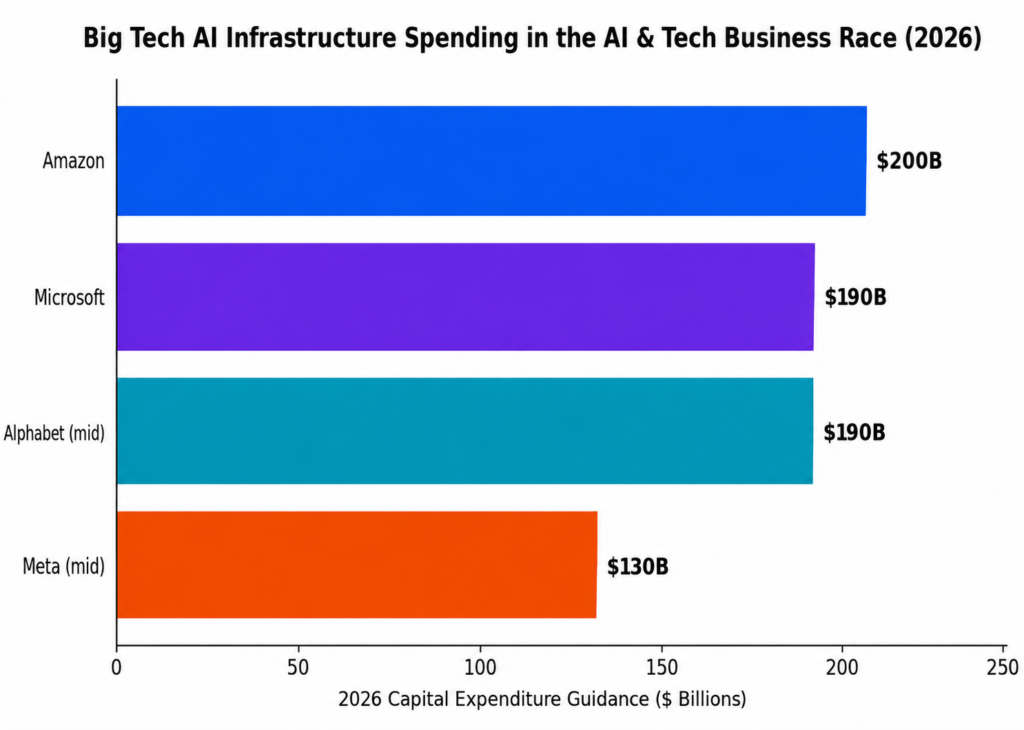
Microsoft set its 2026 capital expenditure at roughly $190 billion, well above earlier analyst estimates, with a chunk of the increase driven by rising memory chip and component costs. The company says it expects to stay capacity-constrained even at this spending level — demand for AI compute is outpacing even these numbers. Microsoft’s strategy leans on deep integration between OpenAI’s models and its own Azure and Copilot products.
Google AI Developments
Alphabet has raised its capex guidance several times this year, now sitting somewhere between $175 billion and $205 billion depending on the quarter. Google Cloud revenue jumped 63% year-over-year at one point, driven largely by AI demand, and its enterprise cloud backlog has nearly doubled in a single quarter. Gemini remains central to the strategy, alongside custom AI chips meant to cut reliance on Nvidia.
Meta AI Initiatives
Meta has taken a different path, investing heavily in AI infrastructure despite having no public cloud business to monetize that spending directly. Mark Zuckerberg has been candid about the current limits of AI agents, joking that there aren’t many he’d actually hand to his own mother — a rare bit of honesty in an industry usually flooded with hype. Meta’s capex guidance sits between $115 billion and $145 billion for the year.
Amazon AI Investments
Amazon is the biggest spender of the group, with capex guidance around $200 billion, mostly funneled into AWS infrastructure and partnerships with chipmakers like Nvidia. The company recently announced plans with Nvidia to bring 2 million additional GPUs online. That spending has pushed Amazon’s free cash flow negative — a trade-off it seems willing to make rather than fall behind.
Apple AI Projects
Apple has moved more cautiously than its peers, focusing on integrating AI into its own devices and software rather than building massive standalone infrastructure. That’s drawn both criticism, for seeming to lag, and cautious praise, for avoiding the runaway spending squeezing free cash flow elsewhere.
AI Startups and Innovation in AI & Tech Business
Big tech dominates the headlines, but startups are still where a lot of the actual innovation happens.
Emerging AI Startups
New AI startups keep showing up across nearly every industry, from healthcare diagnostics to legal document review to coding assistants. What’s changed is which kind of startup wins. Thin wrappers — tools that just add an interface on top of someone else’s model — are getting squeezed as the underlying models improve and platforms add the same features natively. The startups actually thriving tend to sell managed outcomes and deep workflow integration, not raw AI output.
Venture Capital Investments
Venture money keeps flowing into AI faster than into most other sectors. Investors increasingly favor companies with a clear, defensible niche — compliance tools for regulated industries, human-reviewed AI services, specialized workflow platforms — over generic AI chat products that bigger players can copy easily.
AI Unicorn Companies
The list of AI unicorns keeps growing, and increasingly includes names most people outside the industry have never heard of. Instead of a handful of famous companies, the current wave is full of specialized players in AI-powered cybersecurity, enterprise agent orchestration, and vertical tools built for healthcare and finance.
Business Opportunities in AI & Tech Business
For entrepreneurs watching all this, there’s real opportunity in the gaps. Niche B2B layers — compliance copilots, local trust systems built for a specific industry — leave room to compete even against companies with much bigger budgets. The trick is solving one real, specific problem instead of trying to out-build the giants at their own general-purpose game.
Suggested internal link: if you have a dedicated post on AI startup funding or a specific niche (e.g., legal AI, healthcare AI), link the relevant phrase above to it.
Cybersecurity and AI
AI is reshaping cybersecurity from both sides of the fight — another front line inside AI & Tech Business.
AI in Cybersecurity
It’s a genuinely dual-use technology here. Defenders use it to spot threats faster and respond automatically. Attackers use similar techniques to write more convincing phishing emails and probe for vulnerabilities at scale. OpenAI’s $1 billion commitment toward subsidized cyber-defense access for critical infrastructure operators is one sign of how seriously the industry takes that arms race.
AI-Powered Threat Detection
Modern threat detection leans on AI to spot unusual patterns across huge volumes of network traffic — something no team of human analysts could do manually at the same speed. These systems can flag anomalies within seconds, cutting the time between a breach happening and someone noticing.
Cybersecurity Challenges
AI-powered security tools aren’t a fix-all, though. AMD recently disclosed high-severity vulnerabilities tied to its memory controllers — a reminder that the hardware underneath AI systems has its own weak points. As agents get more autonomous access to business systems, the blast radius of a failure grows too, which makes access controls more important, not less.
Data Protection and Risk Management
Businesses running AI at scale need to think hard about where sensitive data flows and who, or what, can touch it. Good practice means keeping agents narrow in scope, requiring human approval for anything touching payments or customer records, and keeping audit trails clear enough to trace exactly what happened when something goes wrong.
Suggested internal link: if you have a cybersecurity or data-protection guide on your site, link it here.
Cryptocurrency, Blockchain and Technology
AI isn’t the only technology reshaping business, and its overlap with crypto is worth a look inside the broader AI & Tech Business picture.
Crypto Industry Updates
The crypto industry keeps maturing, with clearer regulatory frameworks showing up in several major markets and steadily rising institutional adoption. Prices are still volatile, but the infrastructure underneath digital assets is noticeably sturdier than it was a few years ago.
Blockchain Innovation
Blockchain keeps finding uses beyond crypto trading — supply chain tracking, digital identity verification, transparent record-keeping. The core strength, an unchangeable shared ledger, has real business value in all three.
AI and Crypto Integration
One of the more interesting overlaps right now is AI agents handling on-chain transactions autonomously, which opens the door to new kinds of automated financial services. At the same time, blockchain’s transparent record-keeping is being explored as a way to track how AI models are trained and where their data comes from — a layer of accountability most AI systems don’t have yet.
Future Technology Trends
The lines between AI, blockchain, and regular software will probably keep blurring. Decentralized compute networks, where training and inference happen across distributed blockchain infrastructure instead of centralized data centers, are still early but worth watching.
Future of AI & Tech Business
So where does AI & Tech Business go next? A few industries look set for real change.
AI in Healthcare
Healthcare stands to gain a lot from AI, and it’s already happening — diagnostic imaging tools catching what doctors might miss, documentation assistants freeing up time for actual patient care. ChatGPT’s healthcare data integration, giving clinicians access to biomedical research and medication information inside their workflow, is one example of how deep this is going.
AI in Finance
Finance was an early adopter, using AI for fraud detection, algorithmic trading, credit risk assessment, and increasingly automated customer service. Expect agentic AI to take on more here too — reconciling accounts, processing loan applications, with far less manual work than before.
AI in Manufacturing
Manufacturing is quietly turning into one of AI’s bigger success stories. Predictive maintenance flags equipment problems before they cause downtime. AI-powered quality control catches defects human inspectors might miss on a fast line. Paired with robotics, it’s helping factories run more efficiently and adapt faster to changing demand.
AI in Retail and E-commerce
Retailers lean hard on AI for personalized recommendations, dynamic pricing, and inventory forecasting. Agentic AI is starting to reshape customer service here too, with autonomous agents handling order tracking and routine returns without a human involved.
Future AI & Tech Business Predictions
If current trends hold, combined AI infrastructure spending crosses $1 trillion within the next year or two, agentic AI becomes a standard feature rather than a novelty in enterprise software, and regulation keeps evolving unevenly across countries and states. The businesses that do well in AI & Tech Business will likely be the ones treating this as a real strategic input, not background noise.
Frequently Asked Questions
What is AI & Tech Business?
It’s the combined ecosystem of AI technology, the companies building and selling it, and the business, investment, and regulatory forces shaping how it grows and spreads across industries.
Why is AI important for businesses?
It automates repetitive tasks, speeds up decisions, and unlocks efficiencies that weren’t possible before. Companies that adopt it thoughtfully tend to gain a real edge over the ones that wait too long.
What is Agentic AI?
Systems that can plan and complete multi-step tasks toward a goal with limited human supervision, rather than just responding to a single prompt like traditional generative AI.
Which companies are leading the AI & Tech Business race?
OpenAI, Google, Microsoft, Meta, and Amazon are the current frontrunners, each investing tens or hundreds of billions into AI infrastructure and models. Nvidia dominates the chip market underneath most of it.
How do AI regulations impact AI & Tech Business?
They affect how businesses collect data, document their systems, and handle human oversight for high-risk use cases. Rules vary a lot between the EU, the US, and other regions, so companies operating internationally usually need compliance strategies flexible enough to satisfy more than one framework at once.
What are the latest semiconductor industry trends?
Rising chip prices driven by AI demand, intense competition between Nvidia, AMD, Intel, and Broadcom for AI accelerator market share, memory innovation like HBM4, and China’s steady progress toward domestic chip self-sufficiency.