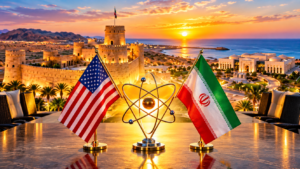

For anyone following Iran US Ceasefire Updates, the situation is unsettled. The 14-point memorandum of understanding (MoU) signed on June 17 formalized a ceasefire and opened a 60-day window to negotiate a permanent deal. That framework has since broken down, and no replacement has been announced. Peace talks remain stalled, the Strait of Hormuz remains contested, and diplomats are working around the UN General Assembly. This article separates what is confirmed from what each side claims.
For broader context, see our Iran-US relations overview.
What Is the Current Status of the Iran US Ceasefire?
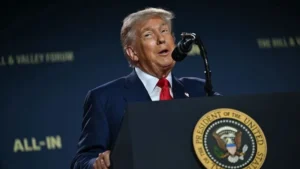
No formal ceasefire is operating as the June MoU intended. On July 8, President Trump said that “as far as I’m concerned, it’s over,” while adding that he would allow peace talks to continue.
Iran has not declared the arrangement dead. On September 1, President Masoud Pezeshkian said Iran would “immediately reciprocate” if the US returned to its MoU commitments.
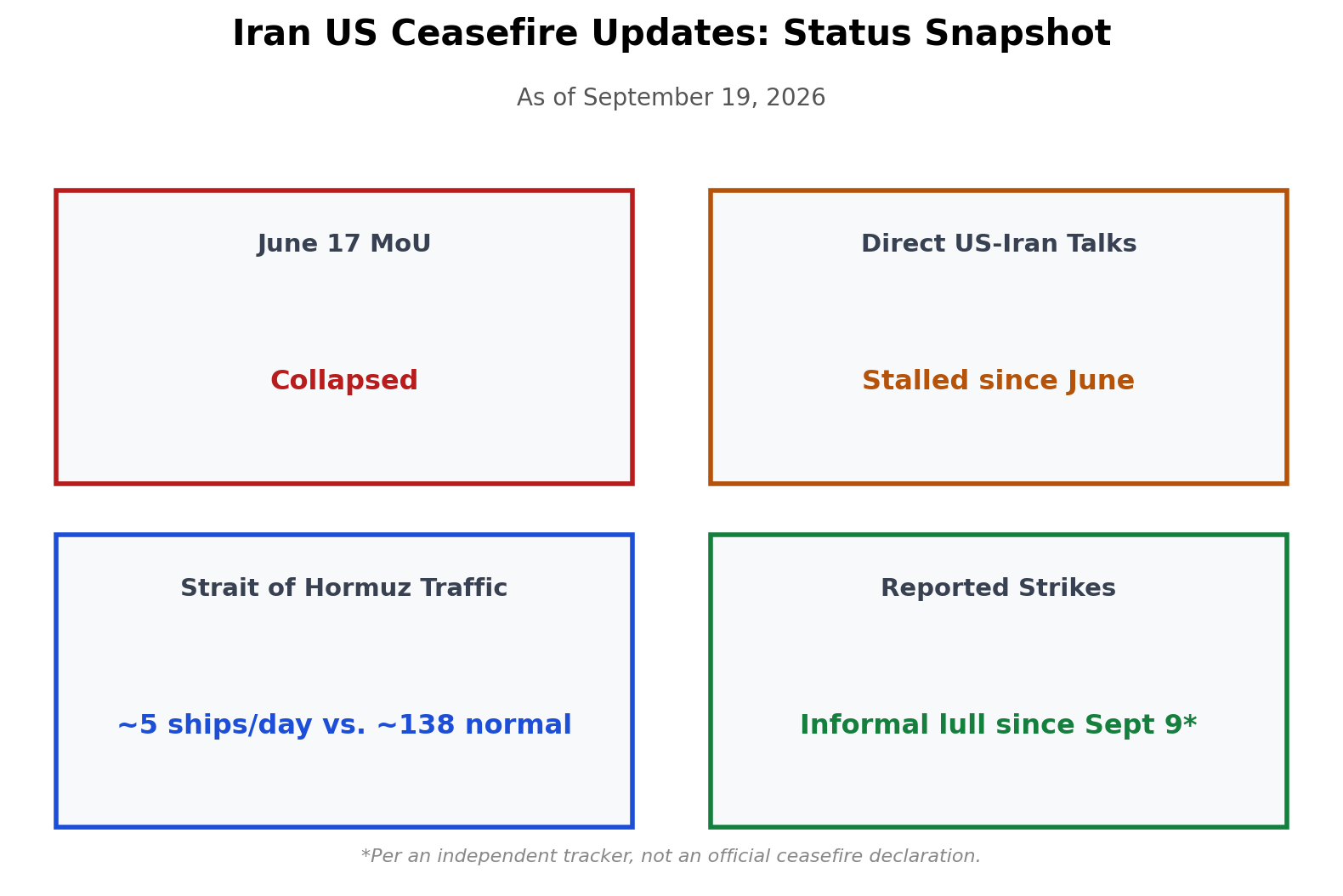
Fighting has been uneven since July. TIME reported that active hostilities resumed in early September, with tankers near Hormuz coming under fire. The independent GlobalSecurity tracker, an aggregator rather than an official source, reports no new Iranian attack on any host state for nine consecutive days as of September 18. That is an informal lull, not an announced truce. On September 17, Trump told Axios he is approaching a critical juncture over whether to restart attacks.
How the Iran US Ceasefire Agreement Developed
The framework behind these Iran US Ceasefire Updates has three stages.
April. A Pakistan-brokered two-week ceasefire was announced on April 7, hours before a Trump deadline over Iranian infrastructure. No jointly agreed text was released, and the two sides’ differing public statements foreshadowed later disputes. Vice President JD Vance then traveled to Pakistan for talks, and the ceasefire was extended indefinitely in late April.
June. The MoU set a 60-day negotiating period. The US agreed to end its naval blockade, refrain from new sanctions and work on an economic reconstruction package. Iran agreed to clear Hormuz of mines and allow trade.
The ambiguity. The text asked Iran for “best efforts” on safe passage without fees for the 60 days only, which left open the possibility of later service fees. The two sides read that language differently.
Major Developments Since the Ceasefire
- June 25: Iran launched a drone strike on a ship in Hormuz, which the US interpreted as a violation. The exchange of fire ended shortly afterward.
- July 7–8: Iran struck three vessels, and the US rescinded Iran’s license to sell oil internationally. Trump then declared the ceasefire over, and the US hit 90 targets according to CENTCOM.
- July 28: Mediators led by Qatar and Pakistan reported progress after both sides paused attacks.
- August 8–10: Iran set six conditions for reopening Hormuz, and Trump responded by demanding compensation from Tehran (details below).
- August 30–September 2: The US struck Larak Island, and the IRGC retaliated against US bases in Jordan. On September 2 the IRGC announced further operations against US positions in Jordan, Bahrain and Iraq.
- September 8–9: CBS News, citing people with direct knowledge, reported that Iranian missiles damaged US aircraft at Muwaffaq Salti Air Base in Jordan.
Iran US Ceasefire Updates: Violations and Disputes
Both governments accuse the other of breaking the deal. TIME reported that the MoU collapsed when Washington and Tehran accused each other of violations and could not agree on next steps.
The US points to Iranian attacks on commercial shipping. Iran and its officials argue the MoU allowed it to keep some authority over the strait. Iranian Parliament Speaker Mohammad Bagher Ghalibaf said Hormuz “will only open with Iranian arrangements.” Vance said US strikes were directly linked to Iranian actions in the strait.
A separate dispute concerns nuclear inspections. GlobalSecurity’s daily war calendar records that Vance called an inspection agreement a major milestone while an Iranian spokesperson disputed that Iran had agreed to readmit IAEA inspectors. That claim is unverified here, so readers should treat it as contested.
The Role of Diplomacy and Negotiations
These Iran US Ceasefire Updates also cover the diplomatic track. Public signals from Washington have shifted. On August 27, Trump said the US did not want to speak to Iran. On September 14 he said the US was open to restarting negotiations, and on September 16 he said he had heard from Iran “directly” without giving detail. The last official high-level talks took place in Switzerland in June.
Iran is also sending mixed signals. Pezeshkian and Foreign Minister Abbas Araghchi emphasize diplomacy, while hard-liners such as IRGC General Ahmad Vahidi favor confrontation. Mohsen Rezaei, secretary of the Supreme National Security Council, said on September 14 there would be “no talks until Iran’s conditions are met.”
Those conditions were laid out on August 8. Iran’s Supreme National Security Council said Hormuz would stay closed until the US ends threats and attacks on Iran and its allies, lifts the naval blockade, pays war compensation, lifts sanctions and releases frozen assets. Trump answered on August 10 that he would require compensation from Iran. The US is also pursuing economic pressure. Treasury Secretary Scott Bessent said Washington intends to economically “asphyxiate” the regime.
Why the Strait of Hormuz Matters to the Iran US Ceasefire
No set of Iran US Ceasefire Updates is complete without Hormuz. Around a fifth of global oil production flowed through the strait before the war began on February 28. Kpler data shared with TIME showed five ships crossing on September 16, against about 138 in a typical prewar 24-hour period. Oil prices rose above $100 a barrel in the week of September 9, the first time since July.
Iran’s stated position is that the waterway is now a bargaining tool. An IRGC spokesman said Tehran’s strategy is to maintain control of the strait until its conditions are accepted. Washington’s position is that the passage must stay open. Trump has repeatedly said the US has near-total control of the waterway, though traffic remains disrupted.
The Red Sea adds pressure. Yemen’s Houthis captured Perim Island in the Bab el-Mandeb Strait last week, and experts told TIME this could give Tehran added leverage.
Iran US Ceasefire Updates: International Mediation Efforts
- Pakistan: brokered the April ceasefire and hosted the first high-level talks.
- Qatar: a key mediator, whose prime minister visited Tehran on August 27.
- Oman: involved in talks with Iran on a temporary shipping corridor and mine clearance in the strait.
- Gulf states: postponed a planned meeting with Tehran on reopening Hormuz on September 14.
- China: privately asked Iran to help rein in the Houthis, according to Iranian sources cited by Reuters.
- United Nations: Russia and China vetoed a US resolution on September 17 that would have renewed the mandate of UN experts monitoring nuclear sanctions on Iran.
Iran US Ceasefire Updates: What’s Blocking a Lasting Deal?
- Hormuz control: Iran seeks a continuing role and possible fees, while the US wants unrestricted passage.
- Sanctions and assets: Iran demands full relief and release of frozen funds, while the US is adding economic pressure.
- Blockade and forces: Iran wants the naval blockade lifted and US forces withdrawn.
- Nuclear program: inspection access and the future of Iran’s program remain contested.
- Compensation: Iran demands war reparations, and Trump has demanded compensation from Iran.
- Trust and sequencing: each side says the other must move first, and Iran’s leadership is publicly divided.
What Happens Next in the Iran US Ceasefire Story?
The next entry in these Iran US Ceasefire Updates will likely follow the UN General Assembly. Only a few steps are confirmed. Trump is expected to meet Gulf leaders on the sidelines of the UN General Assembly on Tuesday, September 22, to discuss next steps, according to Axios. The State Department has approved visas for Iran’s core UN delegation, including Pezeshkian and Araghchi. No direct US-Iran meeting has been announced. Whether talks resume, or whether the US restarts strikes, remains uncertain.
Iran US Ceasefire Updates: Full Timeline
|
Date |
Event |
|
February 28 |
US and Israeli strikes on Iran begin |
|
April 7 |
Two-week ceasefire announced |
|
Late April |
Ceasefire extended indefinitely |
|
June 17 |
14-point MoU signed |
|
June 25 |
First alleged violation |
|
July 8 |
Trump says the ceasefire is “over” |
|
July 28 |
Mediators report progress after a pause |
|
August 8 |
Iran issues six conditions |
|
Aug 30–Sept 2 |
US strike on Larak Island and IRGC retaliation |
|
September 8–9 |
Iranian strike on Jordan base reported |
|
September 17 |
Trump says he is weighing whether to restart attacks |
|
September 22 |
Trump expected to meet Gulf leaders at the UN |
FAQ: Iran US Ceasefire Updates
What is the current status of the Iran US ceasefire? The June MoU framework has collapsed, and no new formal ceasefire has been announced. An informal lull in reported strikes has held since about September 9, according to one tracker.
When did the Iran US ceasefire begin? The first ceasefire was announced on April 7, 2026, and the MoU followed on June 17.
What were the main terms of the Iran US ceasefire? A 60-day negotiating window, an end to the US blockade, no new US sanctions, Iranian mine clearance, and trade through Hormuz.
Why has the Iran US ceasefire faced difficulties? Disputed Hormuz language, attacks on shipping, US retaliation and mutual violation claims.
Are Iran and the United States currently negotiating? Not formally. Trump says he is open to talks, Iran says none can happen until its conditions are met, and mediators are still working.
Why is the Strait of Hormuz important to the Iran US ceasefire? It carries about a fifth of global oil, and control over it is Iran’s main leverage.