

The Orange Basin, a petroleum province shared by Namibia and South Africa, has become a test case for how African governments balance the interests of oil companies against those of local communities, with billions of dollars in investment, jobs and tax revenue riding on the outcome.
The basin has turned Namibia into a global exploration hotspot. The country is pushing toward first oil by 2030, with initial production expected to reach around 150,000 barrels per day through TotalEnergies’ Venus project. South Africa, by contrast, has yet to unlock comparable reserves from its share of the same basin.
Two countries, two very different paths
Two events in June illustrated just how far apart Namibia and South Africa have drifted in developing the basin.
On June 9, Shell described a new offshore discovery in Namibia’s petroleum exploration license 39 as showing the “most promising subsurface results to date.” The license area has produced multiple encouraging wells since 2022, including Graff-1X, the country’s first major oil discovery.
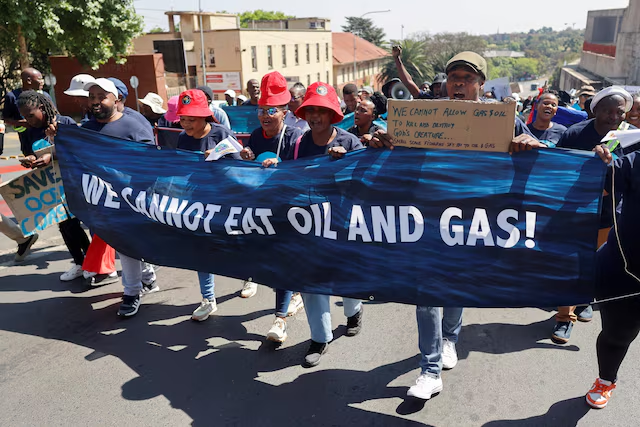
A week earlier, in a packed courthouse in Cape Town, environmental groups and fishing communities moved to overturn a permit that allows TGS to carry out offshore seismic surveys in South Africa’s portion of the basin.
Legal challenges pile up in South Africa
Environmental organizations and local communities have filed at least four court cases and numerous other appeals against offshore projects and proposed onshore liquefied natural gas developments in South Africa since 2021, according to the eco-justice group Green Connection.
Those challenges have delayed up to 10 wells that had been expected to be drilled by 2030, South Africa’s petroleum regulator, PASA, said.
TotalEnergies chief executive Patrick Pouyanne pointed to the legal environment when asked about South Africa and Namibia during the company’s October results presentation. “We cannot explore, we cannot spend money in a geography if we have to face courts permanently and the permitting becomes really too complex,” he said.
Permits can take years to secure
The Orange Basin formed millions of years ago as South America broke away from Africa. It takes its name from a river that empties into the Atlantic Ocean along the border between South Africa and Namibia.
Roughly two-thirds of the basin sits within South African waters, where non-governmental organizations and environmental activists have taken a far more combative stance toward extractive industry projects than their counterparts in Namibia, with mixed results.
South Africa’s regulatory system spans multiple government ministries and allows for extensive internal appeals against environmental and social impact assessments, in addition to judicial reviews that can themselves be appealed further.
The Offshore Petroleum Association of South Africa says exploration permits in the country can take up to five years to secure, compared with three to nine months in other African nations. “A similar route of long delays threatens to frustrate South Africa should there be any discoveries,” OPASA spokesperson Niall Kramer said.
TotalEnergies has acquired acreage along South Africa’s west coast and had aimed to drill its first exploration well there this year, though those plans now hang in the balance.
A pending court ruling could reshape the landscape
Much of the industry’s attention is now fixed on an expected ruling, possibly later this year, from South Africa’s Constitutional Court, which could either ease or further complicate the process of securing offshore exploration permits.
The case dates back to 2021 and centers on a challenge brought by environmental groups and local communities against a Shell-led seismic survey along South Africa’s Wild Coast, a region heavily dependent on tourism.
Environmental lawyer Ricky Stone said the court is expected to weigh whether commercial interests can outweigh the rights and dignity of coastal communities. “This judgment will be one of the most significant precedents in South African environmental and constitutional law in a generation, whatever the Constitutional Court decides,” he said.
Shell declined to comment on the case, citing its close period ahead of earnings.
Officials back oil and gas despite the friction
While some South African politicians have pushed for a greater focus on renewable energy, petroleum minister Gwede Mantashe continues to back oil and gas development. He has also supported industry calls for specialized courts to handle energy-related disputes more efficiently.
South Africa’s west coast has shown signs of promise. The Ibhubesi gas field is estimated to hold about 540 billion cubic feet of gas and 4.3 million barrels of condensate. In 2022, a well drilled by Eco Atlantic Oil & Gas, called Gazania-1, also turned up light oil-associated gases, though not in commercially viable quantities.
Eco Atlantic CEO Gil Holzman said the well’s outcome demonstrated that drilling in the basin does not have to come at the community’s expense. “We drilled and nothing happened,” he told Reuters. “So, we are living proof that one can actually drill in the basin, leave the surface untouched, and it had zero negative impact on the local communities, zero impact at all on the environment.”
Fishing communities see it differently
Not everyone shares that view. Outside the Cape Town courthouse last month, where the case against TGS was being heard, Stanley Young, a 65-year-old small-scale fisherman from Port Nolloth, offered a starkly different assessment of what offshore drilling could mean for people who depend on the ocean for their livelihoods.
“The ocean provides for us for generations and we must protect it,” he told Reuters. “If oil and gas comes in here, it will destroy our livelihoods completely.”
What comes next
The outcome of the Constitutional Court’s pending ruling could determine whether South Africa follows Namibia’s trajectory toward rapid offshore development or continues to see projects tied up in extended legal battles. For companies like TotalEnergies, which have already committed capital to South African acreage, the court’s decision will likely shape whether exploration plans move forward on anything resembling the timeline Namibia has managed to achieve.
For now, the contrast between the two neighbors remains stark: Namibia advancing toward first oil within the decade, and South Africa still waiting to find out whether its share of the same basin will ever be developed at all.